

Symbolism in Film shows how filmmakers use visual details to express ideas beyond dialogue and action. It transforms ordinary entertainment into a meaningful visual language. Through objects, colors, props, sound, and scenes, filmmakers communicate emotions, themes, and hidden meanings.
From classic cinema to modern blockbusters, symbols add narrative depth, emotional resonance, and cultural significance. Camera work, camera angles, and other visual elements also support nonverbal storytelling and visual storytelling.
Understanding film symbolism techniques improves film analysis and audience perception. Color symbolism, object symbolism, and sound symbolism reveal characters’ feelings, support character development, and offer insight into their choices. These techniques also express social messages, cultural context, and historical significance.
Studying iconic films shows how creative storytelling and artistic expression create emotional impact. Through symbolic representation and visual communication, filmmakers share deeper messages, cultural ideas, and meaningful life lessons. These storytelling methods remain important in modern cinema.
Quick Answer
Symbolism in film uses images, colors, objects, settings, and sounds to express deeper meanings. In American cinema, these techniques often explore freedom, identity, love, power, and social change while allowing audiences to interpret stories beyond their literal events.
TL;DR
- Colors communicate emotions, danger, hope, and change.
- Objects can represent memories, relationships, power, or personal struggles.
- Lighting and camera angles influence how viewers understand characters.
- Recurring images connect important themes throughout a movie.
- American films often use symbolism to explore identity, freedom, and belonging.
- Context matters because symbols can carry different meanings across cultures.
What Is Symbolism in Film?
Symbolism in film occurs when an image, object, action, or sound represents an idea beyond its literal purpose. A character might hold a key, but that key could also represent freedom, trust, or access to hidden knowledge.
Unlike direct dialogue, symbolism invites viewers to interpret meaning through visual and emotional clues. It works best when the symbol connects naturally with the characters, setting, and central conflict.
Symbolism, Motifs, and Metaphors
These three storytelling techniques often work together, but they serve different purposes.
- Symbol: An object or image that represents a deeper idea.
- Motif: A repeated image, sound, or action that develops meaning over time.
- Metaphor: A comparison that presents one thing as another to express an idea.
For example, a locked door might symbolize a character’s fear. If the door appears throughout the movie, it becomes a motif. If the character describes their heart as a locked room, that comparison acts as a metaphor.
Why Filmmakers Use Symbols
Symbols help directors communicate complicated ideas without explaining everything aloud. They also encourage audiences to notice patterns and connect separate scenes.
A recurring photograph might reveal a character’s attachment to the past. Meanwhile, a changing landscape could reflect their emotional journey. These details give the story depth while keeping its dialogue natural.
History and Origins of Film Symbolism
Film symbolism didn’t begin with movies. It developed from older storytelling traditions, including theater, painting, mythology, religious art, and literature.
For centuries, artists used familiar objects and visual patterns to communicate ideas about life, death, power, love, and the natural world. Early filmmakers inherited these traditions and discovered new ways to bring them to moving images.
Ancient and Pre-Christian Roots
Ancient Greek drama used masks, costumes, and recognizable mythological figures to communicate social and moral ideas. Roman art also used objects, gestures, and personifications to express power, victory, and public identity.
Other ancient societies developed rich visual traditions of their own. Egyptian art, for instance, used particular animals, colors, and objects within religious and royal imagery.
These traditions weren’t identical, but they demonstrate an important point: people used visual signs to communicate complex ideas long before cinema existed.
From Theater to Early Cinema
During the late 19th and early 20th centuries, filmmakers adapted visual storytelling for the screen. Silent movies relied heavily on gestures, facial expressions, costumes, lighting, and carefully arranged scenes.
German Expressionist cinema became especially influential. Films such as The Cabinet of Dr. Caligari (1920) used distorted sets and sharp shadows to create feelings of fear and psychological instability.
Later, filmmakers explored symbolism through editing, color, sound, and increasingly complex visual compositions. As cinema developed, symbols became useful for both artistic expression and social commentary.
Symbolism in American Cinema
In the United States, movies often reflect national ideas about freedom, ambition, family, justice, and belonging. However, American cinema also questions these ideals by showing the conflicts and sacrifices behind them.
Hollywood’s storytelling traditions have helped familiar images become widely recognized. Highways, suburban houses, crowded cities, school hallways, and open landscapes can all carry cultural meaning.
The American Dream and Personal Freedom
The American Dream often appears through houses, cars, workplaces, and images of upward mobility. A beautiful home may represent success, yet it can also reveal loneliness or pressure to maintain appearances.
Similarly, the open road frequently suggests independence and the possibility of starting over. However, a long journey can also represent uncertainty, isolation, or the difficulty of escaping one’s past.
Family, Community, and Identity
American films often use kitchens, family photographs, front porches, and holiday gatherings to explore belonging. These settings can represent comfort, tradition, and shared memory.
Yet the same spaces may reveal conflict. An empty chair at a family table can suggest grief, while a closed bedroom door may communicate a desire for independence.
These interpretations depend on the film’s context rather than on fixed rules about American culture.
Common Types of Symbolism in Film
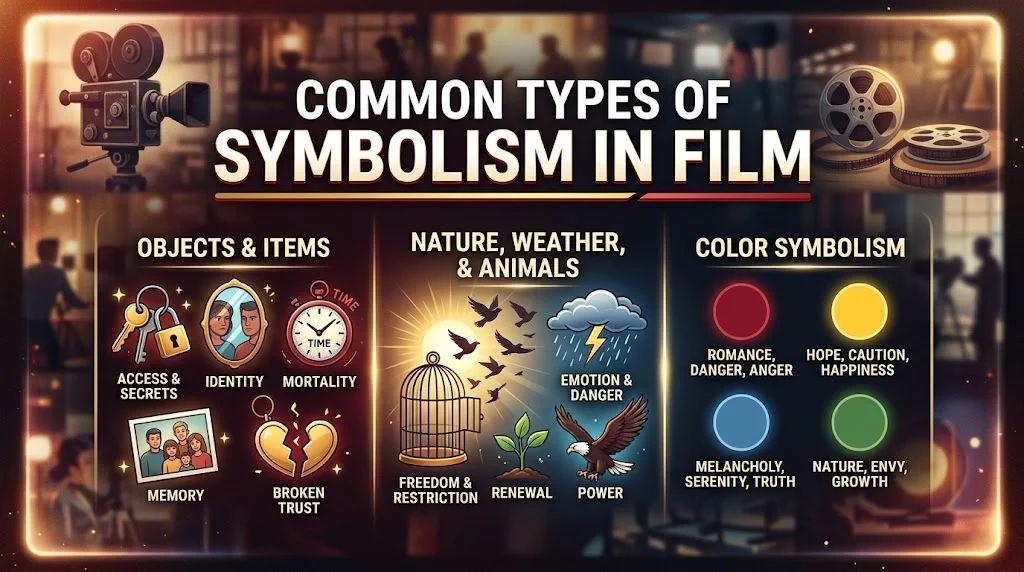
Filmmakers can turn almost any element into a symbol. The most effective examples usually connect with the story’s main themes and change meaning as events unfold.
Objects and Everyday Items
Ordinary objects often carry emotional weight because audiences associate them with familiar experiences. A photograph, ring, letter, or childhood toy can represent an entire relationship.
- Keys: Access, freedom, secrets, or responsibility.
- Mirrors: Identity, self-awareness, or a divided sense of self.
- Clocks: Time, pressure, aging, or mortality.
- Photographs: Memory, loss, family, or an idealized past.
- Broken objects: Damaged trust, disruption, or a relationship in decline.
A symbol becomes more powerful when its meaning develops through action. For example, a character who initially refuses to wear a family ring might finally accept it after reconciling with a loved one.
Nature, Weather, and Animals
Natural elements often reflect the emotional direction of a story. Rain can suggest grief or renewal, while a sunrise may signal hope or a fresh beginning.
Birds frequently represent freedom, but their meaning depends on the scene. A bird inside a cage might suggest restriction, while a flock flying across an open sky may suggest possibility.
Nature doesn’t always mirror human emotions, either. A storm can represent an external threat rather than a character’s sadness. The surrounding story determines which interpretation fits best.
What Do Colors Mean in Film?
Color symbolism is one of the most recognizable cinematic techniques. Directors and production designers use costumes, lighting, props, and backgrounds to establish moods and connect images.
However, no color has one universal meaning. Red can suggest romance, danger, anger, or courage, depending on its use.
Common Color Symbolism
| Color | Common Associations in American Cinema | Possible Uses |
| Red | Passion, danger, anger, desire | Romance, conflict, warnings |
| Blue | Calm, sadness, distance, reflection | Loneliness, quiet scenes |
| Green | Nature, growth, envy, ambition | Renewal, wealth, longing |
| White | Innocence, peace, emptiness, new beginnings | Weddings, transitions, loss |
| Black | Mystery, grief, authority, fear | Suspense, mourning, power |
| Yellow | Warmth, optimism, anxiety, caution | Childhood, unease, warning |
How Color Palettes Tell Stories
Filmmakers sometimes associate a character with a particular color. As the character changes, their clothing or surroundings may change, too.
A warm palette might create a sense of comfort early in a movie. Later, colder colors could suggest emotional distance or a loss of security.
Color can also distinguish different worlds within one story. A bright, carefully controlled environment may contrast with a darker, more uncertain setting. This contrast guides attention and helps viewers recognize changes.
When Color Meanings Change
Cultural background and personal experience influence how people interpret colors. White, for example, can suggest weddings and purity in many American settings, but it can also appear in mourning traditions elsewhere.
Directors may deliberately challenge familiar associations. A cheerful yellow room can feel threatening when the lighting, music, and character behavior suggest danger.
Therefore, it’s better to ask why a color appears in a particular scene than to memorize a fixed definition.
How Camera Angles and Lighting Create Symbolism
Symbolism doesn’t depend only on what appears in the frame. Camera placement, lighting, composition, and movement influence how audiences understand what they see.
These choices can make a character seem powerful, vulnerable, isolated, or trapped. They also create visual relationships between characters and their surroundings.
Camera Angles and Framing
A low-angle shot looks upward at a subject, potentially making that person appear powerful or intimidating. A high-angle shot looks down and may suggest vulnerability or reduced control.
Framing adds another layer of meaning. A character placed behind bars, narrow doorways, or window frames might appear emotionally or physically confined.
However, these effects aren’t automatic. A low-angle shot might simply show a child’s view of an adult, while a high-angle shot could establish the layout of a room.
Light and Shadow
Bright lighting can suggest openness, safety, or clarity. Deep shadows can create uncertainty, conceal information, or hint at a character’s hidden motives.
Filmmakers often use contrast to show competing sides of a character. A face partly covered by shadow might suggest secrecy, but it could also reflect a difficult decision or an uncertain situation.
The strongest interpretations consider lighting alongside performance, dialogue, sound, and plot.
Symbolism Through Sound, Editing, and Setting
Film is an audiovisual art form, so symbolism can develop through sound and timing as well as images. A repeated musical phrase, sudden silence, or carefully placed cut can change the meaning of a scene.
Sound and Music
Music can connect a sound with a particular character, memory, or emotional state. When the same melody returns under different circumstances, its meaning may change.
Silence can be just as significant. Removing background noise might make a character’s isolation more noticeable or create tension before an important revelation.
Sound effects also carry meaning. The repeated ticking of a clock can suggest time pressure, while distant footsteps may communicate fear or anticipation.
Editing and Visual Patterns
Editing controls how images relate to one another. A filmmaker might cut between a smiling character and a crumbling building to suggest a contrast between public confidence and private instability.
Repeated shots can establish patterns, while sudden visual changes can signal a turning point. A doorway shown open in the first scene and closed in the final scene might suggest that a relationship has changed.
Settings and Landscapes
Locations often represent more than physical space. A crowded city may suggest opportunity, pressure, anonymity, or social inequality.
An isolated cabin might represent peace and independence, but it could also suggest danger or loneliness. The character’s relationship with the setting helps determine its symbolic role.
Famous Examples of Symbolism in Film
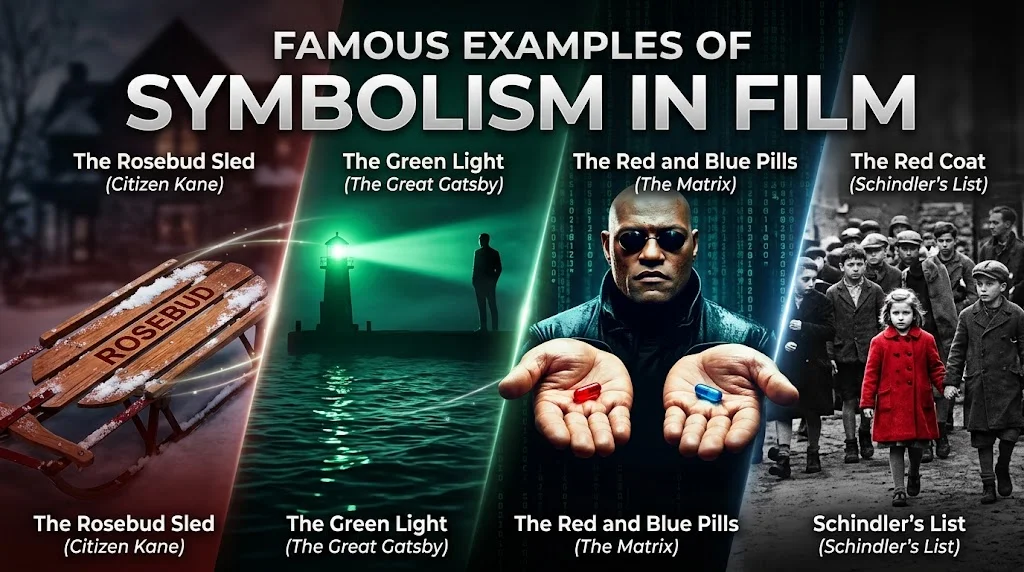
Some films become especially memorable because their symbols connect personal stories with larger questions. These examples show how ordinary objects and repeated images can carry several layers of meaning.
Citizen Kane (1941): The Rosebud Sled
In Citizen Kane, the word “Rosebud” becomes a mystery surrounding Charles Foster Kane’s final moments. The story eventually connects it to a sled from his childhood.
The sled represents more than a forgotten possession. It points toward childhood innocence, lost security, and a past that wealth and power couldn’t restore.
The symbol also shows how an ordinary object can reveal an emotional truth that a character’s public image conceals.
The Great Gatsby (2013): The Green Light
In The Great Gatsby, the green light across the water represents Gatsby’s longing for Daisy and the future he imagines with her.
It also connects personal desire with wealth, social status, and the promise of a better life. For American audiences, the light can suggest the attraction of the American Dream and the difficulty of reaching an idealized future.
Its distance matters. Gatsby can see the light, but seeing it doesn’t mean he can achieve what it represents.
The Matrix (1999): The Red and Blue Pills
In The Matrix, the red and blue pills represent a choice between discovering an uncomfortable reality and remaining within a familiar illusion.
The scene turns an abstract philosophical question into a simple physical decision. It asks viewers to consider truth, freedom, comfort, and the consequences of knowledge.
Over time, the pills also became recognizable images in online discussions. However, their modern political uses can differ sharply from their original role in the film.
Schindler’s List (1993): The Red Coat
In Schindler’s List, most of the film appears in black and white, while a young girl’s red coat stands out.
The color draws attention to one child’s experience amid the mass violence of the Holocaust. It can also represent innocence, vulnerability, and the human cost of treating people as anonymous numbers.
The coat’s meaning comes from the historical setting and the film’s visual choices. It shouldn’t be separated from the suffering and persecution the story depicts.
Spiritual and Cross-Cultural Meanings in Film
Film symbolism often draws from religious stories, mythology, folklore, and spiritual traditions. These references can give a story additional meaning, even when its central plot isn’t religious.
However, symbols don’t carry identical meanings everywhere. A respectful interpretation considers the tradition and historical context behind each reference.
Religious and Mythological Imagery
Water appears in many traditions and can be associated with cleansing, renewal, danger, or transformation. A film showing a character entering water might suggest a fresh start, but the meaning depends on the scene.
Other recurring images include:
- Light: Knowledge, hope, revelation, or divine presence in some traditions.
- Fire: Destruction, purification, energy, or transformation.
- Journeys: Trials, personal growth, exile, or spiritual discovery.
- Trees: Life, ancestry, connection, or the relationship between earth and sky.
These are broad associations, not universal definitions. A symbol may carry a very specific meaning within one religion or cultural tradition.
Why Cultural Context Matters
Filmmakers sometimes borrow imagery from traditions different from their own. When used thoughtfully, these references can introduce audiences to unfamiliar beliefs and histories.
Problems arise when sacred objects become decorative stereotypes or when complex traditions are reduced to simple signs of evil or mystery. Understanding the source helps viewers distinguish meaningful representation from careless borrowing.
Emotional and Psychological Meaning of Film Symbols
Symbols can affect viewers before they consciously understand them. A dark hallway may create tension, while a familiar song can bring back memories of comfort or loss.
These responses depend on personal experiences, cultural learning, and the way a scene is presented. The same image can comfort one viewer and unsettle another.
How Symbols Connect With Feelings
Filmmakers often connect objects with emotional turning points. A childhood photograph may initially seem ordinary, then become painful after viewers learn what happened to the person pictured.
Recurring symbols also help audiences follow a character’s inner journey. A room that once felt safe may become frightening after betrayal or loss.
Personal Interpretation and Meaning
Viewers bring their own experiences to a movie. Someone who has moved frequently might see a suitcase as a symbol of freedom, while another person might associate it with instability.
Neither response automatically defines the filmmaker’s intention. A useful interpretation explains how the symbol connects with the story’s events, character development, and central themes.
Modern Uses of Film Symbolism
Today, film symbolism reaches audiences far beyond theaters. Streaming platforms, short videos, fan communities, fashion, and digital art all help cinematic images circulate.
As these images move between platforms, their meanings can expand or change.
Tattoos, Fashion, and Home Decor
Movie-inspired tattoos often preserve a personal connection to a story. A small symbol might represent resilience, a favorite character, a difficult life chapter, or a belief about personal freedom.
Fashion and home decor use similar ideas. Posters, framed film stills, and recognizable objects can express nostalgia, creativity, or admiration for a particular story.
The meaning is personal rather than fixed. Two people might choose the same image for completely different reasons.
Social Media and Digital Culture
Online communities frequently use movie images as profile pictures, reaction images, and visual shorthand. A single frame can communicate sadness, determination, irony, or hope.
Some symbols also become detached from their original context. The red and blue pills from The Matrix, for example, now appear in discussions that go beyond the film’s fictional world.
This shift shows how audiences participate in creating meaning. A symbol can keep its original interpretation while gaining new associations.
Branding and Popular Culture
Filmmaking techniques also influence advertising, music videos, and commercial design. Brands may use color, lighting, familiar objects, or visual contrasts to create particular impressions.
However, a cinematic symbol doesn’t automatically carry the same meaning in an advertisement. Its effect depends on the product, audience, surrounding images, and cultural associations.
read more: Pyramid Symbolism: Spiritual Meaning, Power & Wisdom
Misunderstandings and Controversies in Film Symbolism
Symbolism encourages interpretation, but it can also lead to unsupported claims. Not every background object contains a hidden message, and not every visual choice has a single intended meaning.
A careful viewer looks for evidence before drawing conclusions.
Overinterpreting Every Detail
One common mistake is treating every color, object, or camera movement as a deliberate symbol. Sometimes a blue shirt is simply a blue shirt.
A stronger interpretation considers repetition, emphasis, character development, and thematic relevance. If an object appears once without meaningful connection to the story, its symbolic importance may be limited.
Political and Cultural Reinterpretations
Films can acquire new meanings as social values change. A story originally presented as a celebration of ambition might later be interpreted as a warning about greed or inequality.
Digital communities may also repurpose familiar symbols for political or ideological messages. These uses don’t always reflect the film’s original themes.
Viewers should distinguish the movie’s context from later interpretations, especially when an image becomes associated with divisive movements or harmful stereotypes.
Representation and Stereotypes
Symbols involving race, religion, gender, nationality, or disability can reinforce harmful assumptions when used carelessly. A character repeatedly linked with threatening imagery, for example, may encourage audiences to associate an entire group with danger.
Context matters here, too. Historical films may depict prejudice to criticize it rather than endorse it. The story’s framing, character treatment, and consequences help clarify the difference.
How to Analyze Symbolism in Film
You don’t need a film studies degree to understand cinematic symbolism. A careful viewing and a few practical questions can help you uncover meaningful patterns.
A Simple Step-by-Step Method
- Notice unusual details: Look for objects, colors, sounds, or images that attract attention.
- Track repetition: Check whether the same element appears in different scenes.
- Connect it to characters: Consider how the symbol relates to a character’s desires or struggles.
- Examine changes: Ask whether the object’s condition or meaning shifts throughout the story.
- Consider cultural context: Research relevant historical or religious associations when necessary.
- Support your interpretation: Explain how the symbol connects with specific events and themes.
Ask What the Symbol Adds
Suppose a film repeatedly shows a character standing outside a locked house. At first, the house might simply establish the setting.
Later, you learn that the character was rejected by their family. The locked door may now represent exclusion, unresolved conflict, or a desire for acceptance.
A strong interpretation explains this connection rather than simply labeling the door a symbol of sadness.
Distinguish Intention From Interpretation
A filmmaker may deliberately include a symbol, but audiences can discover meanings beyond the original intention. Director interviews and production notes can provide useful clues, although they don’t eliminate every possible interpretation.
The goal isn’t to find one secret answer for every image. Instead, build a convincing explanation grounded in what the film actually shows.
FAQs About Symbolism in Film
1. What is symbolism in film?
Symbolism in film is the use of objects, colors, sounds, and images to express deeper meanings. It helps filmmakers communicate ideas beyond dialogue and action.
2. Why do filmmakers use symbolism?
Filmmakers use symbolism to add emotional depth, develop characters, and communicate hidden messages. It also makes stories more meaningful and memorable.
3. What are common examples of film symbolism?
Common examples include red representing danger or passion, darkness suggesting fear, and light symbolizing hope or truth.
4. How does color symbolism work in movies?
Color symbolism uses different colors to express emotions and themes. For example, blue often suggests sadness or peace, while red can represent love, anger, or danger.
5. How does symbolism improve storytelling?
Symbolism adds layers of meaning to film narratives. It encourages viewers to think deeply, understand characters, and connect with stories emotionally.
6. Can film symbolism have different cultural meanings?
Yes. Symbols can carry different meanings across cultures and historical periods. A color, object, or gesture may represent different ideas depending on the audience.
Conclusion
Symbolism in Film makes storytelling more powerful by giving ordinary visual details deeper meaning. Through colors, objects, sounds, camera work, and visual motifs, filmmakers express emotions and ideas beyond words. These film techniques add depth to characters, strengthen themes, and create emotional connections with audiences. From classic cinema to modern blockbusters, symbolism helps viewers explore hidden messages and understand stories from different perspectives. Recognizing these symbols makes watching films more interesting and reveals the creative thinking behind memorable cinematic experiences.

Mark Taylor is a content writer at soulmeaings.com. He writes clear, research-based articles on symbolism, spiritual meaning, and cultural interpretation, helping readers understand the ideas behind the symbols they encounter.