
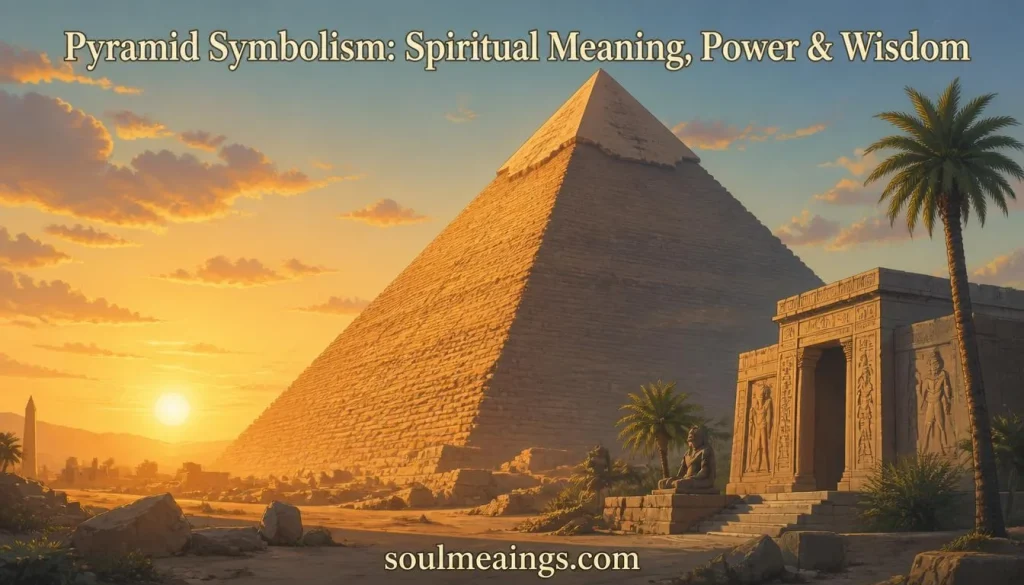
Pyramid Symbolism: Spiritual Meaning, Power & Wisdom explores how pyramids represent strength, ancient knowledge, spiritual growth, and cosmic connection.
Pyramids are among the most recognizable shapes in human history. From the ancient deserts of Egypt to modern logos, their geometric form represents mystery, power, wisdom, and spiritual meaning. Their structure symbolizes strength, stability, and eternity, while their history connects with ancient architecture and human civilization.
As an enduring symbol of ancient civilizations, pyramids reflect cultural heritage, sacred geometry, and spiritual symbolism. Their simple shape carries profound meanings across different cultures and aspects of life.
The monumental pyramids of Egypt are remarkable human-made wonders known for their geometric precision and lasting presence. Their symbolism connects with spiritual traditions, higher consciousness, enlightenment, divine connection, and ascension.
Different interpretations associate pyramids with energy, transformation, spiritual development, and cosmic connection. Their meanings also appear in art, literature, and modern applications. Today, pyramid symbolism continues to inspire higher knowledge, personal growth, and valuable life lessons.
Quick Answer
Pyramid symbolism in the United States often represents strength, achievement, stability, and the pursuit of wisdom. Spiritually, pyramids can symbolize ascension, balance, and a connection between Earth and the divine. Their meaning changes across cultures, from ancient burial monuments to modern symbols of personal growth and mystery.
TL;DR
- Pyramids often symbolize strength, stability, wisdom, and spiritual growth.
- Ancient Egyptian pyramids were closely connected with kingship, death, and the afterlife.
- In America, the pyramid on the dollar bill represents enduring national ideals.
- Spiritually, the shape can suggest rising toward higher understanding.
- Pyramid tattoos and artwork often express ambition, balance, or personal transformation.
- Historical meanings vary, so context matters when interpreting pyramid imagery.
What Does a Pyramid Symbolize?
A pyramid combines a broad foundation with sides that rise toward a single point. This design makes it a powerful image of progress, order, and lasting achievement. In modern American culture, its meaning often depends on whether it appears in spiritual artwork, architecture, history, or national symbols.
Strength and Stability
The pyramid’s wide base supports its rising structure. As a result, people often associate it with dependable foundations and long-term success.
• Strength: A pyramid suggests endurance through challenges and changing circumstances.
• Stability: Its balanced shape represents order, structure, and grounded thinking.
• Achievement: The rising sides can reflect progress toward an important goal.
• Leadership: Its organized form may suggest authority, hierarchy, and responsibility.
Wisdom and Spiritual Growth
The upward point also invites spiritual interpretations. Some people view the pyramid as a symbol of moving beyond ordinary concerns toward deeper understanding.
Its shape can represent the journey from basic knowledge to greater awareness. However, this is a modern interpretive approach, not a single meaning shared by every ancient culture.
History and Ancient Origins of Pyramid Symbolism
Pyramids have ancient roots, especially in Egypt, where their construction reflected religious beliefs, royal authority, and ideas about life after death. Understanding this history helps separate documented traditions from modern spiritual interpretations.
Ancient Egyptian Beliefs
Ancient Egyptian pyramid building developed from earlier royal tombs called mastabas. Around 2670 BCE, the Step Pyramid of King Djoser at Saqqara marked a major development in monumental architecture.
Later, Egyptian builders created the smooth-sided pyramids associated with Giza. These structures served as royal burial monuments within larger complexes of temples, tombs, and ceremonial spaces.
For ancient Egyptians, death wasn’t necessarily the end of existence. Royal funerary beliefs connected the pyramid complex with the king’s transformation and continued existence in the afterlife.
The pyramid’s precise religious meaning remains debated in some details. Scholars have explored possible connections to the sun’s rays, the sacred mound of creation, and the deceased king’s ascent toward the heavens.
The Sun, Creation, and Rebirth
In ancient Egyptian traditions, the first land rising from primordial waters was an important creation image. Some scholars connect the pyramid’s form with this sacred mound, though interpretations aren’t entirely settled.
The sun also held a central place in Egyptian religion. The pyramid’s sloping sides may have evoked sunlight descending toward Earth, while its summit could suggest a meeting point between earthly and heavenly realms.
These connections help explain why pyramids represented more than impressive construction. They belonged to a religious landscape shaped by kingship, creation, and hopes for eternal life.
Other Ancient Pyramid Traditions
Egypt wasn’t the only place where people built pyramid-shaped monuments. Different societies developed their own structures for different purposes.
• Nubia: The ancient kingdoms of Kush built pyramids as royal and elite burial monuments.
• Mesoamerica: Maya and Aztec societies constructed stepped pyramids for ceremonies and religious activities.
• Ancient Mesopotamia: Ziggurats used tiered forms to create elevated platforms associated with temples.
• Ancient China: Some royal burial mounds developed pyramid-like profiles, reflecting different funerary traditions.
These examples don’t establish one shared pyramid religion. Instead, they show how different societies used elevated monumental structures to express authority, sacred importance, and relationships between human communities and the divine.
Pyramid Symbolism in the United States
In America, pyramid imagery carries an especially recognizable national meaning. It appears on the reverse of the one-dollar bill as part of the Great Seal of the United States, adopted in 1782 and incorporated into the bill’s design in 1935.
The Unfinished Pyramid on the Dollar Bill
The American pyramid has thirteen courses of masonry and an unfinished top. Above it sits the Eye of Providence, an eye surrounded by rays of light.
The unfinished pyramid represents the nation’s strength and duration. Its incomplete form also suggests a country still developing, rather than a finished project.
The number thirteen refers to the original thirteen American colonies. Together, these elements express ideas about national beginnings, continuity, and the work of building a lasting republic.
Why Americans Associate Pyramids With Mystery
The dollar bill’s eye and pyramid have inspired decades of public curiosity. Movies, books, online discussions, and conspiracy theories often combine these symbols with stories about secret societies.
However, the existence of these symbols doesn’t prove that a hidden organization controls the government. The pyramid and eye have documented histories within the design of the Great Seal.
For many Americans, the image now carries several meanings at once:
• National identity: A reminder of the country’s founding era and its original colonies.
• Endurance: An image of a nation intended to last through generations.
• Progress: An unfinished structure representing continuing national development.
• Mystery: A familiar emblem that popular culture has surrounded with speculative stories.
Pyramid Imagery in American Life
Beyond currency, pyramid shapes appear in museums, memorials, commercial buildings, decorative objects, and entertainment. Their visual simplicity makes them easy to recognize and adapt.
In modern design, pyramids may communicate ambition, organization, knowledge, or luxury. Yet a pyramid’s meaning depends on its setting, and not every triangular structure carries a spiritual or political message.
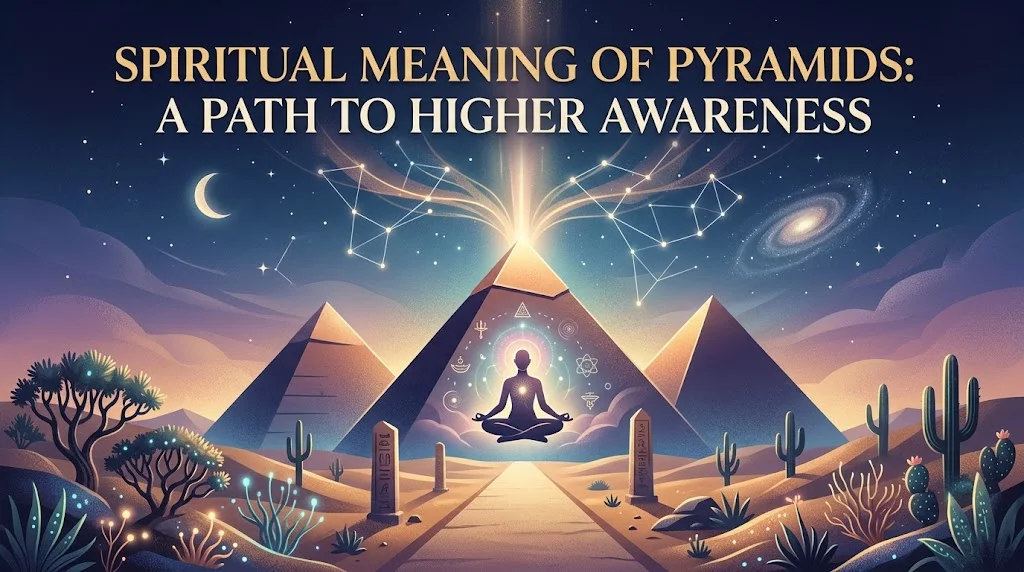
Spiritual Meaning of Pyramids
For many people today, pyramids represent a connection between the physical world and higher awareness. These interpretations appear in meditation practices, spiritual artwork, and personal reflection.
However, modern spiritual meanings shouldn’t automatically be treated as ancient Egyptian beliefs. Some are recent interpretations that combine older imagery with contemporary ideas about energy and consciousness.
Ascension and Higher Awareness
The pyramid’s upward-pointing summit offers a natural image of spiritual aspiration. People may interpret it as a journey from everyday concerns toward greater understanding.
• Ascension: Moving toward a higher level of awareness or purpose.
• Inner wisdom: Looking beyond surface appearances to explore deeper questions.
• Balance: Connecting practical responsibilities with personal values.
• Transformation: Releasing old habits while developing a clearer sense of direction.
These meanings can provide personal inspiration without requiring a belief in supernatural forces.
The Pyramid as a Sacred Shape
Some spiritual traditions treat elevated places as settings for prayer, worship, or encounters with the sacred. Pyramid-shaped monuments can fit within this broader pattern.
Still, pyramids aren’t universally sacred in the same way. Their meanings come from specific traditions, practices, and histories rather than geometry alone.
Does a Pyramid Have Special Energy?
Some modern spiritual communities claim that pyramids concentrate energy or improve meditation. These ideas appear in contemporary alternative-spirituality movements.
However, there isn’t reliable scientific evidence that pyramid shapes produce special healing powers or supernatural energy. People may still find pyramid imagery calming, meaningful, or useful as a focus for meditation.
That distinction matters: a symbol can hold genuine personal value without every supernatural claim about it being an established fact.
Pyramid Symbolism Across Cultures and Religions
Pyramid-shaped structures have appeared in several societies, but their purposes and meanings differ. For American readers, comparing these traditions offers a broader view without treating distinct cultures as interchangeable.
Egyptian, Maya, and Aztec Meanings
Ancient Egyptian pyramids primarily served royal funerary purposes. Their religious setting connected kingship, death, and the afterlife.
In contrast, many Maya and Aztec pyramids were stepped platforms supporting temples or ceremonial spaces. These structures could connect religious practice with community life, political authority, and sacred landscapes.
The differences are important. A stepped temple in Mesoamerica shouldn’t automatically be interpreted through Egyptian beliefs about royal burial.
Hindu and Buddhist Contexts
In Hindu and Buddhist traditions, sacred architecture includes structures with symbolic forms and meanings that vary by region. Buddhist stupas, for example, often feature a domed body and an ascending architectural element rather than a true pyramid.
Some modern spiritual writers compare these structures with pyramids because both can suggest sacred ascent or cosmic order. However, such comparisons are interpretations, not proof that the traditions share identical beliefs.
A Comparison of Common Meanings
| Context | Meaning in the USA | Common Associations | Notes |
| Ancient Egypt | Ancient wisdom and royal power | Afterlife, kingship, permanence | Primarily associated with funerary complexes |
| American dollar bill | National endurance | Founding ideals, continuity | Part of the Great Seal |
| Maya and Aztec architecture | Ancient civilizations and sacred places | Ritual, temples, authority | Meanings differed between societies |
| Modern spirituality | Personal or spiritual development | Ascension, balance, awareness | Interpretations vary among practitioners |
| Contemporary design | Ambition and organization | Achievement, structure, stability | Meaning depends on the design and setting |
Emotional and Psychological Meaning of Pyramids
A pyramid can influence how people feel about stability, progress, and personal direction. Its strong base and upward form provide familiar visual cues that people may connect with their own experiences.
These associations aren’t fixed psychological laws. Instead, they reflect common ways people interpret shape, balance, and movement.
Stability and Confidence
The wide base may suggest security and dependable support. Meanwhile, the narrowing sides draw attention toward a clear destination.
Someone facing a difficult period might use a pyramid as a reminder to strengthen their foundations before pursuing ambitious goals.
• Confidence: Trusting the skills and support you’ve developed.
• Patience: Accepting that meaningful progress takes time.
• Focus: Directing attention toward a clear priority.
• Resilience: Building a stable foundation during uncertain periods.
Hierarchy and Personal Growth
Pyramids also resemble organizational charts, with a broad base and a narrow top. This arrangement can suggest leadership, rank, and unequal access to authority.
In a personal-growth setting, however, the same shape may represent gradual learning. Each level becomes a step toward greater knowledge rather than a position above other people.
The context matters because the pyramid can communicate cooperation and development, but it can also suggest rigid hierarchies.
Pyramid Colors, Shapes, and Their Meanings
Pyramids appear in natural stone, gold, black, white, and many other colors. Their visual details can influence interpretation, particularly in tattoos, jewelry, meditation art, and home decor.
Common Pyramid Colors
Color meanings are cultural associations, not universal rules. A color’s significance may change according to the artwork, the viewer, or the tradition involved.
- Gold: Often suggests sunlight, achievement, wealth, or sacred importance.
- Black: May represent mystery, protection, elegance, or the unknown.
- White: Commonly evokes clarity, simplicity, peace, or new beginnings.
- Blue: Can suggest reflection, calmness, knowledge, or spiritual awareness.
- Green: May evoke nature, renewal, balance, or personal development.
Shape and Design Details
The structure itself can add another layer of meaning. A pyramid with a broad base may emphasize security, while a sharp summit can draw attention to ambition or spiritual aspiration.
An unfinished pyramid may represent an ongoing journey. A pyramid with an eye can evoke awareness or divine observation, especially when it references the Great Seal.
A stepped pyramid may recall ancient ceremonial architecture. A minimalist outline, meanwhile, can communicate modern simplicity without any direct religious connection.
Pyramid Tattoos and Modern Symbolism
Pyramid tattoos appeal to people who appreciate ancient history, geometric art, or spiritual imagery. Their meaning depends on the design and the wearer’s intentions.
In the United States, pyramid tattoos can express personal ambition, curiosity about ancient civilizations, or an interest in spiritual ideas.
Popular Pyramid Tattoo Meanings
Common interpretations include:
• Personal strength: A reminder to stay grounded during difficult times.
• Ambition: A visual statement about pursuing long-term goals.
• Spiritual exploration: An expression of interest in consciousness or ancient beliefs.
• Balance: A reminder to maintain stability while embracing change.
• Historical curiosity: An appreciation for ancient architecture and civilization.
Choosing a Meaningful Design
Consider the details before choosing a pyramid tattoo. An Egyptian pyramid, a stepped Mesoamerican temple, and the American dollar-bill design have different cultural associations.
If a design references a specific civilization, learning about its history helps avoid confusing distinct traditions. Personal symbolism becomes more meaningful when it respects the original context.
Pyramids in Home Decor, Art, and Social Media
Pyramid imagery remains popular because it combines simple geometry with a strong sense of direction. Today, it appears in wall art, jewelry, sculptures, digital illustrations, and contemporary interiors.
Home Decor and Interior Design
A pyramid-shaped sculpture may add a sense of structure to a room. Gold or stone finishes can create an impression of luxury, while clean geometric outlines suit minimalist spaces.
Some people display pyramid objects as reminders of personal goals or spiritual beliefs. Others simply enjoy their shape and architectural history.
Social Media and Digital Culture
On social media, pyramids may represent ambition, secret knowledge, ancient mysteries, or spiritual awakening. Their meaning often comes from accompanying captions, colors, and other visual elements.
An image of an Egyptian monument might celebrate history, while a geometric pyramid could communicate self-improvement. A pyramid paired with an eye may refer to the dollar bill or invite discussion about conspiracy theories.
Unlike a standardized emoji, a pyramid image has no single universal digital meaning. Its surrounding content usually provides the clearest clues.
read more: Cherry Blossom Symbolism: Beauty, Renewal & Meaning
Pyramid Symbolism, Power, and Leadership
Throughout history, pyramids have been associated with rulers, institutions, and large-scale achievements. Their monumental size can communicate authority, while their carefully organized form suggests planning and coordination.
Power and Social Hierarchy
Ancient Egyptian pyramids reflected the resources and authority of royal institutions. Their construction required skilled workers, organized labor, materials, and long-term planning.
Today, pyramid diagrams are common in American workplaces, schools, and business presentations. They often illustrate management structures, levels of responsibility, or systems of organization.
However, these modern diagrams aren’t direct evidence of ancient spiritual beliefs. They use the familiar shape to make complex relationships easier to understand.
When the Pyramid Represents Inequality
A pyramid can also represent unequal power. A narrow top and broad base may suggest that authority belongs to a few people while many others support the system.
In this context, the pyramid becomes a symbol of social structure rather than spiritual wisdom. Its meaning depends on whether the viewer sees the arrangement as organized, restrictive, or unfair.
Misunderstandings and Controversies About Pyramid Symbolism
Pyramids attract speculation because their scale, age, and cultural importance invite questions. Some modern interpretations mix historical facts with unsupported claims, making it important to distinguish evidence from belief.
The Pyramid on the Dollar Bill and Conspiracy Theories
The unfinished pyramid and Eye of Providence on the American dollar bill have inspired theories about secret societies and hidden political control. These claims often circulate through online videos, entertainment, and social media.
The historical record provides a more grounded explanation. The pyramid belongs to the reverse of the Great Seal, adopted in 1782, and appeared on the dollar bill in 1935.
The eye is an established symbol of providence, often understood as divine watchfulness. Its presence doesn’t demonstrate that a secret organization controls the United States.
Ancient Mysteries and Unsupported Claims
Some popular accounts suggest that ancient pyramids were built with lost supernatural technology or that their shapes possess proven healing powers. Such ideas may be intriguing, but they shouldn’t be confused with established archaeological or scientific findings.
Researchers continue to investigate ancient construction methods and religious beliefs. However, uncertainty about some historical details doesn’t mean every extraordinary explanation is equally credible.
Respecting Cultural Heritage
Pyramids are important cultural monuments, not simply mysterious objects for modern interpretation. Egyptian, Maya, and Aztec traditions each deserve attention on their own terms.
When using pyramid imagery, consider these principles:
• Distinguish documented history from modern spiritual speculation.
• Avoid treating different ancient civilizations as one shared culture.
• Respect the religious and cultural significance of sacred sites.
• Don’t label every pyramid or eye design as a secret-society symbol.
How Pyramid Symbolism Has Changed Over Time
Pyramid symbolism has evolved as societies have built new structures and reinterpreted older ones. Its history shows how a physical form can acquire different meanings without losing its original associations.
From Royal Tombs to National Emblems
In ancient Egypt, pyramids were closely connected with royal burial and beliefs about the afterlife. Their monumental design also demonstrated the power and resources of the state.
Centuries later, interest in ancient Egypt influenced art, architecture, collecting, and popular culture in the United States and Europe. Egyptian-inspired designs became especially visible during periods of renewed public fascination with archaeology.
The American Great Seal added another layer of meaning. Rather than depicting an Egyptian tomb, its unfinished pyramid expressed national strength and duration.
From Ancient Monument to Personal Symbol
Today, people can interpret pyramids through history, spirituality, architecture, psychology, or personal identity. A pyramid may represent ancient beliefs for one person and ambition or self-development for another.
Digital media has also expanded the range of interpretations. Spiritual content, historical documentaries, movies, and conspiracy theories now compete to shape how audiences understand pyramid imagery.
The result is a flexible symbol with both documented historical meanings and newer personal associations.
FAQs About Pyramid Symbolism
1. What does a pyramid symbolize?
A pyramid symbolizes strength, stability, wisdom, and spiritual growth. It also represents ambition, balance, and the connection between earth and higher consciousness.
2. What is the spiritual meaning of a pyramid?
Spiritually, a pyramid represents ascension, enlightenment, transformation, and divine connection. Many interpretations connect its shape with personal growth and higher awareness.
3. Why were pyramids important in ancient Egypt?
Ancient Egyptians built pyramids as royal tombs for their rulers. They reflected beliefs about death, the afterlife, eternity, and spiritual transformation.
4. What does the pyramid shape represent?
The pyramid’s wide base represents stability and strength, while its pointed top symbolizes ambition, ascension, and reaching higher knowledge.
5. What is the connection between pyramids and sacred geometry?
Pyramids are associated with sacred geometry because of their balanced proportions and geometric structure. Their shape inspires ideas about harmony, balance, and universal order.
6. What life lessons can we learn from pyramid symbolism?
Pyramid symbolism encourages patience, strong foundations, determination, and personal growth. It reminds us that lasting achievements require steady effort.
Conclusion
Pyramid Symbolism: Spiritual Meaning, Power & Wisdom reveals how one ancient shape can carry many layers of meaning. From the pyramids of Egypt to modern art and architecture, pyramids represent strength, stability, eternity, and higher knowledge. Their connection with sacred geometry, spiritual growth, and cultural heritage makes them meaningful across different traditions.
The pyramid also offers valuable life lessons. Its strong foundation reminds us to build our lives with patience and purpose. Its rising shape inspires us to keep learning, growing, and reaching toward our goals. Ultimately, the pyramid remains a powerful symbol of wisdom, transformation, balance, and human ambition.

Sophia Wilson is a spiritual content writer and researcher at SoulMeanings.com, specializing in dream meanings, symbolism, spiritual insights, and personal growth topics that help readers navigate life’s journey with greater understanding.

Pingback: Symbolism in Film: Meaning, Techniques and Storytelling Insights