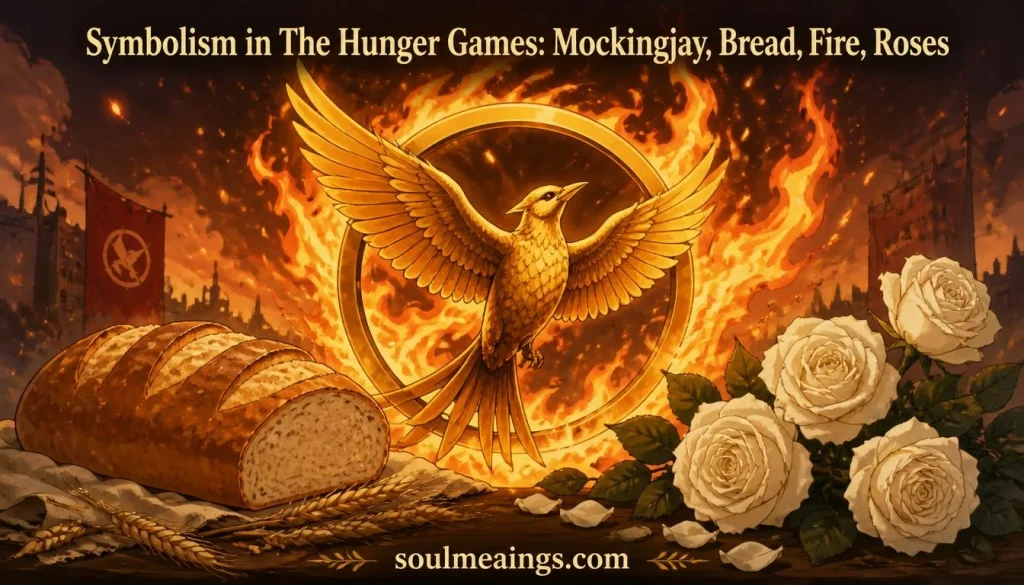
In The Hunger Games, Suzanne Collins uses powerful symbols to explore survival, resistance, freedom, and inequality.
The Mockingjay, bread, fire, roses, and the arena carry deeper meanings beyond the story. The Mockingjay pin, associated with Katniss Everdeen, represents hope, rebellion, and identity. Similarly, bread symbolizes human kindness and survival, while the three-finger salute expresses defiance and social resistance.
These Hunger Games symbols also reflect real-world issues such as government control, media influence, economic differences, and social inequality. Their cultural significance connects with American history, freedom, and justice.
Through visual imagery and recurring literary symbolism, Collins explores sacrifice, transformation, personal identity, and human struggle. These themes explain why the story remains meaningful to readers today.
Quick Answer
Symbolism in The Hunger Games explores rebellion, hope, survival, sacrifice, and political control. In American culture, the mockingjay represents resistance, bread represents community, fire represents transformation, and roses represent beauty mixed with power and danger.
TL;DR
- Mockingjay: Rebellion, freedom, hope, and resistance.
- Bread: Survival, kindness, nourishment, and human connection.
- Fire: Courage, transformation, anger, and revolution.
- Roses: Beauty, authority, secrecy, and manipulation.
- Together, these symbols reveal the human cost of oppression.
- Their meanings connect fictional Panem with real-world experiences.
What Does Symbolism in The Hunger Games Represent?
The four major symbols reveal different sides of Panem’s struggle. Each begins with an ordinary object or image. However, its meaning changes as the characters face injustice and danger.
The Four Main Symbols
The Mockingjay: Hope and Rebellion
The mockingjay becomes the most recognizable symbol of resistance. It represents survival, independence, and the unexpected power of ordinary people.
Bread: Survival and Human Kindness
Bread represents the basic need for food and security. However, sharing bread also expresses love, generosity, gratitude, and solidarity.
Fire: Transformation and Resistance
Fire represents Katniss’s strong personality and growing influence. It also reflects anger against injustice and the possibility of revolutionary change.
Roses: Beauty and Hidden Danger
President Snow’s white roses represent authority, intimidation, and carefully maintained appearances. Their beauty hides the cruelty behind his political power.
Why These Symbols Matter Together
The symbols create a connection between personal experiences and larger political events.
- The mockingjay turns an individual struggle into collective resistance.
- Bread creates connections between people separated by poverty.
- Fire makes hidden anger visible to the entire nation.
- Roses expose the difference between attractive appearances and cruel intentions.
Together, they show how power can influence symbols and how people can reclaim their meanings.
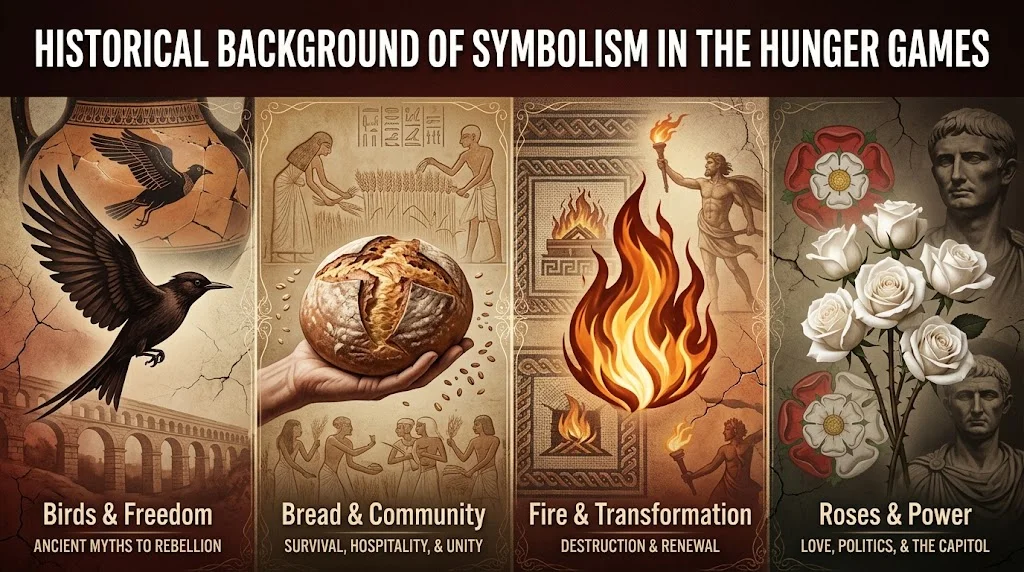
Historical Background of Symbolism in The Hunger Games
Suzanne Collins draws on familiar images with long cultural histories. Birds, food, fire, and flowers have represented human experiences for centuries.
Although the story gives these images fictional meanings, readers recognize their older associations.
Ancient Roots of Bird Symbolism
Birds have appeared in ancient myths, religious stories, and cultural traditions. They often represent freedom, communication, wisdom, and spiritual connection.
In Greek mythology, birds sometimes served as messengers connected with the gods. Ancient Egyptians also associated certain birds with divine qualities and protection.
The mockingjay builds on this familiar relationship between birds and freedom. However, its fictional history gives the image a more political meaning.
Bread Throughout Human History
Bread has supported human communities for thousands of years. Ancient civilizations treated grain production as essential to survival and social stability.
In ancient Egypt, bread served as everyday nourishment and appeared in religious offerings. Greek and Roman societies also connected bread with household life and public welfare.
Consequently, bread developed meanings beyond food. It became associated with hospitality, generosity, community, and shared responsibility.
Fire in Ancient Beliefs
Fire held an important place in ancient civilizations. It provided warmth, protection, cooking, and light.
However, fire also represented destruction and renewal. Greek mythology connected fire with Prometheus, who brought fire to humanity.
In various spiritual traditions, fire became associated with purification, energy, and transformation. These older meanings help explain its powerful role in Katniss’s story.
The Historical Meaning of Roses
Roses have carried different meanings throughout history. Ancient Greeks and Romans associated them with love, beauty, celebration, and mythology.
The flower became important in European religious art, literature, and royal traditions. White roses often developed associations with purity, remembrance, and innocence.
However, roses could also represent political identity. The English Wars of the Roses famously used red and white roses as symbols of rival royal houses.
These historical associations create an interesting contrast with President Snow’s white roses.
Mockingjay Symbolism: Rebellion, Freedom and Hope
The mockingjay is the central symbol of the rebellion in The Hunger Games. Its importance comes from an unexpected origin and its connection with Katniss Everdeen.
Unlike a traditional national emblem, the mockingjay represents something the Capitol never intended to create.
How the Mockingjay Originated
The mockingjay emerged from the Capitol’s failed experiment with jabberjays. These genetically engineered birds could remember and repeat human conversations.
The Capitol originally used them to collect information about people considered enemies. However, rebels discovered the birds’ purpose and began feeding them false information.
When the Capitol abandoned the jabberjays, the birds survived. They eventually mated with mockingbirds and produced a new species.
The mockingjay became an unexpected reminder that nature can resist human control.
What the Mockingjay Represents
Its fictional history creates several important meanings:
- Rebellion: It represents resistance against oppressive authority.
- Survival: It shows how unexpected survivors can overcome difficult conditions.
- Freedom: Its bird form suggests independence and escape from captivity.
- Hope: It gives oppressed communities an image around which they can unite.
- Identity: It becomes connected with Katniss and her growing public influence.
Why Katniss Becomes the Mockingjay
Katniss doesn’t initially choose to become a revolutionary symbol. Her actions gradually give the mockingjay its political importance.
Her decision to honor Rue’s death challenges the Capitol’s treatment of tributes. Later, her public defiance inspires people throughout Panem.
However, the rebellion also uses her image for political purposes. Katniss becomes both a person and a carefully presented symbol.
This difference matters because she struggles to maintain her identity while others control her public image.
The Mockingjay in American Culture
For American readers, the mockingjay connects with familiar ideas about independence and resistance.
The United States has a long cultural tradition of using symbols to express collective identity. Flags, monuments, songs, and historical images can unite people around shared beliefs.
Similarly, the mockingjay becomes more than a decorative bird. It represents a community’s desire to challenge an unjust system.
Bread Symbolism: Survival, Kindness and Community
Bread has one of the most emotional roles in The Hunger Games. It connects Katniss and Peeta while representing the struggle against hunger.
In Panem, food also reveals the differences between wealthy citizens and struggling districts.
Peeta’s Bread and Katniss’s Survival
One of the most important moments occurs during Katniss’s childhood. Her family faces severe hunger, leaving her desperate for food.
Peeta secretly gives her burnt bread from his family’s bakery. This small act helps Katniss regain the strength to survive.
The bread becomes connected with kindness, hope, and unexpected generosity.
It also changes how Katniss remembers Peeta. His gift becomes an important emotional connection between them.
Bread From District 11
Another meaningful moment follows Rue’s death.
Katniss honors Rue by decorating her body with flowers. Her actions show respect for Rue’s humanity rather than treating her as another defeated tribute.
Afterward, District 11 sends Katniss bread as a gesture of gratitude.
This gift carries meaning beyond nourishment. It represents solidarity between people who are supposed to remain divided.
The moment also challenges the Capitol’s efforts to keep districts isolated.
What Bread Represents in The Hunger Games
- Survival: Food provides the strength needed to continue living.
- Generosity: Peeta’s childhood gift demonstrates kindness without expecting repayment.
- Unity: District 11’s bread connects people across district boundaries.
- Gratitude: Sharing food becomes a meaningful expression of appreciation.
- Equality: Bread highlights the unfair distribution of basic resources.
Bread and American Cultural Values
In American culture, bread often represents home, family, and hospitality.
Family meals and holiday gatherings frequently use bread as a symbol of togetherness. Thanksgiving dinners, community kitchens, and food donations also reflect its social importance.
The story adds another dimension by showing what happens when food becomes a political privilege.
It encourages readers to recognize that access to basic necessities affects dignity and freedom.
Fire Symbolism: Katniss and the Power of Transformation
Fire is closely connected with Katniss’s identity. It begins as part of her appearance and gradually becomes a symbol of her influence.
Her nickname, “the girl on fire,” captures this transformation.
Why Katniss Is Called the Girl on Fire
Cinna creates a striking costume for Katniss during the opening ceremonies. The dress appears covered in flames through special visual effects.
This appearance makes her unforgettable to Capitol audiences.
However, fire soon becomes more than a fashion statement. It reflects her courage, anger, determination, and refusal to behave as expected.
Her personality gives the image its deeper meaning.
Fire as Rebellion
Fire can spread beyond the place where it begins. This makes it a fitting image for a rebellion that grows across multiple districts.
Katniss’s actions inspire people who have experienced oppression for generations.
The mockingjay represents the movement, while fire expresses its growing energy.
In this way, fire becomes a visual language for political transformation.
DOI+1
Positive and Negative Meanings of Fire
| Context | Meaning in the USA | Common Associations | Notes |
| Burning flames | Courage and determination | Strength, passion | Personal motivation |
| Small flame | Hope and comfort | Warmth, renewal | New beginnings |
| Wildfire | Destruction and danger | Loss, fear | Uncontrolled change |
| Revolutionary fire | Resistance | Freedom, protest | Political transformation |
| Fire in clothing | Individual expression | Confidence, identity | Katniss’s public image |
Fire and American Identity
American history includes many symbolic references to fire and revolution.
The American Revolution is frequently represented through images of independence, courage, and resistance. Political speeches and cultural expressions also use flames to describe passion and determination.
However, fire isn’t always positive. It can represent violence, destruction, and uncontrolled anger.
The Hunger Games captures both sides. Katniss’s influence creates hope, but revolution also brings suffering and difficult choices.
Rose Symbolism: President Snow, Beauty and Hidden Danger
Roses have traditionally represented love, beauty, innocence, and admiration. However, The Hunger Games gives the white rose a disturbing political meaning.
President Snow uses the flower as part of his carefully maintained public appearance.
Why President Snow Uses White Roses
Snow frequently wears a white rose in his lapel. Its fragrance helps hide the smell of blood caused by sores in his mouth.
These sores resulted from his use of poison against political enemies.
The flower therefore conceals physical evidence of his violence. Its beauty creates a sharp contrast with his cruelty.
The rose becomes a symbol of appearances hiding unpleasant truths.
SparkNotes+1
Roses as a Message of Intimidation
Snow’s roses become especially threatening when he sends them to Katniss.
After the destruction of District 12, a white rose appears in her former home. This isn’t a friendly gesture.
Instead, it reminds Katniss that Snow can reach her even when she believes herself safe.
The flower communicates surveillance, control, and revenge.
What Roses Represent in the Story
- Power: Snow uses the flower to reinforce his image of authority.
- Deception: Its pleasant appearance hides violence and corruption.
- Fear: Roses become reminders of Snow’s ability to intimidate.
- Control: Their presence suggests that Katniss remains under observation.
- Contradiction: A traditionally beautiful flower becomes a source of anxiety.
The White Rose in American Culture
White roses commonly appear at weddings, memorial services, and formal celebrations in the United States.
They can represent innocence, remembrance, respect, and new beginnings.
However, their meaning depends on context. A white rose can express affection in one situation and political intimidation in another.
The Hunger Games uses this contrast to show how powerful people can change the meaning of familiar symbols.
How the Four Symbols Connect With Each Other
The mockingjay, bread, fire, and roses don’t work independently. Together, they explain the relationship between ordinary people and political power.
Each symbol represents a different part of Panem’s conflict.
A Connection Between Hope and Resistance
The mockingjay represents collective hope. Bread gives that hope a human and emotional foundation.
Without kindness and community, resistance becomes only a struggle for power. The story shows that genuine change also requires compassion.
A Connection Between Fire and Political Control
Fire represents the energy behind change. However, its meaning becomes complicated when revolutionary leaders begin controlling public messages.
Katniss experiences this problem when District 13 turns her into a political image.
The rebellion may oppose Snow’s authority, but it can also use manipulation.
A Connection Between Roses and Deception
Snow’s roses represent the appearance of order and perfection. Their beauty hides the violence supporting his government.
Fire challenges that appearance, while the mockingjay gives resistance a recognizable identity.
Bread reminds readers what is actually at stake: ordinary people’s lives.
Symbolism in The Hunger Games and American Society
American readers can connect Panem’s fictional symbols with broader questions about freedom, inequality, and political communication.
The story doesn’t represent one exact American event. Instead, it explores problems that appear in many societies.
Freedom and National Identity
The mockingjay connects with the American idea that individuals should have a voice.
It also raises questions about who controls national symbols. A symbol may begin with one meaning and acquire another through public action.
Inequality and Access to Food
Bread highlights the relationship between poverty and political power.
In Panem, food shortages help maintain the Capitol’s control over struggling districts.
American readers may connect this theme with discussions about food insecurity, economic inequality, and community support.
Media and Public Image
Katniss’s transformation into a public figure reveals how media can shape political identity.
Her clothing, speeches, and recorded appearances become tools for influencing public opinion.
This reflects wider American concerns about celebrity culture, political advertising, television, and social media.
Scholarly discussions of the films have also examined surveillance and reality television as important parts of their cultural message.
Get Access+1
read more: Rose Symbolism: Spiritual Meaning and Literary Insights
Cross-Cultural and Spiritual Meanings of These Symbols
Although the story takes place in a fictional country, its symbols connect with traditions beyond American culture.
Birds, bread, fire, and roses appear in many religious and cultural settings. Their meanings vary according to history and belief.
Birds and Spiritual Freedom
Birds often represent freedom, hope, and the connection between earthly and spiritual life.
In Christian art, the dove commonly represents peace and the Holy Spirit. In other traditions, birds may represent ancestors, messengers, or spiritual protection.
The mockingjay is fictional, but its association with freedom follows a familiar symbolic pattern.
Bread and Religious Traditions
Bread has a significant place in Christianity, especially through the Last Supper and the Eucharist.
It can represent nourishment, sacrifice, remembrance, and spiritual connection.
In Jewish traditions, bread also has important roles in religious meals and celebrations. For example, challah is traditionally associated with Shabbat and festive occasions.
These traditions help explain why bread can carry emotional and communal meanings beyond everyday food.
Jem Bloomfield, 2017+1
Fire and Spiritual Transformation
Fire appears in many religious and cultural traditions.
In Hindu traditions, fire has an important role in ceremonies and offerings. In Christianity, fire can represent divine presence, purification, or the Holy Spirit.
These interpretations differ, but many connect fire with transformation and powerful energy.
Roses and Religious Associations
In Christian symbolism, roses can represent love, purity, and the Virgin Mary.
In other cultural traditions, roses may express romance, beauty, mourning, or remembrance.
President Snow’s white rose uses familiar associations but changes their emotional effect through its threatening context.
Emotional and Psychological Meaning of the Four Symbols
Symbols influence how readers understand characters and events. They create emotional connections without requiring lengthy explanations.
The Hunger Games uses this effect to make political struggles feel personal.
The Mockingjay and Emotional Hope
The mockingjay can inspire feelings of courage and belonging.
Readers may connect with its message because it represents someone unexpected becoming powerful.
It also suggests that personal weaknesses don’t always prevent meaningful change.
Bread and Emotional Security
Bread creates feelings of comfort and connection.
Peeta’s gift matters because it arrives during a moment of extreme vulnerability.
It reminds readers that small acts of kindness can change someone’s life.
Fire and Personal Strength
Fire creates feelings of energy, confidence, and determination.
For some readers, Katniss represents someone who refuses to remain silent when treated unfairly.
However, fire also suggests anger and emotional exhaustion.
Roses and Hidden Fear
Snow’s roses create discomfort because their beauty conflicts with their meaning.
Readers begin to associate the flower with danger rather than affection.
This emotional reversal makes the symbol especially memorable.
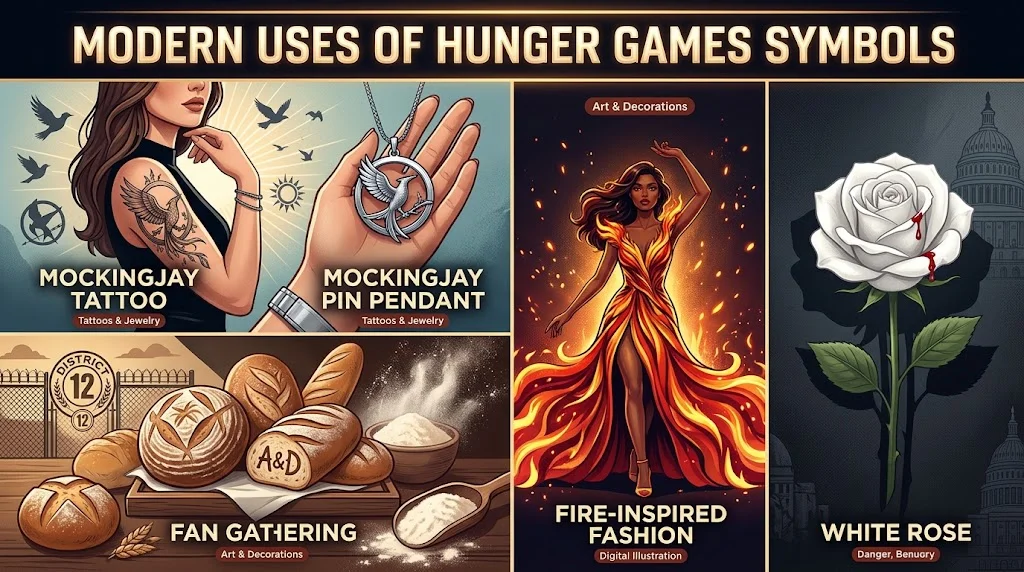
Modern Uses of Hunger Games Symbols
The four symbols have become recognizable parts of contemporary popular culture.
Fans use them to express personal values, discuss fictional themes, and create artwork inspired by the series.
Mockingjay Tattoos and Jewelry
The mockingjay is especially popular in fan-inspired designs.
People may choose this image because it represents:
- Personal independence and courage.
- Standing against unfair treatment.
- Hope during difficult experiences.
- Strength after surviving hardship.
- Loyalty to personal beliefs.
The circular pin design also makes the symbol easy to recognize in jewelry and artwork.
Bread in Fan Art and Decorations
Bread appears in fan illustrations and themed gatherings.
It represents the relationship between Katniss and Peeta, along with the story’s themes of generosity and survival.
Fans may also use bread imagery when discussing community and kindness.
Fire-Inspired Fashion and Artwork
Fire remains closely connected with Katniss’s public identity.
Red, orange, and gold designs often communicate energy and confidence.
Fan-inspired costumes, digital illustrations, and dramatic photography frequently use these colors.
Roses in Decorative Art
White roses can create a striking visual connection with President Snow.
Some fan artworks use a single white rose against a dark background. This arrangement communicates beauty, danger, and hidden authority.
The contrast also makes the flower an effective storytelling image.
Misunderstandings and Controversies Around the Symbols
Symbols can have different meanings depending on who uses them. The Hunger Games demonstrates this through political messaging, public image, and rebellion.
Understanding the context helps readers avoid confusing fictional symbolism with real-world political beliefs.
The Mockingjay Is Not Simply a Symbol of Violence
Some readers associate the mockingjay with revolution and armed resistance.
However, its meaning is broader than fighting. It represents solidarity, freedom, survival, and the desire for justice.
The story also questions whether violent rebellion can create lasting peace.
Fire Doesn’t Always Mean Courage
Fire can represent passion and transformation. However, it can also represent destruction and uncontrolled anger.
Katniss’s experiences show that resistance carries emotional and human costs.
Therefore, fire shouldn’t be understood as an entirely positive symbol.
White Roses Aren’t Naturally Symbols of Evil
President Snow changes the emotional meaning of white roses through his behavior.
Outside the story, white roses continue to represent love, innocence, sympathy, and remembrance.
Their association with Snow shouldn’t erase their traditional cultural meanings.
Political Symbols Can Be Misused
The rebellion uses Katniss’s image to influence public opinion. However, the Capitol also uses media to manipulate citizens.
This creates an important question: who controls a symbol, and whose interests does it serve?
The story suggests that even symbols of freedom can become tools of political control.
How the Meaning of These Symbols Changes Throughout the Story
The symbols develop as Katniss’s experiences become more complicated. Their meanings aren’t fixed at the beginning of the series.
Instead, they change alongside her relationships, political awareness, and personal struggles.
The Mockingjay Becomes a National Symbol
Initially, the mockingjay is a small personal token. Later, it becomes the recognizable image of a nationwide rebellion.
Its transformation shows how ordinary objects can gain political importance.
Bread Develops a Meaning of Unity
At first, bread represents Katniss’s survival and Peeta’s kindness.
Later, gifts of bread communicate connections between districts. It becomes an expression of solidarity that challenges separation.
Fire Changes From Fashion to Revolution
Fire initially attracts attention through Katniss’s costumes.
However, its meaning gradually becomes connected with political resistance. It represents the influence she develops beyond the arena.
Roses Change From Beauty to Threat
Roses traditionally suggest affection and beauty.
However, Snow’s repeated use of white roses makes them reminders of surveillance and fear.
The prequel, The Ballad of Songbirds and Snakes, adds further background to Snow’s early connection with roses. This makes the flower’s later role even more interesting.
TIME+1
What These Symbols Teach About Identity and Personal Growth
Beyond political conflict, The Hunger Games explores how people develop their identities under pressure.
The four symbols offer different lessons about courage, compassion, and personal responsibility.
Finding Strength in Unexpected Places
The mockingjay reminds readers that strength doesn’t always come from traditional sources of power.
Katniss becomes influential without initially seeking political leadership.
Her actions show that ordinary people can challenge expectations.
Understanding the Value of Kindness
Bread demonstrates that kindness can have lasting consequences.
Peeta’s childhood gift becomes an important part of Katniss’s survival.
Likewise, District 11’s gift shows how compassion can connect people across boundaries.
Recognizing the Cost of Change
Fire represents the energy needed to challenge injustice.
However, the story also shows that transformation can involve loss, fear, and difficult decisions.
Real change requires more than anger or excitement.
Looking Beyond Attractive Appearances
Snow’s roses remind readers that beauty doesn’t always indicate goodness.
Powerful people can use polished appearances to hide harmful intentions.
The flower encourages readers to consider actions rather than appearances.
FAQs About Symbolism in The Hunger Games
1. What does the Mockingjay symbolize in The Hunger Games?
The Mockingjay symbolizes hope, freedom, rebellion, and resistance. It becomes a powerful sign of unity against oppression.
2. What does bread symbolize in The Hunger Games?
Bread represents survival, kindness, generosity, and hope. It also shows how small acts can create meaningful connections.
3. What does fire symbolize in The Hunger Games?
Fire represents transformation, courage, passion, and rebellion. It also reflects Katniss’s growing influence as a symbol of resistance.
4. What do roses symbolize in The Hunger Games?
Roses symbolize beauty, power, control, and danger. President Snow’s white roses also create an image of fear and hidden cruelty.
5. What does the three-finger salute mean?
The three-finger salute represents respect, unity, grief, and defiance. It becomes a recognizable expression of resistance against the Capitol.
6. Why is symbolism important in The Hunger Games?
Symbolism helps readers understand deeper themes involving freedom, inequality, survival, and government control. It connects the fictional story with real-world experiences.
Conclusion
Symbolism in The Hunger Games gives deeper meaning to ordinary objects, characters, and actions. The Mockingjay, bread, fire, and roses represent important ideas about hope, survival, rebellion, and power. Through these symbols, Suzanne Collins explores freedom, sacrifice, identity, and resistance. These powerful meanings help readers connect the fictional world with real-life struggles. Ultimately, the series shows how simple symbols can inspire courage, unity, and the desire for change.

Evelyn Thomas is the voice behind SoulMeanings.com, sharing thoughtful articles on spirituality, dream interpretation, symbolism, and self-discovery to inspire meaningful living.