
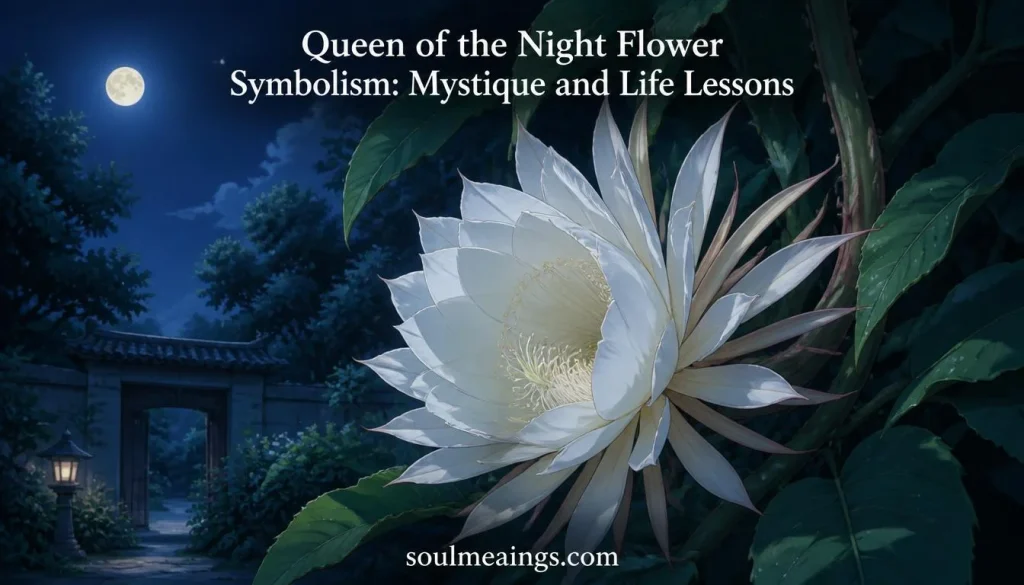
Queen of the Night Flower Symbolism explores the spiritual meaning, rare beauty, and cultural significance of this mysterious bloom.
Scientifically known as Epiphyllum oxypetalum, this flower blooms only at night and wilts before sunrise. Its brief appearance symbolizes transience, impermanence, and the beauty of fleeting moments. Its enchanting aroma, delicate petals, and mysterious nature also represent wonder, transformation, and spiritual awakening.
Across cultures, the Queen of the Night flower meaning connects with love, patience, intuition, and personal growth. Its spiritual symbolism encourages us to appreciate special moments and accept life’s natural changes.
In folklore, literature, and art, it represents mystery and temporary beauty. A Queen of the Night flower tattoo can symbolize romantic love, spiritual connection, or personal transformation. Ultimately, this rare bloom teaches us to value every moment and embrace the beauty of impermanence.
Quick Answer
Queen of the Night Flower Symbolism in the United States commonly suggests mystery, rare beauty, personal transformation, and the importance of living in the moment. Its nighttime blooming also inspires spiritual reflection, patience, and appreciation for opportunities that may not last.
TL;DR
• Mystery: Its nighttime blossoms represent hidden beauty and the unknown.
• Transformation: Opening after dark suggests change and personal growth.
• Patience: Its flowering cycle reminds us that meaningful things take time.
• Impermanence: Short-lived blooms encourage us to appreciate the present.
• Spirituality: Its white petals often inspire peace and inner reflection.
• Modern meaning: The flower suits garden designs, artwork, tattoos, and personal gifts.
What Is the Queen of the Night Flower?
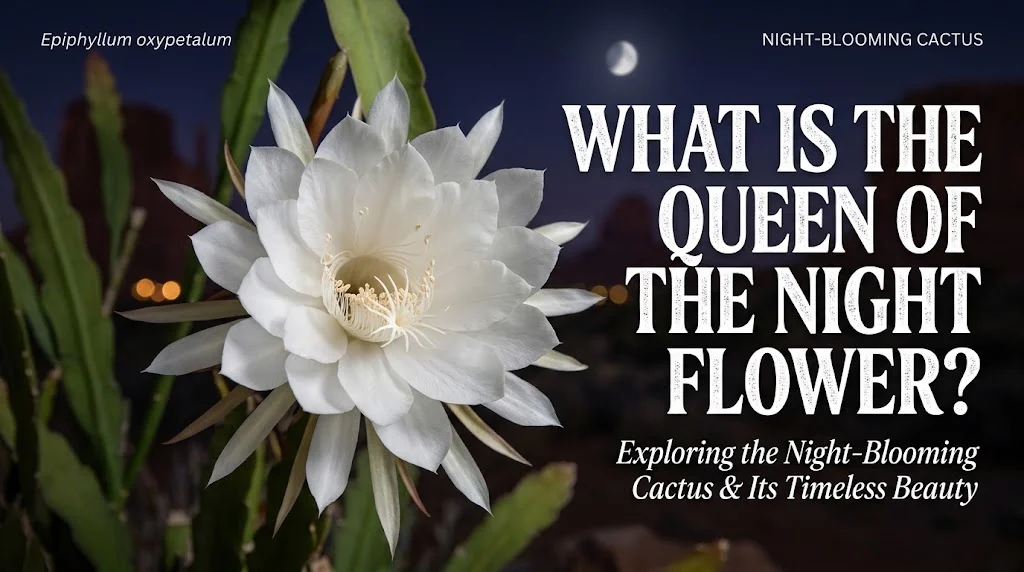
The Queen of the Night is a name given to several night-blooming plants. One well-known example is Epiphyllum oxypetalum, a tropical cactus admired for its large, fragrant, white flowers. Another is the desert-dwelling Peniocereus greggii, native to parts of the southwestern United States and Mexico.
Appearance and Natural Characteristics
The flower’s appearance helps explain its symbolic appeal. Its broad white petals open after sunset, while its fragrance makes the nighttime experience even more memorable.
Common visual features include:
• White petals: Suggest purity, peace, sincerity, and spiritual reflection.
• Long, delicate petals: Evoke grace, openness, and gentle strength.
• Green, flattened stems: Represent endurance, adaptability, and steady growth.
• Nighttime flowering: Connects the plant with mystery, intuition, and hidden possibilities.
• Brief blossoms: Remind observers that beautiful experiences can be temporary.
These associations are interpretations rather than fixed meanings. The flower’s botanical characteristics provide the foundation, while personal experiences shape its symbolism.
Why Is It Called the Queen of the Night?
The name reflects the flower’s striking appearance after dark. Its dramatic white blossoms seem to emerge from the shadows, creating a memorable contrast between darkness and light.
However, the name doesn’t identify just one species. Therefore, botanical identification matters when discussing the flower’s history, habitat, or cultural associations.
Queen of the Night Flower Symbolism and Core Meanings
The flower’s most familiar symbolic themes grow from its unusual blooming cycle. For American readers, it offers a natural way to explore beauty, personal change, and experiences that deserve attention.
Mystery, Beauty, and Transformation
The Queen of the Night doesn’t reveal its full beauty throughout the day. Instead, it opens under darkness, making it a powerful image of things that develop privately.
Its symbolism can include:
• Mystery: Not everything valuable needs to be immediately understood.
• Hidden potential: Personal strengths can emerge when circumstances change.
• Transformation: Growth sometimes happens quietly before others notice.
• Rare beauty: Unusual experiences can leave lasting emotional impressions.
• Mindfulness: Being present helps us appreciate moments that won’t return.
In this sense, the flower represents more than beauty. It suggests that timing, patience, and quiet development can be just as meaningful as visible success.
What the Flower Teaches About Life
Its short flowering period creates a simple lesson: meaningful moments deserve our attention. We can’t preserve every experience, but we can appreciate it while it lasts.
The flower also challenges the idea that growth must happen publicly. Like a plant preparing to bloom in darkness, people can make progress without sharing every step.
Historical Origins and Botanical Background
The Queen of the Night has roots in the plant life of the Americas. Its symbolism, however, shouldn’t be confused with a single ancient religious tradition or a universal historical meaning.
Origins in the Americas
Epiphyllum oxypetalum is native to Central America and is also associated with cultivation across tropical regions. It grows as an epiphytic cactus, meaning it can grow on other plants without taking nourishment from them.
Its nighttime flowers attract nocturnal pollinators. Pale petals and strong fragrance help make the blossoms noticeable after sunset.
These natural adaptations explain much of the flower’s unusual appearance. They also help people understand why night, scent, and rarity became central to its modern symbolic appeal.
How Flower Symbolism Developed
People have long used flowers to express feelings that can be difficult to put into words. In nineteenth-century America, the language of flowers became especially popular, with floral dictionaries connecting particular plants and colors to emotions.
However, there isn’t one widely established historical dictionary assigning a single meaning to the Queen of the Night. Many current interpretations arise from its appearance, flowering cycle, and associations with darkness and moonlight.
Its symbolic meaning has therefore developed through observation, storytelling, gardening, and personal experience.
Spiritual Meaning of the Queen of the Night Flower
Many people interpret unusual natural events through a spiritual lens. The Queen of the Night can encourage reflection without requiring any particular religious belief.
Spiritual Growth and Inner Awareness
The flower’s nighttime bloom can represent a moment of discovery after a period of uncertainty. Its appearance suggests that personal insight may develop when life becomes quieter.
Common spiritual interpretations include:
• Inner wisdom: Listen carefully to your thoughts before making important choices.
• Renewal: A new chapter can begin after a difficult period.
• Faith and patience: Allow growth to unfold without forcing every outcome.
• Intuition: Pay attention to feelings while considering practical evidence.
• Connection with nature: Make room for quiet observation and gratitude.
These meanings are personal interpretations, not proven supernatural properties. The flower can still inspire reflection even when someone views it entirely through nature.
Does the Flower Represent Good Luck?
Some people may view a rare bloom as a positive sign because it arrives unexpectedly. They might connect it with hope, new opportunities, or a welcome change.
However, there’s no universal tradition proving that the flower predicts good fortune. Its value lies in the meaning an individual gives the experience, rather than a guaranteed promise about the future.
Queen of the Night Flower Meaning in the USA
In the United States, the flower’s symbolism often overlaps with gardening, personal spirituality, and appreciation for unusual natural events. Its rare-looking blossoms can turn an ordinary evening into a shared experience.
American Gardening and Community Traditions
American botanical gardens sometimes organize special evening events around Queen of the Night blooms. Visitors gather to photograph the flowers, observe their opening, and share the experience with others.
For example, botanical gardens have showcased night-blooming cacti as special events because their flowers may last only a few hours. Such gatherings give the plant a community meaning beyond its appearance.
In American homes, the flower may also represent patience and care. Gardeners often watch developing buds closely, waiting for the moment when they finally open.
Common American Interpretations
| Context | Meaning in the USA | Common Associations | Notes |
| Home gardening | Patience and natural wonder | Care, anticipation | A bloom can reward long-term attention |
| Personal spirituality | Reflection and renewal | Hope, intuition | Meanings vary by individual |
| Art and photography | Rare beauty | Moonlight, contrast | Often emphasizes nighttime drama |
| Gifts and celebrations | A special experience | Appreciation, uniqueness | Personal context shapes the message |
| Memorial or reflective spaces | The beauty of life | Remembrance, impermanence | Not a universal memorial symbol |
Unlike familiar American floral symbols associated with established holidays, the Queen of the Night doesn’t have one dominant national meaning. Its appeal comes mainly from its unusual flowering habit and the feelings it inspires.
Cross-Cultural Meanings and Traditions
The flower’s significance changes as it moves between cultures. Its botanical identity may remain the same, but local stories, language, food traditions, and spiritual beliefs can shape how people understand it.
Chinese Cultural Associations
In Chinese, Epiphyllum oxypetalum is commonly known as tan hua (昙花). The expression tan hua yi xian (昙花一现) describes something that appears briefly and then disappears.
This expression is often used for beauty, success, or opportunities that don’t last long. It closely matches the flower’s short blooming period.
For readers in the United States, this example shows how a plant’s natural behavior can influence a language and its everyday expressions. It also demonstrates why the flower’s meaning extends beyond modern Western spirituality.
Broader Spiritual Interpretations
Across different communities, nighttime flowers may invite reflection on life’s mysteries, transitions, and the natural world. However, these shared themes don’t mean every culture assigns the same beliefs to this particular plant.
It’s important to distinguish documented cultural traditions from modern symbolic interpretations. Respectful exploration allows readers to appreciate different perspectives without treating them as interchangeable.
Emotional and Psychological Associations
Flowers can carry emotional meaning because people connect them with memories, relationships, and meaningful experiences. The Queen of the Night adds another layer through its nighttime appearance and brief flowering period.
Mystery, Calm, and Anticipation
The flower can evoke several feelings at once. Its white petals may feel peaceful, while its appearance after dark adds an element of suspense.
• Wonder: Watching a rare bloom can renew appreciation for nature.
• Calm: Quiet nighttime observation can encourage a slower pace.
• Anticipation: Waiting for a flower to open makes the experience more meaningful.
• Nostalgia: A remembered bloom may bring back a special evening.
• Acceptance: Its brief life encourages appreciation without attachment.
These feelings aren’t universal. Someone who loves gardening may associate the flower with achievement, while another person may connect it with a loved one.
The Psychology of Hidden Beauty
The flower can also serve as a metaphor for people whose qualities aren’t immediately visible. A quiet person, for example, may possess creativity, courage, or insight that emerges over time.
This interpretation can encourage patience with ourselves and others. Still, a flower doesn’t prove anything about human personality; it simply offers an image through which we can explore our experiences.
Read more: Blue Flower Symbolism: Peace, Hope & Spiritual Meaning
Modern Uses in Tattoos, Art, and Home Decor
Today, floral imagery appears in tattoos, jewelry, illustrations, and home interiors. The Queen of the Night offers a distinctive choice for people drawn to moonlight, rare blooms, and personal transformation.
Queen of the Night Flower Tattoos
A tattoo featuring this flower can communicate a private value or meaningful life experience. Its symbolism depends on the design and the wearer’s intentions.
Popular design ideas include:
• Flower with a crescent moon: A connection with mystery and nighttime beauty.
• White bloom with dark shading: The discovery of light during uncertain times.
• Flower with emerging buds: Patience, preparation, and future possibilities.
• Minimalist floral outline: Quiet confidence and understated elegance.
• Flower with a meaningful date: A reminder of a special moment or personal milestone.
Before choosing a design, consider what the flower means to you. A personal story often gives a tattoo more significance than a general symbolic definition.
Home Decor and Creative Expression
In American homes, the flower can inspire botanical prints, nighttime garden photography, ceramic designs, and floral arrangements.
Its white petals work well with deep green, charcoal, silver, and soft blue. These combinations create a calm, moonlit atmosphere without requiring an explicitly spiritual theme.
Artists may also use the flower to explore contrast. The bright blossom against darkness can suggest hope, discovery, or beauty found in unexpected places.
Queen of the Night Flower in Social Media and Popular Culture
Social media has made unusual plant blooms easier to share with wider audiences. Photos and time-lapse videos can capture the flower opening, allowing viewers to experience an event they might never witness in person.
Why People Share Night-Blooming Flowers
The flower works well in visual storytelling because its transformation is easy to understand. A closed bud becomes an open blossom, then fades as morning approaches.
Common online themes include:
• Rare moments: Sharing a bloom that friends may never see in person.
• Personal milestones: Marking the first flower on a carefully grown plant.
• Nature appreciation: Encouraging followers to notice small wonders.
• Reflective captions: Connecting the bloom with change, patience, or gratitude.
• Gardening communities: Exchanging photographs and observations about flowering times.
Avoiding Overstated Claims
Online posts sometimes describe flowers as definite signs from the universe or guaranteed predictors of future events. Such claims may reflect personal beliefs, but they aren’t established botanical facts.
A more thoughtful approach presents spiritual interpretations as possibilities rather than certainties. This leaves room for different beliefs while preserving the flower’s emotional appeal.
Misunderstandings and Controversies
The Queen of the Night has no single, widely recognized controversial symbolic meaning in the United States. Most confusion concerns its common name, spiritual claims, and assumptions about what nighttime flowering represents.
One Name, Several Different Plants
The name Queen of the Night can refer to different species, including Epiphyllum oxypetalum, Selenicereus species, and Peniocereus greggii. Night-blooming jasmine, Cestrum nocturnum, also uses the same common name in some regions, despite being a different kind of plant.
This distinction matters because these plants differ in appearance, habitat, and growth habits. Some also have different safety considerations.
When researching a plant, check its botanical name rather than relying on a common name alone.
Separating Symbolism From Fact
Another misunderstanding is the belief that every flower has one fixed spiritual meaning. In reality, symbolic interpretations can vary across families, communities, and individuals.
Consider these distinctions:
• Botanical fact: Certain species open their flowers after dark.
• Cultural meaning: A community may connect the bloom with a local expression or tradition.
• Personal symbolism: Someone may see the flower as a reminder of hope.
• Spiritual belief: An individual may interpret an unexpected bloom as meaningful.
Keeping these categories separate helps prevent personal interpretations from being presented as universal truths.
How the Flower’s Meaning Has Changed Over Time
The Queen of the Night’s modern symbolism draws on both natural history and changing cultural interests. Its meaning isn’t fixed, and different generations may emphasize different qualities.
From Botanical Curiosity to Personal Symbol
Historically, the flower attracted attention because of its striking nighttime bloom. Gardeners and botanical observers valued its unusual flowering behavior, while communities developed stories and customs around the experience.
Over time, photographs and online sharing made these rare blooms more accessible to wider audiences. As a result, personal interpretations involving mindfulness, transformation, and spiritual reflection became easier to share.
Traditional and Modern Interpretations Compared
| Earlier emphasis | Modern interpretation | What remains meaningful |
| Botanical rarity | Individuality | The flower remains unusual |
| Waiting for a bloom | Patience and mindfulness | Timing still matters |
| Shared garden experiences | Online community | People enjoy witnessing beauty together |
| Short flowering period | Living in the present | Temporary experiences remain precious |
These categories aren’t strict historical stages. Older and newer interpretations can exist together, depending on the person and community.
Life Lessons From the Queen of the Night Flower
Beyond its appearance, the flower offers several useful ways to think about personal growth. These lessons don’t require spiritual beliefs; they emerge naturally from observing its growth and flowering cycle.
Practice Patience Without Losing Hope
A flower may develop for a long time before opening. Similarly, personal goals often require preparation that other people can’t see.
Instead of judging progress only by visible results, recognize the work happening beneath the surface. Patience doesn’t mean doing nothing; it means allowing time for steady effort to develop.
Appreciate Moments Before They Pass
The flower’s brief display reminds us that not every meaningful experience can be repeated. A conversation, family gathering, or quiet evening may become valuable precisely because it doesn’t last forever.
This lesson encourages attention rather than fear. We can enjoy the present without worrying constantly about its ending.
Let Growth Happen in Its Own Time
The Queen of the Night doesn’t bloom simply because someone wants it to. Its flowering depends on natural conditions and the plant’s own development.
People also grow at different rates. Comparing your progress with someone else’s can distract you from the path that suits your circumstances.
Find Strength in Quietness
The flower doesn’t need daytime attention to become remarkable. Its nighttime display illustrates how something can hold value without being constantly visible.
In everyday life, this can mean respecting private goals, setting personal boundaries, and allowing your work to speak for itself.
FAQs
1. What does the Queen of the Night flower symbolize?
The Queen of the Night flower symbolizes mystery, rare beauty, love, patience, and transformation. It also represents the temporary nature of life.
2. What is the spiritual meaning of the Queen of the Night flower?
Spiritually, it represents awakening, intuition, personal growth, and spiritual insight. Its nighttime bloom reminds us to appreciate life’s special moments.
3. Why is the Queen of the Night flower considered special?
It is special because it blooms at night and wilts before sunrise. This rare event makes it a symbol of fleeting beauty and wonder.
4. Does the Queen of the Night flower symbolize love?
Yes, it can symbolize romantic love, devotion, patience, and meaningful connections. Its rare bloom may represent precious moments shared with someone special.
5. What does a Queen of the Night flower tattoo mean?
A Queen of the Night flower tattoo can represent mystery, transformation, spiritual growth, and rare beauty. Some people choose it to express love or personal experiences.
6. Is the Queen of the Night flower a symbol of good luck?
In some cultural beliefs, the flower is associated with good luck, positive energy, and blessings. However, these meanings vary across traditions.
Conclusion
The Queen of the Night Flower Symbolism reflects the beauty of mystery, transformation, and life’s temporary moments. Its rare nighttime bloom reminds us that beautiful experiences do not always last forever. From love and spirituality to patience and personal growth, this flower carries meaningful lessons across cultures. Whether admired in nature, used in art, or chosen as a tattoo, the Queen of the Night encourages us to appreciate every moment, welcome change, and find beauty in life’s fleeting experiences.

Isabella Taylor is a spiritual content creator who shares thoughtful insights on dreams, symbols, and self-discovery. Through her writing at SoulMeanings.com, she inspires readers to find meaning and guidance in everyday life.


Pingback: Carnation Flower Symbolism: Love, Meaning and Life Lessons