
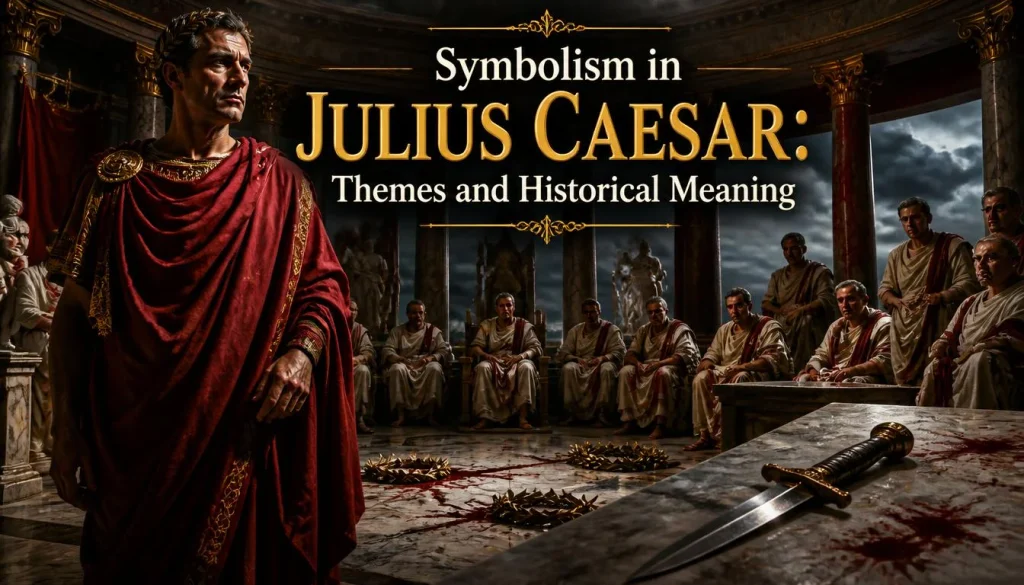
The symbolism in Julius Caesar turns ordinary things like a crown, a dagger, a thunderstorm, and blood-stained hands into warnings about what happens when ambition outruns accountability. Shakespeare never stops to explain these images. He lets them work quietly in the background, which is why readers keep finding new layers in them. For American audiences, the meaning hits close to home, because the United States borrowed much of its political vocabulary from the same Roman Republic this tragedy puts on trial.
Whether you’re writing an essay, preparing a lesson, or wondering why this four-century-old play keeps surfacing in headlines and on stage, knowing its symbols reveals the story beneath the plot. This guide explains what each major symbol means, how it connects to real Roman history, and why modern Americans still read the play as a mirror of their own political world.
Quick Answer
The symbolism in Julius Caesar centers on power, betrayal, fate, and the struggle between democracy and dictatorship. In the United States, the play often symbolizes political tension, public manipulation, and the risks tied to ambitious leaders. More broadly, it also reflects universal fears about loyalty, violence, and human pride.
TL;DR
• Caesar symbolizes power, ambition, and political authority.
• Blood imagery reflects guilt, violence, and irreversible change.
• Rome represents both democracy and political instability.
• Storms and omens symbolize fear and approaching chaos.
• Americans often connect the play to modern politics.
• The story’s meanings evolved through centuries of interpretation.
Overview of Symbolism in Julius Caesar
Symbols That Shape the Story
The play uses visual and emotional symbols to deepen its themes. Shakespeare rarely explains these symbols directly. Instead, audiences understand them through action, language, and repeated imagery.
Several symbols appear throughout the story:
• Laurel crowns symbolize victory and political status.
• Knives represent betrayal hidden behind friendship.
• Blood symbolizes guilt, sacrifice, and violent transformation.
• Storms suggest disorder in both nature and government.
• The ghost symbolizes memory, fate, and psychological fear.
These symbols matter because they help readers understand emotions beneath the political conflict. Even today, audiences often recognize these images immediately.
Why Americans Still Study the Play
In the United States, Julius Caesar remains common in classrooms and theaters because its themes feel timeless. Americans often connect the story to debates about leadership, public opinion, and political violence.
The play also reflects fears about democracy collapsing under strong personalities. Because American culture values freedom and civic responsibility, the story continues to spark discussion.
Read Also: Tarantula Symbolism: Spiritual Meaning & Transformation
Historical Background of Julius Caesar
Ancient Roman Roots
The real Julius Caesar lived during the final years of the Roman Republic. Rome was politically unstable, and many feared Caesar wanted absolute power.
Historically, Caesar became dictator for life in 44 BCE. Soon afterward, senators assassinated him in the Senate chamber. The event shocked Rome and helped trigger the rise of the Roman Empire.
For ancient Romans, symbolism mattered deeply:
• Eagles represented Roman strength and military success.
• Laurel wreaths symbolized honor and victory.
• Public statues reflected status and political influence.
• Omens and astrology shaped political decisions.
Because Romans believed fate influenced human events, signs and prophecies carried major emotional weight.
Shakespeare’s Interpretation
More than 1,600 years later, William Shakespeare transformed Roman history into a political tragedy. He wrote during the reign of Elizabeth I, when England also worried about leadership and succession.
As a result, Shakespeare emphasized:
• Fear of tyrants and unstable rulers.
• Public manipulation through speeches and emotion.
• The fragile balance between liberty and authority.
• Moral uncertainty surrounding political violence.
His version shaped how modern audiences understand Caesar more than the actual history did.
What Caesar Symbolizes
Power and Ambition
Caesar symbolizes authority, confidence, and rising political dominance. Many characters admire him, yet others fear him at the same time.
His growing power creates anxiety because it threatens the Roman Republic. Therefore, Caesar becomes a symbol of ambition that may grow too large for democracy to survive.
In American culture, people often compare powerful leaders to Caesar when discussing:
• Executive power and political influence.
• Charismatic public figures.
• Concerns about authoritarian leadership.
• National division around political personalities.
Human Pride and Vulnerability
Although Caesar appears strong, he also ignores warnings and believes himself nearly untouchable. His confidence becomes symbolic of human pride.
The famous warning “Beware the Ides of March” symbolizes ignored danger. Today, Americans often use the phrase to describe overlooked threats or coming disaster.
Read Also: ONG Meaning in Text: Definition, Uses, and Examples
The Symbolism of Brutus
Honor Versus Betrayal
Marcus Junius Brutus symbolizes moral conflict. Unlike some conspirators, Brutus believes he acts for Rome’s good rather than personal gain.
However, his decision creates one of literature’s greatest betrayals. Because Caesar trusts him deeply, Brutus represents the painful clash between friendship and political duty.
The American Connection
In the United States, Brutus often symbolizes difficult moral choices in politics and public life. Americans sometimes view him as:
• A defender of republican ideals.
• A tragic figure destroyed by idealism.
• A warning against political extremism.
• A symbol of conflicted patriotism.
Different generations interpret him differently depending on political and cultural concerns.
Storms, Omens, and Fate
Nature as a Warning Symbol
One of the play’s strongest symbols is the violent storm before Caesar’s assassination. Shakespeare uses strange weather to reflect social and political disorder.
In ancient cultures, storms often symbolized divine anger or imbalance. Therefore, Roman audiences would have seen these signs as deeply unsettling.
The play includes symbolic omens such as:
• Lions wandering city streets.
• Graves opening during storms.
• Thunder shaking Rome repeatedly.
• A soothsayer predicting danger.
These signs build tension and suggest fate cannot be escaped.
Fate Versus Free Will
The story repeatedly asks whether people control their destiny. Some characters believe fate guides events, while others trust personal choice.
This tension still appeals to American audiences because it reflects modern debates about responsibility, destiny, and human control over history.
Related Topics: Nature Symbolism: Spiritual, Cultural & Literary Meanings
Blood as a Symbol
Violence and Political Sacrifice
Blood appears throughout the play as a symbol of irreversible change. After Caesar’s death, the conspirators literally cover themselves in his blood.
The moment symbolizes several ideas at once:
• Political violence permanently stains society.
• Sacrifice can become morally complicated.
• Guilt follows destructive decisions.
• Revolution creates lasting consequences.
Because blood imagery feels physical and emotional, audiences often remember these scenes vividly.
Psychological Meaning
Blood also represents inner guilt. Characters cannot escape emotional consequences after the assassination.
Modern readers often connect this symbolism to trauma, regret, and the emotional cost of violence. As a result, the imagery still feels psychologically powerful today.
The Symbolism of Rome
Rome as an Ideal
Rome symbolizes civilization, order, law, and public identity. Characters constantly claim they act “for Rome,” even while destroying its stability.
This contradiction matters because it shows how political ideals can justify harmful actions.
| Context | Meaning in the USA | Common Associations | Notes |
| Roman Republic | Democracy and civic duty | Senate, elections, law | Often linked to American government |
| Caesar’s Rule | Fear of concentrated power | Dictatorship, authority | Used in political commentary |
| The Senate | Public debate and conflict | Democracy, division | Symbol of political struggle |
| Roman Crowds | Influence of mass opinion | Media, public emotion | Connected to persuasion |
| Civil War After Caesar | National instability | Polarization, unrest | Reflects fears of collapse |
Roman Influence on America
American culture often borrows Roman symbols and language. For example, government buildings in Washington use Roman-inspired architecture.
Because the United States values republican government, Americans frequently compare modern politics to ancient Rome.
Speech and Persuasion as Symbols
Language as Power
The speeches in Julius Caesar symbolize the power of rhetoric. Words shape public opinion more effectively than weapons.
Brutus speaks logically, while Mark Antony uses emotion and repetition. Antony’s funeral speech especially symbolizes manipulation through public performance.
Modern Relevance
Today, Americans often connect the play to:
• Political speeches and campaign messaging.
• Media influence over public emotion.
• Viral communication and social pressure.
• Persuasive storytelling in leadership.
Because modern society depends heavily on communication, these themes remain extremely relevant.
Psychological and Emotional Symbolism
Fear, Loyalty, and Identity
The play explores emotional symbolism through relationships and inner conflict. Characters struggle between public duty and personal loyalty.
Psychologically, the story symbolizes:
• Fear of losing freedom.
• Anxiety about unstable leadership.
• The emotional burden of betrayal.
• Confusion between patriotism and violence.
These emotions help explain why audiences still respond strongly to the story.
The Shadow of Guilt
Brutus and Cassius both experience emotional decline after Caesar’s death. Their guilt becomes symbolic of moral consequences that cannot disappear.
Modern audiences often interpret the ghost of Caesar as a psychological symbol rather than a literal spirit.
Cross-Cultural and Spiritual Interpretations
Fate and Destiny Across Cultures
Many cultures connect omens and prophecy with spiritual meaning. Therefore, the play’s warnings and supernatural signs resonate beyond Western literature.
For example:
• Ancient Romans trusted signs from the gods.
• Greek tragedies often explored unavoidable fate.
• Some Eastern traditions connect imbalance with natural disorder.
• Christian readers sometimes interpret pride as moral downfall.
Although interpretations vary, the central themes remain widely recognizable.
Universal Human Themes
The story survives because its symbolism feels universal. Nearly every culture understands betrayal, ambition, and fear of corruption.
As a result, Julius Caesar continues appearing in schools and theaters worldwide.
Modern Usage and Pop Culture Meaning
Political Symbolism Today
Modern productions often adapt Julius Caesar to contemporary politics. Directors sometimes dress Caesar like modern leaders to emphasize current concerns.
Because of this, the play occasionally sparks controversy. However, these adaptations usually aim to explore political fear rather than support violence.
Social Media, Tattoos, and Visual Culture
The play’s symbols also appear in modern identity and artistic expression.
Common examples include:
• Laurel wreath tattoos symbolizing victory or ambition.
• “Et tu, Brute?” references about betrayal.
• Roman statue imagery on social media aesthetics.
• Quotes about fate, leadership, and loyalty.
• Senate imagery in political memes and commentary.
Today, Roman symbolism often mixes history with modern identity trends.
Misunderstandings and Controversies
Is the Play Anti-Democracy?
Some readers think the play clearly supports democracy, while others see it criticizing mob rule. In reality, Shakespeare leaves many questions unresolved.
The story shows both the danger of dictatorship and the danger of political violence. Because of this balance, interpretations continue changing.
Political Misuse
At times, people misuse Roman symbolism to promote extreme political ideas. However, historians and educators usually distinguish between historical symbolism and modern political appropriation.
It is important to understand context rather than assume one fixed meaning.
How the Meaning Changed Over Time
Earlier Interpretations
Earlier audiences often focused on morality and leadership. In past centuries, many readers viewed Caesar as either a heroic ruler or a dangerous tyrant.
Meanwhile, Brutus was sometimes treated almost like a patriotic martyr.
Modern Interpretations
Today, interpretations are more complex. Modern audiences often focus on:
• Media manipulation and public persuasion.
• Political polarization and social division.
• Psychological guilt and emotional trauma.
• The blurred line between heroism and violence.
Because society changes, the symbolism continues evolving too.
Why Julius Caesar Still Matters in America
A Mirror of Political Anxiety
Americans often revisit Julius Caesar during periods of political tension. The play reflects fears about unstable leadership, divided citizens, and emotional public debate.
Its themes feel especially relevant during elections or national crises.
Education and Cultural Legacy
The play also remains important because it teaches students how symbolism works in literature and politics. Many Americans first encounter Roman history through Shakespeare’s version.
As a result, the story became part of broader American cultural identity.
FAQs
What does Julius Caesar symbolize?
The play symbolizes power, betrayal, political conflict, and the struggle between liberty and authority. It also reflects fears about ambition and unstable leadership.
Why is blood important in Julius Caesar?
Blood symbolizes guilt, sacrifice, violence, and irreversible change. After Caesar’s death, it also represents the moral consequences of political action.
What does the storm symbolize in the play?
The storm symbolizes chaos, fear, and disorder in Rome. It warns that political balance is collapsing before the assassination.
Why do Americans still study Julius Caesar?
Americans study the play because its themes connect to democracy, leadership, persuasion, and political division. Many readers see parallels with modern public life.
Is Brutus a hero or a villain?
Interpretations differ widely. Some see Brutus as honorable but misguided, while others view him as a tragic betrayer blinded by ideology.
What does “Et tu, Brute?” symbolize today?
The phrase symbolizes personal betrayal by someone trusted deeply. Americans often use it in politics, entertainment, and everyday speech.
Conclusion
The symbolism in Julius Caesar remains powerful because it speaks to timeless human fears and desires. Through storms, blood, speeches, crowns, and betrayal, the story explores how ambition and political conflict can reshape society.
In the United States, the play continues influencing conversations about democracy, leadership, and public responsibility. Although the story comes from ancient Rome, its emotional and political symbolism still feels strikingly modern.
Today, readers return to Julius Caesar not only for history or literature, but also for insight into human nature itself.

Evelyn Thomas is the voice behind SoulMeanings.com, sharing thoughtful articles on spirituality, dream interpretation, symbolism, and self-discovery to inspire meaningful living.


Pingback: Alexandrite Symbolism: Transformation and Spiritual Meaning