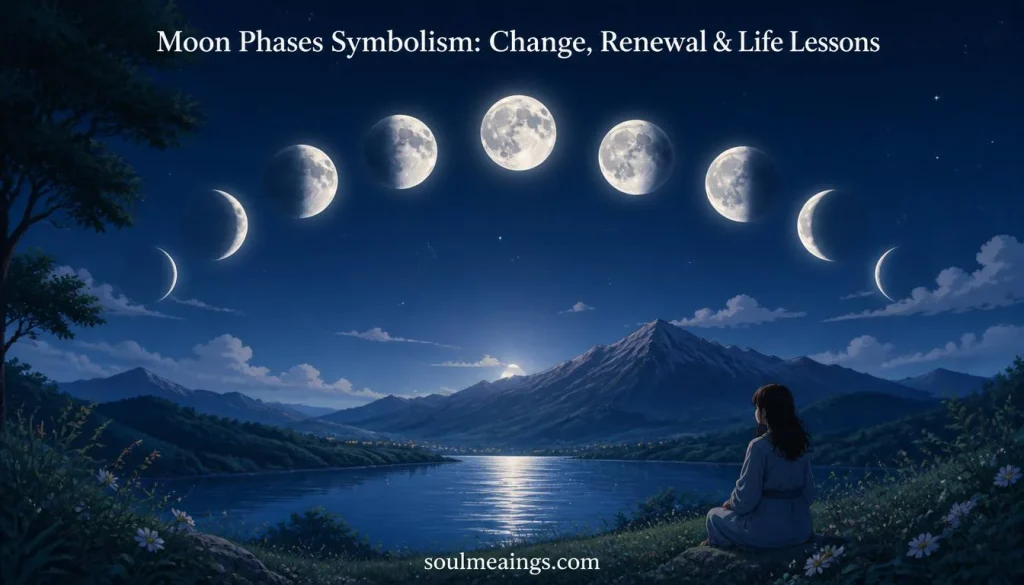
Moon Phases Symbolism: Change, Renewal & Life Lessons reflects its lasting influence on human life, spirituality, and culture.
Across the United States and other cultures, the moon serves as a natural calendar and a symbol of change. From the new moon to the full moon, each phase carries a unique spiritual meaning.
These lunar phases represent life cycles, emotional states, personal transformation, and natural rhythms. Their cultural symbolism appears in ancient beliefs, religions, and spiritual traditions.
The lunar cycle also inspires personal growth, renewal, and reflection. Many people use moon phases in spiritual practices, wellness, and self-growth to set intentions and embrace change.
The new moon often symbolizes fresh starts, while the full moon represents completion. Together, these phases offer life lessons about growth, emotions, and the changing nature of life.
Quick Answer
Moon phase symbolism in the United States commonly represents transformation, renewal, emotional awareness, and the cycles of life. Spiritually, the phases are often interpreted as reminders to begin again, nurture growth, celebrate achievements, release what no longer serves you, and accept change.
TL;DR
- The new moon symbolizes fresh starts, reflection, and hidden possibilities.
- The waxing moon represents growth, hope, and increasing momentum.
- The full moon symbolizes completion, clarity, and heightened awareness.
- The waning moon represents release, rest, and letting go.
- Ancient cultures used lunar cycles to track time and seasonal changes.
- Modern moon imagery appears in tattoos, jewelry, decor, and spiritual practices.
What Do Moon Phases Symbolize?
Moon phases are the different appearances of the moon as it orbits Earth. Because sunlight illuminates different portions of the moon’s visible side, it appears to change throughout a cycle lasting about 29.5 days. These natural changes have inspired symbolic meanings connected to the passage of time and human experience.
The Main Symbolic Meanings
Although interpretations vary, several themes appear frequently in modern moon symbolism.
- Transformation: The moon’s changing appearance reflects life’s constant movement.
- Renewal: The cycle suggests that endings can make room for beginnings.
- Balance: Light and darkness represent contrasting experiences that coexist.
- Growth: Increasing moonlight can symbolize learning, progress, and developing potential.
- Release: Decreasing moonlight can represent reflection, acceptance, and letting go.
These meanings aren’t fixed rules. Instead, they offer a symbolic language people can use to understand their experiences.
Why the Moon Feels Meaningful
The moon provides a visible pattern that repeats without remaining exactly the same each night. As a result, people often connect it with experiences such as growing older, changing relationships, overcoming challenges, and beginning new chapters.
In American culture, moon imagery also appears in poetry, music, films, and everyday conversation. Its familiar presence makes it an accessible symbol of mystery, beauty, and change.
Historical Origins of Moon Phase Symbolism
The moon’s symbolic importance began long before modern spirituality or popular astrology. Ancient communities observed its changing appearance and used lunar patterns to understand time, seasonal activities, and the world around them.
Ancient Civilizations and Lunar Cycles
In ancient Mesopotamia, the moon played an important role in religious life and timekeeping. The lunar deity Sin, also known as Nanna in Sumerian tradition, was associated with the moon and its recurring cycle.
Ancient Egypt also connected lunar deities with time, knowledge, and religious life. The god Thoth, for example, was associated with writing, wisdom, and the measurement of time, including lunar reckoning.
Meanwhile, ancient Greek traditions associated the moon with deities such as Selene and Artemis. These figures developed distinct associations with moonlight, the natural world, and divine power.
Pre-Christian Beliefs and Nature
Before Christianity spread across Europe, many communities observed the moon through seasonal customs, local religious practices, and agricultural traditions. Lunar cycles helped people organize activities and mark important times of the year.
However, there was never one universal pre-Christian meaning for every moon phase. Interpretations differed across places, languages, and communities.
Over time, some older lunar customs blended with later religious practices, folklore, and seasonal celebrations. Others survived in stories, artwork, and modern spiritual interpretations.
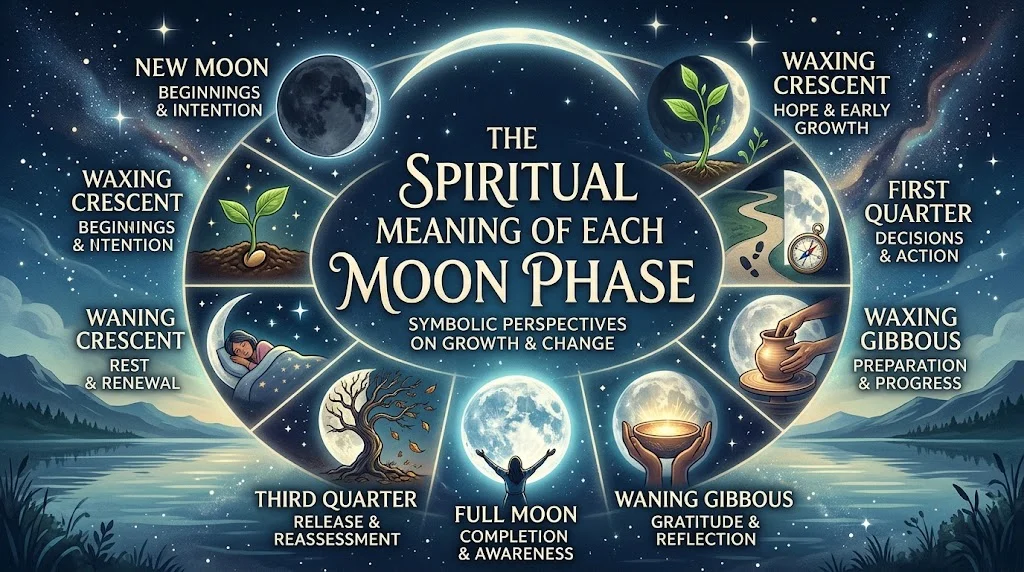
The Spiritual Meaning of Each Moon Phase
Each phase offers a different symbolic perspective on growth and change. In modern American spirituality, people often use these stages as prompts for setting intentions, reviewing progress, and reflecting on personal experiences.
New Moon: Beginnings and Intention
The new moon is difficult to see because its illuminated side faces away from Earth. Symbolically, it represents a blank page, quiet reflection, and possibilities that haven’t yet become visible. Some people use this phase to set goals or consider what they want to change.
Waxing Crescent: Hope and Early Growth
A waxing crescent appears as a thin curve of light that gradually grows. It commonly symbolizes optimism, courage, and the first steps toward a goal. This phase can remind you that small efforts matter, even when results aren’t immediately visible.
First Quarter: Decisions and Action
During the first quarter, half of the moon’s visible disk appears illuminated. Symbolically, this stage represents determination, choices, and facing obstacles. It can encourage you to move beyond planning and take practical steps toward something important.
Waxing Gibbous: Preparation and Progress
The waxing gibbous moon appears more than half illuminated as it approaches fullness. It often represents refinement, patience, and continued effort. This stage reminds people that meaningful progress may require adjustments before a goal feels complete.
Full Moon: Completion and Awareness
The full moon appears as a bright, nearly complete circle. It commonly symbolizes fulfillment, clarity, gratitude, and culmination. For some spiritual practitioners, it provides an opportunity to celebrate progress or reflect on lessons learned.
Waning Gibbous: Gratitude and Reflection
After the full moon, its illuminated portion gradually decreases. Symbolically, this phase represents reflection, sharing wisdom, and appreciating what you’ve learned. It encourages you to consider how your experiences can help you move forward.
Third Quarter: Release and Reassessment
The third quarter moon shows the opposite half of the visible disk compared with the first quarter. In spiritual interpretations, it represents reassessment, forgiveness, and letting go of outdated habits. This stage can inspire you to make space for healthier choices.
Waning Crescent: Rest and Renewal
The waning crescent appears as a narrow sliver before the next new moon. It often symbolizes closure, quietness, and preparation for another beginning. Rather than demanding constant progress, this phase reminds you that rest and reflection also have value.
These interpretations are contemporary symbolic associations, not scientifically established effects of lunar phases on human behavior. You can use them as reflective tools without treating them as predictions.
Moon Phase Symbolism in the United States
In the United States, the moon occupies an unusual place between science, folklore, popular culture, and spirituality. Americans encounter lunar imagery in calendars, children’s stories, space exploration, holiday traditions, and contemporary art.
The Moon and American History
Before clocks became widespread, people relied on natural signs to organize daily activities. Lunar observations helped communities track time, while almanacs combined astronomical information with seasonal guidance and other practical knowledge.
The moon also became part of America’s larger story of exploration. The Apollo missions, particularly the first crewed lunar landing on July 20, 1969, strengthened its association with discovery, ambition, and human achievement.
Today, moon imagery can suggest both the mystery of the natural world and the possibilities of scientific exploration.
Modern American Interpretations
Common associations include:
- Personal freedom: Choosing your own path through life’s changing stages.
- New beginnings: Starting a project, relationship, or personal chapter.
- Emotional reflection: Making room to understand your thoughts and feelings.
- Natural connection: Appreciating the rhythms of the sky and changing seasons.
- Curiosity: Exploring space, astronomy, and questions about humanity’s place in the universe.
These meanings aren’t shared equally by every American. Family traditions, religious beliefs, personal experiences, and cultural backgrounds all shape how people interpret the moon.
Moon Phases and Cross-Cultural Spiritual Beliefs
Moon symbolism extends far beyond the United States. Different societies have developed their own stories, calendars, ceremonies, and spiritual interpretations around the same visible lunar cycle.
Hindu Traditions
In Hindu traditions, lunar days and phases can play important roles in religious calendars and observances. The full moon, known as Purnima, and the new moon, known as Amavasya, have significance in various practices.
Their meaning depends on the specific festival, tradition, and religious context. Therefore, it’s more accurate to discuss individual observances than to assign one universal meaning to the moon across Hindu communities.
Buddhist Traditions
Full moon days are important in several Buddhist traditions. In some communities, they are associated with religious observances, meditation, teachings, and reflection.
The precise practices vary by country, school, and local custom. Moon imagery can also appear in Buddhist art and literature, where its interpretation depends on the particular teaching or story.
Chinese Cultural Traditions
The moon holds a prominent place in Chinese cultural history, including the Mid-Autumn Festival. Celebrations commonly involve family gatherings, mooncakes, and appreciation of the full moon.
The moon can evoke reunion, harmony, and connection with loved ones. These associations are especially visible during festivals that bring families together.
Indigenous Traditions in North America
Indigenous nations across North America have distinct lunar calendars, seasonal observations, stories, and traditions. Some community-specific moon names connect lunar cycles with local plants, animals, weather, and harvesting periods.
However, there is no single Indigenous American system of moon symbolism. Names and meanings differ among nations, and some traditions should be understood through the communities that maintain them.
For American readers, respecting these differences means recognizing lunar traditions as living cultural knowledge rather than treating them as interchangeable spiritual ideas.
Moon Phases, Emotions, and Psychological Meaning
The moon’s changing appearance often provides a useful metaphor for emotional life. Its cycle suggests that people can experience different moods, needs, and levels of energy without remaining in one state forever.
Why the Lunar Cycle Feels Relatable
People naturally look for patterns that help them understand their experiences. A repeating lunar cycle offers a simple way to think about progress, uncertainty, achievement, and rest.
For example, someone beginning a new job might identify with the new moon. Someone finishing a demanding project might relate more closely to the full moon’s symbolism of completion.
These comparisons can encourage self-awareness. However, they don’t mean that the moon determines your emotions or personality.
What the Moon Can Represent Emotionally
- Hope: A thin crescent suggests that possibilities can emerge gradually.
- Confidence: A bright full moon can represent visibility and self-expression.
- Acceptance: The waning phases offer a metaphor for releasing expectations.
- Patience: The complete cycle reminds us that growth takes time.
- Inner peace: The dark moon can represent quiet reflection and personal space.
The value lies in the reflection these symbols encourage. They can help you name an experience without requiring you to believe in supernatural explanations.
Moon Phase Symbolism in Astrology and Spiritual Practices
Moon phases have an established place in astrology and many contemporary spiritual practices. In the United States, people may follow lunar calendars, attend moon circles, or use the phases to organize personal reflection.
Lunar Astrology
In astrology, the moon is commonly associated with emotions, instincts, habits, and inner needs. Practitioners interpret its phase alongside other astrological factors, although these interpretations vary.
A waxing moon may be understood as a period for building momentum, while a waning moon may encourage review and release. These are astrological interpretations rather than scientifically verified descriptions of how people behave.
Moon Rituals and Intention Setting
Some people create simple rituals around the new and full moons. These activities may involve journaling, meditation, quiet reflection, or setting personal goals.
Common examples include:
- Writing intentions during the new moon.
- Reviewing progress as the moon grows brighter.
- Expressing gratitude around the full moon.
- Reflecting on habits to release during the waning phases.
- Taking quiet time before beginning another cycle.
Such practices can offer structure and personal meaning. There is no scientific requirement to perform them, and people can adapt them to their own beliefs.
read more: Symbolism vs Allegory: Differences, Meaning & Literary Insights
Moon Phase Symbolism in Tattoos, Jewelry, and Home Decor
Moon phase designs are popular in contemporary American fashion and interior design. Their appeal comes partly from their simple shapes and partly from the meanings people attach to the lunar cycle.
Moon Phase Tattoos
A moon phase tattoo may represent personal growth, life transitions, spirituality, or a connection with nature. Some people choose the phase associated with a meaningful date, while others prefer a complete lunar sequence.
Common design choices include:
- A full lunar sequence: The changing stages of life.
- A crescent moon: Hope, possibility, or personal development.
- A full moon: Wholeness, awareness, or accomplishment.
- A new moon: Fresh starts and private reflection.
- Moon phases with flowers: Growth, natural beauty, and renewal.
The meaning ultimately depends on the person wearing the design. A moon tattoo doesn’t automatically reveal someone’s religion, beliefs, or personality.
Moon Jewelry and Home Decor
Moon necklaces, wall hangings, lamps, and decorative prints can create a sense of calm or mystery. A full lunar sequence may also serve as a reminder of time passing and personal change.
In minimalist American interiors, moon motifs often appear in silver, gold, black, and muted blue. These colors create different moods without changing the underlying lunar imagery.
Moon-themed objects can therefore be decorative, spiritual, sentimental, or a mixture of all three.
The Meaning of Moon Phases on Social Media
On social platforms, moon symbols often communicate a mood or aesthetic without requiring a lengthy explanation. Users may include lunar imagery in profile pictures, captions, digital artwork, and personal posts.
Common Digital Interpretations
| Moon Symbol | Common Online Meaning | Typical Context |
| New moon | Reset, privacy, fresh start | Personal goals and journaling |
| Waxing crescent | Hope and progress | New projects and motivation |
| Full moon | Fulfillment and visibility | Milestones and expressive posts |
| Waning moon | Reflection and release | Personal changes and endings |
| Complete moon sequence | Transformation and life’s cycles | Tattoos, bios, and spiritual art |
These interpretations are informal, not universal definitions. A moon emoji or image might simply reflect someone’s interest in astronomy, nighttime photography, or a particular visual style.
Moon Emojis and Digital Identity
The crescent moon emoji can suggest nighttime, sleep, peaceful moods, or an interest in lunar imagery. Other moon emojis may be used for decoration, celestial themes, or spiritual expression.
Context matters more than the symbol alone. If someone includes a moon in a bio or message, it’s best not to assume a specific spiritual belief or emotional state.
Moon Phases, Nature, and Seasonal Traditions
The moon has long helped people observe natural patterns. Its cycle is especially meaningful in societies that use lunar calendars or connect seasonal activities with the sky.
Lunar Cycles and Timekeeping
The cycle from one new moon to the next lasts approximately 29.5 days. This repeating pattern has helped communities organize months, festivals, and seasonal observations.
Many traditional calendars have used lunar or lunisolar systems. Lunisolar calendars track lunar months while adjusting to keep the calendar aligned with the solar year.
In the United States, lunar observations also remain relevant to astronomy, fishing traditions, gardening folklore, and public interest in celestial events.
Full Moon Names in American Culture
Names such as the Wolf Moon, Strawberry Moon, and Harvest Moon appear regularly in American calendars and seasonal publications. Their origins are varied, drawing on different European and Indigenous traditions as well as modern popular usage.
However, the names aren’t a single universal Indigenous calendar. Specific nations have their own names and seasonal systems, while popular American lists often combine traditions from different sources.
The Harvest Moon is a particularly recognizable example. It refers to the full moon closest to the autumnal equinox, not simply the full moon of September every year.
These traditions show how the moon connects astronomical observation with local history, seasonal change, and community life.
Misunderstandings and Controversies About Moon Symbolism
Moon imagery is generally flexible and widely used. However, misunderstandings can arise when people assume that every phase has one fixed meaning or that symbolic associations prove supernatural effects.
Common Misconceptions
Myth: The full moon always changes human behavior.
The full moon has a long history of folklore connecting it with unusual behavior. However, claims that it reliably causes major changes in human emotions or actions aren’t supported by consistent scientific evidence.
Myth: Every moon phase has the same spiritual meaning.
Moon symbolism differs across cultures, religions, and modern spiritual communities. A new moon might represent renewal in one practice, while another tradition gives it a different role.
Myth: Moon imagery always signals a particular religion.
Moon designs appear in religious art, cultural traditions, fashion, and ordinary decoration. A crescent or lunar sequence alone doesn’t establish someone’s beliefs.
Cultural Respect and Responsible Use
Some moon names, stories, and ceremonial practices belong to specific cultural communities. Using them without context can flatten meaningful differences between traditions.
A respectful approach includes learning where a symbol comes from and distinguishing public cultural imagery from practices that communities consider private or sacred. It also means avoiding claims that one modern interpretation represents every member of a culture.
How Moon Phase Meanings Have Changed Over Time
Moon symbolism has evolved as people developed new ways to understand the natural world. Ancient observations, religious traditions, folklore, scientific discovery, and modern personal expression have all contributed to its changing meaning.
From Practical Timekeeping to Personal Reflection
For early communities, lunar observation had practical value. It helped people track time, recognize seasonal patterns, and coordinate activities.
Later, stories and religious practices gave the moon additional cultural meanings. In many places, it became associated with deities, fertility, time, mystery, and the recurring processes of nature.
Scientific astronomy eventually explained why the moon appears to change shape. These discoveries didn’t eliminate symbolic interpretations. Instead, science and symbolism continued to serve different purposes.
The Modern Revival of Lunar Imagery
Today, moon phases appear in wellness culture, astrology, tattoos, fashion, and online communities. Some people revive older lunar practices, while others create personal meanings that reflect their own experiences.
This revival doesn’t mean every modern moon ritual has ancient origins. Many popular practices are contemporary combinations of older ideas, newer spiritual movements, and individual creativity.
The enduring appeal comes from the moon’s visible cycle. It offers a familiar image through which people can explore change, uncertainty, achievement, and renewal.
FAQs About Moon Phases Symbolism
What does moon phases symbolism mean?
Moon phases symbolism represents change, growth, renewal, and the natural cycles of life. Each phase offers a different way to understand personal and spiritual transformation.
What does the new moon symbolize?
The new moon often symbolizes fresh starts, new opportunities, and setting intentions. Many people use this phase to reflect on goals and welcome new beginnings.
What does the full moon symbolize spiritually?
The full moon often represents completion, clarity, reflection, and emotional awareness. It can also encourage people to recognize their progress and release old habits.
How do moon phases represent personal growth?
Moon phases reflect how life moves through beginnings, development, change, and completion. They remind us that personal growth takes time and that change is a natural part of life.
What do moon phases mean in different cultures?
Different cultures and spiritual traditions connect moon phases with timekeeping, harvests, renewal, and religious practices. Meanings vary depending on cultural beliefs and historical traditions.
How can I use moon phases symbolism in everyday life?
You can use moon phases symbolism for journaling, reflection, goal-setting, or mindfulness. For example, set intentions during the new moon and review your progress around the full moon.
Conclusion
Moon Phases Symbolism: Change, Renewal & Life Lessons offers a meaningful way to reflect on life’s natural cycles. From the new moon to the full moon, each phase can represent a different stage of growth, change, and renewal. Across cultures, these lunar patterns have inspired spiritual beliefs and personal reflection for thousands of years. By exploring their symbolism, you can find fresh ways to understand your emotions, set intentions, and welcome new beginnings. Ultimately, the moon reminds us that change is natural, growth takes time, and every phase has its own value.

Evelyn Thomas is the voice behind SoulMeanings.com, sharing thoughtful articles on spirituality, dream interpretation, symbolism, and self-discovery to inspire meaningful living.