
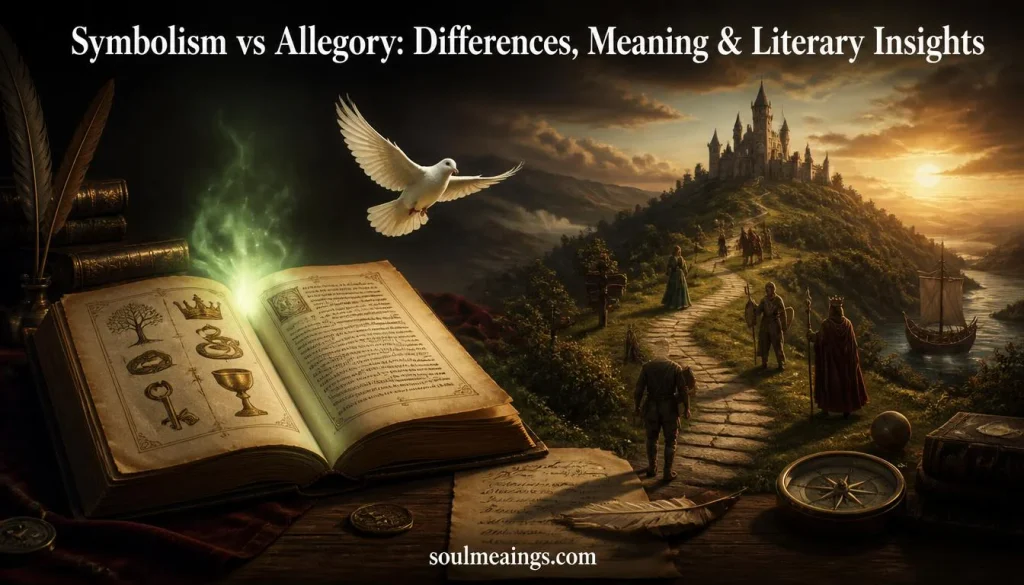

Symbolism vs Allegory: Differences, Meaning & Literary Insights explores how writers use symbols and stories to communicate deeper ideas.
In literature, art, and storytelling, symbolism and allegory are powerful literary devices. Symbolism communicates meaning through individual objects, actions, or figures, while allegory uses an entire story to convey a deeper message.
For example, a dove often symbolizes peace, whereas an allegorical story may explore justice or freedom through characters and events. These techniques appear in novels, films, paintings, books, visual art, and social media, helping readers discover hidden meanings and appreciate different interpretations.
Both techniques explore abstract ideas such as morality, love, politics, spirituality, and personal growth. Symbolic storytelling uses figurative language, metaphors, and symbols to express themes and concepts. Meanwhile, allegorical narratives connect characters and events with moral lessons, philosophical ideas, and social commentary.
Although both techniques share similarities and overlaps, their key difference lies in how they communicate meaning. Understanding their cultural significance, spiritual themes, and historical context helps readers interpret stories, recognize deeper messages, and appreciate how literature reflects human experiences across cultures and generations.
What Is Symbolism?
Definition of Symbolism
Symbolism is a literary and artistic technique that uses something concrete to represent an abstract idea, emotion, or concept. A symbol can be an object, color, person, animal, place, action, or recurring image.
Writers use symbolism to communicate meaning indirectly. Instead of stating an idea outright, they give readers something to interpret.
For example, a dove often represents peace, a red rose can represent romantic love, and a storm might suggest emotional conflict. However, a symbol’s meaning depends on its context and the creator’s intentions.
Key Features of Symbolism
Symbolism has several important characteristics:
- Represents deeper ideas: Objects and images communicate meanings beyond their literal functions.
- Encourages interpretation: Readers can explore what a symbol means within a particular story.
- Creates emotional connections: Symbols can make abstract feelings easier to understand.
- Supports major themes: Repeated images often reinforce a work’s central message.
- Can be subtle or direct: Some symbols are widely recognized, while others require close reading.
Types of Symbolism
Symbolism appears in different forms across literature, art, religion, and everyday life.
1. Conventional Symbolism
Conventional symbols have widely recognized meanings within a particular culture or context.
Examples include:
- A heart representing love.
- A white flag representing surrender.
- A dove representing peace.
- A wedding ring representing commitment.
These meanings are familiar, although they aren’t universal in every situation.
2. Personal Symbolism
Personal symbols develop specific meanings within an individual’s life or a creative work.
For example, an old photograph might represent grief to one character and happiness to another. Its meaning comes from personal memories rather than a universal definition.
3. Natural Symbolism
Natural symbolism draws meaning from animals, plants, weather, landscapes, and natural events.
Examples include:
- Spring representing renewal.
- Autumn suggesting aging or transition.
- A river representing the passage of time.
- A sunrise symbolizing a fresh beginning.
4. Abstract Symbolism
Abstract symbolism uses images, colors, or objects to express ideas that are difficult to represent physically.
For example, darkness may suggest ignorance, uncertainty, or fear. Light can suggest knowledge, hope, or understanding.
The exact meaning depends on how the symbol functions within the work.
read more: Blue Jay Symbolism: Spiritual Meaning and Insight
What Is Allegory?
Definition of Allegory
Allegory is a storytelling or artistic technique in which characters, events, settings, and actions work together to communicate a deeper meaning. The literal narrative represents another story, idea, or system of beliefs.
Unlike a single symbol, an allegory usually develops its meaning across an extended narrative or composition.
For example, George Orwell’s Animal Farm tells the story of animals who overthrow their human owner. Beneath the surface, the novel explores political revolution, corruption, propaganda, and authoritarian power.
The animals and events connect to broader political ideas, making the entire narrative allegorical.
Key Features of Allegory
Allegory often includes the following features:
- Extended symbolic meaning: Multiple elements contribute to a larger message.
- Representational characters: Characters may embody virtues, flaws, political groups, or social forces.
- Meaningful events: Conflicts and outcomes reflect broader real-world or philosophical concerns.
- A central message: Many allegories explore morality, power, justice, faith, or human behavior.
- Two levels of interpretation: Readers follow the literal story while examining its figurative meaning.
Not every allegory offers one simple interpretation. Some works support several readings, especially when they explore complicated political or philosophical questions.
Types of Allegory
1. Moral Allegory
Moral allegory explores ethical choices, virtues, personal struggles, and the consequences of human behavior.
John Bunyan’s The Pilgrim’s Progress follows Christian on a journey toward salvation. His experiences represent spiritual struggles and the challenges of living according to religious beliefs.
2. Political Allegory
Political allegory uses fictional events and characters to examine political systems, leaders, revolutions, or social power.
George Orwell’s Animal Farm is a major example. The animals’ revolution and the pigs’ growing control illustrate how revolutionary ideals can become distorted by authoritarian leadership.
3. Religious Allegory
Religious allegory communicates spiritual beliefs through characters, journeys, and events.
For example, The Pilgrim’s Progress presents Christian faith through a journey filled with symbolic places, challenges, and encounters.
Religious allegories can also appear in paintings, poetry, myths, and dramatic works.
4. Philosophical Allegory
Philosophical allegory explores abstract questions about knowledge, truth, freedom, identity, and human existence.
Plato’s Allegory of the Cave describes prisoners who mistake shadows for reality. Their experience illustrates the difference between appearances and deeper understanding.
5. Social Allegory
Social allegory examines class divisions, prejudice, inequality, and other social problems through a sustained narrative.
A fictional society divided into rigid social groups, for example, might represent the effects of discrimination or unequal access to power.
Key Differences Between Symbolism and Allegory
The main difference between symbolism and allegory is their scope. Symbolism often gives deeper meaning to an individual element, while allegory connects multiple elements to develop a broader message.
| Feature | Symbolism | Allegory |
| Meaning | An object or action represents a deeper idea | A narrative or artwork represents a broader idea |
| Scope | Often limited to a particular element | Usually extends across the entire work or a substantial part |
| Structure | May appear briefly or recur throughout a work | Develops through connected characters, events, and details |
| Interpretation | Often allows several meanings | Often supports a sustained central interpretation |
| Purpose | Adds depth, emotion, and thematic meaning | Explores a larger moral, political, social, or philosophical message |
| Example | A dove representing peace | Animal Farm representing political revolution and authoritarianism |
Symbolism vs Allegory: A Simple Example
Imagine a novel featuring a locked door.
- Symbolism: The locked door represents a character’s fear of emotional intimacy.
- Allegory: An entire story follows a character moving through rooms, each representing a stage of personal growth, until the final door represents self-acceptance.
The locked door is a symbol because it represents an idea. The character’s extended journey can be allegorical because multiple elements contribute to a broader message.
This distinction is useful when analyzing literature because it helps readers understand how individual details contribute to a work’s overall meaning.
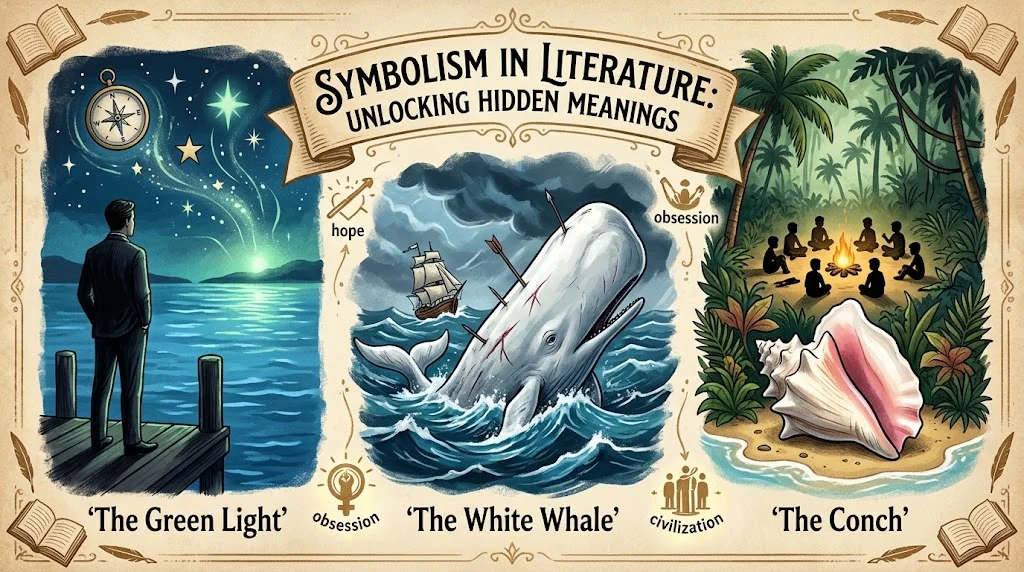
Symbolism in Literature
Symbolism allows writers to communicate complex emotions and themes without explaining every detail. A recurring object or image can become increasingly meaningful as the story develops.
Examples of Symbolism in Literature
1. The Green Light in The Great Gatsby
In F. Scott Fitzgerald’s The Great Gatsby, the green light across the water represents Gatsby’s hopes and dreams, particularly his desire to reunite with Daisy.
It also suggests the difficulty of reaching an idealized future. The light becomes a powerful image of longing, ambition, and the distance between dreams and reality.
2. The White Whale in Moby-Dick
Herman Melville’s Moby-Dick centers on Captain Ahab’s pursuit of the white whale.
The whale can represent nature’s power, the unknowable, obsession, or the human desire to impose meaning on the world. Its significance remains open to interpretation.
3. The Conch in Lord of the Flies
In William Golding’s Lord of the Flies, the conch shell initially represents order, cooperation, and the rules governing the boys’ meetings.
As the boys’ society becomes increasingly violent, the conch’s declining authority reflects the collapse of their well-mannered behavior.
How Symbolism Enhances Literature
Symbolism enriches literature in several ways:
- It creates deeper emotional connections between readers and characters.
- It reinforces themes without repeatedly stating them.
- It encourages readers to notice patterns and interpret details.
- It allows a story to communicate different meanings to different audiences.
A strong symbol often becomes more meaningful as readers learn about the characters and events surrounding it.
Allegory in Literature
Allegory gives writers a way to examine real-world problems through fictional situations. By presenting familiar issues in an unfamiliar form, authors can encourage readers to question society, morality, and human behavior.
Examples of Allegory in Literature
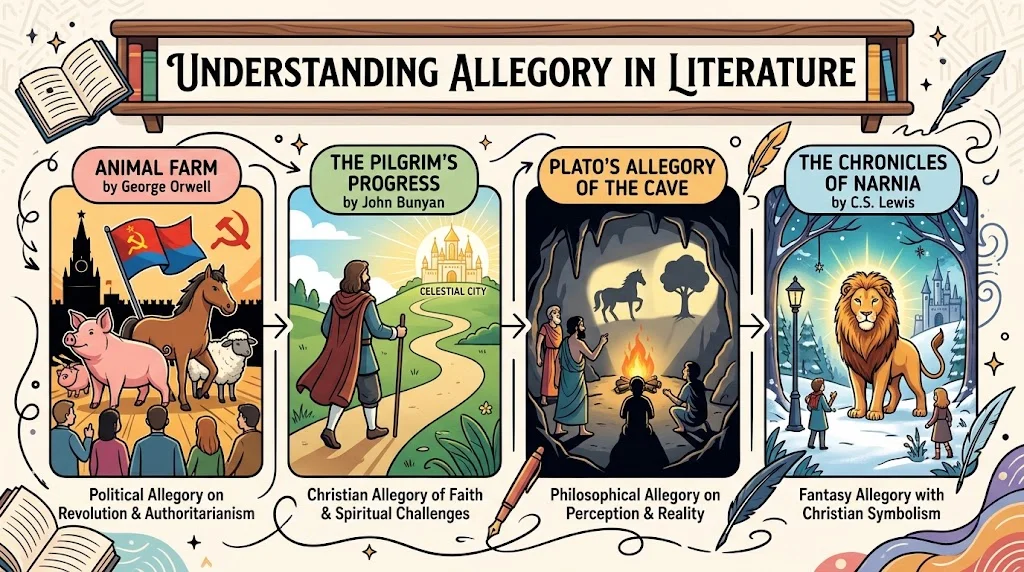
1. Animal Farm by George Orwell
Animal Farm is a political allegory that examines the Russian Revolution and the development of authoritarian rule in the Soviet Union.
The animals overthrow their human owner in the hope of creating a more equal society. However, the pigs gradually establish their own oppressive system.
The story explores corruption, propaganda, inequality, and the misuse of political power.
2. The Pilgrim’s Progress by John Bunyan
This Christian allegory follows a character named Christian as he travels toward the Celestial City.
His journey represents the pursuit of salvation and the spiritual challenges that arise along the way. Characters and locations embody religious ideas, temptations, virtues, and obstacles.
3. Plato’s Allegory of the Cave
In Plato’s Republic, the Allegory of the Cave describes prisoners who have mistaken shadows for reality.
When one prisoner escapes and discovers the outside world, he begins to understand how limited his earlier knowledge was.
The allegory explores education, truth, perception, and the difficult process of gaining understanding.
4. The Chronicles of Narnia by C. S. Lewis
The Chronicles of Narnia series contains Christian symbolism and allegorical interpretations, particularly through Aslan’s sacrifice and return in The Lion, the Witch and the Wardrobe.
Aslan is commonly interpreted as a Christ-like figure. However, the series includes broader fantasy themes, so describing every element as a strict allegorical equivalent would oversimplify the books.
How Allegory Enhances Literature
Allegory helps writers:
- Explore sensitive political, religious, or social issues indirectly.
- Present complicated moral questions through memorable characters.
- Encourage readers to compare fictional events with real experiences.
- Connect a story’s events to a larger philosophical or cultural message.
Because allegories develop meaning across multiple elements, understanding them often requires examining the entire work rather than one isolated detail.
Symbolism vs Allegory in Art and Visual Media
Symbolism and allegory aren’t limited to written stories. Painters, sculptors, filmmakers, and other artists use both techniques to communicate ideas visually.
Symbolism in Art
Symbolism in art occurs when a particular visual element represents an emotion, belief, or abstract concept.
For example:
- A skull may symbolize mortality.
- A candle may represent hope or the passage of time.
- A broken chain may represent freedom.
- A wilting flower may suggest loss or the temporary nature of life.
Vincent van Gogh’s The Starry Night is often interpreted through its expressive sky, swirling forms, and luminous stars. Viewers may associate these features with emotion, movement, or the relationship between humanity and the natural world.
These interpretations are not necessarily fixed meanings established by the artist. Art can invite personal responses alongside historical analysis.
Allegory in Art
Allegory in art uses a broader arrangement of figures, objects, and actions to represent an extended idea.
For example, Sandro Botticelli’s Primavera brings together mythological figures and natural imagery. The painting is commonly interpreted in relation to spring, fertility, and classical mythology, although its precise meaning remains debated.
Personifications of Justice, Victory, or Charity also appear in allegorical paintings and sculptures. These figures represent abstract concepts through recognizable human forms and accompanying attributes.
The Main Visual Difference
A painting featuring a single wilted flower might use symbolism to suggest grief or loss. An elaborate painting showing several figures representing Justice, Greed, and Truth could function allegorically if their relationships communicate a broader moral message.
In practice, a single artwork can use both techniques simultaneously.
Symbolism vs Allegory in Movies, Games, and Modern Culture
Modern media often combines symbolism and allegory to explore identity, power, morality, and social change.
Symbolism in Movies
Film directors use lighting, colors, props, sounds, and recurring images to establish meaning.
For example:
- Red lighting can suggest danger, anger, or passion.
- Mirrors can represent divided identity or self-reflection.
- A character’s repeated journey through a doorway can suggest transition.
- A recurring bird image may represent freedom or confinement.
In Star Wars, the lightsaber is more than a weapon. Its meaning also depends on the character using it, the conflict surrounding it, and its connection to the Jedi or Sith.
Allegory in Movies
Films can develop allegorical meanings through their entire plots and fictional worlds.
The Matrix can be interpreted as an allegory about control, reality, freedom, and awakening. Its simulated world and the characters’ attempts to escape encourage viewers to question what they accept as real.
However, the film also explores these ideas through science fiction, action, and individual character development. Its meaning isn’t limited to one allegorical reading.
Symbolism and Allegory in Video Games
Video games use visual and interactive elements to communicate ideas.
Symbolism examples:
- A key representing access or opportunity.
- A health potion representing recovery.
- A ruined city suggesting the consequences of conflict.
Allegory examples:
A game may create an entire fictional society to explore authoritarianism, inequality, environmental destruction, or the dangers of unchecked technological progress.
BioShock, for example, examines political and philosophical ideas through its setting, characters, and narrative. Its fictional city of Rapture helps develop a sustained critique of extreme ideological ambition.
Symbolism and Allegory in Music
Music uses lyrics, imagery, sound, and recurring motifs to create meaning.
A songwriter might use rain to represent sadness or a rising sun to suggest hope. These are examples of symbolism.
A concept album that follows a character through a sustained struggle against social oppression might work allegorically, especially when its songs collectively develop a broader message.
The distinction depends on how consistently the individual elements connect to the larger narrative.
Spiritual and Cultural Significance of Symbolism and Allegory
Symbolism and allegory have played important roles in religious traditions, cultural storytelling, mythology, and philosophical teaching.
Symbolism in Spiritual Traditions
Symbols can communicate beliefs, values, and spiritual experiences through familiar images.
Examples include:
- The cross: Associated with Christianity, faith, sacrifice, and redemption.
- The lotus: Associated with purity, spiritual growth, and enlightenment in several Asian religious traditions.
- Light: Often represents knowledge, divine presence, or hope.
- Water: May represent purification, renewal, or transformation in different traditions.
These associations vary across cultures and historical periods. A symbol should be understood within its specific religious or cultural context rather than assigned one universal meaning.
Allegory in Spiritual Storytelling
Spiritual allegories use stories to explore faith, temptation, redemption, and moral responsibility.
The parable of the Prodigal Son in the Gospel of Luke, for example, tells of a son who leaves home, wastes his inheritance, and eventually returns to his forgiving father.
The story teaches about repentance, forgiveness, and reconciliation. It is often interpreted allegorically, although it is also understood as a parable with a direct moral and spiritual message.
Both techniques help communities preserve ideas and communicate them across generations. Symbolism concentrates meaning into images, while allegory can develop teachings through extended narratives.
read more: Symbolism in Poetry: Meaning and Literary Significance
Can Symbolism and Allegory Exist Together?
Yes. Symbolism and allegory often work together, and recognizing their relationship can make literary analysis more accurate.
An allegorical story frequently includes individual symbols that reinforce its larger meaning. Likewise, a work built around symbolism may suggest a broader allegorical interpretation.
Consider a fictional story about a village living under a corrupt ruler.
- A broken crown might symbolize the loss of legitimate authority.
- A locked gate might symbolize the people’s lack of freedom.
- A journey through the wilderness might symbolize a struggle for independence.
- The entire story might function as a political allegory about tyranny and resistance.
The individual images work symbolically, while the connected narrative develops a broader political message.
However, not every story with multiple symbols is an allegory. The elements must form a meaningful relationship with a larger idea for an allegorical reading to be convincing.
How to Identify Symbolism and Allegory in a Story
You don’t need specialized literary training to recognize these techniques. A few practical questions can help you identify them while reading a book, watching a movie, or studying an artwork.
How to Identify Symbolism
Look for objects, colors, places, or actions that seem more important than their literal function.
Ask yourself:
- Does this object appear repeatedly?
- Does its meaning change as the story progresses?
- Is it connected to a character’s emotions or decisions?
- Could it represent an abstract idea such as hope, fear, or freedom?
For example, if a character repeatedly looks at an empty chair after losing a loved one, the chair may symbolize absence, grief, or unresolved memories.
Consider the surrounding events before deciding what it means.
How to Identify Allegory
Look for connections between the overall narrative and a broader moral, political, social, or philosophical idea.
Ask yourself:
- Do characters consistently represent particular ideas or groups?
- Do major events reflect a recognizable real-world conflict?
- Does the setting represent a broader social or philosophical system?
- Do multiple details support a shared underlying message?
For example, a story about animals forming a government, creating rules, and eventually becoming oppressed by their leaders may invite an allegorical reading about political power.
The strongest interpretation explains several parts of the narrative rather than relying on one isolated detail.
Life Lessons from Understanding Symbolism and Allegory
Studying symbolism and allegory can help readers understand stories and reflect on the world around them.
- Look beyond appearances: Symbols encourage you to consider meanings that aren’t immediately obvious.
- Question authority: Political allegories can reveal how power, propaganda, and corruption influence society.
- Reflect on moral choices: Allegorical stories often explore the consequences of selfishness, dishonesty, courage, or compassion.
- Appreciate different perspectives: Symbols may carry different meanings depending on culture, history, and personal experience.
- Recognize recurring patterns: Both techniques help you notice connections between individual details and broader themes.
These lessons shouldn’t replace careful interpretation. A meaningful reading considers the author’s context, the work’s details, and the possibility of multiple valid perspectives.
FAQs About Symbolism vs Allegory
What Is the Main Difference Between Symbolism and Allegory?
Symbolism uses an object, action, or figure to represent a deeper meaning. Allegory uses an entire story, including its characters and events, to communicate a broader message.
Can a Story Use Both Symbolism and Allegory?
Yes, a story can use both techniques. An allegorical narrative may include symbolic objects, colors, or actions to strengthen its central message.
What Is an Example of Symbolism in Literature?
A dove is a common symbol of peace. Similarly, darkness may represent fear, uncertainty, or evil, depending on the story’s context.
What Is an Example of Allegory?
George Orwell’s Animal Farm is a well-known example of allegory. Its farm animals and their actions represent political power, corruption, and social inequality.
Why Do Writers Use Symbolism and Allegory?
Writers use these literary devices to explore complex ideas, express emotions, and communicate moral or social messages. They also encourage readers to think beyond the literal meaning of a story.
Are Symbolism and Allegory the Same as Metaphor?
No, although they can overlap. A metaphor compares two things directly, symbolism gives something a deeper meaning, and allegory develops a broader message through an entire narrative.
Conclusion
Understanding symbolism vs allegory helps readers recognize how writers communicate ideas beyond literal words. Symbolism gives individual objects, actions, and figures deeper meanings, while allegory builds a larger message through characters, events, and entire stories. Both techniques appear in literature, art, films, and modern media. By recognizing their differences and similarities, you can better understand hidden meanings, explore cultural and spiritual themes, and appreciate the deeper messages behind the stories you read and watch.

Mark Taylor is a content writer at soulmeaings.com. He writes clear, research-based articles on symbolism, spiritual meaning, and cultural interpretation, helping readers understand the ideas behind the symbols they encounter.


Pingback: Moon Phases Symbolism: Change, Renewal & Life Lessons