
Symbolism in Poetry: Meaning, Interpretation & Literary Significance explores how poets use familiar images to express deeper ideas and emotions.
Poetry is a powerful medium for expressing complex emotions, ideas, and experiences through symbolism in poetry. Poets use objects, colors, and actions to give deeper meanings to ordinary things. For example, a rose, a storm, or a quiet road can symbolize love, death, nature, or spirituality.
Different types of symbolism create powerful messages through symbolic imagery, visual imagery, natural symbols, color symbolism, and action symbolism. Metaphors, figurative language, and poetic devices strengthen poetic expression by adding hidden meanings to familiar words.
A symbol’s meaning often depends on its cultural context, literary themes, and personal interpretation. This creates layered interpretations, personal connections, and emotional depth. Through creative writing and artistic expression, poets use symbolism techniques to improve poetic language and communication.
The cultural significance and modern applications of poetry show how poetry symbolism continues to shape writing and reading experiences. Ultimately, its literary significance lies in helping readers understand the deeper meanings and symbolic representation of human experiences.
Quick Answer
Symbolism in poetry uses objects, colors, people, places, or natural images to represent deeper ideas and emotions. In American literature, common examples include roses for love, birds for freedom, and darkness for uncertainty, although context can change each symbol’s meaning.
TL;DR
- Symbolism gives ordinary words and images deeper meanings.
- Poets use symbols to express emotions, beliefs, and complex ideas.
- Nature, colors, seasons, and everyday objects often become poetic symbols.
- Symbolism has roots in ancient storytelling, religion, and cultural traditions.
- American poets use symbols to explore freedom, identity, loss, and change.
- Context helps readers interpret symbols without assuming one universal meaning.
What Is Symbolism in Poetry?
Symbolism is a literary device that gives an image, object, action, or place a meaning beyond its literal purpose. It allows poets to explore complicated subjects through familiar things. For American readers, recognizing these details can make classic and contemporary poems easier to understand.
How Symbols Work in a Poem
A symbol usually has two levels of meaning. The first is what readers can see, hear, touch, or imagine. The second is the deeper idea connected to that detail.
For example, a candle can simply light a dark room. However, a poet might use it to represent hope, faith, memory, or a life slowly fading.
Symbols can appear in several forms:
• Objects, such as keys, mirrors, candles, and doors.
• Natural images, including rivers, birds, mountains, and storms.
• Colors that suggest emotions, beliefs, or social meanings.
• Actions, such as crossing a bridge or opening a window.
• Places that represent safety, isolation, belonging, or freedom.
Why Poets Use Symbolism
Poets often use symbols because direct explanations can’t express every feeling equally well. A single image can suggest several emotions at once.
Imagine a poem about someone leaving home. Instead of describing every emotion, the poet might show an empty chair beside a window. That image could suggest absence, loneliness, memory, or an unfinished goodbye.
Historical Origins of Symbolism in Poetry
Symbolism didn’t begin with modern poetry. People have used meaningful images in oral storytelling, myths, songs, ceremonies, and written literature for thousands of years.
However, the meanings attached to these images have changed across cultures and historical periods. Understanding this background helps readers recognize the traditions that shaped poetic language.
Ancient and Pre-Christian Roots
Ancient societies often connected natural objects with ideas about life, death, power, and the sacred. These associations appeared in myths, ritual songs, and early literary traditions.
• The sun often represented life, power, renewal, or divine authority.
• Rivers could suggest fertility, journeys, boundaries, or passage into another world.
• Trees frequently connected ideas of growth, ancestry, shelter, and continuity.
• Birds could represent the soul, messages, freedom, or relationships with the divine.
These associations weren’t identical everywhere. Their meanings depended on local beliefs, stories, and historical circumstances.
Symbolism in Classical and Religious Writing
Greek and Roman literature used gods, animals, objects, and natural events to communicate larger ideas. Later, Christian literature developed familiar associations involving light, darkness, gardens, crosses, and journeys.
Other religious traditions also developed rich symbolic languages. Their meanings reflect distinct histories and beliefs rather than one universal system.
During the Middle Ages, allegorical poetry often presented virtues, sins, and spiritual struggles through characters and objects. In later centuries, poets continued adapting these older images to explore personal and social questions.
The Rise of the Symbolist Movement
In the nineteenth century, Symbolism emerged as a literary and artistic movement, particularly in France and Belgium. Writers sought to suggest hidden realities through mood, sound, imagery, and indirect expression.
Poets such as Charles Baudelaire, Stéphane Mallarmé, and Paul Verlaine helped shape this movement. Their work influenced later writers, including modernists who experimented with layered meanings and unfamiliar images.
Importantly, the historical Symbolist movement is not the same as symbolism as a general literary device. The device is much older and remains common in poetry today.
Common Symbols in Poetry and Their Meanings
Some images appear repeatedly in poetry because they connect easily with familiar human experiences. Nevertheless, their meanings aren’t fixed, and context remains essential.
Nature Symbols
Nature gives poets a rich collection of images for describing change, emotion, and human relationships.
• Roses often suggest love, beauty, affection, or the brief nature of life.
• Rivers may represent time, movement, change, or a journey through life.
• Storms can suggest conflict, emotional turmoil, danger, or approaching change.
• Birds frequently represent freedom, longing, escape, or confinement.
• Trees may symbolize growth, family roots, endurance, or the passage of generations.
• Winter can suggest hardship, isolation, aging, or a period of rest.
Everyday Objects and Places
Ordinary objects can become powerful symbols when poets connect them with a larger theme.
A locked door might suggest exclusion, while an open window could represent opportunity. Similarly, a mirror might invite reflection on identity, self-knowledge, or appearance.
A road often suggests choices and personal direction. However, it might also represent uncertainty, repetition, or a journey without a clear destination.
Colors and Their Associations
Colors can establish a poem’s emotional atmosphere and support its central ideas. Their meanings may also change according to cultural context.
| Color | Common Associations | Possible Meaning in a Poem |
| Red | Love, anger, danger | Passion, conflict, or sacrifice |
| White | Purity, peace, emptiness | Innocence, mourning, or a fresh beginning |
| Black | Darkness, grief, mystery | Loss, fear, secrecy, or power |
| Green | Nature, growth, renewal | Hope, jealousy, or new possibilities |
| Blue | Calm, sadness, distance | Peace, longing, or emotional isolation |
These associations are starting points, not universal rules. A poet might use white to suggest loneliness rather than purity, depending on the surrounding images.
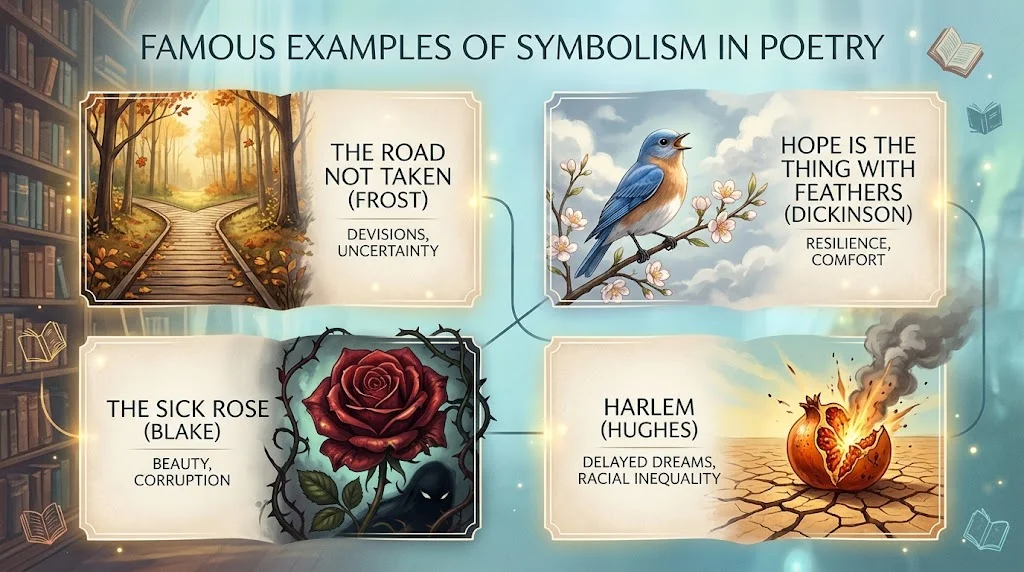
Famous Examples of Symbolism in Poetry
Reading familiar poems helps explain how symbolism works in practice. The strongest interpretations connect specific images with the poem’s language, tone, and overall message.
Robert Frost’s “The Road Not Taken”
Robert Frost’s poem uses a fork in a wooded path as its central image. The speaker must choose one direction, making the road a natural symbol of decisions and uncertainty.
Readers often connect the poem with independence and choosing an unusual path. However, the poem also questions how people remember their choices and create stories about their lives afterward.
The roads don’t simply mean that one choice is better than another. Instead, they invite readers to consider uncertainty, memory, and the consequences of decisions.
Emily Dickinson’s “Hope Is the Thing with Feathers”
Emily Dickinson compares hope to a bird that continues singing through difficult conditions. The bird becomes a symbol of resilience, comfort, and the ability to endure hardship.
This image makes an abstract feeling easier to imagine. Readers can picture a small creature continuing its song even when circumstances become unpleasant.
William Blake’s “The Sick Rose”
William Blake’s poem presents a rose affected by an unseen force. The rose can suggest beauty, love, or vulnerability, while the destructive presence introduces ideas of secrecy and corruption.
The poem doesn’t provide one simple explanation for every image. Its ambiguity encourages readers to consider how hidden forces can damage something beautiful.
Langston Hughes’s “Harlem”
In “Harlem,” Langston Hughes uses a series of vivid comparisons to explore what happens to a dream that has been postponed. Images involving drying, decay, and an explosive ending make the consequences of delayed hopes feel physical.
In its American historical context, the poem is closely connected to racial inequality and frustrated aspirations. Its symbols and comparisons turn a social question into an urgent emotional experience.
These examples show that symbolism can communicate personal feelings, philosophical questions, and public concerns. The best interpretation explains how an image supports the poem’s larger meaning.
Types of Symbolism in Poetry
Poets use different kinds of symbols depending on their subjects, styles, and goals. Recognizing these types helps readers understand how individual images contribute to a poem’s larger message.
Conventional and Personal Symbols
Conventional symbols carry familiar associations within a particular culture or tradition. For example, a heart commonly represents love, while a dove often suggests peace.
Personal symbols gain meaning through an individual poet’s experiences or through a particular poem. A cracked teacup might represent family tension in one poem, even though it has no widely accepted symbolic meaning.
Natural and Religious Symbols
Natural symbols draw on the physical world, including weather, animals, plants, and landscapes. Religious symbols connect with specific beliefs, sacred stories, and spiritual traditions.
A river might represent life’s movement in one poem and spiritual cleansing in another. Readers should examine the poem before deciding which interpretation fits best.
Symbols, Metaphors, and Allegories
These literary devices sometimes overlap, but they aren’t interchangeable.
• Symbolism gives an image a deeper meaning beyond its literal role.
• Metaphor describes one thing in terms of another to create a comparison.
• Allegory develops a broader meaning through an extended story or connected set of symbols.
• Imagery uses sensory details to help readers picture, hear, feel, smell, or taste something.
A poem can use all four devices together. For example, a storm may provide imagery, function as a symbol of conflict, and become part of a larger allegory about personal struggle.
Symbolism in Poetry in American Culture
In the United States, poetry often explores freedom, identity, opportunity, injustice, and belonging. Symbols help writers address these subjects through images that readers can understand emotionally.
American poetry also reflects the country’s many cultural traditions. Its symbolic language has developed through Indigenous oral traditions, African American literary traditions, European influences, immigration, and changing social movements.
Freedom, Identity, and the American Dream
Roads, open skies, birds, and horizons often appear in American writing as images of freedom and possibility. These images can reflect the desire for independence or a better future.
However, freedom doesn’t mean the same thing to every speaker or community. A road might represent opportunity for one character and displacement for another.
Poets can also use walls, fences, and closed doors to explore exclusion. Such images may reflect personal barriers or larger social inequalities.
Social Change and American Poetry
American poets have used symbolism to address difficult questions about race, labor, gender, war, and social belonging. Through familiar images, they can reveal experiences that direct statements might struggle to convey.
Langston Hughes, for example, explored the emotional weight of delayed dreams. Other American writers have used landscapes, homes, rivers, and changing seasons to consider memory, migration, and national identity.
These symbols aren’t merely decorative. They help readers connect private emotions with historical experiences and public concerns.
Spiritual and Cross-Cultural Meanings of Poetic Symbols
Symbolism in poetry often draws on spiritual traditions and cultural stories. However, the same image can carry different meanings across communities, so interpretations require care.
Common Spiritual Associations
Some symbolic associations appear across multiple traditions, although their specific meanings differ.
• Light may suggest wisdom, truth, hope, or spiritual awareness.
• Water can represent cleansing, renewal, life, or transformation.
• Mountains may suggest spiritual effort, isolation, or a meeting with the sacred.
• Gardens can evoke fertility, peace, paradise, or a protected inner world.
• Journeys often suggest personal growth, moral testing, or spiritual discovery.
These are broad possibilities rather than shared beliefs held by every culture.
Cultural Context Matters
A lotus, for example, has important meanings in several Asian religious and cultural traditions. Depending on its context, it can be associated with purity, spiritual development, or renewal.
Likewise, a cross can carry specific Christian meanings, while a crescent may hold religious or cultural significance in particular settings. Poets may draw on these associations to communicate ideas about faith, identity, or belonging.
Readers should avoid treating cultural symbols as interchangeable decorations. Understanding their origins helps preserve the meaning and context behind them.
Emotional and Psychological Meaning of Symbolism
Symbols allow poets to express feelings without naming them directly. A silent room might communicate loneliness more powerfully than the sentence “I feel alone.”
Because readers bring their own memories to a poem, a symbol can also produce different emotional responses. One reader might find rain comforting, while another associates it with grief or disappointment.
How Symbols Shape Mood
Poets often combine symbols with sound, rhythm, and sensory details to create a particular atmosphere.
• Gentle rain may suggest comfort, reflection, or emotional release.
• Broken glass can evoke damage, fragility, or a relationship falling apart.
• An empty house might suggest abandonment, memory, or the loss of belonging.
• Morning light can create a feeling of renewal after a difficult period.
• A fading photograph may evoke aging, nostalgia, or the fear of forgetting.
The emotional effect depends on how these details work together. A symbol’s placement, repetition, and relationship to the speaker can change its meaning.
Why Readers Connect With Symbols
Symbols give readers room to participate in interpretation. Instead of receiving every message directly, they connect images with the poem’s themes and their own experiences.
This process can make a poem feel personal without requiring every reader to reach the same conclusion. It also explains why readers sometimes revisit a poem and discover a different meaning later.
read more: Ladybug Symbolism: Spiritual Meaning, Luck and Transformation
Modern Uses of Symbolism in Poetry
Symbolism remains relevant because contemporary writers use it to discuss everyday life, relationships, technology, and social change. Its presence extends beyond printed poems into music, spoken-word performances, online writing, and visual culture.
Song Lyrics and Spoken-Word Poetry
American songwriters frequently use symbolic images to communicate heartbreak, ambition, freedom, and personal change. A fading light might suggest the end of a relationship, while a rising sun could represent a fresh start.
Spoken-word poets also use symbols to explore identity, family, community, and social justice. Their performances often combine repeated images with rhythm, gesture, and vocal emphasis.
Social Media and Digital Writing
Short poems shared online often rely on recognizable images because readers encounter them quickly. Rain, flowers, moons, mirrors, and empty streets can communicate an emotional atmosphere in very few words.
However, an image’s online meaning may differ from its meaning in a literary poem. A moon might represent solitude in one post and romance in another.
Tattoos, Decor, and Personal Identity
People sometimes borrow poetic symbols for tattoos, artwork, jewelry, and home decor. A compass may represent direction, while a tree might suggest family connections or personal growth.
These personal choices aren’t automatically literary symbolism. However, they follow a similar principle: an ordinary image becomes meaningful through its connection to an idea or experience.
Misunderstandings and Controversies About Symbolism
Symbolism can enrich poetry, but it also creates opportunities for overinterpretation. Readers sometimes assign meanings that the poem itself doesn’t support.
Does Every Image Have a Hidden Meaning?
No. Some details simply establish a setting, describe an experience, or create a sensory impression.
A poem mentioning a blue shirt doesn’t necessarily use blue to symbolize sadness. If the color isn’t emphasized or connected to the poem’s larger concerns, a symbolic interpretation may be unnecessary.
Can One Symbol Have Several Meanings?
Yes. A snake might suggest danger, temptation, healing, transformation, or wisdom, depending on its cultural background and literary context.
Religious and cultural associations can also differ significantly. Assuming that one meaning applies everywhere can lead to inaccurate or disrespectful interpretations.
When Symbolism Reflects Harmful Stereotypes
Some literary works use symbols shaped by racial prejudice, colonial attitudes, or unfair cultural assumptions. Readers should examine these choices within their historical setting without automatically treating them as neutral or universal.
For example, descriptions of darkness as evil may draw on familiar literary conventions. However, readers can also question how repeated associations between darkness and wrongdoing affect broader cultural ideas.
Careful interpretation considers both the writer’s historical context and the possible effects of the language. Recognizing a symbol doesn’t require endorsing every idea attached to it.
How Symbolism in Poetry Has Changed Over Time
The use of symbolism has evolved alongside literature, religion, philosophy, and social life. Some associations remain familiar, while others have become more personal, contested, or open to reinterpretation.
From Shared Traditions to Personal Meaning
In older literary traditions, poets often drew on recognizable myths, religious stories, and established cultural associations. These references helped audiences understand themes without lengthy explanations.
Later writers increasingly experimented with private imagery and less direct forms of expression. Modern poetry can use familiar symbols in unexpected ways or create entirely new associations.
Contemporary Interpretations
Today, readers often interpret symbols through multiple perspectives, including personal experience, historical knowledge, and cultural background.
A home might represent comfort and belonging, but it could also suggest confinement or painful memories. Neither interpretation is automatically correct; the poem’s details determine which reading is more convincing.
Ultimately, symbolism remains flexible because language and human experiences continue to change.
FAQs
1. What Is Symbolism in Poetry?
Symbolism in poetry is a literary device in which poets use objects, colors, or actions to represent deeper ideas, emotions, or messages.
2. Why Do Poets Use Symbolism?
Poets use symbolism to express complex feelings, develop themes, and communicate meanings without explaining everything directly.
3. What Are Common Examples of Symbolism in Poetry?
Common examples include a rose representing love, a storm symbolizing conflict, and a road representing life’s journey.
4. How Does Color Symbolism Work in Poetry?
Color symbolism gives colors deeper meanings. Red may represent passion, white can suggest purity, and black often symbolizes mystery or grief.
5. How Does Symbolism Improve Poetry?
Symbolism adds emotional depth, strengthens imagery, and encourages readers to explore different interpretations of a poem.
6. Can Symbolism Have Different Meanings Across Cultures?
Yes. Cultural context can change how readers understand a symbol. The same image may represent hope in one culture and mourning in another.
Conclusion
Symbolism in poetry helps poets transform ordinary images into meaningful expressions of human experiences. Through metaphors, colors, objects, and actions, writers explore themes like love, death, nature, and spirituality. Understanding these symbolic meanings makes poetry more engaging and reveals deeper messages. By considering cultural context and personal interpretation, readers can appreciate the literary significance of symbolism and discover new meaning in every poem.

Charlotte Brown is a passionate writer at SoulMeanings.com, dedicated to exploring spirituality, symbolism, dreams, and life’s deeper meanings. Her work helps readers find clarity, inspiration, and personal insight.
Pingback: Stag Beetle Symbolism: Strength and Transformation