
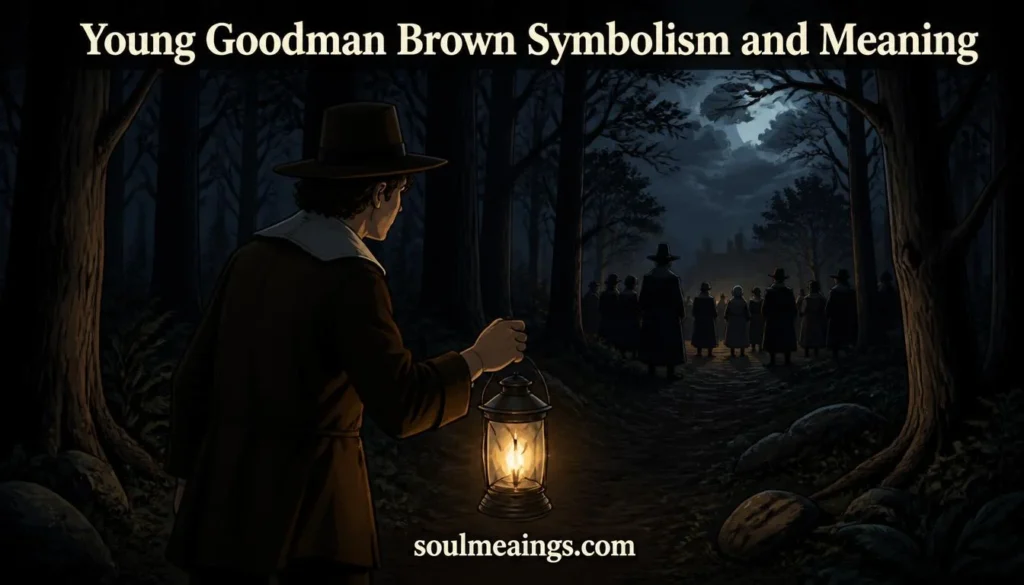
Young Goodman Brown Symbolism and Meaning explores how Nathaniel Hawthorne uses symbols to reveal the struggles between faith, morality, and human nature.
Nathaniel Hawthorne’s Young Goodman Brown, published in 1835, is an important American short story known for its rich symbolism, allegory, and psychological insight. The story follows a Puritan man into a dark forest, where temptation and mysterious events challenge his religious beliefs.
Through good and evil, innocence and corruption, and faith and doubt, Hawthorne examines hypocrisy, sin, guilt, and human behavior. Its forest imagery, characters, and spiritual symbolism reveal the conflict between Puritan values and human imperfection.
These literary themes remain relevant to modern life, encouraging readers to question trust, morality, and the nature of human relationships.
Quick Answer
Young Goodman Brown symbolism mainly represents the loss of innocence, spiritual doubt, and fear of hidden evil in American society. In the United States, the story is often understood as a warning about suspicion, religious extremism, and the dangers of losing trust in humanity. More broadly, its symbols explore temptation, guilt, and the struggle between public morality and private truth.
TL;DR
• The forest symbolizes temptation and moral confusion.
• Faith represents innocence, religion, and emotional trust.
• Pink ribbons symbolize purity mixed with human weakness.
• The story reflects early American Puritan anxieties.
• Modern readers see themes of hypocrisy and paranoia.
• Its meaning shifts between spiritual and psychological interpretations.
Overview of Young Goodman Brown Symbolism
The Story’s Central Symbols
The story uses simple objects and places to express deep emotional and spiritual fears. For American readers, these symbols reflect colonial history and ongoing cultural debates about morality and judgment.
Nathaniel Hawthorne built the story around contrasts between light and darkness, innocence and corruption, faith and doubt. Because the symbols overlap, readers often disagree about what truly happened.
• The forest suggests danger outside society.
• Faith symbolizes both religion and Goodman Brown’s wife.
• Darkness represents secrecy, temptation, and fear.
• The nighttime journey reflects inner spiritual struggle.
• The devil appears as a familiar human figure.
• Salem imagery connects to Puritan guilt and suspicion.
Why the Symbolism Still Matters
Today, many Americans connect the story to distrust in institutions and communities. Its themes feel modern because people still question whether appearances hide darker truths.
The story also speaks to personal anxiety. Goodman Brown becomes trapped by suspicion, and that emotional isolation feels familiar to many readers today.
Historical Background and Puritan Roots
Colonial New England Influences
To understand the symbolism, readers need to understand Puritan New England. The Puritans believed human beings were naturally sinful and constantly tempted by evil. That worldview shaped early American culture and literature.
Hawthorne came from a family connected to the Salem witch trials. One of his ancestors served as a judge during the trials. Because of this family history, Hawthorne often explored guilt, judgment, and religious fear.
Puritan Symbolism in the Story
Puritan communities emphasized strict morality and public behavior. However, Hawthorne questioned whether outward goodness truly reflected inner character.
• Public piety often masked private sin.
• The devil was viewed as an active spiritual force.
• Forests symbolized wilderness and moral danger.
• Religious doubt carried social consequences.
• Community reputation shaped personal identity.
Ancient and Archetypal Patterns
Although the story is deeply American, its symbolism connects to older traditions. The journey into the forest resembles ancient myths about descending into darkness before gaining knowledge.
Across cultures, forests often symbolize uncertainty and transformation. Likewise, nighttime journeys commonly represent spiritual testing or encounters with hidden truth.
The Symbolism of the Forest
The Forest as a Moral Wilderness
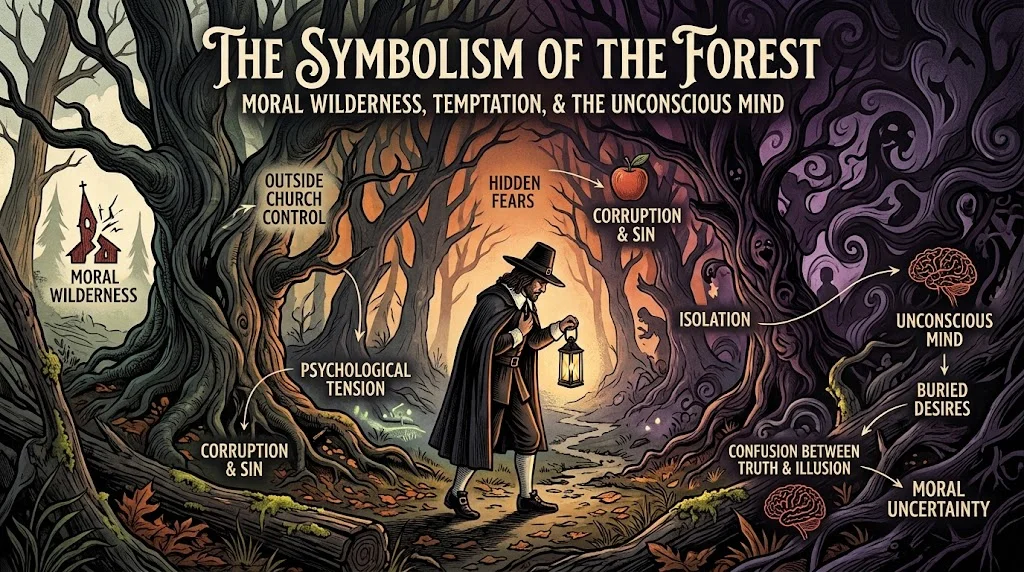
The forest is the story’s strongest symbol. In colonial America, forests were seen as dangerous, uncivilized places outside church control. Hawthorne uses that fear to create psychological tension.
For Goodman Brown, entering the woods means leaving social order behind. The deeper he travels, the more unstable his beliefs become.
Spiritual and Psychological Meanings
The forest can represent actual evil, but many readers also interpret it psychologically. It may symbolize the hidden fears inside Goodman Brown himself.
• Fear of hidden corruption.
• Temptation away from social expectations.
• Isolation from community and faith.
• Confusion between truth and illusion.
• The unconscious mind and buried desires.
• Moral uncertainty and emotional darkness.
Why Americans Connect to This Symbol
American culture often treats wilderness as both dangerous and freeing. From frontier stories to horror films, forests continue to symbolize uncertainty and transformation.
Because of this tradition, modern readers still recognize the forest as a place where identity changes.
The Meaning of Faith and the Pink Ribbons
Faith as a Character and Symbol
Faith is Goodman Brown’s wife, but she also symbolizes religious belief and innocence. Hawthorne intentionally gives her a symbolic name to connect marriage and spirituality.
When Goodman Brown leaves Faith behind, the moment suggests more than physical separation. It represents emotional and spiritual distance from trust itself.
The Pink Ribbons
The pink ribbons are among the story’s most famous symbols. Their soft color combines innocence and human imperfection.
Many readers see pink as a blend of white purity and red passion. Because of that, the ribbons suggest that goodness and weakness exist together.
| Symbol | Meaning in the USA | Common Associations | Notes |
| Faith | Religious belief and trust | Innocence, marriage, morality | Both literal and symbolic |
| Pink ribbons | Fragile innocence | Childhood, purity, vulnerability | Symbolic emotional detail |
| Forest | Moral uncertainty | Fear, wilderness, temptation | Linked to American frontier imagery |
| Darkness | Hidden truth | Sin, secrecy, guilt | Emotional and spiritual tension |
| The devil’s staff | Corrupt power | Serpent imagery, temptation | Biblical symbolism |
Emotional Impact of Faith’s Symbolism
The loss of Faith destroys Goodman Brown emotionally. Even if the nighttime events were only a dream, he can no longer trust other people.
That emotional collapse is central to the story’s meaning. Hawthorne suggests suspicion itself can poison human connection.
Spiritual Meaning in Young Goodman Brown
Temptation and Sin
The story strongly reflects Christian symbolism, especially ideas about temptation and spiritual weakness. Goodman Brown faces a choice between trust and despair.
However, Hawthorne avoids simple moral lessons. Instead, he explores how fear of sin can become destructive.
The Devil Figure
The traveler Goodman Brown meets resembles him physically. Some readers interpret this similarity as symbolic of humanity’s shared sinful nature.
Others believe the devil figure represents inner temptation rather than a literal supernatural being.
• Evil appearing ordinary and familiar.
• Spiritual corruption hiding beneath respectability.
• Fear of human weakness.
• Doubt replacing compassion.
• Judgment becoming emotionally destructive.
Broader Spiritual Interpretations
Outside Christianity, readers often interpret the story as a universal spiritual crisis. The journey reflects the fear of discovering uncomfortable truths about society and oneself.
Today, many readers focus less on theology and more on emotional alienation and moral confusion.
Themes of Hypocrisy and Hidden Evil
Public Goodness Versus Private Darkness
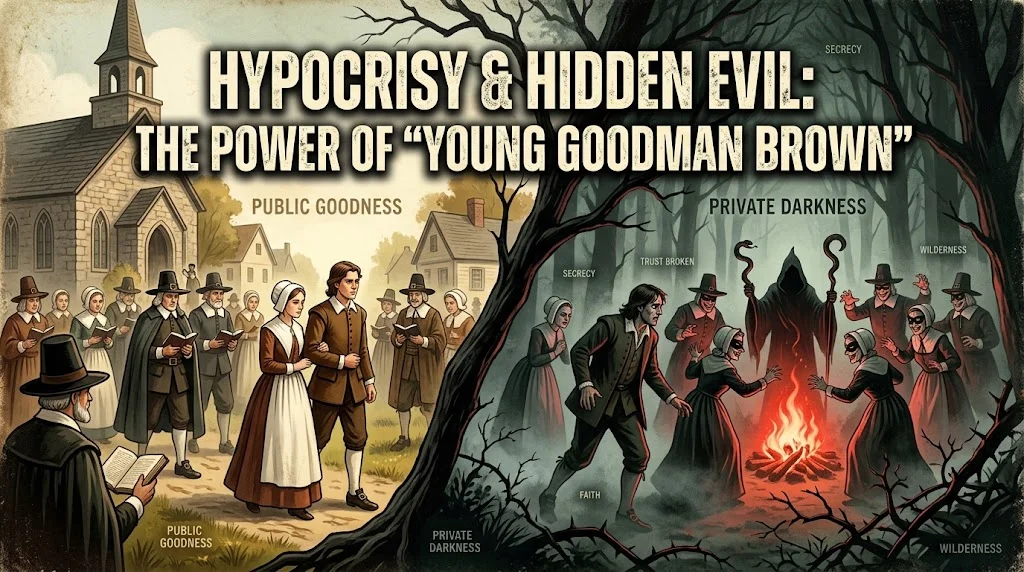
One of the story’s strongest themes involves hypocrisy. Goodman Brown sees respected community members participating in evil rituals. Whether real or imagined, the experience destroys his trust.
For American audiences, this theme remains powerful because scandals and public betrayals still shape cultural conversations.
Fear of Corruption
The story suggests nobody is completely pure. Hawthorne challenges the idea that moral perfection exists in human society.
• Religious leaders may hide flaws.
• Communities can encourage secrecy.
• Fear creates suspicion and isolation.
• Moral judgment often lacks compassion.
• Innocence can disappear quickly.
Modern Relevance
Today, readers often compare the story’s themes to distrust in institutions, politics, and social media culture. The fear that people hide their true selves remains emotionally familiar.
Because of this, the story continues to feel modern despite its colonial setting.
Psychological Meaning and Emotional Symbolism
Fear, Anxiety, and Isolation
Many scholars interpret the story psychologically rather than literally. Goodman Brown may experience paranoia, guilt, or emotional breakdown instead of supernatural events.
This interpretation became especially popular during the twentieth century, when psychology shaped literary analysis in the United States.
The Symbolism of Doubt
Once Goodman Brown doubts humanity, he can never fully reconnect with others. That emotional isolation becomes the story’s real tragedy.
• Suspicion replacing emotional intimacy.
• Anxiety distorting reality.
• Fear destroying community trust.
• Obsession with purity causing loneliness.
• Emotional rigidity leading to despair.
Why Readers Relate Today
Modern readers often connect with feelings of distrust and alienation. In a world filled with misinformation and online conflict, the story’s emotional themes remain highly recognizable.
Young Goodman Brown in American Literature
A Foundation of American Gothic Writing
The story helped shape American Gothic literature. This literary style combines psychological fear, moral tension, and dark settings.
Writers after Hawthorne continued exploring hidden evil beneath ordinary life. Because of that influence, Young Goodman Brown remains important in American literary history.
Common Gothic Elements
• Dark forests and isolated settings.
• Religious anxiety and moral fear.
• Unclear reality versus illusion.
• Emotional guilt and paranoia.
• Hidden corruption beneath normal society.
Influence on Modern Culture
Modern horror films, television, and psychological thrillers still use similar symbolic patterns. Secret communities, moral collapse, and distrust of appearances appear throughout American storytelling today.
Cross-Cultural and Universal Symbolism
Shared Human Themes
Although the story reflects Puritan America, its symbolism connects to universal fears. Many cultures tell stories about temptation, spiritual testing, and journeys into darkness.
Because of this, readers worldwide often recognize the emotional meaning behind the symbols.
Common Cross-Cultural Associations
• Forests representing transformation and uncertainty.
• Night journeys symbolizing spiritual awakening.
• Masks hiding true identity.
• Temptation testing personal values.
• Communities struggling with moral fear.
Differences in Interpretation
However, non-American readers may focus less on Puritan religion and more on psychological or social themes. In contrast, American readers often connect the story directly to colonial history and religious culture.
read more: Summer Solstice Symbolism: Meaning and Significance
Modern Usage and Pop Culture Meaning
Symbolism in Schools and Media
The story remains widely taught in American schools and colleges. Students often discuss its symbolism when exploring themes of trust, religion, and identity.
Online discussions also connect the story to modern fears about conspiracy thinking and public hypocrisy.
Symbolism in Creative Expression
Today, the imagery from the story appears in art, tattoos, and Gothic fashion aesthetics.
• Forest tattoos suggesting personal transformation.
• Pink ribbons symbolizing lost innocence.
• Dark woodland imagery in fashion photography.
• Literary references in horror storytelling.
• Salem imagery linked to mystery and suspicion.
Social Media Interpretations
On social media, readers often debate whether Goodman Brown experienced reality or psychological collapse. That ambiguity helps keep the story culturally relevant.
Misunderstandings and Controversies
Is the Story Anti-Religion?
Some readers believe Hawthorne attacked religion itself. However, many scholars argue the story criticizes fear, hypocrisy, and extremism rather than spirituality.
Hawthorne seemed more interested in emotional damage caused by rigid judgment.
Confusion About the Ending
Readers still debate whether the forest events actually happened. Hawthorne intentionally leaves the answer unclear.
That ambiguity creates multiple interpretations:
• A literal encounter with evil.
• A dream shaped by anxiety.
• A symbolic spiritual crisis.
• A warning against paranoia.
• A critique of moral absolutism.
Changing Interpretations Over Time
Earlier readers often focused on sin and religious morality. Modern audiences tend to emphasize psychology, identity, and emotional distrust instead.
How the Symbolism Changed Over Time
Nineteenth-Century Readings
When the story first appeared, many readers focused on Christian morality and temptation. The religious symbolism felt direct and familiar.
Twentieth-Century Psychological Focus
Later interpretations explored repression, fear, and paranoia. Scholars increasingly viewed Goodman Brown’s journey as psychological rather than supernatural.
Twenty-First-Century Meaning
Today, readers often connect the story to broader social anxieties.
• Distrust in public institutions.
• Fear of hidden corruption.
• Emotional isolation in modern society.
• Conflicts between identity and morality.
• Online culture encouraging suspicion.
Because meanings continue evolving, the story remains widely discussed in American culture.
FAQs
1. What does Young Goodman Brown symbolize?
Young Goodman Brown symbolizes the struggle between faith, doubt, and human nature. His journey reveals how fear and suspicion can change a person’s view of others.
2. What does the forest symbolize in Young Goodman Brown?
The forest symbolizes darkness, temptation, and moral uncertainty. It represents a place where Goodman Brown faces challenges to his religious beliefs.
3. What does Faith symbolize in the story?
Faith, Goodman Brown’s wife, symbolizes religious faith, innocence, and trust. Her character also represents the beliefs Goodman Brown struggles to maintain.
4. What is the main theme of Young Goodman Brown?
The main themes include good and evil, hypocrisy, religious doubt, and the complexity of human nature. Hawthorne questions whether anyone can be entirely innocent or morally perfect.
5. What does the pink ribbon symbolize?
Faith’s pink ribbons symbolize innocence, purity, and goodness. When Goodman Brown sees a ribbon in the forest, it strengthens his doubts about Faith and the people around him.
6. What is the spiritual meaning of Young Goodman Brown?
The spiritual meaning centers on the struggle to maintain faith amid doubt and temptation. The story also warns against judging others without understanding human weakness.
Conclusion
Young Goodman Brown Symbolism and Meaning reveals Nathaniel Hawthorne’s concerns about faith, morality, hypocrisy, and human nature. Through the forest, Faith, the pink ribbons, and the mysterious nighttime journey, Hawthorne shows how suspicion can weaken trust and change a person’s worldview. The story’s Puritan themes reflect early American religious beliefs while raising questions that remain relevant today. Ultimately, its powerful symbolism encourages readers to consider the relationship between innocence, evil, spiritual doubt, and human judgment.

Charlotte Brown is a passionate writer at SoulMeanings.com, dedicated to exploring spirituality, symbolism, dreams, and life’s deeper meanings. Her work helps readers find clarity, inspiration, and personal insight.
Pingback: Lavender Symbolism: Spiritual Meaning, Healing and Calm
Pingback: Yew Symbolism: Spiritual Meaning, Immortality & Protection