
Turtle Symbolism: Meaning and Cultural Insights explores how patience, wisdom, protection, and longevity connect with human life and cultural beliefs.
Turtles are ancient creatures that have lived on Earth for millions of years. Their slow, steady pace, protective shells, and calm movements have captivated humans for thousands of years. Across different cultures, turtles symbolize resilience, emotional strength, stability, and steady progress.
Their ability to live on land and water connects them with balance, nature, adaptability, and survival. Their long lives also represent endurance, persistence, and personal growth. To me, turtles remind us that progress doesn’t always require speed. Sometimes, patience, harmony, and flexibility matter more than rushing toward a goal.
For centuries, turtles have appeared in creation stories, spiritual traditions, Native American folklore, Eastern spirituality, and mythology. Their meanings vary across local traditions, religious beliefs, and cultural symbolism. Turtles also feature in dreams, literature, artwork, and modern tattoos, where they can represent safety, security, self-protection, and personal values.
Today, turtle symbolism inspires personal designs and offers valuable life lessons about protecting what matters, honoring your own pace, and learning from personal experiences. However, turtles don’t hold the same meaning in every culture.
Quick Answer
Turtle symbolism in the United States commonly represents patience, protection, resilience, longevity, and steady progress. In various spiritual traditions, turtles also symbolize the Earth, creation, wisdom, and the connection between land and water.
TL;DR
- Turtles commonly symbolize patience, protection, resilience, and longevity.
- Their shells represent safety, boundaries, and a sense of home.
- Some Indigenous North American traditions connect turtles with creation and the Earth.
- Hindu and East Asian traditions offer distinct meanings involving cosmic support and long life.
- Turtle tattoos often express personal growth, peace, or environmental awareness.
- Modern interpretations emphasize steady progress rather than speed or competition.
What Does a Turtle Symbolize?
Turtles have distinctive physical features that help explain their symbolic appeal. Their protective shells, deliberate movements, and long lives inspire ideas about security, patience, and endurance.
Although the details vary, several meanings appear frequently in modern interpretations. These associations can help explain why turtles remain popular symbols in American culture.
Patience and Steady Progress
A turtle’s slow, deliberate movement makes it a natural symbol of patience. It suggests that meaningful progress doesn’t always require speed.
In everyday American life, this meaning can encourage people to focus on their goals without comparing themselves with others. A turtle reminds us that consistent effort can matter more than quick results.
Protection and Security
A turtle carries its protective shell wherever it goes. Symbolically, this feature represents safety, personal boundaries, and emotional shelter.
For some people, a turtle represents the ability to protect their peace while remaining open to the world. It can also suggest the comfort of having a place where you feel secure.
Longevity and Resilience
Many turtle species live for decades, although lifespans vary widely by species. Their endurance has helped establish turtles as symbols of longevity and persistence.
Consequently, turtle imagery often represents lasting relationships, enduring wisdom, and the ability to withstand difficult circumstances. It can also remind people that growth takes time.
Historical Origins of Turtle Symbolism
Turtle symbolism is much older than modern jewelry, tattoos, or inspirational sayings. Archaeological evidence and traditional stories show that turtles have held cultural importance for thousands of years.
However, not every tradition developed the same beliefs. The turtle’s connection with water, land, shelter, and survival inspired different interpretations in different places.
Ancient Turtle Imagery
Turtles appeared in ancient art and material culture long before modern wildlife symbolism became popular. Their shells and distinctive shapes made them recognizable subjects for artists and craftspeople.
In ancient Greece, turtle and tortoise images appeared on coins. These designs show that turtles held a place in public imagery and everyday exchange, although their precise meanings varied by setting.
In ancient China, turtle shells were used in divination practices. Divination involved seeking guidance or answers through ritual methods, and shell markings became part of certain historical practices.
The Turtle as a Cosmic Symbol
Some ancient traditions used the turtle to explain the structure or origin of the world. Its rounded shell suggested a connection between the sky, the land, and the waters below.
In Hindu tradition, Vishnu’s turtle incarnation, Kurma, supports Mount Mandara in the story of the churning of the cosmic ocean. This story connects the turtle with divine support, stability, and the preservation of cosmic order.
These traditions show how an ordinary animal can become part of a much larger explanation of existence. However, similar images across cultures don’t necessarily mean the traditions share one origin.
Turtle Symbolism in Native American Cultures
Turtles hold important spiritual and cultural meanings for several Indigenous peoples in North America. These traditions are especially relevant to understanding turtle symbolism in the United States, where the animal is connected with creation, land, protection, and community.
However, Indigenous nations have distinct histories and beliefs. Turtle stories should be understood within their specific traditions rather than treated as one shared Native American belief.
The Meaning of Turtle Island
In some Indigenous creation stories, the Earth forms on the back of a great turtle. One well-known account describes Sky Woman falling from the sky world into a vast body of water.
Animals help her reach safety, and earth is gathered and placed on the turtle’s back. The land gradually grows, creating the world where people can live.
This story is associated with the term Turtle Island, which some Indigenous peoples use for North America or parts of their homeland. The turtle represents more than stability in this context. It connects creation, land, responsibility, and the relationship between people and the natural world.
Protection and Sacred Meaning
Turtles also appear in Indigenous art, ceremonial objects, and traditional practices. Their shells can represent protection, while their connection with the land and water gives them additional significance.
For example, Diné traditions recognize the turtle’s shell as a symbol of protection and perseverance. Lakota traditions also connect the turtle with Mother Earth, longevity, and the protection of life.
These meanings aren’t interchangeable across nations. When using turtle imagery inspired by a specific Indigenous tradition, learning about its origins helps preserve its cultural significance.
read more: Stag Beetle Symbolism: Strength and Transformation
Turtle Symbolism in American Culture
In the United States, turtles represent both everyday values and deeper cultural ideas. Their familiar appearance makes them popular in children’s stories, nature education, environmental campaigns, and decorative designs.
At the same time, their meanings can shift depending on the setting. A turtle on a child’s backpack might suggest friendliness, while one in a spiritual artwork may represent protection or connection with the Earth.
Patience in Everyday American Life
American culture often celebrates speed, achievement, and productivity. Against that background, the turtle offers a different message: steady progress has value, even when it isn’t immediately visible.
The familiar fable The Tortoise and the Hare reinforces this lesson. The tortoise wins the race because it continues moving while the hare becomes overconfident and stops making progress.
Today, people may use turtle imagery to express values such as:
- Staying focused on long-term goals instead of chasing quick success.
- Building confidence through small, consistent steps.
- Protecting personal time and maintaining healthy boundaries.
- Choosing a calmer pace during demanding periods.
Turtles and Environmental Awareness
Sea turtles have become recognizable symbols of ocean conservation in the United States. Their presence in coastal communities, wildlife education, and conservation campaigns encourages people to think about marine habitats.
This association is particularly meaningful because several sea turtle species face serious conservation threats. Their symbolism can therefore connect personal admiration with environmental responsibility.
For many Americans, a turtle represents both the beauty of nature and the need to protect it. This meaning extends beyond spirituality into everyday choices about wildlife and the environment.
Spiritual Meaning of Turtles
The spiritual meaning of a turtle often centers on grounding, patience, protection, and the connection between physical life and deeper values. People may interpret a turtle encounter as a personal reminder, although these interpretations aren’t universal facts.
For some, turtles represent a steady spiritual journey rather than a sudden transformation. Their deliberate movements suggest reflection, while their shells evoke the importance of feeling safe and centered.
Turtle as a Spiritual Guide
In contemporary spiritual practices, a turtle may be described as a spirit animal or spiritual guide. People use this language to express qualities they admire or hope to develop.
Common personal interpretations include:
- Grounding: Staying connected to your values and surroundings.
- Patience: Allowing personal growth to happen at a natural pace.
- Protection: Creating boundaries that support emotional well-being.
- Wisdom: Learning from experience instead of reacting too quickly.
- Persistence: Continuing toward meaningful goals through difficult periods.
These are modern spiritual interpretations, not universal rules. The meaning of a turtle depends on the individual and the tradition involved.
What Does It Mean When You See a Turtle?
Some people interpret seeing a turtle as a reminder to slow down or trust their progress. Others simply enjoy the encounter as a meaningful connection with wildlife.
A turtle appearing near your home, on a walk, or during a beach visit doesn’t have one fixed spiritual meaning. You can reflect on what the experience brings to mind without assuming it predicts a particular event.
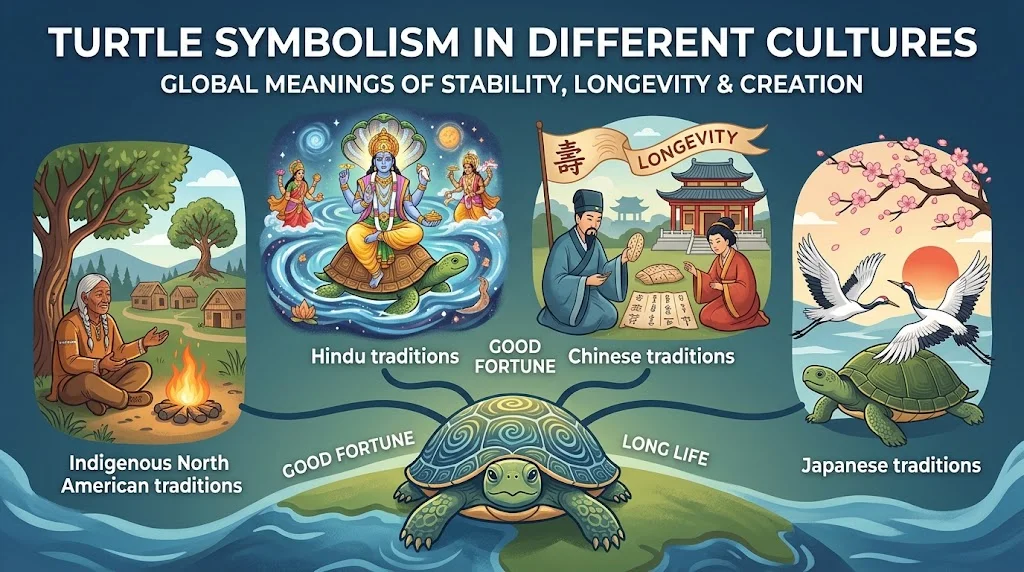
Turtle Symbolism in Different Cultures
Turtles appear in traditions around the world, but their meanings reflect different histories and beliefs. Comparing these interpretations helps explain the animal’s wide cultural influence.
The table below highlights several established associations without suggesting that all cultures understand turtles in the same way.
| Cultural Context | Common Symbolic Meaning | Common Associations | Important Note |
| Indigenous North American traditions | Creation, land, protection | Turtle Island, Earth, community | Beliefs vary by nation |
| Hindu traditions | Cosmic support and preservation | Vishnu’s Kurma incarnation | Rooted in specific religious stories |
| Chinese traditions | Longevity and endurance | Wisdom, divination, stability | Meanings developed over time |
| Japanese traditions | Long life and good fortune | Turtles paired with cranes | Especially visible in art and celebrations |
| Contemporary American spirituality | Patience and resilience | Grounding, boundaries, personal growth | Interpretations vary by individual |
Hindu Turtle Symbolism
In Hindu tradition, Kurma is the turtle incarnation of Vishnu. During the story of the churning of the cosmic ocean, Kurma supports Mount Mandara, which serves as the churning support.
This role connects the turtle with stability and the support needed for a major cosmic process. It also illustrates how turtles can symbolize a foundation that allows transformation to take place.
Chinese and Japanese Turtle Symbolism
In Chinese traditions, turtles and tortoises have long been associated with longevity, endurance, and divination. Their shells also became connected with ideas about the structure of the cosmos.
Japanese art often portrays turtles as symbols of long life and good fortune. They may appear alongside cranes, another traditional symbol of longevity.
These associations remain visible in decorative art and cultural imagery. However, their specific meanings depend on the artwork, historical period, and surrounding symbols.
Emotional and Psychological Meaning of Turtles
Turtles can evoke feelings of calm, safety, independence, and quiet determination. Their appearance and behavior offer familiar images that people use to express emotional experiences.
A turtle’s shell is especially powerful as a metaphor. It suggests a safe space, while the animal’s ability to emerge from that shell’s protection suggests a balance between caution and engagement.
Comfort, Safety, and Boundaries
People sometimes connect turtle imagery with the desire to feel protected. This interpretation can be especially meaningful during periods of change or uncertainty.
A turtle may remind someone that it’s reasonable to take time before responding to a difficult situation. It can also represent the importance of knowing when to step back and when to participate.
Resilience and Self-Acceptance
Turtle symbolism can also challenge the idea that everyone must move at the same speed. Its steady pace offers a simple image of progress without constant comparison.
For someone working toward a personal goal, the turtle may represent persistence rather than perfection. Its meaning can encourage patience with setbacks and respect for individual differences.
These are symbolic associations, not psychological diagnoses or guaranteed effects. Their value comes from the meaning people personally attach to them.
Turtle Tattoos and Their Meanings
Turtle tattoos are popular choices for people who want a design connected with nature, personal growth, or lasting values. Their meaning often depends on the turtle’s species, artistic style, and accompanying details.
Some people choose a turtle to remember a difficult period they’ve overcome. Others use it to express family connections, environmental concerns, or an appreciation for ocean life.
Common Turtle Tattoo Designs
- Sea turtle: Often represents freedom, ocean life, and a connection with nature.
- Small turtle: May symbolize quiet strength, simplicity, or personal milestones.
- Turtle with waves: Can express movement, adaptability, and a love of the sea.
- Turtle with flowers: Often combines resilience with growth and renewal.
- Geometric turtle: May emphasize balance, structure, and harmony.
- Turtle silhouette: Offers a simple reminder of patience or perseverance.
Choosing a Meaningful Design
Before choosing a tattoo, consider what the turtle represents to you. A design based on personal experience may carry a different meaning from one inspired by a traditional cultural story.
If you’re drawn to Indigenous imagery, research the specific nation and design rather than treating sacred symbols as general decoration. This approach supports informed, respectful choices.
Turtle Symbolism in Dreams, Art, and Everyday Objects
Turtles appear in dreams, paintings, jewelry, home decor, and digital communication. In each setting, the surrounding details can influence how people interpret the symbol.
There isn’t one scientifically established meaning for dreaming about a turtle. However, personal reflection can help you explore why the animal stood out to you.
What Does a Turtle Mean in a Dream?
Some popular dream interpretations associate turtles with patience, protection, or slow personal change. A turtle entering its shell might suggest a desire for privacy, while one moving through water could bring thoughts of emotional change.
These are interpretive possibilities, not reliable predictions. Your feelings during the dream and your current circumstances may be more meaningful than a universal dream dictionary.
Turtles in Jewelry and Home Decor
Turtle pendants, sculptures, and decorative objects can express personal values without requiring a spiritual belief. A turtle ornament might remind someone of a favorite beach, a family trip, or a loved one.
In a home, turtle imagery can create a natural, peaceful atmosphere. In jewelry, it can serve as a portable reminder of patience, resilience, or connection with nature.
Misunderstandings and Controversies About Turtle Symbolism
Turtle symbolism is generally associated with positive ideas, but misunderstandings can occur when people overlook cultural context. Popular interpretations don’t always match traditional meanings, and similar designs may carry different significance across communities.
Is Turtle Symbolism Universal?
No. Patience and protection are common modern associations, but not every tradition gives turtles the same meaning.
For example, the turtle’s role in an Indigenous creation story is more specific than a general message about taking life slowly. Reducing that story to a motivational slogan can overlook its connection to land, community, and cultural identity.
Cultural Respect and Environmental Responsibility
Using a turtle image doesn’t automatically mean someone is appropriating a culture. However, copying sacred designs or presenting a specific nation’s beliefs as universal can misrepresent their origins.
It’s also worth remembering that symbolic admiration doesn’t replace real-world care. Wild turtles should be observed responsibly, and people should avoid disturbing nesting sites or removing animals from their natural habitats.
A respectful approach recognizes both the cultural significance of turtles and their importance as living animals.
How Turtle Symbolism Has Changed Over Time
Turtle symbolism has developed through mythology, art, storytelling, religion, and modern media. Although many older associations remain recognizable, people continue to give the animal new meanings.
From Sacred Stories to Everyday Symbols
In ancient and traditional settings, turtles could represent cosmic order, creation, longevity, or spiritual protection. These ideas often appeared in stories, ceremonies, and objects with specific cultural purposes.
Later, turtles also became familiar figures in children’s literature and popular entertainment. The tortoise in The Tortoise and the Hare helped popularize the connection between patience and success.
Modern Interpretations
Today, turtles appear in conservation campaigns, personal tattoos, social media posts, and inspirational artwork. Their meanings often emphasize resilience, peaceful living, and steady personal development.
This shift doesn’t mean older beliefs have disappeared. Instead, traditional meanings and modern personal interpretations continue to exist alongside one another.
FAQs About Turtle Symbolism
1. What does turtle symbolism mean?
Turtle symbolism represents patience, wisdom, protection, longevity, and steady progress. It reminds people to trust their journey and appreciate personal growth.
2. What does a turtle symbolize spiritually?
Spiritually, turtles often symbolize grounding, balance, resilience, and inner wisdom. Their calm movements encourage people to remain patient during life’s challenges.
3. What do turtles represent in different cultures?
Turtles appear in Native American folklore, Eastern spirituality, and various creation stories. Their meanings may include protection, stability, creation, and a connection with nature, depending on the tradition.
4. What does seeing a turtle mean?
Seeing a turtle can remind you to slow down, stay patient, and protect what matters. Its meaning depends on your personal experiences and cultural beliefs.
5. What does a turtle symbolize in dreams?
A turtle in a dream may represent patience, emotional security, resilience, or personal growth. Dream meanings aren’t universal and often depend on your feelings and circumstances.
6. What does a turtle tattoo symbolize?
A turtle tattoo commonly represents longevity, strength, protection, wisdom, and perseverance. Some people choose it as a reminder to live at their own pace and stay true to their values.
Conclusion
Turtle symbolism offers meaningful lessons about patience, protection, wisdom, and resilience. From ancient creation stories to modern tattoos, turtles remind us that growth takes time and everyone’s journey is different. Their cultural and spiritual meanings vary, but their steady nature inspires people to embrace personal growth, protect what matters, and face challenges with patience. Whether you encounter a turtle in nature, a dream, or a piece of art, its symbolism can encourage you to find balance and move forward at your own pace.

Isabella Taylor is a spiritual content creator who shares thoughtful insights on dreams, symbols, and self-discovery. Through her writing at SoulMeanings.com, she inspires readers to find meaning and guidance in everyday life.