
ONG Meaning in Text: Definition, Uses, and Examples explains how this popular abbreviation expresses honesty and emphasizes truth in online conversations.
ONG meaning in text usually stands for “on God.” This popular internet slang appears in text messages, TikTok, social media posts, online chats, and gaming conversations.
Often used by Gen Z, ONG acts as an emphatic marker to express honesty, emphasize truth, or show that a statement is 100% true. It can work like a promise or modern-day oath, depending on the context and the speaker’s tone.
The origin of ONG is linked to informal speech and regional language. Today, this text slang is common across digital platforms. People use it to express sincerity, add emphasis, and strengthen messages during emotional conversations.
Understanding its meaning, uses, and real-life examples helps you interpret ONG correctly and use this popular abbreviation naturally in everyday texting.
Quick Answer: What Does ONG Mean in Text?
ONG stands for “on God.” It’s an informal slang expression people use to emphasize that they’re telling the truth, strongly agree with something, or genuinely mean what they say.
For example:
- “ONG, I didn’t touch your phone.” — Emphasizes honesty.
- “ONG, that test was so hard.” — Expresses strong agreement or frustration.
- “ONG, this song is amazing.” — Emphasizes an opinion.
- “ONG, you actually won?” — Shows surprise or disbelief.
In most casual text conversations, ONG adds emphasis to a statement. It doesn’t automatically mean the person is making a literal religious statement.
What Does ONG Mean in Text?
The abbreviation ONG comes from the phrase “on God.” In everyday digital communication, people use it to reinforce their words, express conviction, or show that they genuinely believe something.
Think of ONG as a way to add extra weight to a sentence. Instead of simply saying, “That movie was great,” someone might write, “ONG, that movie was great.” The abbreviation makes the reaction sound stronger and more personal.
Its meaning can shift slightly depending on the situation.
What Does ONG Stand For?
ONG stands for “on God.” The phrase invokes God as a way to emphasize sincerity or the truthfulness of a statement.
In casual conversations, people may use it to mean:
- I’m telling the truth: “ONG, I left my homework at home.”
- I completely agree: “ONG, that restaurant is incredible.”
- I genuinely believe this: “ONG, this is the best game ever.”
- I’m surprised: “ONG, you met your favorite singer?”
- I’m frustrated: “ONG, why does this keep happening?”
The abbreviation doesn’t have one fixed emotional meaning. A message about a missing wallet may use ONG to stress honesty, while a message about a great concert may use it to express excitement.
Context is the key. Read the surrounding messages to understand whether the person is emphasizing truth, sharing an opinion, or reacting emotionally.
Is ONG Slang or an Acronym?
ONG is informal internet slang and an initialism. An initialism uses the first letters of a phrase, with each letter pronounced separately when spoken as letters.
People usually type ONG rather than writing “on God” in full because abbreviations fit the quick, casual style of texting.
Here are a few related expressions:
- ONG: On God.
- OMG: Oh my God.
- FR: For real.
- FRFR: For real, for real.
- ISTG: I swear to God.
- NGL: Not gonna lie.
These expressions can overlap in meaning, but they aren’t identical. Each has its own tone and common uses.
ONG is best suited to informal conversations. In a professional email, a school assignment, or a formal report, writing a complete sentence usually communicates your meaning more clearly.
How Is ONG Used in Text Messages?
People use ONG in different ways depending on what they want to emphasize. It can make a statement sound more sincere, strengthen agreement, or communicate a strong emotional reaction.
Let’s look at its most common uses.
ONG to Show Honesty
One common use of ONG is to emphasize that a statement is true. Someone may add it when explaining what happened, denying an accusation, or trying to convince a friend that they’re being honest.
For example:
Person A: Did you take my headphones?
Person B: ONG, I didn’t even touch them.
Here, the sender uses ONG to reinforce the denial. They’re asking the other person to take their statement seriously.
Other examples include:
- “ONG, I forgot we had homework.”
- “I left the keys on the table, ONG.”
- “ONG, I’m not making this up.”
- “ONG, that’s exactly what happened.”
Keep in mind that ONG expresses the sender’s claim of sincerity. It doesn’t prove that the claim is true.
ONG to Express Agreement
ONG can also emphasize agreement. Friends often use it when someone says something they strongly relate to or believe is accurate.
For example:
Friend A: Mondays are always exhausting.
Friend B: ONG, especially after a busy weekend.
The second person isn’t necessarily swearing that the statement is true. They’re emphasizing how strongly they agree.
More examples:
- “ONG, that teacher gives so much homework.”
- “ONG, this weather is perfect.”
- “ONG, we need another vacation.”
- “ONG, that was the best part of the movie.”
In these examples, ONG adds enthusiasm and makes the agreement feel more expressive.
ONG to Show Surprise or Excitement
Sometimes ONG appears at the beginning of a message when someone hears unexpected news. It can express excitement, disbelief, or amazement.
Imagine your friend tells you that they won concert tickets.
Friend A: I got two tickets to the concert!
Friend B: ONG, are you serious?
The abbreviation emphasizes the second person’s surprise. The question that follows helps reveal the intended emotion.
Other examples include:
- “ONG, you actually met him?”
- “ONG, we’re going on a road trip?”
- “ONG, that dress looks amazing.”
- “ONG, I can’t believe you did that!”
The same abbreviation can express positive or negative emotions. The surrounding words tell you which one the sender intends.
ONG to Emphasize an Opinion
People also use ONG to make opinions sound stronger. This is especially common when discussing music, movies, food, games, fashion, or everyday experiences.
For example:
“ONG, this song never gets old.”
The sender isn’t simply stating a preference. They’re adding extra emphasis to show how much they enjoy the song.
More examples:
- “ONG, that pizza is worth every penny.”
- “ONG, this game is ridiculously good.”
- “ONG, the ending was unbelievable.”
- “ONG, that was the funniest video I’ve seen all week.”
In these cases, ONG functions like an emphasis marker. It makes the statement sound more energetic without changing its basic meaning.
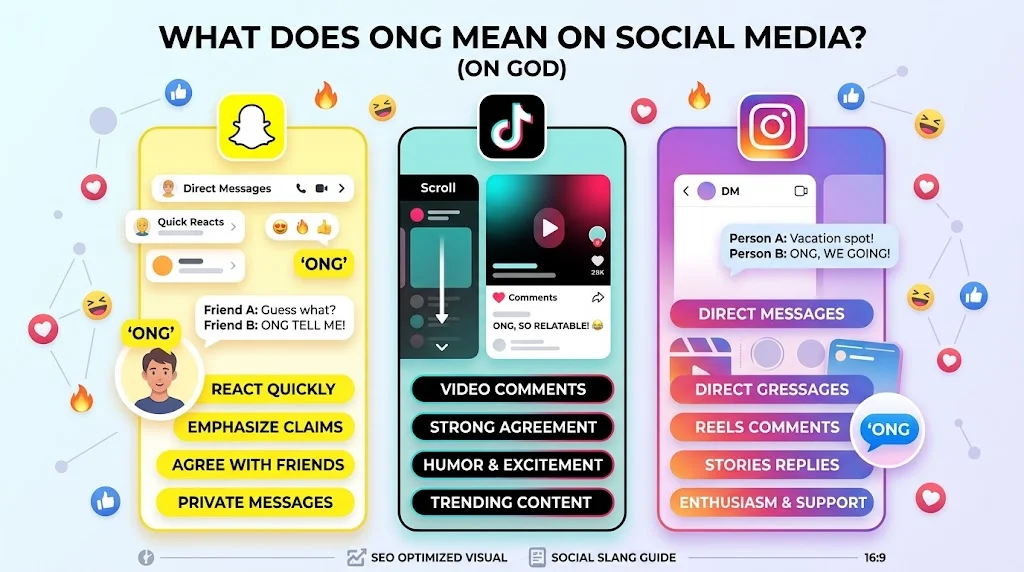
ONG Meaning on Snapchat, TikTok, and Instagram
The meaning of ONG generally stays the same across social platforms, but the setting can influence how people use it. A private message may feel more personal than a public comment, while a short video reaction may focus on humor or excitement.
ONG Meaning on Snapchat
On Snapchat, ONG commonly appears in direct messages, snaps, and conversations between friends. People use it to react quickly, emphasize a claim, or agree with something another person says.
For example:
Friend A: You won’t believe what happened at school today.
Friend B: ONG, tell me everything.
Here, ONG adds excitement and shows that the second friend wants to hear the story.
You might also see messages such as:
- “ONG, that snap is hilarious.”
- “ONG, I sent you the picture already.”
- “ONG, you’re actually coming tonight?”
- “ONG, I thought the event was tomorrow.”
Snapchat messages often rely on shared context. If you’re unsure what someone means, consider the conversation immediately before their message.
ONG Meaning on TikTok
On TikTok, ONG may appear in video comments, replies, captions, and conversations about trending content. People use it to emphasize reactions to funny clips, relatable situations, music, and personal opinions.
For example, someone might comment:
“ONG, this is exactly what happens in my friend group.”
The commenter uses ONG to show strong agreement with the video’s message.
Other examples include:
- “ONG, the plot twist got me.”
- “ONG, this sound is stuck in my head.”
- “ONG, the comments are funnier than the video.”
- “ONG, someone finally said it.”
The abbreviation can help communicate tone in a short comment. However, it doesn’t automatically indicate that someone is being serious. People also use emphatic slang jokingly or dramatically.
ONG Meaning on Instagram
On Instagram, ONG can appear in direct messages, Reels comments, Stories replies, and conversations about photos or posts.
For example:
Person A: Look at this vacation spot!
Person B: ONG, we need to go there.
The reply shows enthusiasm and agreement. The sender likes the destination and wants to visit it.
Other examples include:
- “ONG, these pictures came out so well.”
- “ONG, your outfit looks amazing.”
- “ONG, that Reel made my day.”
- “ONG, I remember this trend.”
As with other platforms, the abbreviation works best when the conversation is casual and both people understand the slang.
ONG Meaning in Gaming and Group Chats
Gaming chats and group messages move quickly, so short expressions can communicate strong reactions without requiring long explanations.
Players might use ONG after an unexpected victory, a frustrating mistake, or a surprising moment during a match.
For example:
Player A: I won with one point of health left.
Player B: ONG, that was too close.
Here, ONG emphasizes disbelief and excitement.
Other examples include:
- “ONG, that comeback was unreal.”
- “ONG, we almost lost that match.”
- “ONG, how did you hit that shot?”
- “ONG, this group chat never gets quiet.”
The abbreviation helps create an informal, expressive tone. Its exact meaning still depends on the situation.
related post: TP Meaning in Text: Full Form, Usage and Examples
ONG Meaning in Different Conversations
The same three letters can communicate different feelings in different relationships. Understanding the sender’s tone and the surrounding conversation helps you avoid misreading the message.
ONG Between Friends
Friends often use ONG to share excitement, emphasize opinions, or make ordinary statements more expressive.
For example:
“ONG, you need to try this restaurant.”
The sender probably thinks the restaurant is excellent and wants their friend to experience it.
A few more examples:
- “ONG, I have so much to tell you.”
- “ONG, we haven’t hung out in forever.”
- “ONG, that joke was terrible.”
- “ONG, you’re going to love this movie.”
Among friends, the abbreviation usually feels relaxed and familiar. However, not everyone uses internet slang, so the wording may confuse someone who hasn’t encountered it before.
ONG in Arguments or Disagreements
During disagreements, ONG can reinforce a claim or show frustration. It may appear when someone feels misunderstood and wants the other person to believe their version of events.
For example:
“ONG, that’s not what I said.”
The sender sounds frustrated and emphasizes that they believe the other person misunderstood them.
Other examples include:
- “ONG, I already explained this.”
- “ONG, you’re missing my point.”
- “ONG, I never agreed to that.”
- “ONG, please listen to what I’m saying.”
Although the abbreviation can add emphasis, it doesn’t settle an argument. If a conversation becomes tense, clear explanations are usually more useful than increasingly emphatic language.
ONG in Flirty or Romantic Texts
In a flirty conversation, ONG can add excitement to a compliment or reaction. However, the abbreviation itself doesn’t indicate romantic interest.
For example:
“ONG, you look amazing in that picture.”
Depending on the relationship, this could be a friendly compliment, playful teasing, or romantic interest. The surrounding messages provide important clues.
Other examples include:
- “ONG, you remembered my favorite song.”
- “ONG, that smile is unfair.”
- “ONG, you’re making me blush.”
- “ONG, that was actually so sweet.”
Don’t assume someone likes you romantically just because they use ONG. Look at the overall conversation and how the person communicates with you.
ONG in Serious Conversations
People sometimes use ONG when discussing something important or trying to reassure someone. It can make a statement sound sincere, but it remains informal slang.
For example:
“ONG, I didn’t tell anyone your secret.”
The sender is emphasizing their denial. Whether you trust the statement depends on the circumstances, not the abbreviation.
In sensitive situations, clearer wording may work better:
- Instead of “ONG, I’m serious,” write “I’m being completely honest with you.”
- Instead of “ONG, I’ll be there,” write “I promise I’ll arrive at 6 p.m.”
- Instead of “ONG, I didn’t do it,” explain what happened directly.
When the stakes are high, clarity matters more than slang.
ONG Examples in Realistic Text Conversations
Short conversations make it easier to see how ONG works in everyday communication. Notice how the surrounding words change its emotional tone.
Casual Conversation
Alex: Have you tried the new burger place?
Jordan: ONG, yes! Their fries are incredible.
Meaning: Jordan uses ONG to emphasize a positive opinion.
Making a Promise or Claim
Mia: Did you send the assignment to the teacher?
Sam: ONG, I sent it last night.
Meaning: Sam uses ONG to reinforce the claim that the assignment was sent.
Reacting to Unexpected News
Taylor: I just found out we’re getting an extra day off.
Chris: ONG, that’s the best news ever!
Meaning: Chris expresses excitement and surprise.
Agreeing With Someone
Riley: That final episode was better than the entire season.
Casey: ONG, the ending was incredible.
Meaning: Casey strongly agrees with Riley’s opinion.
ONG in Social Media Comments
Creator: A video showing a pet stealing food from the kitchen.
Commenter: “ONG, my dog does the exact same thing.”
Meaning: The commenter relates to the video and emphasizes the similarity.
These examples illustrate an important point: ONG doesn’t have to translate into one exact emotion every time. It adds emphasis, while the rest of the message explains what the sender wants to communicate.
ONG vs. OMG: What’s the Difference?
ONG and OMG look similar, but they have different full forms and typical uses.
ONG means “on God,” while OMG means “oh my God.” Both can express strong emotions, but ONG more often emphasizes sincerity or agreement, whereas OMG frequently expresses surprise, excitement, shock, or frustration.
| Feature | ONG | OMG |
| Full form | On God | Oh my God |
| Common purpose | Emphasizing truth or agreement | Expressing surprise or emotion |
| Typical tone | Sincere, emphatic, or assertive | Surprised, excited, shocked, or frustrated |
| Example | “ONG, I’m telling the truth.” | “OMG, I forgot my keys.” |
Consider these two messages:
- “ONG, that restaurant is amazing.” — Emphasizes the strength of the opinion.
- “OMG, that restaurant is amazing!” — Expresses a strong reaction or surprise.
The distinction isn’t absolute. People may use either abbreviation in emotional messages, and their personal texting habits can influence the tone.
Can ONG and OMG Be Used Interchangeably?
Sometimes, but not always.
If someone writes, “OMG, you won the competition!” the abbreviation mainly signals surprise. If they write, “ONG, you really won that competition,” they’re emphasizing the truth or significance of the statement.
In casual conversations, the difference may be subtle. Still, knowing their usual meanings helps you understand the intended tone.
ONG vs. ON GOD: Is There a Difference?
ONG is the shortened form of “on God.” In many texting situations, both expressions communicate the same basic idea.
ONG as an Abbreviation
People type ONG to keep messages short and conversational. It fits naturally into quick replies, comments, and informal group chats.
For example:
“ONG, I didn’t know that.”
The abbreviation emphasizes the sender’s reaction without requiring the full phrase.
Writing “On God” in Full
Writing “on God” spells out the phrase and can make the intended meaning clearer to readers unfamiliar with internet slang.
For example:
“On God, that was the best concert I’ve ever attended.”
The full phrase may place more emphasis on the statement, although the effect depends on the writer’s tone and habits.
When Is the Full Phrase Better?
Spelling out the phrase may be helpful when:
- You’re speaking with someone who doesn’t use internet slang.
- You want to avoid confusion in a longer message.
- The conversation involves a serious claim or important clarification.
- You’re writing something that requires formal language.
Neither form automatically makes a statement more truthful. Both communicate the sender’s intended emphasis.
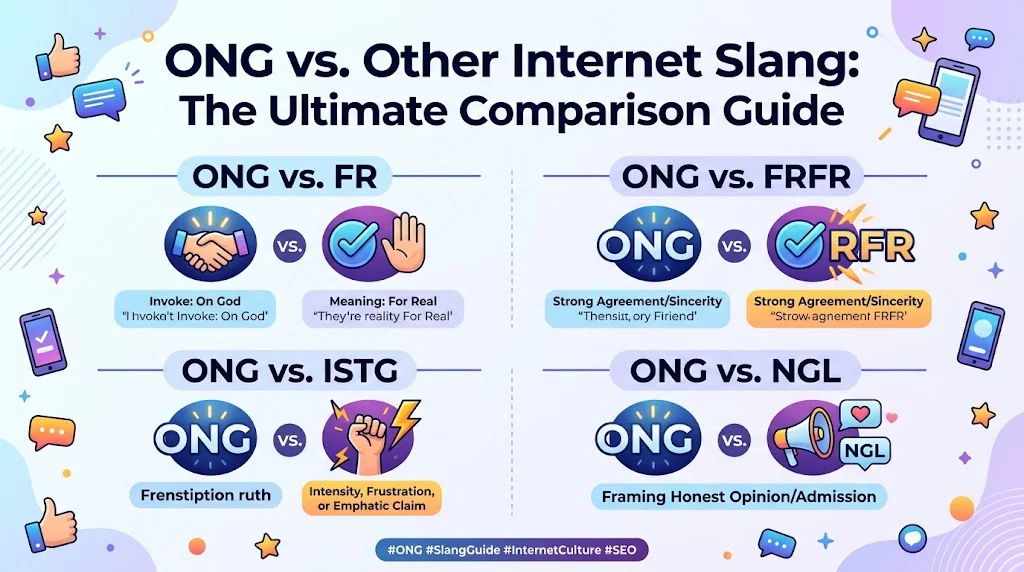
ONG vs. Other Similar Text Slang
ONG belongs to a broader group of internet expressions used to show sincerity, agreement, or emphasis. Understanding the differences helps you choose the right abbreviation and interpret other people’s messages.
ONG vs. FR
FR means “for real.” People use it to express agreement, sincerity, or disbelief.
Examples:
- ONG: “ONG, this food is incredible.”
- FR: “FR, this food is incredible.”
Both can emphasize an opinion. However, ONG invokes the phrase “on God,” while FR more directly means “for real.”
ONG vs. FRFR
FRFR means “for real, for real.” Repeating “for real” adds extra emphasis and can communicate strong agreement or sincerity.
For example:
- ONG: “ONG, I’m not joking.”
- FRFR: “I’m serious, FRFR.”
Both expressions can stress that a statement should be taken seriously. Their tone varies with the conversation.
ONG vs. ISTG
ISTG means “I swear to God.” It’s often used to express frustration, make an emphatic claim, or insist that someone is telling the truth.
For example:
- ONG: “ONG, I left it on the desk.”
- ISTG: “ISTG, I left it on the desk.”
These messages have similar purposes, but ISTG can sound more intense or frustrated. Both expressions invoke God, so some readers may find them religiously sensitive.
ONG vs. NGL
NGL means “not gonna lie.” People use it before sharing an honest opinion, admission, or candid reaction.
For example:
- ONG: “ONG, this is the best song.”
- NGL: “NGL, this is the best song.”
The first emphasizes the statement. The second frames it as a candid opinion.
Here’s a quick comparison:
| Slang | Full form | Main use |
| ONG | On God | Emphasizing sincerity or agreement |
| FR | For real | Agreement, sincerity, or disbelief |
| FRFR | For real, for real | Stronger emphasis |
| ISTG | I swear to God | Emphatic claims or frustration |
| NGL | Not gonna lie | Sharing a candid opinion |
| OMG | Oh my God | Surprise or strong emotion |
These meanings describe common informal usage, not strict rules. People often use slang creatively, and context can change the intended meaning.
How to Reply When Someone Texts ONG
Your response depends on what the person is trying to say. You don’t need to repeat ONG in your reply. A natural response that fits the conversation works just as well.
When You Agree
If someone uses ONG to emphasize an opinion you share, you can respond with:
- “FR!”
- “Exactly!”
- “I know, right?”
- “You’re so right.”
- “That’s what I’m saying!”
Example:
Friend: ONG, this movie is so good.
You: FR! The ending was amazing.
When Someone Makes a Serious Claim
If someone uses ONG to insist that something is true, you can acknowledge their statement or ask for clarification.
Possible replies include:
- “Really?”
- “I hear you.”
- “Okay, I understand.”
- “What happened exactly?”
- “Can you explain what you mean?”
For example:
Friend: ONG, I didn’t know about the plan.
You: Okay, I hear you. Let’s figure out what happened.
Your response should reflect the situation. You can acknowledge what someone says without automatically assuming that the claim is true.
When Someone Expresses Excitement
If ONG appears in an excited message, matching the person’s energy can keep the conversation flowing.
Try replies such as:
- “No way!”
- “That’s awesome!”
- “I’m so happy for you!”
- “That’s actually amazing.”
- “Tell me everything!”
For example:
Friend: ONG, I got the job!
You: That’s awesome! Congratulations!
When You Don’t Understand ONG
There’s nothing wrong with asking someone what an abbreviation means. People have different texting habits, and slang can vary across social groups.
You can simply say:
- “What does ONG mean?”
- “Wait, what do you mean by ONG?”
- “Is that short for something?”
Most misunderstandings disappear once the person explains what they intended.
related post: TGIF Meaning in Text: What It Means and How to Use It
Is ONG Appropriate to Use?
ONG is generally suitable for informal communication, but it isn’t appropriate for every audience or situation. The phrase’s religious association also matters to some people.
When ONG Works Well
ONG can fit naturally into:
- Text messages between friends.
- Casual conversations with family members who understand the slang.
- Social media comments and replies.
- Gaming chats and informal group messages.
- Conversations where you want to emphasize an opinion or reaction.
For example, “ONG, that was hilarious” sounds natural in a casual chat about a funny video.
When to Avoid ONG
Consider using complete sentences instead when communicating in:
- Professional emails and workplace messages.
- Academic assignments or formal reports.
- Official requests and business correspondence.
- Sensitive discussions involving trust or conflict.
- Conversations with people who may misunderstand the abbreviation.
For example, instead of writing, “ONG, I’ll finish the report today,” write, “I’ll finish the report by the end of today.”
The second version is clearer and more professional.
Does ONG Have a Religious Meaning?
Yes, the phrase “on God” has a religious association because it invokes God to emphasize a statement. In casual internet slang, however, people may use it as an expression of sincerity without intending a detailed religious statement.
People interpret the phrase differently. Some treat it as ordinary slang, while others consider invoking God casually inappropriate or disrespectful.
If you aren’t sure how someone feels about the expression, choose wording that respects their preferences. You can also communicate sincerity without using religious language.
Common Misunderstandings About ONG
Although ONG is a short abbreviation, readers can misunderstand it when they focus on the letters instead of the surrounding conversation.
Here are some common mistakes to avoid:
- Assuming ONG always means surprise: It can express agreement, sincerity, frustration, or excitement.
- Confusing ONG with OMG: ONG means “on God,” while OMG means “oh my God.”
- Assuming every use is religious: Some people use ONG as casual slang without intending a literal religious statement.
- Treating ONG as proof: The abbreviation emphasizes a claim but doesn’t establish that it’s true.
- Assuming romantic interest: ONG in a compliment doesn’t automatically mean the sender is flirting.
- Expecting everyone to understand it: Slang familiarity varies by age, community, and personal texting habits.
The easiest way to interpret ONG is to read the entire message and consider the relationship between the people communicating.
FAQs About ONG Meaning in Text
1. What does ONG mean in text?
ONG usually means “on God.” People use it in text messages and online conversations to emphasize honesty or show that they are telling the truth.
2. What does ONG mean on TikTok?
On TikTok, ONG is internet slang used in comments, captions, and messages. It adds emphasis to a statement or shows strong agreement with someone.
3. Is ONG the same as ON GOD?
Yes, ONG is a shortened form of “on God.” Both expressions can emphasize truthfulness, sincerity, or strong feelings in casual conversations.
4. Who commonly uses ONG in text messages?
Gen Z and other social media users commonly use ONG in texts, online chats, and gaming conversations. However, its use varies by person and online community.
5. How do you use ONG in a sentence?
You can use ONG to emphasize that you are being honest. For example, “ONG, that movie was amazing!” expresses strong enthusiasm.
6. Is ONG appropriate for formal conversations?
Generally, ONG is informal internet slang best suited to friends, texting, and social media. In professional emails or formal writing, use clear phrases such as “I promise” or “I’m telling the truth.”
Conclusion
Understanding ONG meaning in text helps you follow modern internet conversations with confidence. This popular abbreviation stands for “on God” and is commonly used to express honesty, emphasize truth, and communicate strong feelings. From TikTok and social media posts to everyday text messages, ONG adds emphasis to informal communication. Remember that its meaning depends on the context, so consider the conversation before using it yourself.

Sophia Wilson is a spiritual content writer and researcher at SoulMeanings.com, specializing in dream meanings, symbolism, spiritual insights, and personal growth topics that help readers navigate life’s journey with greater understanding.

Pingback: NT Meaning in Text: What It Means and How to Use It