
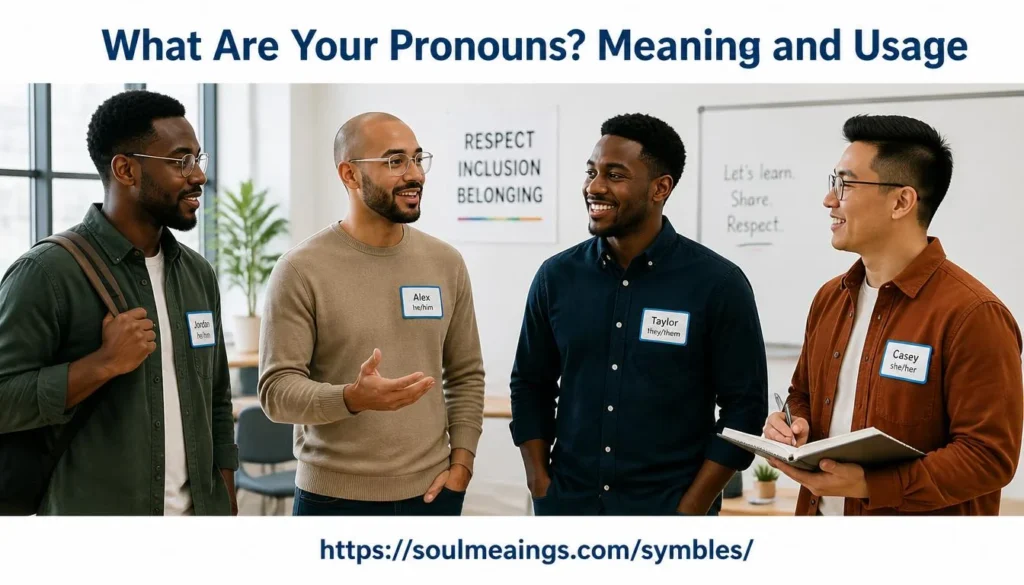
What Are Your Pronouns? Meaning and Usage helps people understand how pronouns work in English and modern communication.
In online and offline settings, a chat, conversation, or phrase may use he, she, or they to refer to someone. In the third person, a singular human may have a gender that seems implied, such as he for a man or boy, or she for a woman or girl.
Yet gender associations based on appearance or names are not always accurate or helpful. Knowing the right words helps users understand how to refer to someone correctly and avoid mistakes. This matters in modern communication, especially across social media, real life, and digital conversations.
From my experience working with language and everyday communication, using words respectfully, clearly, and inclusively can make interactions more thoughtful. People may make assumptions about gender identity or gender expression, but an incorrect assumption about how someone may look or what their appearance suggests does not necessarily demonstrate their identity.
Such assumptions can create a potentially harmful message, so a respectful approach is often better. This guide can help readers learn the full meaning, history, and usage of these terms through simple, easy examples. Language trends continue to change, and even a short bio or search term can benefit from accurate and respectful language.
Quick Answer: What Are Your Pronouns?
“What are your pronouns?” means “Which pronouns should I use when referring to you?”
For example, someone might answer:
- “My pronouns are she/her.”
- “I use he/him pronouns.”
- “I use they/them pronouns.”
- “I use she/they.”
The question usually helps another person know how to refer to you naturally in conversation.
For instance, if Alex uses they/them pronouns, someone might say, “Alex said they will arrive later.” The pronouns replace the person’s name in the sentence.
Cambridge Dictionary similarly explains that personal pronouns can refer to people without repeatedly naming them and gives examples of people sharing pronouns during introductions or in email signatures.
What Is a Pronoun?
A pronoun is a word that takes the place of a noun or noun phrase. Pronouns help English speakers avoid repeating the same name or noun.
Consider this example:
“Jordan went to the store because Jordan needed groceries.”
The sentence sounds repetitive. Using a pronoun makes it smoother:
“Jordan went to the store because they needed groceries.”
Common English pronouns include:
- I
- you
- he
- she
- it
- we
- they
- me
- him
- her
- us
- them
Pronouns also change depending on their grammatical role. Cambridge identifies personal, possessive, reflexive, interrogative, demonstrative, indefinite, and relative pronouns among the major categories.
| Pronoun set | Subject | Object | Possessive | Reflexive |
| She/her | she | her | hers | herself |
| He/him | he | him | his | himself |
| They/them | they | them | theirs | themselves |
| I/me | I | me | mine | myself |
| We/us | we | us | ours | ourselves |
So when someone says “she/her,” they aren’t simply naming one word. They’re commonly giving a short version of the pronoun forms they use.
What Does “My Pronouns Are…” Mean?
When someone says “My pronouns are…”, they’re telling you which pronouns they use when other people refer to them.
For example:
“My name is Taylor. My pronouns are she/her.”
That tells listeners that sentences about Taylor should use forms such as she and her.
You could say:
- “She works here.”
- “I spoke with her yesterday.”
- “That bag belongs to her.”
- “She completed it herself.”
Similarly, someone using he/him might be referred to as:
- “He works here.”
- “I spoke with him yesterday.”
- “That bag belongs to him.”
- “He completed it himself.”
The same principle applies to they/them.
She/Her Pronouns
She/her is one commonly used pronoun set.
Examples include:
- “She joined the meeting.”
- “I called her earlier.”
- “That book is hers.”
- “She prepared it herself.”
He/Him Pronouns
He/him is another common set.
Examples include:
- “He joined the meeting.”
- “I called him earlier.”
- “That book is his.”
- “He prepared it himself.”
They/Them Pronouns
They/them can refer to one person as well as multiple people.
For example:
“Jordan said they would call later.”
Here, they refers to one person named Jordan.
Singular they also appears in ordinary English when someone’s gender isn’t known or isn’t relevant:
“Someone left their umbrella.”
This isn’t a recent grammatical invention. Historical English has used singular they, and modern dictionaries and style resources recognize its established use. Oxford notes that singular they, them, and their are generally acceptable when referring to a singular person.
Why Do People Ask “What Are Your Pronouns?”
There isn’t just one reason someone might ask. Context matters.
The question can help people:
- Avoid making assumptions about how someone should be referred to.
- Communicate clearly during introductions.
- Establish pronoun usage in a group.
- Make online profiles easier to understand.
- Reduce confusion when someone’s name doesn’t reveal their pronouns.
- Know how someone wants to be referred to in conversation.
For example, imagine a conference where several people introduce themselves.
One person says:
“I’m Morgan, and I use they/them pronouns.”
That information gives everyone a simple reference point. Nobody needs to guess later.
Is Asking Someone’s Pronouns Polite?
In many settings, asking can be a straightforward and respectful question. However, tone and context matter.
A casual conversation might make the question feel natural. In another situation, someone may prefer not to discuss personal information.
The best approach is usually simple. Ask without turning the question into an interrogation.
Common Pronouns People May Use
English has several pronoun patterns, and individual usage can vary.
Common examples include:
- she/her
- he/him
- they/them
- she/they
- he/they
- Other pronoun sets used by particular individuals
A useful point often gets lost here: there isn’t a universal rule requiring everyone to use only one pronoun set.
Someone might use more than one set.
Can Someone Use More Than One Pronoun Set?
Yes. Someone may use combinations such as she/they or he/they.
The person can decide how those pronouns should be used. Some people use multiple sets interchangeably. Others may have preferences about when each set appears.
When you’re unsure, the simplest solution is to ask rather than guess.
How to Answer “What Are Your Pronouns?”
There’s no need to give a long speech.
A direct answer works well:
- “I use she/her.”
- “My pronouns are he/him.”
- “I use they/them.”
- “I use she/they.”
If you don’t want to share, you can respond politely without explaining your private reasons.
For example:
“I’d rather not share.”
Or:
“I usually just go by my name.”
If you’re still figuring out what feels comfortable, you can say that too.
The important point is that there isn’t one required script for answering.
How to Ask Someone About Their Pronouns
The most direct wording is:
“What are your pronouns?”
You can also say:
“What pronouns do you use?”
Other possibilities include:
- “Which pronouns should I use for you?”
- “How would you like me to refer to you?”
- “What pronouns do you use?”
In some introductions, sharing your own pronouns first can make the exchange feel less like you’re singling someone out.
For example:
“I’m Sam. I use he/him. What about you?”
The key is to keep the interaction natural.
How to Use Pronouns Correctly in a Sentence
Knowing the pronoun set isn’t enough. You also need to understand how each form works grammatically.
Subject Pronouns
Subject pronouns perform the action.
- She called me.
- He arrived early.
- They finished the project.
Object Pronouns
Object pronouns receive the action.
- I called her.
- We invited him.
- I spoke with them.
Possessive Pronouns
Possessive forms indicate ownership.
- The notebook is hers.
- The coat is his.
- The decision was theirs.
Reflexive Pronouns
Reflexive pronouns refer back to the subject.
- She made it herself.
- He fixed it himself.
- They organized it themselves.
A simple way to remember this is to think of pronouns as different grammatical tools in the same toolbox. The correct tool depends on the sentence.
“What Are Your Pronouns?” in Texting and Social Media
The phrase appears frequently in digital communication.
You may see pronouns listed in:
- Social media profiles
- Messaging profiles
- Online communities
- Professional profiles
- Email signatures
- Virtual meeting introductions
- Community directories
A profile might simply display:
Taylor — she/her
or:
Jordan — they/them
This format gives readers quick information without requiring a separate conversation.
What Does It Mean When Someone Lists Pronouns in Their Bio?
A pronoun listing tells other people which pronouns the person uses when referring to themselves.
The slash format is simply a compact presentation.
For example:
she/her
shows two common grammatical forms.
Likewise:
he/him
and:
they/them
provide quick reference points for others.
related posts: Demure Meaning Slang: What It Means in Text
Is “What Are Your Pronouns?” Asking About Gender?
This question can relate to gender, but pronouns and gender aren’t the same thing.
Grammatically, a pronoun is simply a word that can stand in for a noun or noun phrase. In personal communication, however, someone’s pronoun usage can communicate how they want others to refer to them.
That distinction matters.
Knowing someone’s pronouns doesn’t automatically tell you everything about their identity, background, personality, or personal experiences.
Think of pronouns as one piece of information rather than an entire biography.
Common Misunderstandings About Pronouns
Several misconceptions can make this subject more confusing than it needs to be.
“Pronouns Are the Same as Someone’s Name”
They aren’t.
A name identifies a person directly. A pronoun lets you refer to that person without repeatedly using their name.
For example:
“Morgan said Morgan would bring Morgan’s notebook.”
Natural English would usually replace the repeated references with pronouns.
“Everyone Uses Only One Pronoun Set”
Not necessarily.
Some people use multiple pronoun sets, such as she/they or he/they.
Individual usage can differ.
“They Always Means More Than One Person”
Not always.
Singular they is a recognized English construction.
For example:
“Someone called, but they didn’t leave a message.”
The word they can refer to one unidentified person.
“Pronouns Tell You Everything About Someone”
They don’t.
Pronouns tell you how someone wants to be referred to in language. They aren’t a complete description of someone’s identity.
“Asking About Pronouns Requires a Long Explanation”
Usually, it doesn’t.
A person can simply answer:
“I use they/them.”
The conversation can then continue normally.
What If You Use the Wrong Pronoun?
Mistakes happen, especially when you’re learning someone’s pronouns or changing an old habit.
The most useful response is usually brief correction followed by better usage.
For example:
“She—sorry, they—will join us later.”
Then continue the conversation.
There’s generally no need to create a long discussion around a small mistake. A quick correction keeps the interaction moving.
Instead, focus on getting it right next time.
A Simple Example of Correcting Yourself
Person A: “Did Morgan send the file?”
Person B: “He—sorry, they—sent it this morning.”
Person A: “Thanks. I’ll check it.”
The correction is quick. The conversation moves forward.
Pronouns in the Workplace, School, and Introductions
The phrase “What are your pronouns?” can appear in many settings.
| Setting | How pronouns may appear | Example |
| Workplace | Introductions or profiles | “I’m Alex. I use they/them.” |
| School | Classroom introductions | “My pronouns are she/her.” |
| Conferences | Networking introductions | Name plus pronouns |
| Online groups | Profile information | Pronouns beside a username |
| Signature information | Name followed by pronouns |
The purpose isn’t necessarily identical in every setting. In each case, the practical function remains similar: it gives others information about how to refer to the person.
Natural Ways to Ask About Pronouns
Different situations call for slightly different wording.
| Phrase | Tone | Typical use |
| “What are your pronouns?” | Direct | General conversation |
| “What pronouns do you use?” | Natural | Casual or professional |
| “Which pronouns should I use for you?” | Clear | When clarification matters |
| “How should I refer to you?” | Broader | When you’re unsure |
| “I use she/her. What about you?” | Conversational | Mutual introductions |
“What are your pronouns?” remains one of the clearest options because it gets directly to the point.
What Does “Preferred Pronouns” Mean?
You may also encounter the phrase “preferred pronouns.”
It generally means the pronouns someone wants others to use when referring to them.
However, some people prefer the shorter phrase “pronouns” rather than “preferred pronouns.” The reason is subtle but important: calling them a “preference” can sometimes make pronoun usage sound like a casual option rather than information about how someone wants to be referred to.
For that reason, you’ll often see wording such as:
- “What are your pronouns?”
- “What pronouns do you use?”
- “My pronouns are…”
The exact wording can vary by person, organization, or community.
Can Pronoun Usage Change Over Time?
Yes. A person’s pronoun usage may change.
Someone might use one set of pronouns at one point and later ask others to use a different set. They might also begin using more than one set.
If someone tells you that their pronouns have changed, the practical response is straightforward: use the updated pronouns going forward.
You don’t need to treat the change as a mystery to solve.
Real-Life Examples of “What Are Your Pronouns?”
First Introduction
Alex: “Hi, I’m Alex. I use they/them.”
Jordan: “Nice to meet you. I’m Jordan. I use he/him.”
This exchange establishes both people’s pronouns naturally.
Workplace Introduction
Manager: “Let’s go around and introduce ourselves. Name, role, and pronouns if you’d like.”
Taylor: “I’m Taylor. I’m the project coordinator, and I use she/her.”
This approach gives people room to participate without making the introduction unnecessarily long.
Online Conversation
Person A: “Hey! What are your pronouns?”
Person B: “I use they/them.”
Person A: “Thanks!”
Again, nothing complicated is required.
When Someone Doesn’t Want to Share
Person A: “What pronouns do you use?”
Person B: “I’d rather not say.”
Person A: “No problem.”
The exchange can end there.
What Should You Say After Someone Tells You Their Pronouns?
Usually, very little.
You can simply acknowledge the information and continue talking.
Good responses include:
- “Thanks for letting me know.”
- “Got it.”
- “Thanks.”
- Or no special response at all if the conversation naturally continues.
You don’t need to ask personal questions simply because someone shared their pronouns.
Most importantly, use the information correctly afterward.
Why Pronoun Questions Matter in Modern Communication
At first glance, “What are your pronouns?” looks like a tiny language question. Yet it sits at the intersection of grammar, identity, communication, and social etiquette.
The grammatical foundation remains simple. Pronouns replace nouns and help sentences flow naturally.
The social practice adds another layer. When someone shares their pronouns, they’re giving others useful information about how they want to be referred to.
That makes the phrase practical rather than mysterious.
Whether you encounter it in a classroom, workplace, social profile, or casual introduction, the meaning is usually straightforward: the person is asking which pronouns to use when referring to you.
The easiest response is often the simplest one. Share your pronouns if you’re comfortable doing so, listen when someone shares theirs, and use the information naturally.
FAQs
1. What are pronouns?
Pronouns are words such as he, she, and they used to refer to a person without repeating their name.
2. Why do pronouns matter?
Using someone’s pronouns correctly can support respectful, clear, and inclusive communication.
3. What does “What Are Your Pronouns?” mean?
“What Are Your Pronouns?” asks how someone prefers to be referred to in conversation and written communication.
4. Can you know someone’s pronouns from their appearance?
Not always. A person’s appearance, name, or gender expression may not accurately show which pronouns they use.
5. Why is “they” sometimes used for one person?
They can be used as a singular pronoun when a person’s gender is unknown, unspecified, or when that person uses they/them pronouns.
6. How can I avoid pronoun mistakes?
When you’re unsure, use the person’s name or politely ask which pronouns they use. This can help avoid incorrect assumptions.
Conclusion
Understanding pronouns is an important part of clear and respectful English communication. Words such as he, she, and they help us refer to people in everyday conversation, chat, writing, and other forms of modern communication. However, we should not assume someone’s pronouns from their appearance, name, or gender expression. A person’s gender identity may not be obvious from the way they look, and making an incorrect assumption can sometimes create an uncomfortable or potentially harmful message.
Learning the meaning, history, and usage of pronouns can make communication easier in both online and offline settings. Whether you’re writing a bio, using social media, speaking with someone in real life, or searching for the right term, choosing words carefully shows consideration. When you’re unsure, asking respectfully is often the simplest approach. It can help people communicate clearly, avoid mistakes, and build more inclusive and respectful conversations. With a little understanding and practice, anyone can use pronouns more thoughtfully and confidently.

Sophia Wilson is a spiritual content writer and researcher at SoulMeanings.com, specializing in dream meanings, symbolism, spiritual insights, and personal growth topics that help readers navigate life’s journey with greater understanding.