
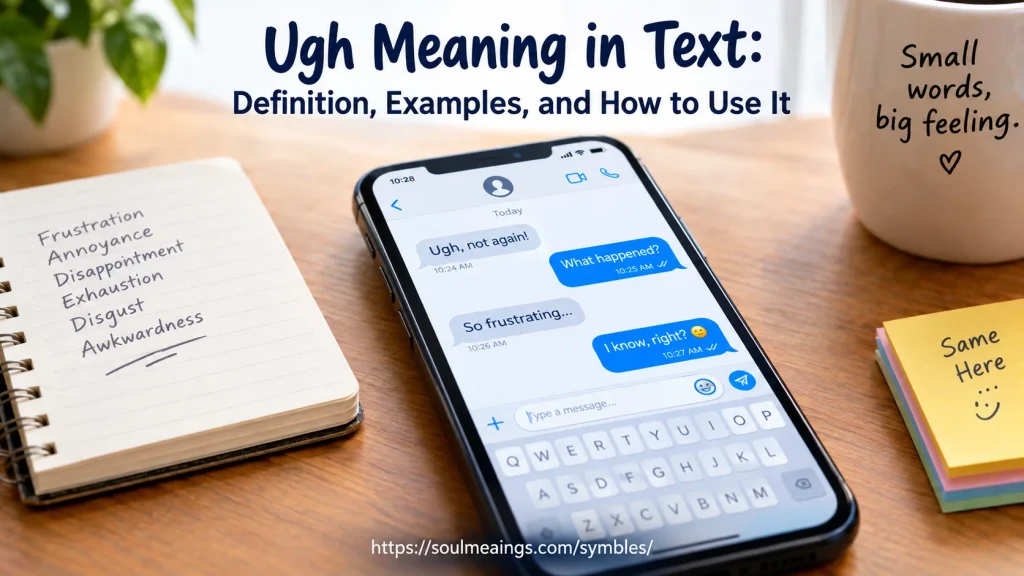

Ugh Meaning in Text: Definition, Examples, and How to Use It explains how people use this simple word to express emotions in messages and online chats.
“Ugh” is a common interjection and emotional reaction rather than a complete sentence with a literal meaning. Depending on the context, tone, and situation, it can express frustration, annoyance, tiredness, disappointment, boredom, irritation, exhaustion, embarrassment, or mild disgust.
For example, after a long day, someone might write, “Ugh, not again!” in a text message, comment, or social media post to show that something went wrong. It can also express playful drama or playful exasperation.
When a friend texts, “I have to work tomorrow,” replying “ugh” may show they’re unhappy. However, after a funny-but-painful story, the same word might express sympathetic frustration. To understand what ugh means in text, consider the conversation, punctuation, emojis, and your relationship with the sender.
People commonly use it in chats and comments on WhatsApp, Instagram, TikTok, and Snapchat. Understanding what it really means and how people use it helps you read messages correctly and reply naturally.
Quick Answer: What Does Ugh Mean in Text?
Ugh is an informal expression people use in texting to show frustration, annoyance, disappointment, exhaustion, or disgust. Its meaning depends on the conversation, so it doesn’t always mean someone is angry with you.
For example:
- “Ugh, not again!” — Frustration about something happening repeatedly.
- “Ugh, I’m so tired.” — Exhaustion or feeling overwhelmed.
- “Ugh, that’s disgusting.” — Disgust or strong dislike.
- “Ugh, I miss you.” — Emotional longing, sometimes expressed playfully.
- “Ugh 😂” — Often playful frustration or an exaggerated reaction.
related post: BWC Meaning in Text: Definition, Slang, and Examples
What Does Ugh Mean in Text?
In texting, ugh is an interjection that communicates a feeling or reaction. An interjection is a word or sound people use to express an emotion, such as surprise, excitement, pain, or frustration.
People often type “ugh” when something bothers them and they want to express that feeling quickly. Instead of writing, “I’m frustrated because my plans changed again,” someone might simply text, “Ugh, seriously?”
Unlike many texting abbreviations, ugh isn’t usually an acronym. It doesn’t stand for a longer phrase. It’s a written representation of an emotional sound people make in everyday speech.
The expression can communicate several feelings, including:
- Frustration: Something isn’t working as expected.
- Annoyance: A person or situation is irritating.
- Disappointment: Something didn’t turn out as hoped.
- Exhaustion: Someone feels tired or overwhelmed.
- Disgust: Something seems unpleasant.
- Awkwardness: A situation feels uncomfortable or embarrassing.
The word itself doesn’t identify the exact emotion. You need to consider what happened before the message and what the person says afterward.
Is Ugh a Word or an Expression?
Yes, ugh is an established English interjection. People use it in spoken conversations and informal writing to express an emotional reaction.
In speech, it may sound like a groan. In text messages, it serves a similar purpose by showing how someone feels without requiring a complete sentence.
For example:
- “Ugh, my phone died.” — Frustration about an inconvenience.
- “Ugh, that smell!” — Disgust or dislike.
- “Ugh, I can’t believe I said that.” — Embarrassment or regret.
Writers may spell it as “ughhh” or “ughhhh” to stretch the sound and emphasize their feelings. These spellings are informal variations rather than separate words with fixed definitions.
What Does Ugh Mean in Different Situations?
The meaning of ugh in text messages changes with the situation. One person might use it to complain about a difficult day, while another might use it to react to something unpleasant.
Here are six common interpretations.
Ugh Meaning: Frustration
Frustration occurs when something goes wrong, takes too long, or prevents someone from reaching a goal.
Examples:
- “Ugh, my laptop froze again.”
- “Ugh, the website won’t load.”
- “Ugh, I missed the bus.”
In these situations, the person is probably reacting to an inconvenience. Their frustration might have nothing to do with the person receiving the message.
Ugh Meaning: Annoyance
Someone might type “ugh” when another person repeatedly does something irritating.
Examples:
- “Ugh, he keeps interrupting me.”
- “Ugh, my brother borrowed my charger again.”
- “Ugh, she’s asking the same question again.”
Here, the expression signals irritation. However, it doesn’t automatically mean the person feels intense anger or dislikes someone entirely.
Ugh Meaning: Disappointment
People also use “ugh” when reality doesn’t match their expectations.
Examples:
- “Ugh, the concert got canceled.”
- “Ugh, I didn’t get the job.”
- “Ugh, our plans fell through.”
The expression communicates disappointment without spelling out every emotion. Depending on the conversation, it may also invite sympathy or reassurance.
Ugh Meaning: Exhaustion
When someone feels physically tired or mentally drained, “ugh” can express that weariness.
Examples:
- “Ugh, I’ve been studying all day.”
- “Ugh, I need a vacation.”
- “Ugh, I have so much work left.”
This usage is especially common when people discuss deadlines, schoolwork, busy schedules, or everyday responsibilities.
Ugh Meaning: Disgust
Sometimes, “ugh” expresses a strong negative reaction to something unpleasant.
Examples:
- “Ugh, that food smells terrible.”
- “Ugh, I stepped in something sticky.”
- “Ugh, I can’t look at that picture.”
In these examples, the expression is closer to a groan of disgust than a complaint about inconvenience.
Ugh Meaning: Awkwardness
People may also type “ugh” after an embarrassing or uncomfortable moment.
Examples:
- “Ugh, I waved at someone who wasn’t waving at me.”
- “Ugh, I sent that message to the wrong person.”
- “Ugh, I forgot their name again.”
Here, the word expresses embarrassment, self-consciousness, or a desire to escape the situation.
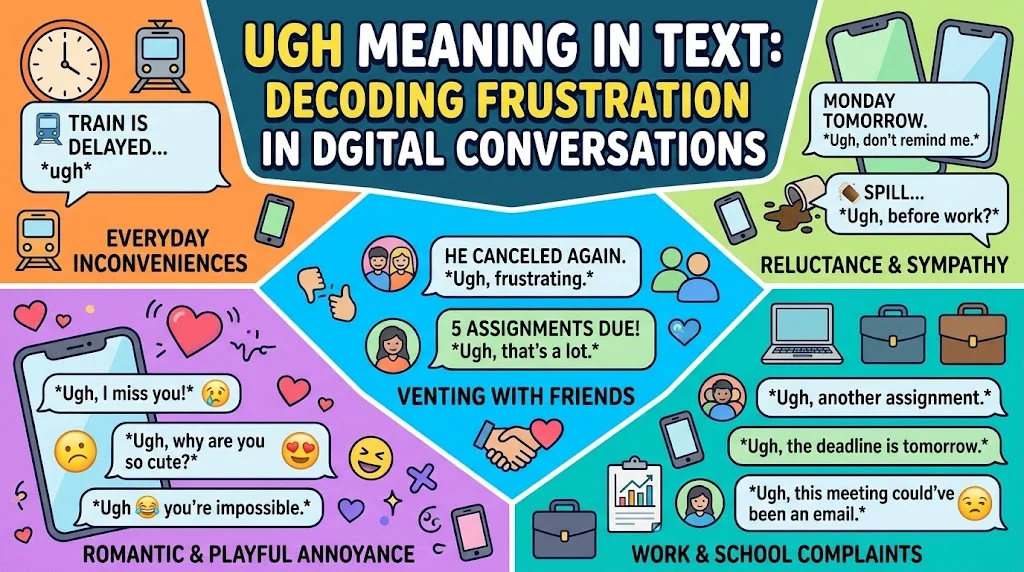
Ugh Meaning in Text With Examples
Looking at real-life-style conversations makes the expression easier to understand. The following examples show how the same word works in different relationships and situations.
Ugh Meaning in Everyday Conversations
People commonly use “ugh” to react to ordinary inconveniences.
Example 1:
Alex: The train is delayed again. Sam: Ugh, that’s so annoying.
Sam uses “ugh” to express frustration about the delay.
Example 2:
Alex: It’s Monday tomorrow. Sam: Ugh, don’t remind me.
Sam sounds reluctant about returning to the weekly routine.
Example 3:
Alex: I spilled coffee on my shirt. Sam: Ugh, right before work?
The response expresses sympathy and recognizes the inconvenience.
Ugh Meaning in Friendships
Friends often use “ugh” while venting, sharing gossip, or discussing frustrating experiences. Because close friends understand each other’s communication styles, the expression may not need much explanation.
For example:
Mia: He canceled our plans for the third time. Jordan: Ugh, that’s frustrating. You must be disappointed.
Here, “ugh” shows sympathy and validates Mia’s feelings.
Another example:
Mia: I have five assignments due this week. Jordan: Ugh, that’s a lot. Want help studying?
In this conversation, the expression acknowledges a stressful situation and opens the door to support.
Ugh Meaning in Romantic Conversations
In romantic conversations, “ugh” can express genuine frustration, affection, longing, or playful annoyance. The surrounding words usually reveal which meaning fits.
Consider these examples:
- “Ugh, I miss you.” — The person may feel sad about being apart.
- “Ugh, why are you so cute?” — Often playful affection.
- “Ugh, you forgot again.” — Likely frustration about repeated behavior.
- “Ugh 😂 you’re impossible.” — May be teasing rather than serious criticism.
Important: Don’t treat “ugh” as proof of romantic interest. Someone might use it affectionately, but the word alone cannot establish attraction or reveal someone’s intentions.
Ugh Meaning in Work or School Chats
Students and coworkers may use “ugh” to complain about deadlines, exams, meetings, or repetitive tasks.
Examples include:
- “Ugh, another assignment.”
- “Ugh, the deadline is tomorrow.”
- “Ugh, this meeting could’ve been an email.”
These messages usually express frustration with the task rather than hostility toward another person.
However, the expression is informal. In a formal email to a manager, teacher, or client, a clearer statement may be more appropriate.
Instead of writing “Ugh, another deadline,” try “I’m concerned about the tight deadline. Can we review the priorities?”
What Does Ugh Mean From a Girl or a Guy?
People sometimes search for gender-specific meanings because they want to understand a particular message. However, ugh generally means the same thing regardless of the sender’s gender.
The situation, relationship, and wording offer better clues than gender alone.
Ugh Meaning From a Girl
When a girl texts “ugh,” she might be expressing frustration, disappointment, exhaustion, disgust, or playful annoyance.
For example:
- “Ugh, my day has been terrible.” — She may want sympathy or a chance to vent.
- “Ugh, he texted me again.” — She might be annoyed or uncomfortable.
- “Ugh, you’re so annoying 😂.” — She could be teasing someone she knows well.
- “Ugh, I wish you were here.” — She may be expressing affection or longing.
Don’t assume every message has a hidden romantic meaning. Read the complete message and consider how she normally communicates.
Ugh Meaning From a Guy
A guy might use “ugh” to express the same range of emotions.
For example:
- “Ugh, I lost the game.” — Disappointment.
- “Ugh, work was exhausting.” — Tiredness.
- “Ugh, I can’t believe I did that.” — Embarrassment.
- “Ugh, you’re too much 😂.” — Potentially playful teasing.
Some people use emotional expressions frequently, while others use them only occasionally. Personal communication habits matter more than gender stereotypes.
Does Ugh Mean Someone Is Mad at You?
Not necessarily. The person might be frustrated with their circumstances rather than with you.
Compare these messages:
| Text message | Possible interpretation |
| “Ugh, traffic is terrible.” | Frustration with traffic |
| “Ugh, I have another exam.” | Stress about school |
| “Ugh, you ignored my message again.” | Frustration directed at you |
| “Ugh, whatever.” | Possible irritation or dismissiveness |
| “Ugh 😂 you’re ridiculous.” | Possibly playful teasing |
If you’re unsure, ask a calm, direct question such as, “Is something bothering you?” This gives the person a chance to explain without making assumptions.
see more: DHZ Meaning in Text: Definition, Slang, and Examples
What Do Different Versions of Ugh Mean?
Small changes in spelling, punctuation, and emojis can affect how a message feels. Still, these differences aren’t strict rules.
| Expression | Common meaning | Example |
| Ugh | General frustration or annoyance | “Ugh, not again.” |
| Ughhh | Drawn-out frustration, sadness, or emphasis | “Ughhh, I’m exhausted.” |
| Ugh! | Strong or emphatic reaction | “Ugh! That’s disgusting.” |
| Ugh… | Disappointment, hesitation, or resignation | “Ugh… I don’t know.” |
| Ugh, whatever | Dismissiveness or irritation | “Ugh, whatever. Do what you want.” |
| Ugh 😩 | Exhaustion or overwhelm | “Ugh 😩 three more hours.” |
| Ugh 🙄 | Exasperation or disbelief | “Ugh 🙄 not this again.” |
| Ugh 😂 | Often humorous or playful frustration | “Ugh 😂 you always do this.” |
What Does Ughhh Mean in Text?
Ughhh is an extended spelling of “ugh.” The extra letters make the reaction feel more drawn out or emotionally intense.
For example, “Ugh, I’m tired” sounds like a straightforward complaint. “Ughhh, I’m so tired” may communicate stronger exhaustion or a more dramatic reaction.
The added letters don’t have a universal meaning. One person may use them for humor, while another uses them to emphasize genuine frustration.
What Does Ugh With an Emoji Mean?
Emojis provide extra clues about the intended tone.
- Ugh 😩: Exhaustion, stress, or feeling overwhelmed.
- Ugh 🙄: Exasperation, impatience, or disbelief.
- Ugh 😂: A humorous complaint or playful annoyance.
- Ugh 😭: Dramatic frustration, sadness, or emotional overwhelm.
- Ugh 😒: Displeasure or irritation.
Interpret the emoji alongside the message rather than treating it as a definitive emotional label.
How Is Ugh Used on Social Media?
The basic meaning of “ugh” remains consistent across platforms. What changes is the context in which people use it.
Ugh Meaning on TikTok
On TikTok, people may use “ugh” in captions, comments, and videos about relatable frustrations.
Examples:
- “Ugh, when your alarm goes off five minutes after you fall asleep.”
- “Ugh, why does this happen every time?”
- “Ugh, I can’t stop watching this.”
The expression can also create an exaggerated, humorous reaction. Its tone depends on the video, caption, and surrounding conversation.
Ugh Meaning on Instagram and Snapchat
On Instagram and Snapchat, “ugh” can appear in story replies, direct messages, captions, and casual reactions.
For example, a friend might post about missing a flight and receive “Ugh, that’s the worst.” Someone might reply “Ugh 😍” to a photo in a playful or affectionate way, depending on their relationship.
The platform doesn’t give the word a separate definition. The message and social context determine its meaning.
Ugh Meaning on WhatsApp and Messenger
On messaging apps such as WhatsApp and Messenger, people commonly use “ugh” while discussing daily problems, canceled plans, or stressful events.
For example:
Taylor: The restaurant is fully booked. Chris: Ugh, seriously? I was looking forward to it.
Chris expresses disappointment about the reservation. The word adds emotional emphasis without requiring a long explanation.
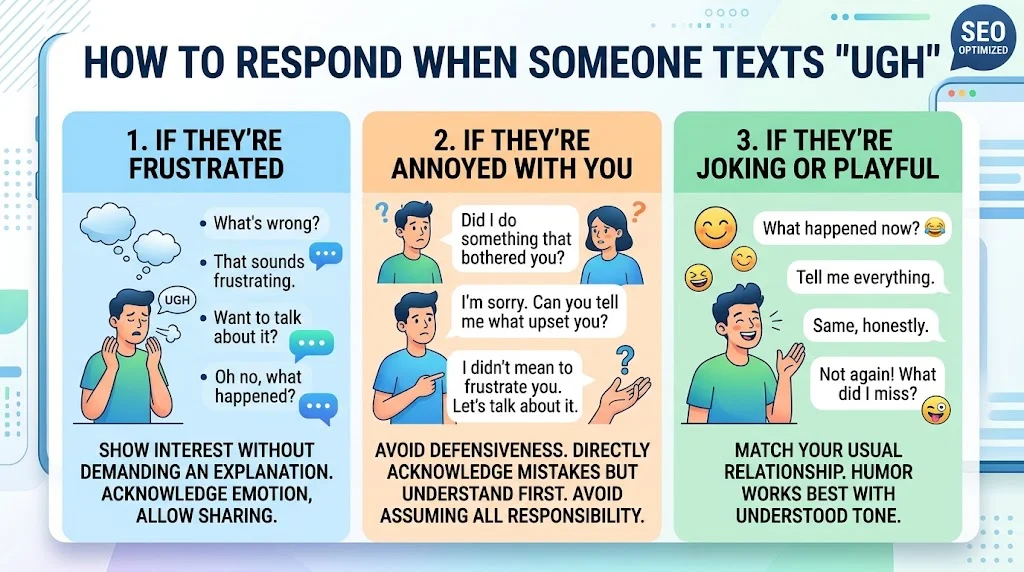
How to Respond When Someone Texts Ugh
The best response depends on whether the person wants support, feels annoyed with you, or is simply joking.
If They’re Frustrated
Show interest without demanding an explanation.
You could reply:
- “What’s wrong?”
- “That sounds frustrating.”
- “Want to talk about it?”
- “Oh no, what happened?”
These responses acknowledge the emotion and allow the person to share more if they want.
If They’re Annoyed With You
If the conversation suggests that you’re the source of frustration, avoid immediately becoming defensive.
Try:
- “Did I do something that bothered you?”
- “I’m sorry. Can you tell me what upset you?”
- “I didn’t mean to frustrate you. Let’s talk about it.”
If you’ve clearly made a mistake, acknowledge it directly. However, don’t assume responsibility for a problem before understanding what happened.
If They’re Joking or Being Playful
A lighthearted response may fit a casual conversation.
Examples include:
- “What happened now? 😂”
- “Tell me everything.”
- “Same, honestly.”
- “Not again! What did I miss?”
Choose a response that matches your usual relationship. Humor works best when both people understand the tone.
Ugh vs. Other Similar Text Expressions
Several texting expressions communicate negative emotions, but each carries a slightly different tone. Understanding these differences can help you choose the right word or interpret someone else’s message.
| Expression | Meaning in text | Example |
| Ugh | Frustration, annoyance, or disgust | “Ugh, I missed the bus.” |
| Ew | Disgust or strong dislike | “Ew, that smells awful.” |
| Sigh | Resignation, disappointment, or tiredness | “Sigh, another long day.” |
| Argh | Strong frustration or anger | “Argh, my computer crashed!” |
| Meh | Indifference or little enthusiasm | “Meh, the movie was okay.” |
| Pfft | Dismissal, disbelief, or amusement | “Pfft, that’s ridiculous.” |
| SMH | Disapproval, disbelief, or disappointment | “SMH, you forgot again.” |
Although these expressions overlap, they aren’t interchangeable in every situation.
For instance, “ew” focuses more directly on disgust, while “ugh” can express frustration about almost anything. Similarly, “meh” suggests a lack of interest rather than a strong emotional reaction.
Is Ugh Rude or Negative?
Ugh usually expresses a negative reaction, but it isn’t automatically rude. Its tone depends on the target of the complaint, the relationship between the people texting, and the words surrounding it.
Consider these situations:
- Harmless: “Ugh, I have so much laundry to do.” The person is complaining about a chore.
- Playful: “Ugh 😂 you’re such a dork.” Friends might use this affectionately.
- Dismissive: “Ugh, whatever.” This can suggest that someone doesn’t want to continue the discussion.
- Potentially hurtful: “Ugh, you’re so annoying.” Depending on the relationship and context, this may sound insulting.
A standalone “ugh” can also confuse the recipient because it doesn’t explain what’s wrong. If someone sends it without additional details, don’t immediately assume they’re upset with you.
In professional settings, it’s usually better to explain the problem directly. Instead of writing “Ugh, this deadline is impossible,” you could say, “I’m concerned about meeting this deadline with the current workload.”
That wording communicates the issue without sounding dismissive.
Read more: IKYFL Meaning in Text: Definition, Uses, and Examples
How to Use Ugh Naturally in a Sentence
Using “ugh” naturally is simple once you understand its tone. It works best in casual conversations where an emotional reaction fits the situation.
Ugh at the Beginning of a Sentence
Placing “ugh” at the beginning emphasizes the feeling behind the rest of the sentence.
Examples:
- “Ugh, I missed the bus.”
- “Ugh, why is it so hot today?”
- “Ugh, I forgot to submit my assignment.”
- “Ugh, this traffic isn’t moving.”
In standard writing, a comma usually separates the interjection from the rest of the sentence.
Ugh as a Standalone Reply
Sometimes, a single word communicates enough.
For example:
Alex: The event has been canceled. Sam: Ugh.
Sam’s reply suggests disappointment or frustration. However, the exact feeling remains unclear without additional context.
A standalone “ugh” can also signal that someone doesn’t feel like explaining their reaction. If you need clarification, a gentle question is usually more helpful than guessing.
Ugh With Emojis
Emojis can make the intended emotion easier to understand.
- “Ugh 😩 I need a break.” — Exhaustion.
- “Ugh 🙄 here we go again.” — Exasperation.
- “Ugh 😂 why does this always happen to me?” — Humorous frustration.
- “Ugh 😭 I miss everyone.” — Emotional longing or sadness.
These combinations are especially useful in informal messages, where readers can’t hear your voice or see your facial expression.
Common Mistakes to Avoid
When using or interpreting “ugh,” keep these points in mind:
- Don’t assume it always means anger.
- Don’t treat it as an acronym with a hidden full form.
- Don’t assume someone is flirting simply because they use it.
- Don’t interpret every short reply as a sign of dislike.
- Avoid using it in formal communication when a clear explanation would be more effective.
The biggest mistake is reading too much into one word. A person’s complete message usually offers more useful clues.
FAQs About Ugh Meaning in Text
1. What does ugh mean in text?
Ugh is an expression people use to show frustration, annoyance, disappointment, boredom, or disgust. Its exact meaning depends on the conversation and tone.
2. Is ugh a bad word?
No, ugh isn’t usually a bad word. It’s a casual expression that shows negative feelings or mild irritation.
3. What does ugh mean from a girl or a guy?
When a girl or guy texts ugh, they might feel annoyed, tired, disappointed, or stressed. Check the context before assuming what they mean.
4. What does ugh mean with emojis?
Ugh 😭 may show dramatic frustration, sadness, or playful disappointment. The emoji helps explain the emotion behind the message.
5. How should I reply when someone texts ugh?
Your reply depends on the situation. You could say “What happened?”, “Same here!”, or “That sounds frustrating.”
6. Can ugh be used in a funny way?
Yes, people often use ugh for humor or playful drama. For example, “Ugh, why am I always hungry?” expresses a relatable feeling in a funny way.
Conclusion
Understanding Ugh Meaning in Text helps you recognize emotions in everyday digital conversations. This short expression can communicate frustration, annoyance, exhaustion, disappointment, or even playful humor. Its meaning often depends on the context, tone, punctuation, and emojis used in a message. Whether you see it on WhatsApp, Instagram, TikTok, or Snapchat, consider the conversation before responding. A simple reply like “What happened?” can keep the conversation going and show that you understand how the other person feels.

Mark Taylor is a content writer at soulmeaings.com. He writes clear, research-based articles on symbolism, spiritual meaning, and cultural interpretation, helping readers understand the ideas behind the symbols they encounter.


Pingback: TM Meaning in Text: What It Means and How to Use It