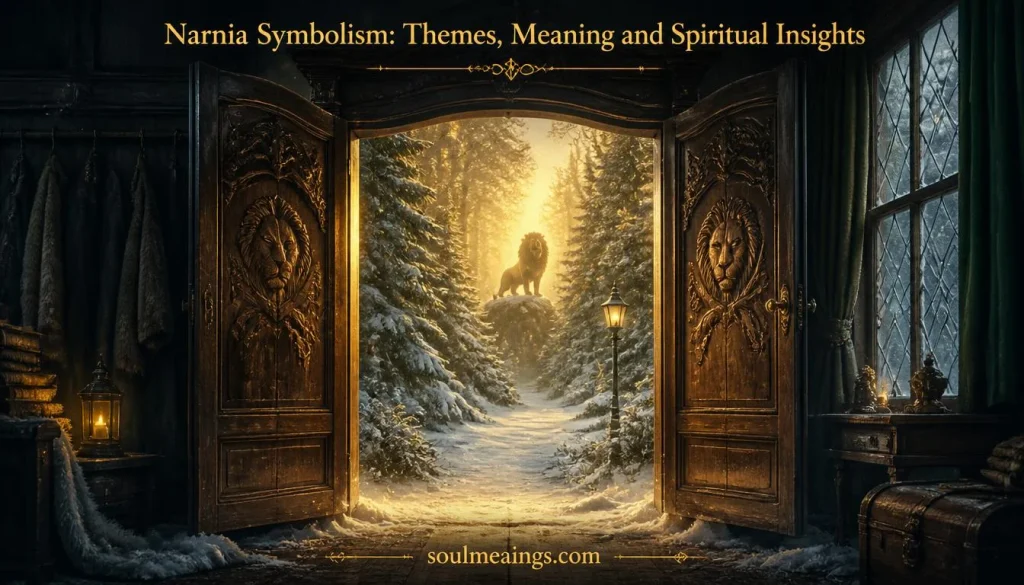
Narnia Symbolism: Themes, Meaning and Spiritual Insights explores how C.S. Lewis uses fantasy to share powerful moral lessons and spiritual insights.
The Chronicles of Narnia, a seven-book series published from 1950 to 1956, combines children’s literature, classic fantasy, Christian allegory, and mythical creatures. Symbols like the wardrobe, lamppost, sea, and stone table represent wonder, adventure, faith, and the journey from ordinary life into a hidden world. Through this magical setting, Lewis explores childhood imagination, courage, and the discovery of deeper truths.
Narnia’s literary symbolism explores good and evil, courage, sacrifice, redemption, and personal growth. Lion Aslan represents hope, bravery, and selflessness, while the White Witch symbolizes temptation, fear, and darkness. The long winter reflects hardship, while light often represents hope and renewal.
Through Christian symbolism, nature symbolism, light and darkness, and seasonal changes, Lewis shares lessons about forgiveness, friendship, loyalty, and wisdom. The characters’ journeys also highlight faith, responsibility, and the importance of making good choices. These timeless themes continue to inspire readers with messages of hope, spiritual growth, and good triumphing over evil.
Quick Answer
Narnia symbolism represents hope, spiritual discovery, courage, sacrifice, redemption, and the victory of good over evil. In the United States, the stories often connect with Christian faith, family values, childhood imagination, and personal transformation. More broadly, Narnia explores how people face temptation, accept responsibility, and find light during difficult times.
TL;DR
• Aslan symbolizes sacrificial love, goodness, authority, and spiritual hope.
• The White Witch represents cruelty, temptation, fear, and oppressive power.
• The wardrobe symbolizes discovery, transition, and the doorway to new possibilities.
• Winter and spring represent despair, hope, renewal, and the return of life.
• Narnia blends Christian themes with ancient mythology and traditional fantasy.
• Its lasting message emphasizes courage, forgiveness, humility, and moral responsibility.
What Does Narnia Symbolize?
Narnia is a fictional world created by British author C. S. Lewis in The Chronicles of Narnia. Its seven novels use magical creatures, extraordinary adventures, and moral conflicts to explore questions about human nature.
For American readers, Narnia often represents the possibility of finding meaning beyond ordinary life. Its fantasy setting makes difficult ideas easier to understand, especially for younger readers.
The Main Symbolic Meanings
Several themes appear throughout the series:
- Hope: Goodness can survive even when circumstances seem hopeless.
- Sacrifice: Genuine love may require courage, generosity, and personal cost.
- Redemption: People can learn from mistakes and become better.
- Freedom: Courage and truth can challenge unjust authority.
- Transformation: Difficult experiences can change a person’s character.
These meanings work together rather than standing alone. For example, Edmund’s betrayal introduces temptation and selfishness, while his later development demonstrates remorse, forgiveness, and the possibility of change.
Narnia also suggests that goodness doesn’t always appear gentle or predictable. Aslan can be comforting, powerful, mysterious, and frightening. This complexity encourages readers to think beyond simple appearances.
The Historical Origins of Narnia Symbolism
Understanding Narnia’s background helps explain its unusual mixture of spiritual themes and ancient fantasy. Lewis began publishing the series in the 1950s, drawing on literary traditions that were much older.
C. S. Lewis and the Birth of Narnia
C. S. Lewis was a British writer, scholar, and Christian thinker. The Lion, the Witch and the Wardrobe appeared in 1950, introducing readers to a magical kingdom hidden beyond an ordinary wardrobe.
Lewis didn’t simply create a direct religious code in which every character represented one fixed idea. Instead, he developed stories from imaginative pictures, mythical creatures, and spiritual convictions.
His background in classical literature helped shape Narnia’s landscape. Greek and Roman mythology, medieval stories, and European folklore all contributed to its atmosphere.
Ancient Mythology and Pre-Christian Roots
Narnia contains creatures whose histories extend far beyond Christianity.
• Fauns: These woodland beings draw from Roman mythology and connect Narnia with nature.
• Centaurs: These half-human, half-horse creatures come from Greek mythology and often suggest wisdom.
• Dryads: These tree spirits reflect ancient ideas about the relationship between nature and the supernatural.
• Satyrs: These mythological beings evoke wildness, celebration, and the untamed natural world.
• Talking animals: These creatures draw on fables and folklore to express moral ideas through stories.
Lewis combined these traditions with Christian themes, creating a world where myth and spirituality interact. Consequently, Narnia symbolizes both a connection to ancient storytelling and a modern search for moral meaning.
Aslan Symbolism: The Lion, Faith, and Sacrifice
Aslan is the central spiritual figure in Narnia. His presence represents goodness, rightful authority, protection, and the possibility of redemption.
For many Christian readers in the United States, Aslan carries strong associations with Jesus Christ. However, his symbolic meaning also reaches readers who appreciate his character without sharing Lewis’s religious beliefs.
Why Is Aslan a Lion?
Lions have long symbolized strength, courage, leadership, and royal authority across many cultures. In Narnia, these associations make Aslan a fitting figure for a powerful yet compassionate king.
His name also means “lion” in Turkish. The name reinforces his identity as a majestic creature rather than an ordinary animal.
Yet Aslan’s strength isn’t his only important quality. His willingness to sacrifice himself reveals a deeper form of power grounded in love and justice.
Aslan as a Symbol of Christian Faith
In The Lion, the Witch and the Wardrobe, Aslan gives his life to save Edmund, who has betrayed his family. He later returns to life, defeating the apparent finality of death.
Many Christians interpret this sequence through the themes of Jesus’s crucifixion and resurrection. The story presents sacrifice, forgiveness, and new life through a fantasy narrative.
Aslan also represents a form of goodness that isn’t always easy to understand. His actions challenge characters to trust what is right, even when they don’t know what will happen next.
The White Witch Symbolism: Evil, Fear, and Temptation
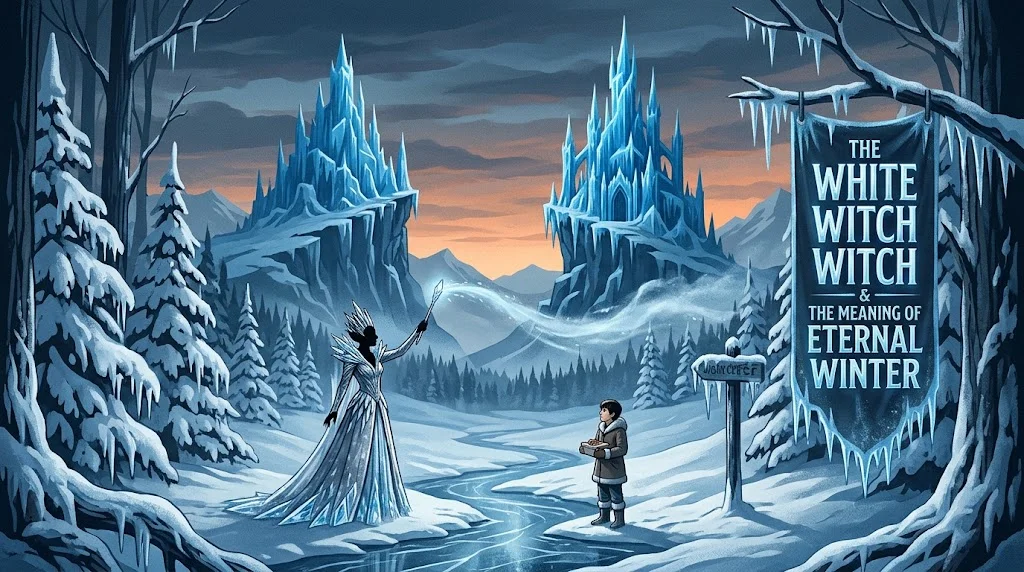
The White Witch, also known as Jadis, represents destructive power and the temptation to place personal desires above others. Her rule turns Narnia into a place of endless winter, reflecting emotional coldness and the loss of hope.
For readers, she illustrates how fear and manipulation can make injustice appear normal. Her power depends partly on convincing others that resistance is impossible.
The Meaning of Eternal Winter
Winter isn’t inherently evil in nature. However, Lewis gives it a particular meaning through the Witch’s unnatural control over Narnia.
• Endless winter symbolizes emotional and spiritual stagnation.
• Snow and ice reflect isolation, fear, and a lack of warmth.
• The Witch’s palace represents control through intimidation.
• Her promises reveal how temptation can disguise selfishness as reward.
The important distinction is that Narnia’s winter doesn’t simply represent sadness. It represents a world where renewal has been prevented by an oppressive ruler.
Temptation and the Desire for Power
The Witch tempts Edmund with Turkish delight and the promise of status. She appeals to his resentment and desire to feel important.
This scene remains relevant because temptation often begins with something attractive. A selfish choice may promise comfort or recognition while hiding its consequences.
The Witch therefore symbolizes more than obvious cruelty. She also represents the seductive side of wrongdoing and the way ambition can weaken judgment.
The Wardrobe Symbolism: Discovery and Transformation
The wardrobe is one of the most recognizable symbols in Narnia. It transforms an ordinary household object into a doorway between familiar reality and an extraordinary world.
For American readers, it often represents imagination, childhood curiosity, and the discovery of possibilities beyond everyday experience.
A Doorway Between Two Worlds
Lucy enters Narnia through the wardrobe without knowing what awaits her. Her experience changes her understanding of what is possible.
The wardrobe can therefore symbolize the moment when curiosity leads to a life-changing discovery.
• An ordinary doorway becomes an invitation to explore.
• Hidden spaces represent possibilities that aren’t immediately visible.
• The passage between worlds reflects personal change.
• Lucy’s discovery encourages readers to remain open to wonder.
What the Wardrobe Means Spiritually
Some readers interpret the wardrobe as a spiritual threshold. It represents moving beyond familiar assumptions and entering a world where deeper truths become visible.
Others see it as a symbol of imagination and the freedom to explore unfamiliar experiences. Neither interpretation requires the wardrobe to have one exclusive meaning.
Its power comes from the contrast between its ordinary appearance and the extraordinary world it reveals.
Narnia Symbolism in America: Faith, Family, and Popular Culture
Narnia holds a lasting place in American reading culture through children’s literature, Christian education, family reading traditions, theater, and film adaptations.
Its themes are particularly accessible because the stories connect moral questions with memorable adventures. Readers can discuss complex ideas through characters and events rather than abstract arguments.
Christian Interpretations in the United States
Many American churches, Christian schools, and families use Narnia to discuss spiritual concepts. Aslan’s sacrifice, Edmund’s redemption, and the return of spring provide familiar examples.
However, the books aren’t limited to religious settings. Teachers and book clubs can also explore courage, honesty, leadership, and the consequences of selfishness.
Narnia in American Family Culture
The series often brings generations together through shared reading and film experiences. Parents may introduce the stories to children, then revisit their meanings as adults.
| Context | Meaning in the USA | Common Associations | Notes |
| Christian faith | Sacrifice and redemption | Aslan, resurrection, grace | A major interpretation of the series |
| Family reading | Growth and moral learning | Siblings, loyalty, forgiveness | Suitable for intergenerational discussion |
| Education | Character and responsibility | Courage, honesty, choices | Supports literary and ethical discussion |
| Fantasy culture | Wonder and escape | Wardrobe, magic, mythical creatures | Connects imagination with adventure |
| Personal identity | Hope and resilience | Transformation, freedom, belonging | Meanings vary by individual reader |
Narnia’s American significance comes from this flexibility. Its Christian foundations remain important, yet its lessons about responsibility and compassion also speak to readers with different backgrounds.
Spiritual Meaning of Narnia Beyond Christianity
Although Christian symbolism is central to many readings of Narnia, the series also draws on broader spiritual and mythological ideas. These include renewal, moral balance, the relationship between humans and nature, and the search for wisdom.
Such connections should be understood as comparisons, not proof that every tradition shares the same beliefs.
Universal Themes of Renewal
The return of spring after the Witch’s winter reflects a widely understandable pattern: life emerging after a period of hardship.
Many cultures use seasonal changes to express hope, renewal, and the continuing cycle of life. Narnia adapts this familiar pattern into a story about liberation from oppression.
Nature as a Spiritual Presence
Narnia’s forests, rivers, talking animals, and ancient trees make nature feel alive with meaning. This resembles mythological traditions in which natural places are connected with spirits, sacred power, or extraordinary beings.
For modern readers, these elements may encourage respect for the natural world. However, Narnia’s fictional creatures shouldn’t be treated as exact representations of any living religious tradition.
Wisdom and the Search for Truth
Characters frequently need to distinguish appearance from reality. Lucy’s honesty, the children’s mistakes, and Aslan’s guidance all contribute to this theme.
Spiritually, the journey can represent the search for truth and the humility required to recognize one’s own limitations.
read more: Evil Symbolism: Meaning in Culture, Myth & Art
Emotional and Psychological Meaning of Narnia
Narnia’s symbolism works because its characters experience emotions that readers recognize. Jealousy, fear, grief, pride, loyalty, and hope shape their decisions.
The fantasy setting makes these experiences easier to discuss, especially with children. It also gives adults a way to revisit difficult questions without immediately relating them to personal conflicts.
Courage and Personal Growth
Courage in Narnia doesn’t mean being fearless. Instead, characters learn to act responsibly even when they feel uncertain or afraid.
• Lucy represents honesty and trust in her own experience.
• Edmund illustrates the consequences of resentment and selfishness.
• Eustace demonstrates that character can change through effort and humility.
• The Pevensie siblings show how loyalty can survive conflict.
These examples encourage readers to see growth as a process rather than a fixed personal quality.
Forgiveness and Emotional Renewal
Edmund’s story is especially important because his betrayal doesn’t permanently define him. He receives forgiveness and has opportunities to make better choices.
This doesn’t mean that wrongdoing has no consequences. Rather, Narnia suggests that accountability and forgiveness can exist together.
The series also presents hope as an active choice. Characters must often take risks, admit mistakes, or help others before their circumstances improve.
Narnia Symbolism in Modern Life: Tattoos, Decor, and Identity
Today, people can use Narnia imagery to express personal values, religious beliefs, or a lasting connection to childhood stories. The meaning depends on the image chosen and the person’s relationship with the series.
Narnia-Inspired Tattoos
Narnia tattoos can carry different messages depending on their design.
• Lion imagery: Courage, strength, spiritual faith, or protection.
• Wardrobe designs: Curiosity, imagination, and personal discovery.
• Winter and spring: Endurance, hope, and renewal after hardship.
• A lamppost in snow: Wonder, nostalgia, and the meeting of ordinary life with fantasy.
• A meaningful quotation: A personal reminder of faith, courage, or forgiveness.
People considering these designs should think about what the image means to them, rather than assuming every viewer will understand it in the same way.
Home Decor and Personal Collections
Narnia-inspired decor may include antique wardrobes, forest imagery, lion figures, old-fashioned lamps, and fantasy artwork. These objects can create a sense of wonder, nostalgia, or connection to a favorite story.
For some households, the imagery also reflects Christian faith. For others, it’s primarily about literature, family memories, and imaginative storytelling.
Social Media and Online Communities
Readers may share Narnia quotations, character art, favorite scenes, and discussions about spiritual meaning. The series also provides a common language for talking about moral choices and personal growth.
However, short posts often simplify complicated characters. A thoughtful interpretation usually considers the wider story rather than relying on a single image or quotation.
Narnia Symbolism and the Meaning of Good Versus Evil
The conflict between good and evil is a major theme throughout the series. However, Narnia’s moral lessons are more nuanced than simply labeling certain characters good and others bad.
Characters face choices, make mistakes, and respond differently to power. Their actions reveal how morality develops through decisions and relationships.
The Difference Between Power and Goodness
The White Witch uses authority to control others. Aslan, by contrast, uses his power in ways associated with justice, sacrifice, and restoration.
This contrast suggests that strength alone doesn’t make a person worthy of leadership.
• Responsible leaders protect others rather than exploit them.
• Fear can produce obedience without genuine loyalty.
• Forgiveness can restore relationships without excusing wrongdoing.
• Courage often requires resisting pressure from powerful figures.
These ideas remain relevant in American discussions about leadership, family responsibility, education, and civic life.
Why the Conflict Isn’t Always Simple
Some characters make harmful choices without being entirely beyond redemption. Edmund’s development is the clearest example.
Likewise, characters who intend to do good may misunderstand situations or make mistakes. The stories encourage readers to judge actions carefully while recognizing the possibility of change.
Misunderstandings and Controversies About Narnia Symbolism
Narnia’s religious and cultural meanings have generated discussion among readers. Some people focus on Christian theology, while others prefer its mythology, fantasy, or moral lessons.
Understanding these different approaches prevents common misunderstandings.
Is Narnia Only a Christian Allegory?
No. Christian symbolism is important, particularly in Aslan’s story, but Lewis didn’t design every character and event as a direct one-to-one representation of a religious idea.
The series also contains classical mythology, folklore, imaginative creatures, and independent character journeys. Treating every detail as a fixed religious code can overlook the complexity of the stories.
Does Narnia Promote One Interpretation?
Lewis’s Christian worldview strongly shaped the books. Still, readers may find additional meanings in friendship, courage, nature, or personal growth.
Recognizing these interpretations doesn’t require denying the author’s religious intentions. It simply acknowledges that stories can speak to readers in different ways.
Cultural Representation and Historical Context
Some discussions of Narnia examine its portrayal of foreign lands and peoples, especially Calormen in The Horse and His Boy. Critics have questioned elements of its descriptions of cultural difference, authority, and religion.
These concerns deserve careful consideration rather than dismissal. Readers can appreciate the series while also examining the historical assumptions and stereotypes that may appear in older literature.
How Narnia Symbolism Has Changed Over Time
Narnia first reached readers in the early 1950s, but its meanings have continued to develop through new generations of readers and adaptations.
Its original religious and literary context remains important. At the same time, changing cultural interests have encouraged new interpretations.
From Children’s Literature to Cultural Classic
The books were initially published as children’s fantasy, yet their moral and spiritual themes helped them reach adult audiences.
In the United States, Christian readers have often emphasized Aslan’s connection to Christ. Other readers have focused on the series’ imaginative world, literary influences, and ethical questions.
Film adaptations have also made its imagery familiar to people who haven’t read all seven novels.
Contemporary Interpretations
Modern readers may approach Narnia through discussions about belonging, leadership, resilience, environmental responsibility, and the meaning of childhood imagination.
These interpretations don’t erase the older ones. Instead, they show how a story can remain relevant as readers bring new experiences and questions to it.
The central themes of courage, sacrifice, and renewal continue to connect the fictional world with everyday life.
FAQs About Narnia Symbolism
What does Narnia symbolize?
Narnia symbolizes faith, courage, hope, redemption, and the struggle between good and evil. Its magical world also represents imagination, personal growth, and important life lessons.
What does Aslan symbolize in Narnia?
Aslan symbolizes sacrifice, bravery, forgiveness, and redemption. His actions reflect Christian themes of love, resurrection, and hope.
What does the White Witch symbolize?
The White Witch symbolizes evil, temptation, fear, and the misuse of power. Her rule also represents the loss of hope and freedom.
What does the wardrobe symbolize in Narnia?
The wardrobe symbolizes discovery, transformation, and the passage between worlds. It shows how ordinary objects can open doors to extraordinary experiences.
What does the long winter symbolize in Narnia?
The long winter symbolizes hardship, fear, and the absence of hope. Its end represents renewal, freedom, and the return of peace.
Is Narnia a Christian allegory?
Narnia contains strong Christian symbolism, especially through Aslan’s sacrifice and return. However, C. S. Lewis also drew inspiration from mythology, folklore, and fantasy storytelling, giving the series broader meanings.
Conclusion
Narnia Symbolism: Themes, Meaning and Spiritual Insights reveals how C. S. Lewis uses a magical world to explore meaningful human experiences. Through Aslan, the White Witch, the wardrobe, and the long winter, the stories examine faith, courage, sacrifice, temptation, and redemption. Their deeper messages encourage readers to choose kindness, face challenges bravely, and hold on to hope during difficult times. By blending Christian symbolism, mythology, and imagination, The Chronicles of Narnia continues to offer timeless lessons about good and evil, personal growth, and the power of hope.

Charlotte Brown is a passionate writer at SoulMeanings.com, dedicated to exploring spirituality, symbolism, dreams, and life’s deeper meanings. Her work helps readers find clarity, inspiration, and personal insight.