
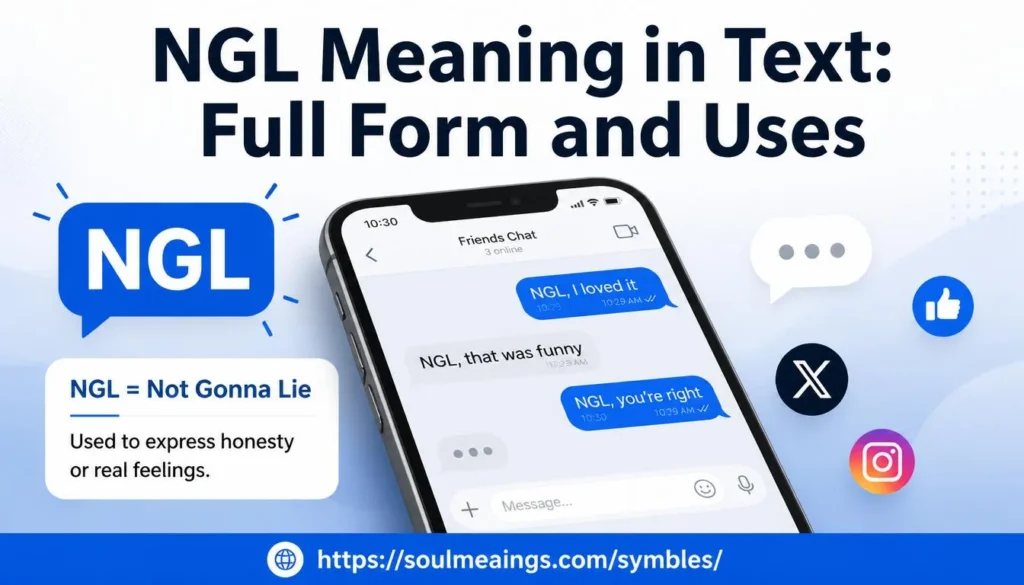
NGL Meaning in Text: Full Form and Uses explains the meaning, text, and abbreviation behind this slang term in online chat.
When you see NGL in a post or message, it may leave you blank until you understand what the abbreviation means. NGL stands for Not Gonna Lie and works as an acronym used everywhere online. This handy abbreviation appears in digital communication, informal language, internet slang, social media, messaging, online chat, texting, and text messages.
Its meaning usually signals that someone wants to sound honest or direct. It has become commonly used in everyday life and daily chats, so you may notice it often while reading casual conversations.
The slang also has a simple usage pattern. Someone may use NGL before an honest response, reply, or explanation, such as “NGL, I liked it” or “NGL, that surprised me.” From a slang expert perspective, this kind of communication makes longer phrases easier to use while keeping the message natural.
You can use NGL yourself in a chat or post when you want to express an opinion. If you’re wondering exactly what the phrase means, remember Not, Gonna, Lie.
Quick Answer: What Does NGL Mean in Text?
NGL means “Not Gonna Lie” in texting and online conversations.
People use it to signal that they’re about to say something honestly or openly. It can introduce a compliment, criticism, confession, opinion, surprise, or emotional reaction.
For example:
NGL, I really liked that song.
This means:
Not gonna lie, I really liked that song.
NGL doesn’t automatically make a statement positive or negative. The words that follow it provide the real context.
TL;DR
- NGL usually stands for “Not Gonna Lie.”
- It’s an informal texting and internet abbreviation.
- People use it before honest opinions or personal reactions.
- It can introduce compliments, criticism, confessions, or jokes.
- You may see NGL at the beginning or end of a sentence.
- Its tone depends heavily on the surrounding message.
- NGL can also refer to the name of an anonymous messaging service in a different context.
What Does NGL Stand For?
The full form of NGL is “Not Gonna Lie.”
Each letter represents one part of the phrase:
| Letter | Word |
| N | Not |
| G | Gonna |
| L | Lie |
“Gonna” is the casual spoken form of “going to.” Because the full expression sounds conversational, NGL fits naturally into informal digital communication.
The phrase “not gonna lie” has a simple purpose. It signals that the speaker wants to be candid about something.
For instance:
- “NGL, I’m tired.”
- “NGL, that was hilarious.”
- “NGL, I didn’t expect that.”
- “NGL, I prefer the first version.”
None of these messages necessarily suggests that the writer lied earlier. Instead, the phrase works like a conversational spotlight. It tells the reader, “Here’s my honest take.”
Cambridge Dictionary gives NGL the meaning “not gonna lie” and specifically describes its use for admitting something or making a criticism or complaint feel less likely to offend.
What Does NGL Mean in Text Messages?
In a text message, NGL usually introduces something the sender considers honest, personal, or slightly revealing.
Think of it as a small verbal doorway. Once someone writes “NGL,” you expect a candid statement to follow.
Consider these examples:
“NGL, I’m nervous about tomorrow.”
The sender admits a genuine feeling.
“NGL, that restaurant was disappointing.”
The sender is giving a straightforward criticism.
“You handled that really well, ngl.”
The sender emphasizes that the compliment is sincere.
“NGL, I forgot about the meeting.”
The sender openly admits a mistake.
This flexibility explains why the abbreviation appears across many kinds of casual conversations.
It doesn’t describe one specific emotion. Instead, it describes the speaker’s attitude toward what they’re saying.
How Is NGL Used in Texting?
NGL for an Honest Opinion
One of the most common uses involves personal opinions.
People often write NGL before giving an assessment of a movie, song, meal, outfit, game, product, or experience.
For example:
NGL, the new season is better than the old one.
The abbreviation tells the reader that this is the person’s genuine view.
You could remove NGL and still understand the sentence. However, adding it gives the message a more conversational and candid feel.
NGL for a Confession or Admission
People also use NGL before admitting something they might normally keep to themselves.
Examples include:
- NGL, I was scared.
- NGL, I forgot your birthday.
- NGL, I almost left early.
- NGL, I didn’t understand the question.
Here, the abbreviation creates a sense of openness.
It can make an admission sound less stiff because the phrase belongs to everyday internet language.
NGL for a Genuine Reaction
Sometimes people use NGL simply to emphasize a reaction.
For example:
NGL, that scared me.
NGL, I wasn’t expecting that ending.
NGL, I’m really excited.
The speaker isn’t necessarily making a serious confession. They’re simply stressing that the reaction is genuine.
NGL Before a Compliment
NGL can also introduce praise.
For example:
NGL, you did a great job.
NGL, that outfit looks amazing.
NGL, your presentation was really good.
In these cases, NGL can make the compliment feel spontaneous.
It may also suggest that the sender doesn’t usually say things like this openly.
NGL Before a Criticism
The abbreviation frequently appears before criticism too.
For example:
NGL, the ending was disappointing.
NGL, this update made the app harder to use.
NGL, I expected more from the movie.
The phrase can make criticism sound conversational rather than overly formal.
However, NGL doesn’t magically make criticism polite. A harsh statement can still sound harsh.
NGL for Humor
People often use NGL when making an embarrassing or funny admission.
For example:
NGL, I practiced that conversation in my head.
NGL, I checked the fridge three times hoping new food appeared.
The humor comes from the admission itself. NGL simply frames it as an honest confession.
Where Do People Use NGL?
NGL works mainly in informal digital communication.
You can encounter it in:
- Text messages
- Group chats
- Instagram comments
- Instagram DMs
- TikTok comments
- Snapchat conversations
- WhatsApp chats
- Online forums
- Gaming conversations
- Casual social media posts
The basic meaning stays the same across these settings.
However, the surrounding conversation determines whether NGL sounds funny, sincere, critical, dramatic, or playful.
NGL in Social Media Comments
A social media comment might say:
NGL, this is actually one of your best posts.
Here, NGL emphasizes the commenter’s honest approval.
Another person might write:
NGL, I liked the old design better.
The same abbreviation now introduces criticism.
NGL in Private Chats
Private conversations often use NGL in a more personal way.
For example:
NGL, I was hoping you’d text me.
That’s more emotionally revealing than:
NGL, the weather is weird today.
The abbreviation stays the same. The emotional weight comes from the rest of the message.
related post: What Does “Home” Mean in Text? Meaning, Uses & Examples
NGL at the Beginning vs. End of a Sentence
The position of NGL can change the flow of the sentence.
NGL at the Beginning
This is one of the most recognizable patterns:
NGL, I really enjoyed it.
NGL, I wasn’t ready for that.
Starting with NGL tells the reader immediately that an honest statement is coming.
NGL at the End
You may also see:
That was actually fun, ngl.
I didn’t expect to like it, ngl.
That exam was difficult, ngl.
The meaning remains essentially unchanged.
Putting NGL at the end can make the sentence feel more like an afterthought or final emphasis. It resembles someone adding, “Honestly,” after making a statement.
Cambridge Dictionary includes examples of both beginning and end placement, which reflects how flexible the expression is in casual communication.
What Tone Does NGL Communicate?
NGL doesn’t have one fixed emotional tone.
Instead, it signals a certain level of candor. The sentence following it determines the mood.
| Tone | Example | What It Communicates |
| Honest | “NGL, I was nervous.” | Open admission |
| Positive | “NGL, you crushed it.” | Sincere praise |
| Critical | “NGL, the ending was weak.” | Candid criticism |
| Funny | “NGL, I ate the whole cake.” | Humorous confession |
| Emotional | “NGL, I miss those days.” | Personal feeling |
| Surprised | “NGL, I didn’t expect that.” | Genuine reaction |
| Casual | “NGL, this place is cool.” | Informal opinion |
This makes NGL particularly useful in casual conversations.
It’s less about the literal meaning of “not gonna lie” and more about the conversational signal behind it.
NGL Examples in Real Conversations
Seeing the abbreviation in complete conversations makes its function easier to understand.
Positive NGL Examples
Friend A: Did you like the concert?
Friend B: NGL, it was amazing.
Here, NGL introduces enthusiastic praise.
Another example:
Friend A: What do you think of my new haircut?
Friend B: NGL, it looks really good.
The abbreviation makes the compliment sound candid and casual.
Negative NGL Examples
Friend A: Did you like the movie?
Friend B: NGL, the first half was boring.
The sender isn’t necessarily trying to insult anyone. They’re simply giving an honest opinion.
Neutral NGL Examples
Friend A: Were you nervous before the interview?
Friend B: NGL, a little.
This use is straightforward. The abbreviation simply introduces an honest admission.
Funny NGL Examples
Friend A: Why did you order dessert again?
Friend B: NGL, I have no self-control around cheesecake.
The abbreviation creates a playful setup for the confession.
NGL vs. Similar Texting Abbreviations
Several internet expressions overlap with NGL. However, they don’t always communicate exactly the same thing.
| Abbreviation | Full Form | Common Purpose | Typical Tone |
| NGL | Not Gonna Lie | Introduces a candid statement | Casual |
| TBH | To Be Honest | Signals honesty or opinion | Casual |
| FR | For Real | Shows agreement or emphasis | Casual |
| FRFR | For Real For Real | Stronger agreement or emphasis | Very casual |
| IMO | In My Opinion | Marks a personal viewpoint | Casual |
| No cap | No lie / no exaggeration | Emphasizes truthfulness | Slang |
NGL vs. TBH
NGL and TBH are probably the closest alternatives.
Compare:
NGL, that was impressive.
TBH, that was impressive.
Both suggest honesty.
The difference is subtle. NGL often feels more conversational and internet-oriented, while TBH can function more directly as “to be honest.”
NGL vs. FR
FR usually means “for real.”
Someone might say:
That movie was incredible, FR.
This emphasizes agreement or sincerity.
NGL instead frames what follows as the speaker’s candid statement.
NGL vs. IMO
IMO means “in my opinion.”
It specifically identifies a personal viewpoint:
IMO, the first movie was better.
NGL doesn’t necessarily introduce an opinion. It can introduce a confession, reaction, compliment, or admission too.
Is NGL Formal or Informal?
NGL is an informal language.
It works well when you’re chatting with friends or posting on social media. It usually doesn’t belong in formal writing.
Good Places to Use NGL
- Texting friends
- Casual group chats
- Social media comments
- DMs
- Informal online discussions
- Gaming chats
Places to Avoid NGL
- Academic essays
- Job applications
- Formal reports
- Business proposals
- Professional correspondence
- Official documents
Instead of:
NGL, I think this proposal needs changes.
A professional message could say:
Honestly, I think this proposal needs a few changes.
Or:
To be honest, I think this proposal needs further revision.
The meaning remains clear without relying on internet slang.
Does NGL Mean Something Else?
Context matters because NGL can refer to more than the texting abbreviation.
In ordinary text slang, it means “Not Gonna Lie.” That’s the meaning most readers expect when they see it in a casual sentence.
However, NGL is also the name of an anonymous messaging service. Its official website describes features that let people receive anonymous messages through a generated link.
The service’s current terms also identify NGL as the name of its application.
That creates an important distinction:
| Context | Likely Meaning |
| “NGL, I love this song.” | Not Gonna Lie |
| “NGL, that was awkward.” | Not Gonna Lie |
| “Send me an NGL message.” | NGL messaging service |
| “I made an NGL link.” | NGL messaging service |
So don’t assume every appearance of NGL refers to the slang expression.
The surrounding words usually make the intended meaning obvious.
How to Reply When Someone Says NGL
You don’t need a special response when someone uses NGL.
Simply respond to the actual statement.
For example:
Them: NGL, that movie was terrible.
Reply: Yeah, the ending didn’t work for me either.
Or:
Them: NGL, I’m really nervous.
Reply: You’ll be fine. You’ve prepared for this.
You can also respond playfully:
Them: NGL, I ate the entire pizza.
Reply: Honestly, that’s impressive.
The key is simple: NGL isn’t usually the main point of the message. It’s a conversational cue around the main point.
Why Do People Use NGL Instead of “Honestly”?
Abbreviations save time, but that’s only part of the story.
Internet slang also carries a particular social tone. Writing NGL feels different from writing “I would like to be honest about this.”
The first sounds casual and spontaneous. The second sounds formal and deliberate.
That’s why abbreviations thrive in digital conversations. They don’t merely shorten language. They also help communicate the relationship between speakers.
Compare these:
NGL, I miss those days.
Honestly, I miss those days.
I would like to say that I miss those days.
All three communicate a similar idea. Yet the first feels the most casual.
Common Mistakes When Using NGL
Although NGL is simple, a few mistakes can make it sound unnatural.
Using It in Formal Writing
NGL belongs mainly to informal communication. Using it in an academic essay can make the writing seem careless.
Assuming It Always Means Something Positive
NGL can introduce praise or criticism.
NGL, you did amazing.
and
NGL, that wasn’t very good.
Both uses are normal.
Treating NGL as Proof of Truth
NGL signals that the speaker intends to sound candid. It doesn’t independently prove that the statement is true.
Someone can write “NGL” and still be mistaken, exaggerating, joking, or being sarcastic.
Ignoring Context
If someone writes:
NGL, you’re different.
That could be a compliment, criticism, or playful observation.
You need the surrounding conversation to understand the intended tone.
A Simple Guide to Understanding NGL
When you encounter NGL in a message, use this quick process:
- Look at the words after NGL.
- Check whether the sender is giving an opinion.
- Look for a confession or admission.
- Consider whether the message sounds playful or sarcastic.
- Check whether NGL refers to the messaging service instead.
- Read the whole conversation before interpreting the tone.
This approach prevents you from treating every NGL message as identical.
FAQs
What does NGL stand for?
NGL stands for Not Gonna Lie. It’s a common abbreviation used in casual texting and online conversations.
What does NGL mean in a text message?
In a text message, NGL usually introduces an honest thought, opinion, or reaction. For example, “NGL, that movie was great.”
Is NGL slang?
Yes, NGL is informal slang. It’s common in texts, chats, comments, and social media posts.
How do you use NGL in a sentence?
You can put NGL at the beginning of a sentence before sharing an honest opinion. For example, “NGL, I wasn’t expecting that.”
Is NGL the same as TBH?
NGL and TBH can have similar meanings because both can introduce an honest statement. However, NGL specifically means “Not Gonna Lie,” while TBH means “To Be Honest.”
Can I use NGL in formal writing?
NGL is best for casual conversations, texts, and social media. Avoid it in formal emails, academic writing, or professional documents unless the setting is intentionally informal.
Conclusion
NGL simply means Not Gonna Lie, and it’s an easy way to introduce an honest thought, opinion, or reaction. This popular abbreviation is common in texts, chats, and social media, especially when someone wants to sound open and direct. Once you understand the meaning, context, and common usage of NGL, it becomes much easier to recognize and understand in everyday online communication.

Sophia Wilson is a spiritual content writer and researcher at SoulMeanings.com, specializing in dream meanings, symbolism, spiritual insights, and personal growth topics that help readers navigate life’s journey with greater understanding.