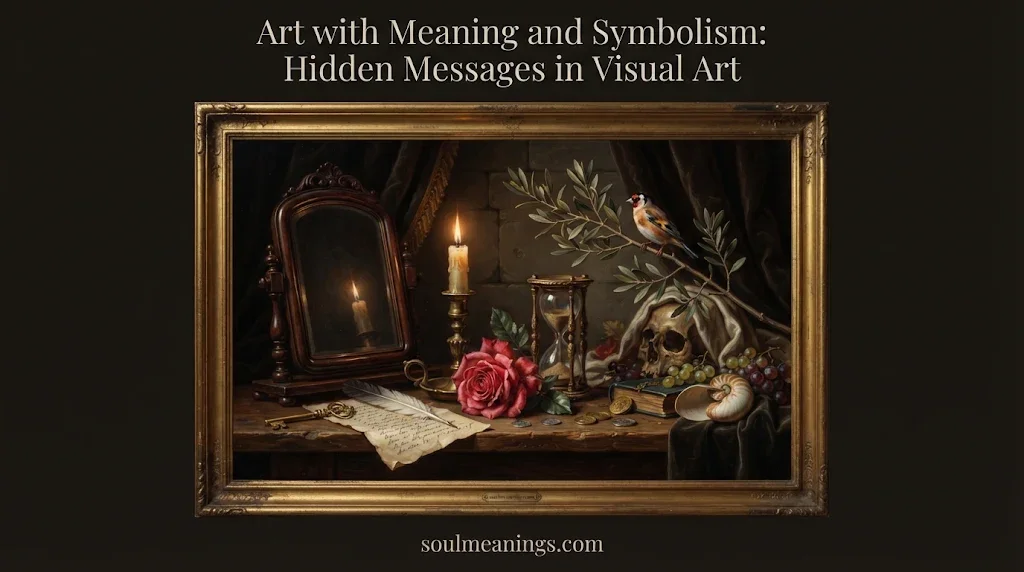
Art with meaning and symbolism shows how artists use colors, images, and objects to express ideas beyond words.
Throughout history, painting, sculpture, photography, and digital art have carried deeper messages through symbols, animals, gestures, landscapes, and patterns. In my view, symbolism in art makes visual expression more powerful by connecting stories, beliefs, emotions, and human experiences.
From Renaissance masterpieces and Christian allegory to abstract paintings and street art, symbols communicate spiritual beliefs, inner turmoil, and social issues.
Across ancient civilizations, religious traditions, and modern movements, artists have used color symbolism, animal symbolism, and symbolic imagery to explore identity, culture, society, and heritage.
Through metaphor, artistic storytelling, and visual communication, ordinary artworks become powerful expressions of human thought, creativity, spirituality, and imagination.
Quick Answer
Art with Meaning and Symbolism uses colors, objects, shapes, and images to communicate deeper ideas. In American culture, it often represents freedom, identity, love, history, social change, and personal beliefs.
TL;DR
- Visual symbols communicate ideas beyond an artwork’s physical appearance.
- Colors often express emotions, beliefs, and cultural values.
- Ancient civilizations used symbols to explain life, death, and spirituality.
- American art frequently explores freedom, identity, history, and equality.
- Modern artists use symbolism in paintings, murals, tattoos, and digital media.
- Personal experiences can influence how people interpret visual messages.
What Is Art with Meaning and Symbolism?
Art with symbolism communicates ideas through visual details rather than words alone. Artists use recognizable objects, colors, figures, and settings to express deeper messages. These details help viewers understand the artwork’s emotional or cultural meaning.
Understanding Visual Symbolism
A symbol is an image, object, or sign that represents something beyond itself. For example, a dove often represents peace, while a broken chain can represent freedom.
However, symbols don’t always have one fixed meaning. Their interpretation can change depending on the artist, audience, and historical setting.
Consider these common examples:
- A rose can represent love, beauty, passion, or remembrance.
- A skull may suggest mortality, danger, or the passage of time.
- An open door can symbolize opportunity, change, or new beginnings.
- A mirror may represent self-reflection, truth, or personal identity.
- A bird in flight can suggest freedom, hope, or spiritual growth.
Why Artists Use Hidden Messages
Artists often want viewers to think beyond the obvious subject. Symbolism allows them to express complicated feelings through familiar images.
For instance, a painting of an empty chair might represent loneliness. A fading candle could suggest the passing of life. Similarly, a stormy sky might reflect emotional conflict.
Therefore, symbolic details can turn an ordinary painting into a meaningful visual story.
How Does Symbolism Appear in Visual Art?
Symbolism appears through colors, shapes, objects, composition, and the relationships between different elements. These details guide viewers toward possible interpretations. In American galleries and public spaces, recognizing them can make artwork easier to understand.
Colors and Their Symbolic Meanings
Colors influence how people experience paintings and illustrations. However, their meanings depend on cultural traditions and artistic choices.
| Color | Common Symbolic Meaning | Emotional Association | Possible Artistic Use |
| Red | Love, danger, passion | Energy and intensity | Strong emotions or conflict |
| Blue | Peace, trust, sadness | Calmness and reflection | Water, skies, spirituality |
| White | Purity, innocence, remembrance | Simplicity and peace | Religious or ceremonial scenes |
| Black | Mystery, death, authority | Seriousness and uncertainty | Shadows and dramatic contrast |
| Green | Nature, growth, renewal | Balance and hope | Landscapes and new beginnings |
| Gold | Wealth, achievement, divinity | Importance and prestige | Sacred objects and power |
Importantly, colors don’t communicate the same message everywhere. White, for example, can represent purity in some settings and mourning in others.
Shapes, Objects, and Composition
Artists also use shapes and arrangements to communicate meaning.
- Circles can represent unity, eternity, and completeness.
- Triangles may suggest stability, hierarchy, or spiritual connection.
- Spirals can represent growth, movement, and transformation.
- Broken objects may suggest loss, change, or damaged relationships.
- Light and shadow can express hope, uncertainty, or inner conflict.
Furthermore, an object’s position matters. A small figure beneath a towering building might suggest powerlessness. In contrast, a person standing above a mountain may symbolize achievement or independence.
Historical Origins of Symbolism in Art
Visual symbolism existed long before modern painting and photography. Ancient societies used images to communicate religious beliefs, political authority, cultural traditions, and ideas about human existence. These early practices shaped many artistic traditions still recognized today.
Ancient Civilizations and Symbolic Images
Ancient Egyptians created paintings and carvings filled with symbolic figures. Animals, colors, and objects often represented gods, protection, and life after death.
For example, the scarab beetle represented renewal and transformation. The ankh symbolized life, while the eye of Horus became associated with protection and healing.
Similarly, ancient Greek artists used mythology to explore courage, wisdom, love, and human weakness. Their paintings and pottery featured gods, heroes, and legendary creatures.
Roman artists also used symbolic images in mosaics, sculptures, and decorative paintings. These works often communicated wealth, status, victory, and religious devotion.
Medieval and Renaissance Symbolism
During the Middle Ages, European religious art used recognizable symbols to explain spiritual ideas. Many viewers couldn’t read, so images helped communicate religious stories.
Artists frequently included:
- Lambs to represent innocence and religious sacrifice.
- Halos to indicate holiness or sacred importance.
- Lilies to represent purity and innocence.
- Serpents to suggest temptation or danger.
- Golden light to communicate divine presence.
During the Renaissance, symbolism became more detailed. Artists explored mythology, science, philosophy, and human emotion.
Paintings also included objects with multiple meanings. A skull could remind viewers of mortality, while a mirror might encourage self-examination.
Symbolism in the Modern Art Movement
From the late nineteenth century onward, many artists moved beyond realistic representation. They explored dreams, emotions, imagination, and personal experiences.
The Symbolist movement used mysterious images and poetic subjects to express ideas that ordinary language couldn’t fully explain.
Later, Surrealist artists explored dreams and the unconscious mind. Abstract artists also used color, form, and movement to communicate without traditional subjects.
Today, these approaches continue influencing contemporary visual art.
What Does Symbolism in American Art Represent?
In the United States, symbolic art reflects national identity, personal freedom, historical experiences, and social values. Artists use familiar images to explore what it means to belong, remember, and express individuality.
Freedom and the American Identity
Freedom is one of the most recognizable themes in American visual art. Artists often use national symbols to communicate independence, courage, and opportunity.
Common examples include:
- The bald eagle represents strength, independence, and national identity.
- The Statue of Liberty symbolizes freedom, hope, and welcoming opportunity.
- The American flag represents national history, unity, and shared identity.
- Open landscapes can suggest independence and the possibility of new beginnings.
- Broken chains may represent liberation and resistance against oppression.
However, these symbols can carry different meanings. For some Americans, national imagery inspires pride. Others use it to question historical events or social inequalities.
Art as a Reflection of American History
American artists have used symbolism to document important historical experiences. Paintings of workers, families, battlefields, and landscapes often communicate broader social messages.
For example, nineteenth-century landscape paintings sometimes presented nature as a source of national pride and possibility. Later, artists explored industrial growth, immigration, racial inequality, and changing communities.
Additionally, public murals have become important forms of cultural expression. They often celebrate local history, community identity, and social movements.
Social Change and Political Expression
Symbolic art also gives Americans a way to discuss difficult subjects. Artists may use broken objects, empty spaces, raised hands, or contrasting colors.
These images can communicate:
- Equality and human dignity.
- Resistance against injustice.
- Environmental protection.
- Community solidarity.
- Memories of historical struggles.
Therefore, American symbolic art doesn’t always celebrate national achievements. It can also encourage viewers to question society and imagine change.
What Are the Spiritual and Religious Meanings in Art?
Religious and spiritual symbolism has influenced visual art across centuries. Artists have used sacred objects, natural elements, and human figures to explore faith, morality, and life’s mysteries. These traditions remain visible in American museums, churches, homes, and contemporary artwork.
Christian Symbolism in Visual Art
Christian artwork frequently includes objects with established religious associations.
Some common examples include:
- A cross represents Christianity, sacrifice, and redemption.
- A dove often represents the Holy Spirit and peace.
- A lamb can symbolize innocence and Christ.
- A fish is an early Christian symbol of faith.
- A vine may represent spiritual connection and growth.
However, these symbols don’t appear exclusively in religious artwork. Modern artists sometimes use them to explore hope, suffering, forgiveness, or cultural identity.
Symbolism in Other Spiritual Traditions
Different cultures have developed their own visual languages. Their symbols reflect unique histories, beliefs, and experiences.
For example, Hindu art frequently features the lotus as a symbol of purity and spiritual growth. Buddhist artwork also uses the lotus to communicate awakening and enlightenment.
In many Indigenous traditions, animals, plants, and natural patterns carry cultural or spiritual significance. However, meanings vary greatly between communities.
Similarly, the yin-yang symbol in Chinese philosophy represents complementary forces and balance. Its familiar circular design communicates the relationship between seemingly opposite elements.
Nature as a Spiritual Symbol
Nature frequently provides artists with spiritual imagery. Mountains, rivers, trees, flowers, and sunlight can represent life’s deeper connections.
A tree might suggest family roots and continuity. Meanwhile, flowing water can represent renewal, change, or purification.
However, viewers should consider the artwork’s original cultural setting. Not every natural image carries a religious meaning.
What Are the Most Common Symbols in Paintings?
Many artists use familiar objects to communicate ideas quickly. These objects can become powerful visual clues when combined with their surroundings. Understanding common symbols helps American audiences explore paintings without assuming every detail has one meaning.
Popular Objects and Their Meanings
Here are some frequently used symbols in traditional and modern artwork:
| Symbol | Common Meaning | Possible Message |
| Rose | Love and beauty | Relationships and emotional connection |
| Butterfly | Transformation | Personal growth and change |
| Clock | Time and mortality | Life’s temporary nature |
| Key | Knowledge and opportunity | Access to new possibilities |
| Mirror | Truth and identity | Understanding yourself |
| Tree | Life and stability | Growth and family connections |
| Skull | Death and mortality | Awareness of life’s limits |
| Bird | Freedom and hope | Independence and spiritual possibilities |
Animals as Visual Symbols
Animals appear in artwork because people connect them with recognizable qualities.
For instance, lions often suggest courage and leadership. Owls can represent wisdom, while butterflies frequently symbolize transformation.
However, animal symbolism changes between cultures. A snake might represent danger in one painting and renewal in another.
Therefore, the artist’s subject and cultural background matter when interpreting animal imagery.
Flowers and Their Symbolic Messages
Flowers are among the most familiar symbols in visual art. Their colors, shapes, and lifespans create different associations.
Red roses often suggest romantic love. White lilies may represent remembrance or purity. Sunflowers can communicate warmth, optimism, and devotion.
Additionally, fading flowers sometimes appear in historical still-life paintings. They remind viewers that beauty and life are temporary.
How Does Symbolic Art Affect Human Emotions?
Symbolic art can influence how people feel, think, and remember experiences. A single image may create comfort, sadness, curiosity, or hope. In the United States, people often connect artwork with personal memories and shared cultural experiences.
Colors and Emotional Responses
Colors can influence the mood of a painting.
For example, warm colors often create feelings of energy and excitement. Cooler shades may produce a quieter or more reflective atmosphere.
However, emotional responses aren’t universal. Personal memories, cultural backgrounds, and individual preferences influence how viewers experience colors.
Personal Identity and Self-Expression
Symbolic artwork allows people to communicate values without explaining everything verbally.
Someone might choose a butterfly tattoo to represent personal growth. Another person may display a mountain painting to express resilience and independence.
Similarly, family portraits and meaningful objects can preserve memories. They connect personal experiences with visual stories.
Why Hidden Messages Create Curiosity
Viewers often enjoy discovering details they initially overlooked. A painting may appear simple until someone notices a hidden object or unusual arrangement.
This discovery encourages deeper attention. It also allows viewers to form personal connections with the artwork.
However, an interesting interpretation isn’t necessarily the artist’s original intention. Good interpretation considers both personal feelings and historical context.
read more: Sparrow Symbolism in Death: Spiritual Meanings and Beliefs
How Is Symbolism Used in Modern Art Today?
Symbolism remains important in contemporary American culture. Artists use visual messages in paintings, photography, murals, digital illustrations, fashion, and home decoration. These modern forms often combine traditional meanings with current social experiences.
Symbolism in Tattoos and Personal Art
Tattoos are a popular way to express personal beliefs and experiences. Many people select designs because of their symbolic associations.
Common choices include:
- Butterflies representing transformation and personal growth.
- Mountains representing strength and overcoming challenges.
- Roses representing love, remembrance, or beauty.
- Birds representing freedom and independence.
- Trees representing family, stability, and personal development.
Nevertheless, tattoo meanings remain personal. Two people can choose the same design for completely different reasons.
Social Media and Digital Illustrations
Modern digital platforms have expanded how people create and share symbolic images.
Artists combine traditional symbols with contemporary subjects. They may use broken hearts, flowers, mirrors, or dark landscapes to communicate emotions.
For example, a wilting flower might represent heartbreak in an illustration. Meanwhile, a growing plant could symbolize healing and personal development.
Additionally, digital art allows artists to challenge familiar interpretations. They can transform traditional images into new visual statements.
Home Decor and Everyday Design
Symbolic artwork also appears in American homes and workplaces.
People select decorative paintings because their imagery reflects personal interests or desired feelings. A peaceful landscape may create a relaxing atmosphere. A bold abstract painting might communicate creativity and confidence.
Similarly, meaningful artwork can become part of family traditions. People display religious images, cultural patterns, and historical scenes to preserve connections with their backgrounds.
What Is the Difference Between Symbolism and Allegory in Art?
Symbolism and allegory both communicate ideas beyond literal images. However, they work differently. Understanding this distinction helps viewers interpret complex artwork more accurately.
Understanding Symbolism
Symbolism uses an object, image, color, or figure to suggest a deeper idea.
For example, a single white dove might represent peace. Its meaning can remain open to different interpretations.
Symbolic meaning doesn’t always require a complete story. Sometimes, one object communicates the artist’s central message.
Understanding Allegory
Allegory uses a larger scene or group of symbols to represent an abstract idea.
For example, an artwork showing a blindfolded woman holding scales and a sword may represent justice. Each object contributes to the broader concept.
Similarly, a painting might show a journey through darkness toward sunlight. The complete scene could represent the human struggle toward knowledge or hope.
Key Differences
| Feature | Symbolism | Allegory |
| Main Purpose | Suggests deeper meaning | Represents a broader idea |
| Structure | Often uses individual images | Often uses connected elements |
| Interpretation | Can remain open-ended | Usually follows a central message |
| Example | A rose representing love | A complete scene representing justice |
Both approaches help artists express complicated ideas through visual storytelling.
How to Interpret Hidden Messages in Visual Art
Interpreting symbolic artwork doesn’t require professional training. You can begin by observing the image and asking simple questions. This approach helps American readers understand unfamiliar paintings while respecting different cultural interpretations.
Observe the Main Subject
First, identify what the artwork actually shows.
Look for people, animals, objects, landscapes, and unusual details. Notice whether the scene feels peaceful, dramatic, mysterious, or uncomfortable.
Then ask yourself why the artist selected those particular subjects.
Examine Colors and Objects
Next, consider the colors and objects used throughout the composition.
A dark background might create mystery. A bright window could suggest hope or possibility.
However, avoid assigning meanings too quickly. An artist might choose a color for visual balance rather than symbolism.
Consider the Historical Context
The artwork’s date and cultural background can change its interpretation.
For example, a religious painting created centuries ago may use symbols familiar to its original audience. A modern viewer might overlook those references.
Therefore, learning about the artist’s period, community, and influences can provide valuable clues.
Compare Different Interpretations
Finally, consider how other viewers understand the artwork.
Museum descriptions, historical records, and artistic commentary can help explain unfamiliar symbols. However, personal interpretations can also add meaningful perspectives.
The strongest reading often combines historical evidence with thoughtful observation.
Misunderstandings and Controversies in Symbolic Art
Symbolic artwork can create disagreement because people interpret images through different experiences. Some symbols also carry painful historical associations. Understanding these issues helps viewers appreciate art without overlooking its cultural responsibilities.
Assuming Every Detail Has a Hidden Meaning
One common misunderstanding is believing every object represents a secret message.
However, artists also include details for beauty, realism, decoration, and composition. A flower might simply be a flower.
Therefore, viewers should distinguish supported interpretations from personal guesses.
Cultural Appropriation and Sacred Symbols
Some symbols have deep importance within particular communities. Using them without understanding their background can cause offense or misrepresentation.
For example, sacred Indigenous designs shouldn’t automatically be treated as decorative patterns. Their meanings may connect with specific communities, histories, or ceremonies.
Respectful interpretation requires learning about the source culture.
Political and Historical Controversies
Certain artworks become controversial because of their political or historical associations.
National flags, monuments, religious images, and historical portraits can represent pride for some viewers. Others may associate them with exclusion, injustice, or painful memories.
Additionally, symbols can change meaning over time. Their interpretation depends on how people use them and the circumstances surrounding their appearance.
Distinguishing Traditional Meanings from Hateful Uses
Not every symbol associated with a controversial movement has always carried that meaning. Some images have older religious, cultural, or artistic histories.
However, context matters. A symbol deliberately used to threaten or promote hatred should not be dismissed as harmless decoration.
Understanding its history helps viewers recognize both traditional meanings and harmful modern uses.
How Have the Meanings of Art Symbols Changed Over Time?
Artistic symbols aren’t permanent. Their meanings evolve as societies change, new movements emerge, and people develop different cultural experiences. In America, this evolution reflects changing ideas about identity, technology, freedom, and belonging.
Traditional Symbols in Contemporary Art
Many traditional symbols remain popular today. However, modern artists often reinterpret their meanings.
For example, a butterfly traditionally represents transformation. Contemporary artists may use it to explore personal recovery, independence, or environmental concerns.
Similarly, a skull once strongly associated with mortality may now represent rebellion, individuality, or acceptance of life’s temporary nature.
Changing Cultural and Social Values
American society has experienced major cultural changes. These developments have influenced how artists represent people, communities, and national identity.
Earlier artworks sometimes reflected narrow ideas about beauty, status, and social roles. Contemporary artists increasingly explore diverse experiences and challenge traditional expectations.
As a result, familiar images can communicate new messages.
Technology and the Future of Visual Symbolism
Digital tools have expanded artistic expression. Photography, animation, artificial intelligence, and digital illustration allow artists to experiment with traditional symbols.
For example, an artist might combine an ancient tree symbol with futuristic architecture. This contrast could explore the relationship between nature and technology.
Despite these changes, the basic purpose remains similar. Artists continue using images to communicate ideas that words sometimes struggle to express.
Famous Artists Who Used Symbolism in Their Artwork
Throughout art history, several influential artists have used symbolic imagery to explore emotions, beliefs, dreams, and human experiences. Their work helps explain how visual details can communicate complicated ideas.
Vincent van Gogh and Emotional Symbolism
Van Gogh used color, brushstrokes, and natural subjects to create powerful emotional effects.
His famous painting The Starry Night presents a dramatic night sky. Its swirling forms and glowing stars invite interpretations involving movement, imagination, and emotional intensity.
His sunflower paintings also explore color, nature, and human experience.
Frida Kahlo and Personal Identity
Frida Kahlo frequently used personal experiences as artistic subjects. Her paintings include animals, plants, traditional clothing, and symbolic objects.
The Two Fridas explores identity and emotional complexity. The Broken Column uses a damaged column to represent physical suffering and vulnerability.
Her artwork demonstrates how personal experiences can become powerful visual messages.
Salvador Dalí and Dream Symbolism
Salvador Dalí became famous for unusual dreamlike images. His paintings combine recognizable objects in unexpected situations.
The Persistence of Memory features melting clocks in a strange landscape. The imagery encourages discussions about time, memory, and the nature of reality.
His work shows how familiar objects can communicate unfamiliar ideas.
FAQs About Art with Meaning and Symbolism
1. What is symbolism in art?
Symbolism in art is the use of images, colors, objects, and patterns to express deeper ideas. Artists use symbols to communicate emotions, beliefs, stories, and hidden messages beyond their literal appearance.
2. Why do artists use symbolism in their artwork?
Artists use symbolism to share feelings, express personal beliefs, and communicate complex ideas. It also helps viewers connect with artwork on emotional, cultural, and spiritual levels.
3. What are common symbols used in visual art?
Common art symbols include flowers, birds, animals, trees, eyes, crosses, and geometric shapes. Each can represent different ideas, such as love, freedom, hope, faith, wisdom, and transformation.
4. How do colors represent meaning in art?
Colors often communicate emotions and ideas. Red may represent love or danger, blue can suggest peace or sadness, while white often symbolizes purity, innocence, or new beginnings.
5. What is the difference between symbolism and abstract art?
Symbolism uses visual elements to communicate deeper meanings. Abstract art focuses on shapes, colors, forms, and textures rather than realistic representation. However, abstract artwork can also contain symbolic messages.
6. How did ancient civilizations use symbolism in art?
Ancient civilizations used symbols in paintings, sculptures, temples, and religious objects. Egyptian art, for example, included symbols connected to protection, power, death, and spiritual beliefs.
7. What is religious symbolism in art?
Religious symbolism uses images and objects to represent spiritual beliefs and sacred stories. Crosses, halos, doves, and lotus flowers are examples associated with different religious traditions.
8. Can modern and digital art contain hidden meanings?
Yes. Modern artists and digital artists use colors, images, shapes, and visual effects to communicate social issues, personal experiences, and cultural ideas. Street art and digital illustrations often contain messages about identity and society.
9. How can viewers understand hidden messages in artwork?
Viewers can examine an artwork’s colors, objects, patterns, historical background, and cultural context. They should also consider the artist’s intentions and their own emotional response.
10. Does every artwork have a symbolic meaning?
No. Some artworks are created mainly for decoration, beauty, or personal enjoyment. Others contain carefully planned symbols and deeper messages. Meaning can also depend on the viewer’s experiences and cultural background.
Conclusion
Art with meaning and symbolism allows artists to communicate ideas beyond ordinary visual expression. Through colors, shapes, objects, animals, and patterns, they share emotions, beliefs, stories, and cultural traditions. From ancient sculptures and Renaissance masterpieces to modern paintings and digital art, symbolism continues to shape how people understand creative expression.
Understanding symbolism in art also helps viewers look beyond an artwork’s appearance. It reveals connections between history, spirituality, identity, and human experience. Whether an artist expresses love, freedom, faith, injustice, or transformation, symbolic elements give visual art another layer of meaning. Ultimately, art becomes more than decoration; it becomes a lasting reflection of human imagination, culture, and thought.

Evelyn Thomas is the voice behind SoulMeanings.com, sharing thoughtful articles on spirituality, dream interpretation, symbolism, and self-discovery to inspire meaningful living.