
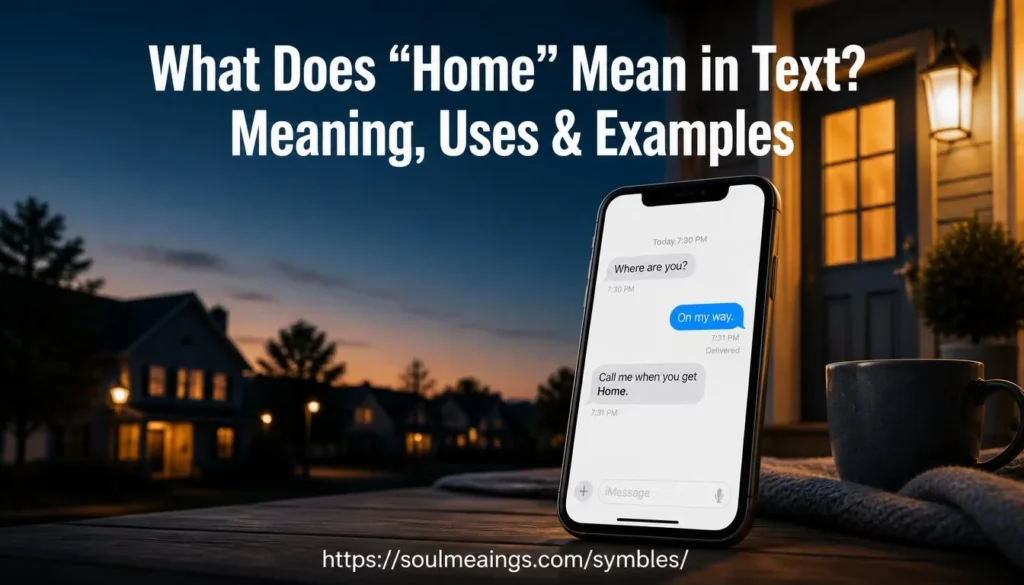
The home meaning in text can change based on the context, conversation, and relationship between the people involved.
Most often, home refers to the physical place or living place where someone lives. For example, “I’m home” usually means a person has arrived at their house, while “Are you home?” asks whether someone is there or available.
However, the word can also have an emotional meaning. A person might say “You feel like home” to describe someone who brings comfort, safety, familiarity, or a strong sense of belonging.
In text messages, online chats, and social media, people often use home in emotionally, socially, or symbolically meaningful ways. The exact meaning depends on the situation, relationship, and words around the message.
This is especially common in modern communication, where people use short phrases and leave out extra words. On platforms such as WhatsApp, Instagram, TikTok, and Snapchat, home can therefore mean a place, a feeling, or a connection.
Quick Answer: What Does “Home” Mean in Text?
“Home” in text usually means the place where someone lives or is staying. It can also refer to someone’s hometown, country, place of origin, or somewhere they feel they belong.
For example:
- “I’m home.” → I have arrived where I live.
- “Are you home?” → Are you at your residence?
- “I miss home.” → I miss my home, hometown, family, or familiar surroundings.
- “This feels like home.” → This place feels comfortable and familiar.
- “You feel like home.” → Being with you creates a strong feeling of comfort or belonging.
- “What’s up, home?” → In some slang contexts, “home” can work as a form of address similar to “homeboy.”
So, home doesn’t have one special texting definition. Context does most of the heavy lifting.
What Does “Home” Usually Mean in Text Messages?
Most of the time, there isn’t a hidden meaning at all.
When someone writes “I’m home,” they generally mean they’ve reached their residence. Cambridge defines home as the house or apartment where someone lives and also uses it as an adverb meaning “at or to your house or the place where you live.”
Consider this exchange:
Alex: Are you still at the office?
Sam: No, I’m home.
Here, “home” simply tells Alex where Sam is.
The same basic meaning appears in messages such as:
- “I’ll be home soon.”
- “I just got home.”
- “Call me when you get home.”
- “Are you home yet?”
- “I’m staying home tonight.”
- “I left my charger at home.”
Nothing mysterious is happening. The word works much like it does in ordinary conversation.
Why Does “Home” Sometimes Feel More Emotional?
Because home can mean more than a building.
Merriam-Webster includes meanings such as a familiar setting, a place of origin, and an environment where someone feels comfortable. Cambridge similarly defines home as a place where someone feels they belong.
That’s why a text such as “I miss home” can mean much more than missing a particular house.
Someone might miss:
- Their parents.
- Their childhood neighborhood.
- Their hometown.
- Familiar food.
- Family traditions.
- A sense of safety.
- A community where they belong.
In other words, home can describe a feeling as much as a location.
Is “Home” a Texting Acronym or Abbreviation?
No. “Home” is normally a regular English word, not a texting acronym.
You may find websites that invent letter-by-letter meanings for words such as HOME. Those aren’t standard definitions. The ordinary word doesn’t need a secret expansion.
There’s also an important distinction between home and abbreviations or slang forms that happen to look similar.
For example:
- Home = usually a residence, origin, or place of belonging.
- Homie = an informal term for a friend.
- Homeboy = an informal term historically associated with a male friend or person from one’s neighborhood or community.
- Homegirl = the corresponding feminine term.
The Oxford English Dictionary documents a slang use of home itself as a form of address equivalent to homeboy or, less often, homegirl. It dates that sense to the mid-20th century and notes its origins and historical association with African American usage.
That is a genuine documented use. It doesn’t mean every text containing “home” uses slang.
The Different Meanings of “Home” in Text
The easiest way to understand the word is to look at its major contexts.
| Context | Likely meaning | Example |
| Residence | The place where someone lives | “I’m home.” |
| Returning | Going back to a familiar place | “Heading home now.” |
| Hometown | A person’s place of origin | “I miss home.” |
| Country | A person’s native or adopted country | “The U.S. is home now.” |
| Belonging | A place where someone feels comfortable | “This feels like home.” |
| Emotional | A person or place associated with comfort | “You feel like home.” |
| Slang | Informal form of address | “What’s up, home?” |
These meanings overlap.
For instance, someone might call their childhood city “home” even though they now live somewhere else. Another person might call a new city home because they’ve built a life there.
Cambridge specifically recognizes home as both a place of origin and a place where someone feels they belong.
What Does “I’m Home” Mean in Text?
“I’m home” usually means “I have arrived at my residence.”
It often appears after someone has been traveling, working, studying, shopping, or spending time elsewhere.
For example:
“I’m home now. Want to talk?”
The first sentence provides a location update. The second tells you why that update matters.
Someone might also text:
“Finally home 😭”
The basic meaning remains the same. The emoji adds exhaustion, relief, frustration, or humor.
Likewise:
“I’m home ❤️”
The heart can make the message warmer. It doesn’t automatically create a romantic meaning.
Why Someone Might Text “I’m Home”
A person may send this message to:
- Let someone know they arrived safely.
- Tell a family member they’re back.
- Signal that they’re available to talk.
- End a conversation about travel.
- Reassure someone who was waiting for them.
- Explain why they can now call or reply.
The surrounding conversation gives you the missing pieces.
What Does “Are You Home?” Mean in Text?
“Are you home?” usually asks whether you’re currently at your residence.
However, the question can serve several purposes.
Someone might ask because they want to:
- Call you.
- Visit you.
- Drop something off.
- Check whether you arrived safely.
- Know whether you’re available.
- Make plans with you.
For example:
“Are you home? I have your book.”
That’s practical.
Now consider:
“Are you home? I need to talk.”
That message carries more urgency. Yet even here, the word “home” itself still refers to location.
This distinction helps prevent overinterpretation. The emotional tone often comes from the rest of the message rather than from the word home itself.
What Does “Home” Mean Emotionally in Text?
Sometimes home becomes a metaphor for comfort, safety, familiarity, or belonging.
This meaning isn’t merely an internet invention. Major dictionaries recognize broader senses of home that go beyond a physical residence. Merriam-Webster includes a “familiar or usual setting” while Cambridge describes home as a place where someone feels they belong.
That creates expressions such as:
- “This place feels like home.”
- “You feel like home.”
- “Being here feels like home.”
- “I finally found my home.”
- “My friends are my home.”
These statements use home as an emotional shortcut.
Think of it like this: a house gives you an address. A home can give you a sense of belonging.
What Feelings Can “Home” Represent?
Depending on the situation, the word can suggest:
- Comfort
- Security
- Familiarity
- Acceptance
- Peace
- Connection
- Belonging
- Nostalgia
Not every use contains all of these feelings. The exact meaning depends on the speaker.
Does “You Feel Like Home” Have a Romantic Meaning?
It can, but it isn’t automatically romantic.
When someone texts “You feel like home,” they’re usually describing a strong feeling of comfort and familiarity. The statement can be romantic when the surrounding conversation involves attraction or intimacy.
For example:
“After a stressful day, talking to you feels like home.”
That sounds emotionally intimate.
But friends can use similar language:
“We’ve known each other since childhood. You feel like home.”
Here, the message may describe deep friendship.
Family members can also inspire the same metaphor.
The important point is simple: don’t decide the relationship from one phrase alone.
Look at the broader conversation, previous messages, and the relationship between the people involved.
What Does “Home” Mean as Slang?
There is a real slang use of home that differs from the ordinary meaning.
The Oxford English Dictionary records home as slang, originally and chiefly associated with African American use, with a sense equivalent to homeboy or less frequently homegirl. It also notes that the word can function as a form of address.
For example, a person might use:
“What’s good, home?”
Here, “home” doesn’t mean someone’s house.
It functions more like an informal way of addressing a friend or acquaintance.
However, this usage shouldn’t be treated as universal. Slang depends heavily on community, generation, region, and personal style.
That’s especially important online. A phrase that sounds natural within one social group may sound unusual or outdated somewhere else.
“Home” vs. “Homie” vs. “Homeboy”
These words are related but aren’t interchangeable.
| Term | Typical meaning | Example |
| Home | Residence, origin, belonging, or informal address in some slang | “I’m home.” |
| Homie | Close friend or familiar person | “My homie picked me up.” |
| Homeboy | Informal term for a male friend or person from one’s community | “He’s an old homeboy.” |
| Homegirl | Informal term for a female friend or person from one’s community | “She’s my homegirl.” |
The safest approach is to read the entire sentence.
Compare:
“I’m going home.”
This clearly concerns a destination.
Now compare:
“What’s up, home?”
Here, “home” can function as an informal form of address.
The spelling alone doesn’t tell you everything. Grammar and context matter.
How Context Changes the Meaning of “Home”
Short messages can be surprisingly slippery.
Consider these examples:
| Text message | Most likely interpretation |
| “I’m home.” | The person has arrived at their residence. |
| “Going home.” | The person is traveling toward home. |
| “I miss home.” | They miss a familiar place, hometown, family, or origin. |
| “Back home.” | They have returned to or are referring to their familiar place. |
| “This feels like home.” | The place feels comfortable and familiar. |
| “You feel like home.” | The person creates a strong sense of emotional comfort. |
| “What’s up, home?” | Possible slang or informal address. |
A useful rule follows from these examples:
Never interpret “home” from the word alone when the surrounding message is available.
Look at the verb first.
“Going home” suggests movement.
“I’m home” suggests arrival or location.
“Feels like home” suggests emotion.
“What’s up, home?” may suggest slang.
One word. Several paths.
What Does “Home” Mean on Social Media?
Social media doesn’t automatically give home a new definition.
People still use it in its ordinary senses. However, short captions often make the emotional meaning more prominent.
You might see:
- “Home ❤️” beneath a family photograph.
- “Back home.” beneath a hometown photo.
- “Feels like home.” beneath a travel picture.
- “My kind of home.” beneath an interior-design post.
- “Home again.” after returning from a trip.
The image can supply information that the text leaves unstated.
For example, someone standing outside their childhood house and writing “Home” may be referring to their hometown or family history. Someone posting a picture of a new apartment might use the same word to celebrate a new residence.
That’s why social-media captions often require visual and conversational context, not just dictionary definitions.
What Does “Home” Mean When Someone Says “I Miss Home”?
This phrase deserves special attention because “home” can become deliberately broad.
Someone living away from their family might mean their parents’ house.
A college student might mean their hometown.
An immigrant might mean their country of origin.
A traveler might mean their current residence.
An adult might even say “I miss home” while referring mainly to the people who made that place meaningful.
Cambridge specifically notes that home can refer to a person’s place of origin and gives examples where someone lives elsewhere but still identifies another place as home.
So if someone texts:
“I really miss home tonight.”
Don’t automatically assume they mean a building.
They could be missing people, routines, memories, food, culture, or familiarity.
related post: What Does Sigma Mean? Slang, Meaning & Usage
What Does “Home” Mean When Someone Calls a Person “Home”?
When a person says “you are home” or “you feel like home,” the word becomes metaphorical.
They’re comparing the person to the emotional qualities associated with home.
That may include:
- Feeling understood.
- Feeling accepted.
- Feeling relaxed.
- Feeling safe.
- Feeling known.
- Feeling connected.
- Feeling able to be yourself.
For example:
“I can be myself around you. You feel like home.”
The speaker isn’t saying the other person is literally a house. They’re describing an emotional experience.
This can appear in romantic relationships. Yet it can also describe close friendships, family relationships, or a powerful connection with a community.
Common Text Examples Using “Home”
Everyday Texts
- “I’m finally home.”
- “Are you home yet?”
- “I’ll be home around eight.”
- “I forgot my keys at home.”
- “Call me when you get home.”
Family and Friends
- “Let me know when you get home.”
- “I miss home.”
- “Can’t wait to go home.”
- “Home feels different without everyone here.”
Romantic or Emotional
- “You feel like home.”
- “Being with you feels like home.”
- “I feel at home around you.”
- “You make anywhere feel like home.”
Travel and Hometown
- “Back home for the weekend.”
- “Nothing beats being home.”
- “Finally back home.”
- “Home will always be home.”
Informal or Slang Use
- “What’s up, home?”
- “Good to see you, home.”
The final category depends on the speaker’s social and linguistic context. The OED confirms that this slang use exists, but it isn’t the default meaning of the word.
How to Tell Which Meaning Someone Intended
When you’re unsure about a text containing home, use a simple context check.
Look at the verb
“Going,” “coming,” “leaving,” and “getting” usually point toward a physical destination.
Look for emotional language
Words such as “feel,” “miss,” “love,” “safe,” and “belong” can signal a deeper meaning.
Consider the relationship
A message between partners may carry different emotional weight than one between coworkers.
Check the previous messages
The answer often appears one or two messages earlier.
If someone says:
“The flight landed.”
Then:
“Finally home!”
The meaning is probably physical.
If someone says:
“I never feel judged around you.”
Then:
“You feel like home.”
The meaning is clearly emotional.
Watch for slang patterns
If “home” appears as a direct form of address, it may be slang.
That doesn’t make it a secret code. It simply means the speaker is using an established informal sense.
Common Misunderstandings About “Home” in Text
Several mistakes appear again and again when people try to decode ordinary words.
Assuming “Home” Is Always Slang
Most uses aren’t slang. “I’m home” is simply ordinary English.
Looking for an Official Full Form
There is no standard acronym expansion for the ordinary word home.
Confusing “Home” With “Homie”
These words overlap historically and culturally, but they aren’t synonyms in every situation.
Assuming “You Feel Like Home” Is Always Romantic
The phrase can be romantic. It can also describe friendship, family, or deep emotional trust.
Treating Social-Media Captions as Fixed Definitions
A caption such as “Home ❤️” can mean many things depending on the photo.
Ignoring the Conversation
The surrounding messages usually provide more information than the single word.
What Does “Home” Mean in Text? A Practical Comparison
Here’s a quick reference you can use when decoding a message:
| Message | Most likely meaning |
| “I’m home.” | I arrived at my residence. |
| “Are you home?” | Are you currently at your residence? |
| “I’m going home.” | I’m traveling toward my home. |
| “I miss home.” | I miss my home, hometown, family, or familiar surroundings. |
| “Back home.” | Back at or referring to a familiar place. |
| “This feels like home.” | This feels comfortable and familiar. |
| “You feel like home.” | You create a strong feeling of comfort and belonging. |
| “You are home to me.” | You represent emotional belonging or comfort. |
| “What’s up, home?” | Possibly an informal slang form of address. |
The table reveals an important pattern: the surrounding words determine the sense.
A Simple Case Study: One Word, Three Meanings
Imagine three people receive the message:
“Home.”
The meaning isn’t obvious until you know what came before it.
Case 1: After a long commute
“Traffic was awful. Home.”
Here, the person probably means “I’m home now.”
Case 2: During a conversation about childhood
“I haven’t visited in years. Home.”
Here, “home” may refer to a hometown or place of origin.
Case 3: During an emotional conversation
“I’ve never felt this comfortable with anyone. You feel like home.”
Now the word represents belonging and emotional comfort.
The spelling hasn’t changed.
The context has.
Frequently Asked Questions
1. What does “home” mean in text?
“Home” usually means the place where someone lives. However, depending on the context, it can also express comfort, safety, belonging, or an emotional connection.
2. What does “I’m home” mean in a text?
“I’m home” usually means the person has arrived at their house or usual place of residence. It can also reassure someone that they arrived safely.
3. What does “Are you home?” mean in texting?
“Are you home?” generally asks whether someone is currently at their home. Depending on the conversation, it may also ask whether they are available to talk or meet.
4. What does “You feel like home” mean?
“You feel like home” is usually an emotional expression. It means someone makes you feel comfortable, safe, familiar, or accepted.
5. Can “home” have a deeper meaning in text?
Yes. Home can describe more than a physical place. In personal conversations, it may represent emotional comfort, familiarity, security, belonging, or a strong connection with someone.
6. Does the meaning of “home” change on social media?
Yes. The meaning can change depending on the platform, conversation, and relationship. On WhatsApp, Instagram, TikTok, or Snapchat, it may be used literally, emotionally, casually, or symbolically.
Conclusion
The meaning of “home” in text depends largely on the context and the relationship between the people communicating. It can simply refer to a place where someone lives, as in “I’m home,” or carry a deeper emotional meaning, as in “You feel like home.”
Understanding the words around home is important because short messages can have several interpretations. Whether it describes a place, feeling, relationship, or sense of belonging, the surrounding conversation usually reveals what the sender truly means.

Sophia Wilson is a spiritual content writer and researcher at SoulMeanings.com, specializing in dream meanings, symbolism, spiritual insights, and personal growth topics that help readers navigate life’s journey with greater understanding.