
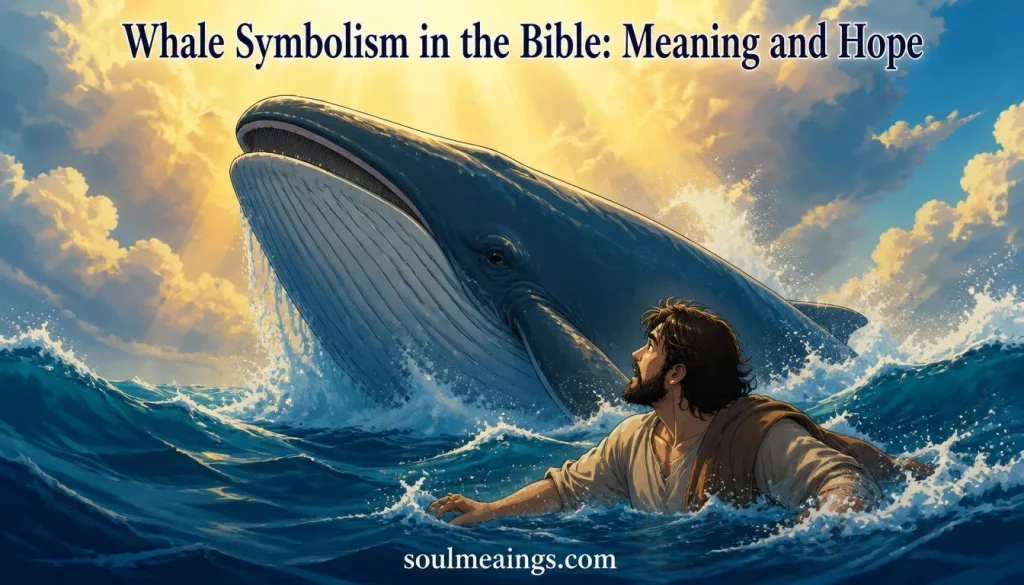
Whale Symbolism in the Bible connects the story of Jonah with faith, repentance, divine protection, and second chances.
The Bible describes a great fish swallowing Jonah and later releasing him. Although many imagine a massive whale, scripture calls it a great fish. This biblical story teaches obedience, forgiveness, and hope during difficult times.
It also represents life’s trials, spiritual reflection, and human survival. Through God’s divine power and guidance, believers can find renewal and personal growth, even in overwhelming circumstances.
Beyond Jonah’s story, whale symbolism carries deeper meanings across different cultures. Whales represent power, deep wisdom, mystery, and transformation. The mystic mandorla connects heaven and earth, symbolizing duality, balance, unity, and spiritual connection.
Historically, whales have also represented the body, grave, life, and death. Their spiritual significance appears in dreams, literature, religious beliefs, and modern applications. Overall, whale symbolism offers valuable biblical teachings, moral lessons, and spiritual insights about life’s challenges.
Quick Answer
Whale symbolism in the Bible primarily represents divine intervention, protection, repentance, and transformation. Through Jonah’s story, the great fish illustrates how God can provide another opportunity, even during moments of fear and uncertainty.
TL;DR
- The great fish represents divine intervention in Jonah’s story.
- Jonah’s experience teaches obedience, repentance, and renewed faith.
- Three days inside the fish connect with resurrection symbolism.
- Biblical sea creatures also demonstrate God’s extraordinary creative power.
- Christian artwork often connects the whale with death and rebirth.
- Modern interpretations emphasize hope, patience, and second chances.
What Does a Whale Represent in the Bible?
Whales carry several powerful associations in biblical interpretation. However, their meaning depends on the passage and its literary context. For American Christian readers, Jonah’s encounter provides the clearest starting point.
The Main Biblical Meanings
The whale or great fish commonly represents:
- Divine intervention: God provides a way forward during an impossible situation.
- Protection: Jonah survives an experience that would normally cause death.
- Repentance: His experience leads him toward prayer and renewed obedience.
- Transformation: His journey changes his understanding of God’s purpose.
- Hope: His release creates an opportunity to begin again.
These meanings aren’t all direct descriptions of a whale in scripture. Some developed through Christian teaching, artistic traditions, and later interpretation.
Why the Whale’s Meaning Matters
The creature represents something much greater than its physical size. It becomes part of a story about human weakness and divine authority.
Jonah cannot control the storm, the sea, or the creature. Nevertheless, his situation remains within God’s control. This contrast makes the great fish a memorable symbol of spiritual dependence.
The Story of Jonah and the Great Fish
The biblical story of Jonah appears in the Old Testament. It provides the foundation for most Christian interpretations of whale symbolism. The story focuses on a prophet who tries to escape a difficult responsibility.
Why Did the Great Fish Swallow Jonah?
God instructed Jonah to travel to Nineveh and warn its people. However, Jonah refused and boarded a ship heading toward Tarshish.
A powerful storm soon threatened the sailors. They eventually discovered Jonah’s involvement and threw him into the sea. Then, according to Jonah 1:17, God appointed a great fish to swallow him.
Jonah remained inside the creature for three days and three nights. During this experience, he prayed and recognized his need for God’s mercy.
Eventually, the fish released him onto dry land. Jonah then continued toward Nineveh and delivered God’s message.
The Spiritual Lessons Behind the Story
This account offers several lessons for readers today:
- Running away from responsibility can create further difficulties.
- Difficult experiences can encourage honest spiritual reflection.
- Repentance creates opportunities for meaningful change.
- Divine mercy can reach people during their darkest moments.
- A second chance can lead toward a better purpose.
Importantly, the story doesn’t present Jonah as a perfect person. Instead, his mistakes make his transformation more meaningful.
Is the Biblical Whale Actually a Whale?
One important detail often surprises modern readers. The Book of Jonah doesn’t specifically identify the creature as a whale. It describes the animal as a great fish.
This distinction matters when interpreting biblical symbolism. Popular American storytelling often uses the phrase “Jonah and the whale,” while biblical translations preserve different wording.
The Hebrew Meaning of Great Fish
Jonah 1:17 uses the Hebrew expression dag gadol, meaning a great fish. The original wording doesn’t identify a particular species.
Therefore, readers shouldn’t assume the creature was definitely a modern biological whale. It could represent a large sea creature within the narrative.
Why Do People Call It a Whale?
The association developed through translation and religious tradition.
In Matthew 12:40, Jesus compares his coming experience with Jonah’s three days inside the sea creature. The Greek word kētos refers broadly to a large sea creature or sea monster.
The King James tradition and later Christian storytelling helped establish the familiar whale image. Bible translations, illustrations, and children’s books strengthened this association.
Bible Gateway+2
The important spiritual message doesn’t depend on identifying the animal’s species. Instead, the story emphasizes God’s intervention and Jonah’s eventual obedience.
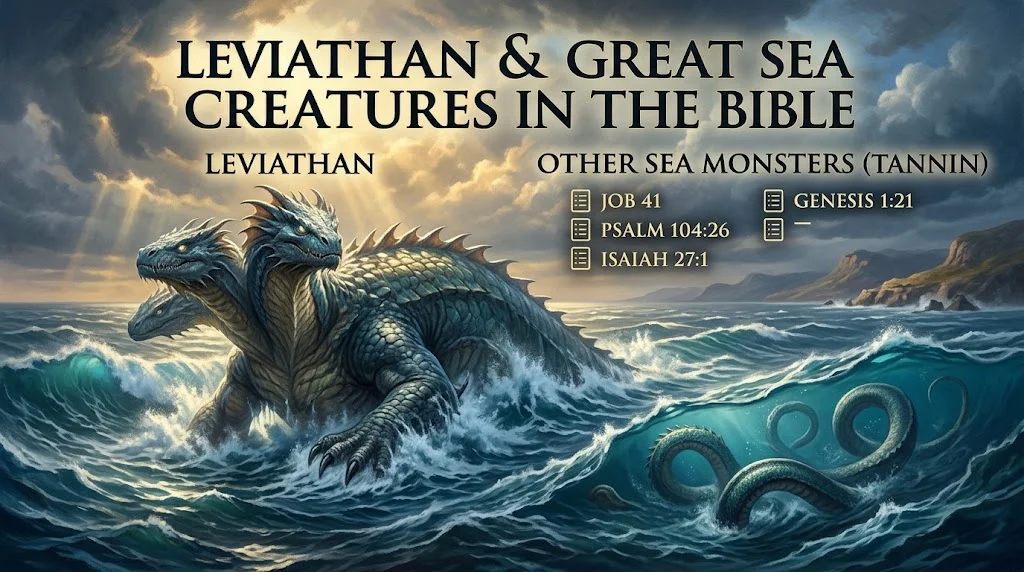
Leviathan and Other Great Sea Creatures in the Bible
The Bible contains several references to enormous sea creatures. However, these references don’t all describe ordinary whales. Some represent mysterious creatures associated with creation, danger, and divine authority.
Leviathan: A Powerful Sea Creature
Leviathan appears in Job 41, Psalm 74:14, Psalm 104:26, and Isaiah 27:1.
The Book of Job describes Leviathan as an extraordinary creature beyond human control. Its enormous strength demonstrates the limits of human power.
In Psalm 104:26, Leviathan appears among the creatures of the sea. This passage places the creature within God’s wider creation.
The Biblical Sea Monsters
Other passages use the Hebrew word tannin, often translated as sea monster, dragon, or serpent.
Genesis 1:21 describes God creating great sea creatures. Their presence demonstrates that even enormous and mysterious animals belong to creation.
These passages provide important context for understanding biblical sea imagery.
Important Biblical References
| Biblical passage | Creature or image | Common spiritual association | Main lesson |
| Jonah 1:17 | Great fish | Divine intervention | Mercy and obedience |
| Matthew 12:40 | Sea creature | Resurrection | Hope after suffering |
| Genesis 1:21 | Great sea creatures | Creation | God’s creative power |
| Job 41 | Leviathan | Uncontrollable strength | Human limitations |
| Psalm 104:26 | Leviathan | Wonder of creation | Divine sovereignty |
| Isaiah 27:1 | Leviathan | Victory over chaos | God’s authority |
These passages shouldn’t be treated as interchangeable descriptions. Jonah’s fish, Leviathan, and the great sea creatures have different literary roles.
Bible Gateway+2
Ancient Origins of Biblical Sea Creature Symbolism
Biblical sea imagery developed within an ancient world filled with stories about powerful waters and mysterious creatures. Understanding this background helps explain why enormous sea animals became meaningful religious images.
Ancient Near Eastern Beliefs
Ancient Mesopotamian and Canaanite traditions included stories about divine powers overcoming dangerous sea forces.
For example, Mesopotamian creation traditions describe Marduk’s conflict with Tiamat. Canaanite stories describe Baal’s struggle against Yamm, the sea.
These stories reflected ancient concerns about disorder, danger, and the forces of nature.
The Connection Between Leviathan and Lotan
The ancient Ugaritic texts mention a sea monster called Lotan. Scholars recognize important connections between Lotan and biblical Leviathan.
Both creatures belong to a wider tradition of powerful sea monster imagery.
However, biblical writers adapted these older images to express a different religious message. Rather than presenting God as one rival among competing divine powers, biblical passages emphasize God’s authority over creation.
This historical background helps explain the Bible’s use of sea monsters without confusing them with Jonah’s great fish.
Jewish Virtual Library+2
What These Ancient Images Represented
Ancient sea creature imagery commonly communicated:
- Fear of powerful and unpredictable natural forces.
- The struggle between order and chaos.
- The limits of human control over nature.
- The authority of the creator over creation.
Today, these ancient themes remain useful when readers explore biblical images of storms, oceans, and enormous creatures.
Whale Symbolism and the Resurrection of Jesus
One of the strongest Christian interpretations connects Jonah’s experience with the resurrection of Jesus Christ. This connection comes directly from the New Testament.
The Sign of Jonah
In Matthew 12:40, Jesus compares Jonah’s three days inside the great fish with his own time in the tomb.
This comparison gives Jonah’s experience a deeper Christian meaning. His return from the creature becomes an image of life emerging after an experience associated with death.
The comparison also appears in Matthew 16:4 and Luke 11:29–30.
Three Days as a Symbol of Renewal
The three-day period carries special importance in Christian interpretation.
It connects several ideas:
- Darkness before a new beginning.
- Suffering before deliverance.
- Death followed by resurrection.
- Waiting before a meaningful change.
- Faith during periods of uncertainty.
However, the whale itself isn’t presented as a direct symbol of Jesus in the biblical passage. The comparison concerns Jonah’s experience and its connection to Christ’s death and resurrection.
Early Christian Artwork
Early Christians frequently depicted Jonah and the great fish in burial settings.
A Roman Christian sarcophagus from the late third century illustrates Jonah’s story. The scene reflects the early Christian association between his deliverance and resurrection.
For these communities, the story offered a hopeful image of life beyond death.
Princeton University Art Museum+2
What Does Whale Symbolism Mean in American Christianity?
In the United States, Jonah and the whale remains one of the most recognizable biblical stories. Its familiar imagery appears in churches, religious education, children’s books, and Christian conversations.
Jonah in American Religious Education
Many American children first encounter the story through illustrated Bible books and Sunday school lessons.
Teachers often use Jonah’s experience to explain obedience, forgiveness, and God’s protection.
The enormous fish also makes the story memorable. Its unusual appearance helps young readers understand difficult spiritual lessons through a simple narrative.
The Whale in American Christian Art
American religious artwork frequently presents the creature as an enormous whale with an open mouth.
Common visual details include:
- A small boat surrounded by dark ocean waves.
- Jonah falling into deep blue water.
- A gigantic whale beneath the ocean surface.
- Jonah praying inside the creature’s belly.
- Bright light representing deliverance and hope.
These images reflect artistic tradition rather than precise zoological descriptions.
Why the Story Remains Relevant
The story continues to connect with everyday American experiences.
People may relate Jonah’s journey to:
- Facing responsibilities they’ve avoided.
- Finding courage during difficult circumstances.
- Asking for forgiveness after making mistakes.
- Learning patience during uncertain periods.
- Discovering hope after personal setbacks.
Consequently, the whale represents more than an unusual biblical animal. It provides a memorable way to discuss faith, accountability, and second chances.
read more: Dreaming of Spiders: Symbolism, Meaning and Life Lessons
Spiritual and Cross-Cultural Meanings of the Whale
Whale symbolism isn’t limited to Christianity. Different communities have developed their own relationships with whales through traditional stories, spiritual practices, and experiences with the natural world.
However, these meanings shouldn’t be confused with direct biblical teachings.
Jewish Interpretations
Jonah’s story belongs to the Hebrew Bible and is also read within Jewish tradition.
The Book of Jonah is traditionally read during Yom Kippur, the Jewish Day of Atonement. Its themes of repentance, mercy, and responsibility carry particular importance.
Later Jewish traditions also developed additional stories about Leviathan. These traditions sometimes describe the creature in connection with future redemption and divine judgment.
Indigenous and Pacific Traditions
Some Indigenous communities and Pacific Island cultures have longstanding relationships with whales.
Depending on the specific community, whales may connect with ancestry, navigation, family history, cultural identity, or the natural world.
These meanings vary considerably. There isn’t one universal Indigenous interpretation of whales.
Broader Spiritual Interpretations
In modern spiritual discussions, people sometimes associate whales with:
- Wisdom and deep understanding.
- Emotional depth and sensitivity.
- Connection with nature.
- Patience and inner strength.
- Protection during difficult transitions.
These are broader contemporary associations, not established meanings in the biblical text.
Emotional and Psychological Meaning of the Biblical Whale
The whale’s enormous size and mysterious underwater world create strong emotional associations. In biblical interpretation, these qualities help readers imagine experiences involving fear, uncertainty, and personal change.
Facing Fear and Uncertainty
Jonah enters the sea after refusing his responsibility. His experience places him in a situation beyond ordinary human control.
Psychologically, this can represent moments when people feel overwhelmed by circumstances. The great fish becomes an image of confronting difficult emotions rather than escaping them.
Finding Strength During Difficult Times
The story also encourages readers to consider how challenging experiences can change their perspectives.
The whale can suggest:
- Patience: Accepting that meaningful change takes time.
- Courage: Facing situations that initially seem frightening.
- Self-reflection: Examining personal decisions and behavior.
- Humility: Recognizing that people cannot control everything.
- Renewal: Finding opportunities after disappointment or failure.
The Meaning of Darkness
The darkness inside the fish often appears in modern interpretations as a metaphor for isolation.
It can represent a difficult personal season when someone needs time to reflect. However, the biblical narrative emphasizes prayer and deliverance rather than treating suffering as something automatically beneficial.
This distinction matters. Not every difficult experience has an obvious purpose, but the story offers hope during uncertainty.
Whale Symbolism in Modern Life and Popular Culture
Today, the whale appears in religious artwork, tattoos, jewelry, clothing, and home decorations. Its meaning often combines traditional biblical associations with broader ideas about nature and spirituality.
Whale Tattoos and Religious Meaning
Some people choose whale tattoos to express their Christian beliefs or personal experiences.
Common designs include:
- A whale with a small Jonah figure.
- Jonah inside an illustrated whale.
- A whale surrounded by ocean waves.
- A simple whale silhouette with a Bible verse.
- A whale combined with a cross or rays of light.
For some individuals, these tattoos represent God’s protection and the possibility of a second chance.
However, others choose whale tattoos for entirely different reasons. Their personal meaning may involve freedom, family, ocean conservation, or emotional strength.
Home Decor and Religious Artwork
Whale imagery can create a peaceful atmosphere in homes and personal spaces.
Popular choices include:
- Ocean-themed wall paintings.
- Jonah and the whale illustrations.
- Decorative whale sculptures.
- Religious prints featuring biblical sea imagery.
- Blue and white artwork inspired by ocean scenes.
In Christian homes, Jonah artwork may serve as a reminder of forgiveness and obedience.
Social Media and Digital Culture
Whale illustrations also appear on social media platforms such as Instagram, Pinterest, and TikTok.
People share biblical artwork, inspirational messages, and reflections about personal transformation.
However, a whale image doesn’t automatically communicate a Christian message. Its meaning depends on the accompanying words, design, and personal intention.
Common Misunderstandings About Whale Symbolism in the Bible
The popularity of Jonah and the whale has created several misunderstandings. Separating biblical details from later interpretations helps readers understand the story more accurately.
The Bible Doesn’t Clearly Identify Jonah’s Animal as a Whale
Jonah 1:17 describes a great fish. The specific animal species isn’t identified.
The familiar whale image developed through translation, interpretation, and artistic tradition.
Leviathan Isn’t Simply Another Name for Jonah’s Fish
Leviathan appears in different biblical passages with its own symbolic role.
Some interpretations connect Leviathan with a powerful sea monster. Jonah’s great fish, however, belongs to a separate narrative.
The Whale Doesn’t Always Represent Protection
In Jonah’s story, the great fish becomes an instrument of deliverance.
However, other sea creature images can communicate danger, mystery, and overwhelming power. Their meanings depend on the passage.
Difficult Experiences Aren’t Always Divine Punishment
Some readers interpret Jonah’s experience as a warning about disobedience.
Nevertheless, the story also emphasizes mercy, repentance, and restoration. It shouldn’t be used to claim that every personal hardship represents God’s punishment.
Modern Spiritual Meanings Aren’t Always Biblical Teachings
Associations such as emotional healing, intuition, and personal energy appear in contemporary spiritual discussions.
They may hold personal meaning, but scripture doesn’t establish them as universal whale symbolism.
How Whale Symbolism Has Changed Over Time
Whale imagery has developed through biblical interpretation, Christian art, literature, and modern popular culture.
Understanding these changes explains why the same creature can communicate several different ideas today.
Ancient Biblical Imagery
In ancient biblical literature, enormous sea creatures could represent the power of nature and the limits of human control.
Leviathan imagery also reflected older ancient Near Eastern traditions concerning the sea and chaos.
Early Christian Interpretations
Early Christians increasingly connected Jonah’s experience with Jesus’ resurrection.
Artists used the great fish as an image of death, deliverance, and renewed life. This interpretation became especially visible in early Christian burial artwork.
Medieval and Renaissance Artwork
During medieval and Renaissance periods, artists often portrayed Jonah’s creature as a strange sea monster.
Some images included dragon-like bodies, unusual heads, and exaggerated teeth. These designs reflected artistic imagination more than accurate whale anatomy.
aleteia.org+1
Modern Interpretations
Today, whale imagery appears in both religious and nonreligious settings.
Its meanings can include:
- Christian hope and resurrection.
- Protection during uncertain circumstances.
- Personal growth and second chances.
- Respect for marine life and nature.
- Emotional strength and spiritual reflection.
The traditional biblical meaning remains important. However, modern audiences often combine it with personal experiences and broader cultural associations.
FAQs About Whale Symbolism in the Bible
1. What does a whale symbolize in the Bible?
A whale or great fish symbolizes divine protection, faith, obedience, and transformation. Its meaning is closely connected to Jonah’s biblical story.
2. What is the spiritual meaning of the whale in the Bible?
The whale represents spiritual growth, hope, repentance, and second chances. It reminds believers that God can provide guidance during difficult times.
3. Why did the great fish swallow Jonah?
God appointed a great fish to swallow Jonah after he tried to escape his mission. This event gave Jonah time to reflect, pray, and return to obedience.
4. Does the Bible describe Jonah’s creature as a whale?
The Book of Jonah describes the creature as a great fish. The familiar image of a whale comes from later religious interpretations and storytelling traditions.
5. What life lessons does Jonah’s story teach?
Jonah’s story teaches obedience, forgiveness, patience, repentance, and faith. It also shows that mistakes do not have to prevent personal growth.
6. Does whale symbolism represent hope and transformation?
Yes, whale symbolism is often connected with hope, survival, renewal, and transformation. Jonah’s release from the great fish represents a new beginning.
Conclusion
Whale Symbolism in the Bible offers meaningful lessons about faith, hope, divine protection, and second chances. Through Jonah’s story, the great fish represents a time of reflection, repentance, and spiritual transformation. It reminds believers that even difficult experiences can lead to personal growth and renewed faith. Beyond biblical teachings, whales also symbolize wisdom, mystery, strength, and the connection between heaven and earth. Their deeper meaning encourages us to trust in divine guidance and face life’s challenges with patience and hope.

Sophia Wilson is a spiritual content writer and researcher at SoulMeanings.com, specializing in dream meanings, symbolism, spiritual insights, and personal growth topics that help readers navigate life’s journey with greater understanding.

Pingback: Number 10 Symbolism: Spiritual, Cultural & Numerology Meaning