


Sand Dollar Symbolism: Meaning, Peace and Transformation explores how ocean treasures connect beach discoveries with spiritual growth and inner peace.
Sand Dollar Symbolism connects the beauty of the ocean with spiritual growth, inner peace, and personal transformation. Beyond their natural beauty, sand dollars represent peace, tranquility, calmness, and harmony. Their circular shape and intricate designs are linked to abundance, prosperity, good fortune, and blessings across different folklore and cultural beliefs.
Finding a sand dollar while beachcombing can feel like discovering a special gift from nature. Washed ashore by ocean waves, these delicate treasures symbolize renewal, self-discovery, and personal growth.
Their connection to marine life, the sea, and ocean symbolism also reflects a deeper bond between the physical world and the divine. For many people, sand dollars inspire spiritual awakening, enlightenment, reflection, and transformation, reminding us to appreciate life’s hidden beauty and deeper meaning.
Quick Answer
In the United States, sand dollar symbolism commonly represents peace, spiritual faith, hope, and transformation. Its five-part design also connects with Christian folklore, while its connection to the ocean suggests renewal, emotional balance, and life’s natural cycles.
TL;DR
• Peace: Sand dollars represent calmness, harmony, and goodwill.
• Transformation: Their natural life cycle reflects change and renewal.
• Spirituality: Christian folklore connects their markings with Jesus Christ.
• Good Fortune: Finding one can feel like receiving a meaningful gift.
• Nature: They symbolize the beauty and mystery of ocean life.
• Modern Meaning: People use them in tattoos, jewelry, gifts, and coastal decor.
What Is a Sand Dollar?
A sand dollar is a flat marine animal related to sea urchins and starfish. Its rounded body and delicate markings make it one of the most recognizable treasures found along American beaches.
Although people often call it a shell, the white object collected on beaches is actually its internal skeleton. Scientists call this structure a test.
Appearance and Natural Features
A sand dollar has a distinctive appearance that contributes to its symbolic meaning.
Its main physical features include:
• A flat, circular body resembling an old silver coin.
• Five flower-like patterns arranged across its upper surface.
• Small openings that create distinctive shapes through its body.
• A pale white or cream color after washing ashore.
• A delicate structure that can break easily when handled.
Living sand dollars look quite different from the familiar white specimens. They usually have gray, brown, green, or purple coloring.
Tiny movable spines cover their bodies and help them move through sandy environments.
Why Does Its Shape Matter?
The five-part pattern resembles a flower, star, or compass. These visual features encourage people to connect sand dollars with harmony and natural balance.
However, the pattern has a biological purpose. It contains specialized structures associated with breathing and water movement.
Its beauty inspires spiritual interpretations, but its original design comes from nature.
Spiritual Meaning of Sand Dollar
The spiritual meaning of a sand dollar often centers on peace, hope, renewal, and personal growth. People may view finding one as a reminder to slow down and reconnect with themselves.
Its connection with the ocean also encourages reflection about life’s changing seasons.
Peace and Inner Calm
Sand dollars commonly represent peaceful energy and emotional balance.
Their gentle appearance and connection with quiet beaches make them natural symbols of relaxation.
People may associate them with:
• Releasing unnecessary worries and emotional tension.
• Finding balance during difficult periods of life.
• Creating peaceful relationships with others.
• Appreciating quiet moments and simple experiences.
• Developing patience during uncertain situations.
For many Americans, a sand dollar represents the peaceful feeling of walking beside the ocean.
Hope and Spiritual Guidance
Some people interpret a sand dollar as a reminder that hope remains possible during difficult experiences.
Its discovery may encourage someone to continue moving forward, even when life feels uncertain.
In spiritual settings, people sometimes connect its star-like pattern with divine guidance. However, this interpretation depends on personal beliefs rather than an established universal tradition.
Connection With Nature
Sand dollars also represent a deeper relationship with the natural world.
They remind people that even small creatures contribute to larger ocean ecosystems. Their delicate appearance can inspire greater appreciation for marine life.
Sand Dollar Symbolism in Christianity
One of the most recognizable interpretations of the sand dollar comes from American Christian folklore. This tradition connects its natural markings with the birth, crucifixion, and resurrection of Jesus Christ.
Some Christian communities call it the Holy Ghost Shell because of these religious associations.
The Five Holes and the Wounds of Christ
Traditional Christian interpretations connect the five openings with the wounds associated with Jesus’ crucifixion.
Four represent the wounds in his hands and feet. The fifth represents the wound in his side.
This interpretation turns the sand dollar into a visual reminder of sacrifice, suffering, and faith.
The Star of Bethlehem
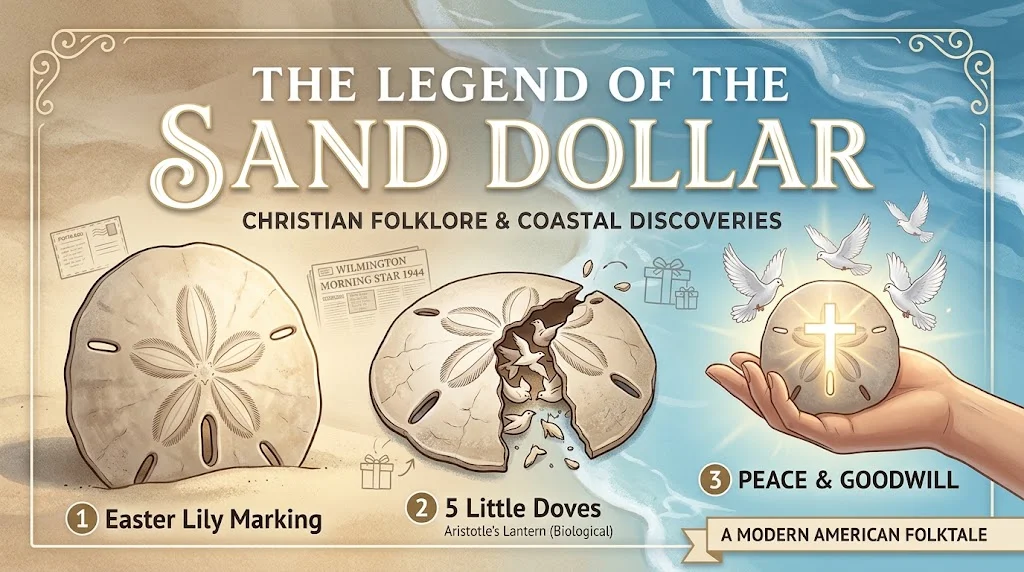
The flower-like pattern on the upper surface sometimes resembles an Easter lily.
Its center is interpreted as the Star of Bethlehem, which guided the biblical visitors toward the birthplace of Jesus.
For Christian believers, this connection represents divine guidance, hope, and the promise of salvation.
The Easter Lily and Christmas Poinsettia
Different parts of the sand dollar have inspired connections with two important Christian holidays.
• The Easter lily represents resurrection and new life.
• The Christmas poinsettia represents the celebration of Jesus’ birth.
• The five internal pieces resemble small doves.
• The doves represent peace, goodwill, and the Holy Spirit in some versions.
These interpretations are part of folklore, not scientific explanations of the animal’s anatomy.
Nevertheless, they remain meaningful to many people who appreciate religious symbolism in nature.
The Legend of the Sand Dollar
The sand dollar legend is a popular American coastal story that explains its unusual markings through Christian imagery. It has circulated through beach communities, religious gatherings, postcards, and souvenir shops.
Although its exact author remains unknown, historical records provide clues about its development.
Where Did the Legend Begin?
A version titled The Holy Ghost Shell appeared in the Wilmington Morning Star newspaper in North Carolina on January 15, 1944.
A Florida postcard collection also preserves a version published in 1954.
Over time, different versions added or emphasized religious details, including the Easter lily, Christmas poinsettia, and five doves.
This history suggests that the familiar legend developed through modern American religious folklore. There is no established evidence that it originated in ancient Christianity.
The Five Little Doves
One of the most memorable parts of the legend involves five small pieces found inside a broken sand dollar.
These pieces resemble tiny birds with folded wings.
Biologically, they are parts of the animal’s feeding structure, known as Aristotle’s lantern.
However, folklore interprets them as five white doves representing peace and goodwill.
This connection helps explain why sand dollars frequently appear in religious gifts and Christian beach souvenirs.
Why Does the Legend Remain Popular?
The story connects a simple natural object with familiar religious ideas.
It also offers a memorable way to teach children about Christian beliefs through something they can discover on a beach.
Today, the legend remains especially visible in American coastal communities.
Historical Origins and Cultural Background of Sand Dollars
Sand dollars belong to an ancient marine animal group with a long evolutionary history. However, their spiritual interpretations require a separate historical explanation.
Understanding this distinction helps prevent modern folklore from being mistaken for ancient tradition.
Ancient Biological Origins
Sand dollars belong to the echinoderm family, which includes sea stars, sea urchins, and sea cucumbers.
Their evolutionary relatives appeared millions of years ago. Fossil evidence shows that sand dollar-like animals developed during prehistoric geological periods.
Their five-part body organization is part of a broader pattern found throughout echinoderms.
Ancient observers also studied sea urchins and their unusual internal structures. Aristotle described the feeding apparatus of sea urchins, which later became known as Aristotle’s lantern.
Were Sand Dollars Ancient Symbols?
There is no strong historical evidence that ancient civilizations assigned sand dollars their familiar modern spiritual meanings.
However, shells and other marine materials held important cultural roles across many societies.
For example, Indigenous communities in North America used different types of shells to create beads, ornaments, and exchange materials.
Some coastal communities developed extensive shell-trading networks.
These traditions should not be confused with a specific ancient sand dollar belief.
How Did Their Modern Meaning Develop?
Their modern symbolism developed through several influences:
• Natural beauty inspired associations with peace and simplicity.
• Christian folklore connected their markings with biblical stories.
• American beach culture made them popular keepsakes.
• Coastal tourism increased their visibility in souvenirs and decorations.
• Modern spirituality expanded their associations with renewal and personal growth.
Therefore, today’s sand dollar meanings combine natural history, folklore, religious interpretation, and personal experience.
What Does a Sand Dollar Mean in American Culture?
In the United States, sand dollars have a strong connection with beaches, coastal vacations, family memories, and spiritual storytelling.
They are particularly familiar along the Atlantic, Gulf, and Pacific coasts.
For many Americans, finding one is part of the excitement of exploring the shoreline.
Beach Memories and Coastal Traditions
Sand dollars often remind people of childhood vacations and peaceful afternoons near the ocean.
They can represent:
• Family trips and memorable beach experiences.
• Relaxation away from busy everyday routines.
• Appreciation for coastal landscapes and marine wildlife.
• Childhood curiosity and discovering natural treasures.
• Personal connections with particular beaches or coastal towns.
American Religious and Holiday Traditions
Christian folklore gives sand dollars a special place in some American religious communities.
People sometimes display them during Christmas and Easter celebrations.
Their white appearance and religious associations make them popular choices for seasonal decorations.
However, not every American interprets sand dollars religiously. Many simply appreciate their natural design and connection with ocean life.
Symbolism Across Different American Contexts
| Context | Meaning in the USA | Common Associations | Notes |
| Beach culture | Peace and relaxation | Ocean vacations, memories | Popular coastal keepsake |
| Christianity | Faith and resurrection | Jesus, doves, Easter | Based on modern folklore |
| Spirituality | Renewal and guidance | Hope, personal growth | Personal interpretation |
| Home decor | Simplicity and tranquility | Coastal living | Popular decorative object |
| Gifts | Love and remembrance | Friendship, gratitude | Often given as a meaningful keepsake |
Sand Dollar Symbolism Across Cultures and Spiritual Traditions
Sand dollar symbolism isn’t identical across the world. Its meanings often depend on local traditions, religious beliefs, and relationships with the ocean.
However, broader shell symbolism provides useful cultural context.
Indigenous North American Traditions
Different Indigenous communities have long-standing relationships with coastal resources.
Shells have served practical, artistic, ceremonial, and economic purposes in various communities.
For example, historical shell-bead traditions among the Chumash of California included exchange, trade, and social relationships.
However, these practices involved specific shell materials and should not automatically be attributed to sand dollars.
There is no single Indigenous interpretation of sand dollar symbolism.
Broader Ocean Symbolism
Across different cultures, the ocean has inspired associations with creation, mystery, movement, and life’s changing cycles.
Because sand dollars live in marine environments, people may connect them with these broader themes.
Common interpretations include:
• Renewal through natural cycles and changing seasons.
• Emotional depth and the mystery of life.
• Connection with nature and the wider world.
• The movement between endings and new beginnings.
Personal Spiritual Interpretations
Modern spiritual communities sometimes interpret sand dollars as signs of encouragement or peaceful change.
Some people associate finding one with spiritual protection or reassurance.
These ideas are personal beliefs rather than universal religious teachings.
read more: Bee Symbolism: Meaning, Community and Life Lessons
Emotional and Psychological Meaning of Sand Dollar
Sand dollars can carry emotional meaning because they connect people with familiar experiences of nature, memory, and discovery.
Their appearance often creates feelings of calmness and appreciation.
Peace and Emotional Balance
The sand dollar’s gentle shape and coastal associations can remind people of peaceful environments.
Someone going through a stressful period might keep one as a reminder of calmer moments.
Its symbolism can encourage:
• Taking time to appreciate quiet surroundings.
• Finding comfort in familiar natural places.
• Creating healthier emotional boundaries.
• Practicing patience during uncertain experiences.
Transformation and Personal Growth
A sand dollar’s life cycle offers an interesting way to reflect on transformation.
The living animal eventually dies, leaving behind a delicate structure that can wash ashore.
This process can symbolize how change creates new perspectives.
People may connect it with moving beyond difficult experiences, accepting endings, and welcoming fresh opportunities.
Memories and Nostalgia
For many people, sand dollars carry personal memories.
A specimen collected during a family vacation may represent childhood, friendship, or time spent with someone special.
Therefore, its emotional meaning can be more personal than any traditional interpretation.
What Does Finding a Sand Dollar Mean?
Finding a sand dollar often feels like discovering a small natural treasure. In spiritual interpretations, people sometimes view the experience as a reminder of hope, good fortune, and positive change.
However, its meaning depends on the person and the circumstances.
Finding a Sand Dollar on the Beach
Some people interpret this discovery as a symbol of new beginnings.
It may encourage you to appreciate unexpected opportunities and remain open to positive experiences.
Common interpretations include:
• A reminder to welcome new experiences.
• Encouragement during periods of personal change.
• A symbol of peaceful moments and gratitude.
• A connection with nature and spiritual reflection.
Finding a Whole Sand Dollar
A complete sand dollar may symbolize wholeness, balance, and personal harmony.
Its circular shape can also suggest continuity and life’s repeating cycles.
Some people keep whole specimens as reminders of meaningful experiences.
Finding a Broken Sand Dollar
A broken specimen can inspire different interpretations.
Some people associate it with vulnerability, emotional healing, or accepting life’s imperfections.
Others see it as a reminder that beauty can remain meaningful even after change.
There is no universal spiritual meaning attached to finding a broken sand dollar.
Is Finding One Good Luck?
Many beachgoers consider finding a sand dollar a lucky experience.
Its rarity on a particular beach can make the discovery feel special.
Spiritually, some people connect it with hope, encouragement, and positive energy.
However, good fortune is a personal interpretation, not a scientifically established property.
Sand Dollar Symbolism in Dreams
Dreaming about sand dollars can reflect your feelings about peace, personal change, memories, or emotional security.
Dream meanings aren’t fixed predictions. Instead, the dream’s setting and your personal experiences can influence its interpretation.
Dreaming of Finding a Sand Dollar
Finding one in a dream may represent discovering something meaningful.
It can suggest:
• Recognizing an opportunity for personal growth.
• Feeling hopeful about an uncertain situation.
• Reconnecting with peaceful memories.
• Discovering something valuable about yourself.
Dreaming of a Broken Sand Dollar
A broken sand dollar may reflect feelings of change or emotional vulnerability.
It could represent a situation that no longer feels complete.
However, the dream might also encourage acceptance and personal growth.
Dreaming of Many Sand Dollars
Seeing several sand dollars may symbolize abundance, gratitude, or meaningful relationships.
The dream could reflect a desire for greater peace and stability.
Its meaning depends on whether the experience feels comforting, exciting, or overwhelming.
Modern Uses of Sand Dollar Symbolism
Today, sand dollars appear in jewelry, tattoos, coastal decorations, handmade crafts, and meaningful gifts.
Their simple design makes them easy to recognize and incorporate into different artistic styles.
Sand Dollar Tattoos
Sand dollar tattoos are popular among people who appreciate ocean life and coastal symbolism.
They can represent personal memories, spiritual beliefs, or meaningful life experiences.
Common tattoo interpretations include:
• Peace: A personal reminder to maintain emotional balance.
• Transformation: Acceptance of change and personal development.
• Faith: A connection with Christian beliefs and religious folklore.
• Family: Memories of meaningful beach experiences.
• Nature: Appreciation for the ocean and marine environments.
Some people combine sand dollars with waves, stars, seashells, or flowers.
Sand Dollars in Home Decor
Sand dollars are familiar decorative elements in American coastal homes.
Their pale colors and natural shapes work well with relaxed interior styles.
Popular uses include:
• Framed coastal artwork and decorative wall displays.
• Seashell collections and glass display containers.
• Beach-inspired wreaths and seasonal arrangements.
• Table decorations and handmade ornaments.
• Coastal-themed bathrooms and living spaces.
Sand Dollars as Gifts
A sand dollar can make a thoughtful gift because of its personal and symbolic associations.
People may give sand dollar jewelry or decorations to celebrate meaningful moments.
Examples include:
- Wedding favors representing peace and togetherness.
- Birthday gifts celebrating personal growth.
- Friendship keepsakes expressing appreciation.
- Christmas ornaments reflecting Christian folklore.
- Memorial gifts honoring special memories.
Sand Dollars in Social Media
On social media, sand dollars frequently appear in beach photography, travel posts, and nature-inspired content.
People may use their images to express peaceful feelings, summer memories, or spiritual reflections.
Unlike a standardized emoji, the sand dollar doesn’t have one universal digital meaning. Its interpretation depends on the accompanying message.
Misunderstandings and Controversies About Sand Dollar Symbolism
Sand dollar symbolism is generally positive, but several misunderstandings surround its history and natural identity.
Separating folklore from scientific facts helps people appreciate both.
Are Sand Dollars Actually Shells?
The white structure is technically called a test, not a traditional shell.
It is the hardened internal skeleton of a sea urchin relative.
This distinction matters because the living animal looks very different from the familiar beach specimen.
Is the Christian Legend Scientifically True?
The Christian legend gives spiritual meanings to the sand dollar’s physical features.
However, science explains these features through the animal’s anatomy.
For example:
- The five-part pattern supports specialized tube feet.
- The openings have natural anatomical functions.
- The internal pieces belong to the feeding apparatus.
- The white color develops after the animal dies and washes ashore.
The religious interpretation is folklore, not a biological explanation.
Does Every Culture Share the Same Meaning?
No. Different people and communities interpret natural objects differently.
Some connect sand dollars with Christian faith. Others associate them with beach memories, peace, or nature.
It’s important not to present one interpretation as a universal cultural belief.
Should You Collect Every Sand Dollar You Find?
Living sand dollars are marine animals, not ordinary beach souvenirs.
Collecting live specimens can disturb coastal ecosystems.
In addition, local beach regulations may restrict collecting shells or other marine life.
When possible, observe living animals in their natural environment and leave them undisturbed.
How Sand Dollar Meanings Have Changed Over Time
Sand dollar symbolism has developed through natural observation, religious storytelling, beach traditions, and modern spiritual interpretations.
Its meaning has never remained completely fixed.
From Marine Animal to Beach Treasure
Originally, sand dollars existed as living creatures within sandy ocean environments.
Their flat bodies and coin-like appearance eventually inspired their familiar English name.
When their skeletons washed ashore, people began collecting them as natural keepsakes.
Growth of Christian Folklore
During the twentieth century, American coastal folklore connected sand dollar markings with Christian imagery.
The Holy Ghost Shell tradition helped establish associations with Jesus, peace, resurrection, and goodwill.
Printed postcards and souvenir materials helped circulate these interpretations.
Modern Spiritual and Personal Meanings
Today, sand dollars represent different ideas depending on personal beliefs.
Their symbolism has expanded beyond religious storytelling.
Modern interpretations commonly emphasize:
• Emotional peace and personal balance.
• Transformation and acceptance of change.
• Spiritual encouragement and hope.
• Gratitude for nature and meaningful experiences.
• Personal memories and connections with loved ones.
This evolution explains why the sand dollar remains meaningful to different generations.
FAQs About Sand Dollar Symbolism
1. What does a sand dollar symbolize?
A sand dollar commonly symbolizes peace, tranquility, abundance, and spiritual connection. It can also represent personal growth and transformation.
2. What is the spiritual meaning of finding a sand dollar?
Finding a sand dollar may symbolize renewal, good fortune, blessings, and spiritual awakening. Many people view it as a reminder to welcome positive changes.
3. Do sand dollars symbolize peace?
Yes, sand dollars are often associated with peace, calmness, and harmony. Their gentle ocean connection reflects emotional balance and inner peace.
4. What does a sand dollar symbolize in Christianity?
In some Christian traditions, sand dollars represent the story of Jesus Christ, including his birth, crucifixion, and resurrection. Their markings are sometimes connected with religious symbolism.
5. Are sand dollars considered good luck?
Many people consider sand dollars symbols of good luck, prosperity, and blessings. Finding one may feel like a positive sign of hope and new opportunities.
6. What does a sand dollar tattoo mean?
A sand dollar tattoo can represent peace, transformation, ocean connection, and spiritual growth. It may also express a person’s love for the sea and meaningful life experiences.
Conclusion
Sand Dollar Symbolism offers a beautiful reminder of peace, abundance, renewal, and transformation. These delicate ocean treasures represent more than natural beauty. They connect the sea with ideas of spiritual growth, inner wisdom, and personal discovery. Whether found on a beach, kept as a souvenir, or chosen as a tattoo, a sand dollar can hold a special meaning. Its symbolism encourages us to welcome change, appreciate life’s simple moments, and find peace within ourselves.

Mark Taylor is a content writer at soulmeaings.com. He writes clear, research-based articles on symbolism, spiritual meaning, and cultural interpretation, helping readers understand the ideas behind the symbols they encounter.