
Eyes Symbolism: What Eyes Mean in History and Today explores how eyes represent vision, wisdom, protection, truth, and spiritual insight across different cultures and generations.
Throughout human history, eyes have been powerful symbols in ancient civilizations, religious traditions, and diverse cultures. Ancient artifacts, religious iconography, and talismans often used eye symbols to represent protection, spiritual awareness, knowledge, and safeguarding.
These symbols reflected historical beliefs and cultural practices, making eyes an important part of cultural heritage and spiritual symbolism.Today, eye symbolism also represents personal identity, honesty, awareness, love, and attraction. In American culture, common phrases like “keep your eyes open” and “the eyes tell all” connect eyes with truth and human expression.
Eyes also appear in tattoos, jewelry, home decor, movies, and social media, where they can express mystery, comfort, danger, and watchfulness. Whether seen as protective symbols or expressions of emotion, eyes continue to influence how people understand themselves and others.
Quick Answer
In American culture, eyes symbolism commonly represents truth, awareness, intelligence, protection, and the ability to see beyond appearances. Across different cultures, eyes can also symbolize spiritual guidance, divine observation, intuition, and protection against negative energy.
TL;DR
- Eyes commonly represent wisdom, truth, awareness, and understanding.
- Ancient Egyptians connected eye symbols with protection and healing.
- American culture often associates eyes with honesty and observation.
- Spiritual traditions connect eyes with divine awareness and intuition.
- Eye tattoos can express individuality, protection, and personal insight.
- Modern eye imagery appears in fashion, art, jewelry, and media.
What Do Eyes Symbolize?
Eyes carry several meanings because they help people understand and connect with the world. Their symbolism depends on expression, direction, color, and cultural setting.
The Main Symbolic Meanings of Eyes
Wisdom and knowledge: Eyes represent the ability to learn, observe, and understand situations. They suggest looking beyond surface appearances.
Truth and honesty: Direct eye contact often communicates sincerity. In everyday American life, people may associate honest eyes with trustworthiness.
Protection and watchfulness: Eye-shaped charms represent protection in several cultural traditions. They also suggest someone is watching over a person or place.
Intuition and awareness: Eyes can represent inner understanding and attention. They remind people to notice details and trust their observations.
Different Eye Expressions and Their Meanings
The expression of an eye can change its symbolic message.
- Open eyes often represent awareness, curiosity, and new understanding.
- Closed eyes suggest rest, reflection, peace, or withdrawal.
- Crying eyes represent sadness, emotional release, and vulnerability.
- Wide eyes communicate surprise, wonder, or sudden realization.
- A single eye can represent focus, mystery, or spiritual observation.
Historical Origins of Eye Symbolism
The history of eye imagery reaches back thousands of years. Ancient communities used eye shapes in religious objects, sculptures, jewelry, and protective decorations.
Ancient Mesopotamian Roots
Some of the earliest known eye-related beliefs appeared in ancient Mesopotamia. Written traditions included protective rituals against harmful gazes. These practices reflected concerns about envy, danger, and unseen forces.
Large eyes also appeared in ancient sculptures. In some Sumerian religious figures, unusually large eyes suggested attention, devotion, and communication with divine powers.
Ancient Egyptian Eye Symbolism
Ancient Egypt developed some of history’s most recognizable eye imagery. The Eye of Horus, also called the Wedjat, became a powerful protective symbol.
According to Egyptian mythology, Horus lost an eye during a struggle with Seth. The eye was restored through divine healing.
As a result, it became associated with:
- Protection against danger and harmful forces.
- Healing, restoration, and physical well-being.
- Wholeness after loss or suffering.
- Renewal, strength, and spiritual continuity.
Egyptians used eye-shaped amulets in jewelry, burials, and other religious settings. These objects reflected hopes for safety in life and beyond.
American Academy of Ophthalmology+1
Greek and Roman Interpretations
Ancient Greek and Roman societies also connected eyes with personal power. The idea of the evil eye described harm caused by an envious or hostile gaze.
People feared that excessive admiration or jealousy could bring misfortune. Therefore, protective charms became part of everyday cultural practices.
These beliefs influenced later Mediterranean traditions. They also helped preserve the eye as an important protective symbol.
The Eye in Medieval and Renaissance Art
During medieval and Renaissance periods, European religious art frequently used eyes to represent divine knowledge. Artists depicted eyes within rays of light or triangular shapes.
The imagery communicated the idea of a higher power observing human actions. Eventually, the Eye of Providence became an important image in Western religious and civic symbolism.
read more: Bats Symbolism: Spiritual, Cultural & Literary Meaning
Eyes Symbolism in American Culture
In the United States, eyes appear in national symbols, religious artwork, advertising, entertainment, and everyday expressions. Their meanings often connect personal freedom, honesty, observation, and divine guidance.
The Eye of Providence on American Currency
One of America’s most recognizable eye symbols is the Eye of Providence. It appears above an unfinished pyramid on the reverse of the Great Seal.
The Great Seal was officially adopted on June 20, 1782. Its design developed through several committees after American independence.
The eye represents divine Providence and the idea of guidance over the nation’s beginnings. The unfinished pyramid represents strength and duration.
Today, Americans encounter this image on the one-dollar bill. It connects eye symbolism with national history, independence, and the country’s founding ideals.
National Archives+1
Eyes and American Social Values
Eyes also carry everyday meanings in American communication.
For example, direct eye contact is often viewed as a sign of confidence and attention. However, expectations vary across individuals and cultural backgrounds.
Common American associations include:
- Eye contact as a sign of honesty and engagement.
- Observant eyes as a symbol of intelligence and awareness.
- Bright eyes as an expression of excitement and enthusiasm.
- Watchful eyes as a sign of responsibility and protection.
- Eyes in public artwork as reminders of freedom and human dignity.
The Eye in American Popular Culture
Movies, television, photography, and advertising frequently use eye imagery. A close-up of someone’s eyes can communicate fear, affection, suspicion, or determination.
Meanwhile, surveillance imagery connects eyes with privacy and public safety. This creates a more complicated meaning involving observation, authority, and personal freedom.
Spiritual Meaning of Eyes
Eyes have spiritual meanings in many traditions. They can represent divine awareness, inner understanding, protection, and the connection between physical and spiritual life.
However, these interpretations aren’t identical across religions. Their meanings depend on individual beliefs and cultural practices.
Divine Vision and Higher Awareness
In several religious traditions, an all-seeing eye represents a higher power’s awareness. It suggests that nothing remains hidden from divine knowledge.
The Eye of Providence is one example of this idea. Its triangular design and surrounding rays communicate divine guidance and watchfulness.
The Third Eye and Inner Wisdom
The third eye is different from ordinary eye symbolism. It generally refers to inner awareness, intuition, and spiritual insight.
In some Hindu traditions, the third eye is associated with Shiva. It can represent higher knowledge and the ability to recognize deeper truths.
Some Buddhist and modern spiritual interpretations also connect inner vision with wisdom and awareness. However, meanings differ across schools and communities.
The Evil Eye and Spiritual Protection
The evil eye is a belief that an envious or harmful gaze can bring misfortune. It appears in different forms across Mediterranean, Middle Eastern, and South Asian cultures.
The traditional blue eye charm, often called a nazar, is commonly used as a protective object. People display it in homes, vehicles, and jewelry.
In the United States, these charms also appear in multicultural communities and contemporary fashion.
American Academy of Ophthalmology+1
Eye Symbolism Across Cultures
| Cultural context | Common meaning | Common associations | Notes |
| Ancient Egypt | Healing and protection | Eye of Horus | Connected with restoration |
| Ancient Greece | Protection from envy | Evil eye | Protective charms developed |
| Hindu traditions | Inner awareness | Third eye | Associated with spiritual insight |
| Islamic cultures | Protection | Nazar and hamsa | Practices vary among communities |
| American civic imagery | Divine Providence | Eye above pyramid | Appears on the Great Seal |
Psychological and Emotional Meaning of Eyes
Eyes communicate feelings before people speak. Their expressions can suggest emotional states, personal attitudes, and relationships.
Eyes as Windows to Emotions
People often describe eyes as windows to the soul. This expression reflects the belief that someone’s gaze can reveal their inner feelings.
For example, soft eyes may suggest kindness. Meanwhile, narrowed eyes can communicate suspicion, concentration, or discomfort.
Common emotional associations include:
- Gentle eyes represent warmth, compassion, and emotional connection.
- Sad eyes suggest grief, disappointment, or loneliness.
- Confident eyes communicate courage and self-belief.
- Tired eyes may symbolize exhaustion or emotional struggle.
- Curious eyes represent openness and a desire to learn.
Eyes and Self-Awareness
Eyes can also represent the ability to recognize personal strengths and weaknesses. Looking inward becomes a metaphor for understanding yourself.
In literature and personal development, this idea often connects with reflection. It encourages people to question assumptions and recognize different perspectives.
The Fear of Being Watched
Eyes don’t always create positive feelings. Sometimes, they represent judgment, exposure, or unwanted attention.
For example, surveillance cameras can make people feel uncomfortable. Similarly, an intense stare may communicate pressure or intimidation.
Therefore, eyes can symbolize both safety and vulnerability.
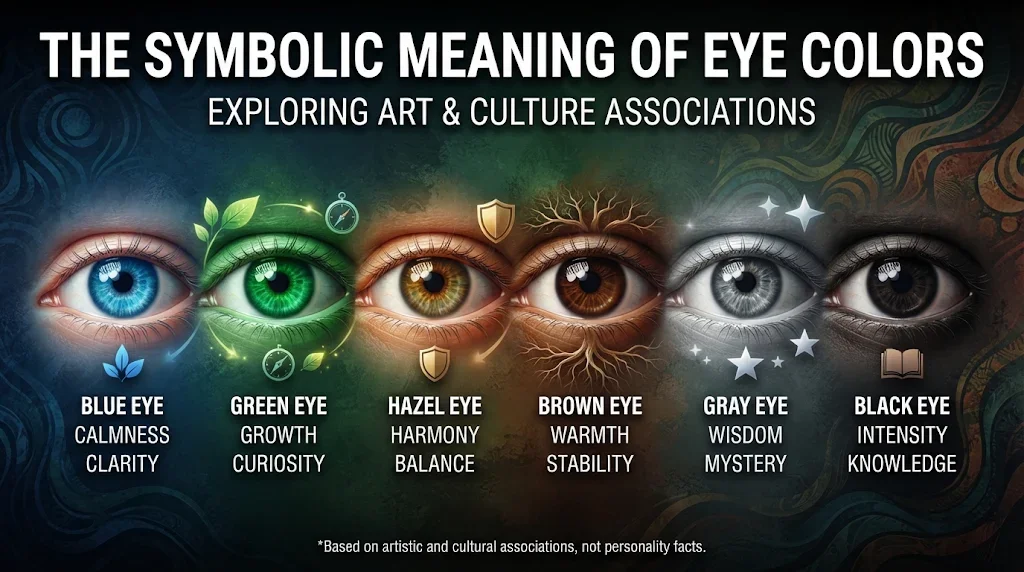
Meaning of Eye Colors in Symbolism
Eye colors add another layer of meaning. Although natural eye colors don’t have fixed symbolic definitions, art and popular culture often give them emotional associations.
Blue Eyes
Blue eyes are often associated with calmness, clarity, openness, and peace. In symbolic artwork, they may represent emotional honesty and spiritual awareness.
Blue also appears frequently in evil eye charms. In that setting, it connects with traditional ideas of protection.
Brown Eyes
Brown eyes often symbolize warmth, stability, reliability, and connection with nature. Their earthy appearance makes them common symbols of comfort and grounded emotions.
Green Eyes
Green eyes can represent growth, mystery, renewal, and curiosity. They also appear in creative works as symbols of independence and individuality.
Gray Eyes
Gray eyes often suggest wisdom, mystery, neutrality, and emotional depth. Their changing appearance can make them useful symbols of uncertainty and complexity.
Black and Dark Eyes
Dark eyes can represent mystery, strength, intensity, and hidden knowledge. In some artistic settings, they communicate seriousness or emotional depth.
Important: These are artistic and cultural associations, not facts about someone’s personality. Eye color doesn’t determine character, intelligence, or emotional behavior.
Modern Uses of Eye Symbolism
Today, eyes appear in fashion, home decoration, digital communication, and personal artwork. Their recognizable shape makes them easy to use in different creative settings.
Eye Tattoos and Personal Identity
Eye tattoos are popular among people who want meaningful personal artwork. Their designs can communicate different experiences and beliefs.
Common eye tattoo meanings include:
- Wisdom: Learning from experiences and understanding life.
- Protection: Feeling watched over or spiritually supported.
- Awareness: Paying attention to personal growth and surroundings.
- Truth: Valuing honesty and recognizing hidden realities.
- Memory: Remembering someone important or a meaningful experience.
- Mystery: Expressing individuality and interest in deeper meanings.
Some people choose an eye tattoo after overcoming difficult experiences. Others use it to represent faith, personal identity, or curiosity.
Eye Jewelry and Fashion
Eye-shaped jewelry is common in contemporary fashion. Necklaces, rings, bracelets, and earrings often feature protective eye designs.
The blue evil eye charm is especially recognizable. Some people wear it for traditional spiritual reasons, while others appreciate its appearance.
Eyes in Home Decor
Eye imagery also appears in wall art, decorative ceramics, textiles, and small ornaments.
In American homes, these objects may serve different purposes:
- Creating a mysterious or artistic atmosphere.
- Expressing interest in ancient cultural traditions.
- Representing personal beliefs about protection.
- Adding colorful details to modern interiors.
Eyes on Social Media
Eye imagery has become common in digital communication. People use eye illustrations, photographs, and emojis to express attention or curiosity.
The eyes emoji (👀) is especially popular in online conversations. Depending on context, it can mean:
- I’m watching or paying attention.
- Something interesting has happened.
- I’m curious about the situation.
- I’ve noticed something surprising.
- I’m waiting for more information.
Its meaning depends heavily on the conversation.
Eyes in Literature, Art, and Popular Media
Writers and artists have used eyes to communicate ideas that words sometimes struggle to express. Their imagery can reveal characters, build suspense, and explore human nature.
Eyes as Symbols in Literature
In literature, eyes frequently represent knowledge, truth, and personal judgment. A character’s gaze may reveal something that dialogue cannot.
Writers also use blindness and vision as metaphors. Seeing can represent understanding, while blindness may represent ignorance or refusal to accept reality.
Eyes in Paintings and Photography
Artists often place eyes at the center of their compositions. This draws attention toward identity, consciousness, and observation.
A single eye can create mystery. Meanwhile, multiple eyes may suggest surveillance, collective awareness, or overwhelming attention.
Photography also uses close-up eye images to capture emotion. Even small changes in expression can create powerful visual messages.
Eyes in Movies and Entertainment
In American entertainment, eyes often communicate hidden information. Horror films use unusual eyes to create fear and uncertainty.
Mystery stories use watchful eyes to suggest secrets or surveillance. Romantic films often use eye contact to communicate attraction and emotional connection.
Misunderstandings and Controversies About Eye Symbolism
Eye symbols have many meanings, but their popularity can create confusion. Understanding their original contexts helps prevent incorrect assumptions.
The Eye of Providence Is Not Automatically a Secret Society Symbol
Some people connect the all-seeing eye with secret organizations or hidden political control. These interpretations often appear in conspiracy theories.
However, the eye on the Great Seal has a documented historical explanation. It represents divine Providence and appears in the original American national design.
Its presence alone doesn’t prove secret activity or hidden control. Historical context matters more than speculation.
The Evil Eye Is Not the Same as an Ordinary Eye
The evil eye refers to a particular cultural belief about harmful gazes. It isn’t simply another name for the physical human eye.
Likewise, not everyone who wears a blue eye charm follows the same religious or spiritual tradition. Some people wear it for fashion, while others value its traditional meaning.
Cultural Appropriation and Respect
Eye symbols have deep roots in different communities. Using them without understanding their background can sometimes create misunderstandings.
A respectful approach includes:
- Learning the cultural background before using traditional symbols.
- Avoiding claims that all cultures share identical beliefs.
- Recognizing religious and personal meanings behind protective objects.
- Distinguishing traditional practices from modern fashion trends.
These considerations help preserve cultural meaning without restricting creative expression.
How Eye Symbolism Has Changed Over Time
Eye symbolism has evolved as societies developed new beliefs, technologies, and forms of communication. Its central connection with observation and awareness has remained remarkably strong.
From Ancient Protection to Modern Identity
In ancient communities, eye-shaped objects often served protective purposes. People used them to express hopes for health, safety, and spiritual support.
During later religious periods, eyes became associated with divine knowledge. European artwork helped popularize the image of an eye representing higher awareness.
In American history, the Eye of Providence became part of national symbolism. Today, people encounter it through currency, historical artwork, and public discussions.
The Influence of Technology
Modern technology has introduced new meanings.
Security cameras, facial recognition, and digital tracking have made eyes symbols of surveillance. Meanwhile, photography and social media have strengthened their connection with personal identity.
Today, eye imagery can communicate both freedom and control. This reflects changing concerns about privacy and public observation.
Which Meanings Remain Important Today?
Several traditional meanings remain popular in modern American culture:
- Protection: Evil eye jewelry continues to appear in fashion and homes.
- Wisdom: Eyes remain common symbols of knowledge and learning.
- Awareness: Modern art connects eyes with consciousness and attention.
- Divine guidance: The Eye of Providence retains historical and religious importance.
- Identity: Eye tattoos and portraits express individual experiences.
The symbol continues to evolve because people still connect sight with understanding.
Frequently Asked Questions
1. What do eyes symbolize?
Eyes commonly symbolize truth, wisdom, awareness, knowledge, protection, and perception. Their meanings can vary across cultures and traditions.
2. What does the eye symbol mean spiritually?
Spiritually, the eye often represents spiritual insight, enlightenment, awareness, and divine protection.
3. What does the evil eye symbolize?
The evil eye is traditionally associated with protection against jealousy, negative energy, and harmful intentions.
4. Why are eyes important in ancient cultures?
Ancient cultures used eye symbols in religious art, artifacts, and talismans to represent protection, wisdom, power, and spiritual awareness.
5. What does an eye tattoo symbolize?
An eye tattoo can represent protection, intuition, truth, observation, personal identity, and spiritual awareness.
6. What do eyes symbolize in modern society?
Today, eyes often represent honesty, attraction, emotional expression, awareness, and human connection. They are also popular symbols in fashion, jewelry, art, and social media.
Conclusion
Eyes have carried powerful meanings throughout history, representing wisdom, truth, protection, awareness, and spirituality. From ancient religious symbols and protective talismans to modern tattoos, jewelry, and social media, eye symbolism continues to influence how people express emotions and identity. Whether viewed as a sign of protection or a reflection of inner feelings, eyes remain meaningful across cultures and generations.

Sophia Wilson is a spiritual content writer and researcher at SoulMeanings.com, specializing in dream meanings, symbolism, spiritual insights, and personal growth topics that help readers navigate life’s journey with greater understanding.


Pingback: Rook Symbolism: Chess Piece, Rook Bird, Piercings and Tattoos
Pingback: Chinese Color Symbolism: Meanings, Myths and Modern Life