
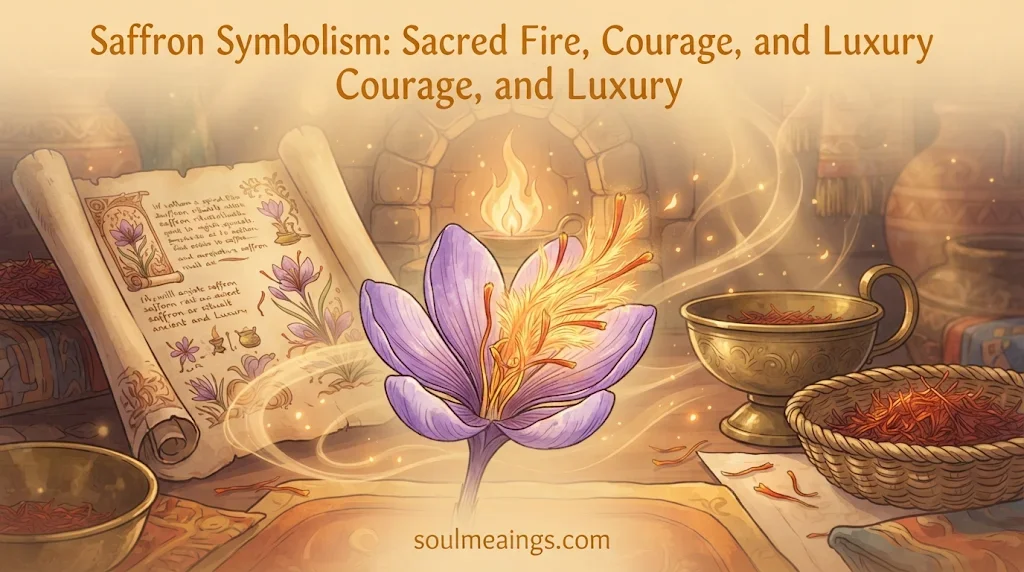
Saffron symbolism reflects the beauty, rarity, and cultural importance of this treasured spice.
The Saffron Crocus (Crocus sativus) produces delicate purple flowers during autumn, but its greatest value lies in its red stigmas, which create the world’s most valuable spice.
Harvested for thousands of years, saffron produces a rich golden-orange color that represents beauty, wealth, and luxury. Its rarity and historical importance have made it a precious part of ancient cultures.
Across different civilizations and cultures, saffron has symbolized prosperity, happiness, purity, and wisdom. Ancient kings valued it as a sign of royal luxury, wealth, and abundance. Its connection with spirituality, religion, and divine energy also gives it deep sacred meaning.
In religious and cultural traditions, saffron represents sacred fire, sacrifice, enlightenment, and courage. Its warm golden shade further reflects positivity, admiration, and spiritual significance, making saffron an enduring symbol of both material luxury and sacred beauty.
Quick Answer
Saffron symbolism in the United States primarily represents spiritual warmth, courage, wisdom, creativity, and refined luxury. Across broader cultural traditions, it also represents purity, sacrifice, devotion, prosperity, and enlightenment.
TL;DR
- Saffron represents sacred fire, spiritual awareness, and inner strength.
- Its golden color traditionally suggests wealth, prestige, and abundance.
- Ancient civilizations valued saffron as a precious dye and fragrance.
- Hindu and Buddhist traditions connect saffron-colored garments with spiritual devotion.
- In America, saffron suggests warmth, creativity, confidence, and sophistication.
- Modern uses include tattoos, fashion, home decor, and cultural celebrations.
1. What Does Saffron Symbolize?
Saffron is a distinctive golden-orange color between yellow, amber, and orange. Its appearance combines the brightness of sunlight with the warmth of fire. Consequently, it often communicates energy without appearing as aggressive as bright red.
For American readers, saffron offers a useful combination of traditional and modern meanings. It can suggest spiritual depth, personal confidence, and expensive taste within the same visual design.
The Three Core Meanings
Sacred fire and spiritual awareness
Saffron’s connection with fire makes it a powerful image of transformation. Fire provides warmth, destroys what has become useless, and creates opportunities for renewal.
Courage and inner strength
Its bold appearance suggests confidence, determination, and willingness to face challenges. Therefore, people may choose saffron when expressing personal growth or resilience.
Luxury and abundance
Historically, saffron was expensive and difficult to produce. Its golden appearance also resembles precious metals, making it a natural symbol of exclusivity and prosperity.
How Saffron Looks
Saffron isn’t one perfectly fixed shade. Depending on lighting, materials, and cultural traditions, it can appear more yellow, orange, or reddish.
- Golden saffron suggests wealth, sunlight, and achievement.
- Deep orange saffron communicates energy and determination.
- Muted saffron suggests wisdom, simplicity, and maturity.
- Bright saffron creates feelings of warmth and celebration.
- Reddish saffron evokes passion, sacrifice, and spiritual intensity.
The setting also changes its message. A saffron robe may suggest devotion, while a saffron-colored luxury accessory may suggest elegance.
2. Historical Origins of Saffron Symbolism
Saffron’s symbolic history reaches back thousands of years. Its importance developed through agriculture, trade, religious ceremonies, medicine, and artistic traditions.
For Americans exploring its meaning, these historical connections explain why saffron represents more than an attractive color.
Ancient Mediterranean Connections
Saffron was valued in ancient Mediterranean societies. Archaeological evidence from Minoan Crete includes artwork depicting saffron harvesting around the second millennium BCE.
Ancient Greeks appreciated saffron for its fragrance, color, and practical uses. It appeared in perfumes, textiles, and ceremonial settings.
Greek mythology also connected saffron with transformation. One story describes a young man named Krokos transforming into the saffron crocus.
Meanwhile, Homer described dawn wearing saffron-colored clothing. This poetic image connected saffron with the arrival of daylight, renewal, and divine beauty.
Ancient Rome and Royal Prestige
Romans used saffron in perfumes, bathing rituals, and luxurious settings. Its fragrance and brilliant color helped establish associations with refinement and celebration.
Because saffron was expensive, its use could communicate social position. Wealthy households could afford products that ordinary people rarely purchased.
The color gradually became associated with extravagance and special occasions.
Saffron in Ancient Persia
Persian traditions also valued saffron for its fragrance, dyeing qualities, and artistic applications. Its golden color appeared in decorative arts and manuscripts.
Persian artists used saffron pigments in certain painting and manuscript traditions. Its luminous appearance made it especially attractive for delicate decorative work.
These traditions strengthened its association with beauty, craftsmanship, and precious materials.
The Ancient Meaning of Fire
Fire has been a powerful human symbol since prehistoric times. Communities depended on it for cooking, warmth, protection, and light.
Over generations, people also connected fire with sacred ceremonies and transformation.
Saffron inherited some of these associations through its resemblance to glowing flames. However, this doesn’t mean every ancient fire tradition specifically used saffron.
Its symbolism developed through the meeting of color, religious practice, and human experience.
read more: Conch Symbolism in Lord of the Flies: Meaning and Leadership
3. Spiritual Meaning of Saffron
Saffron has a particularly rich spiritual identity. Its associations include devotion, purification, wisdom, sacrifice, and freedom from excessive material attachment.
These meanings are especially visible in several Asian religious traditions.
Hindu Spiritual Traditions
Saffron, often called bhagwa or kesari in relevant Indian contexts, has strong associations with Hindu religious life.
Saffron-colored clothing is commonly associated with renunciation, spiritual discipline, and dedication to religious practice.
Some Hindu ascetics wear saffron garments to communicate their distance from ordinary material ambitions. The color can therefore represent a commitment to higher spiritual goals.
However, saffron isn’t limited to renunciation. It also appears in festivals, religious decorations, and ceremonial settings.
Buddhist Spiritual Traditions
Saffron-colored robes are widely associated with Buddhist monastic life, particularly in several Theravada communities.
The robes can represent simplicity, discipline, humility, and commitment to the Buddhist path.
However, Buddhist robe colors vary across countries and traditions. Not every Buddhist monk wears exactly the same shade.
The broader message remains connected with spiritual practice rather than wealth or social status.
Jewish and Islamic Historical Connections
Saffron also appears in older religious and literary contexts beyond Hinduism and Buddhism.
The Hebrew Bible mentions saffron among valuable plants in the Song of Songs. Its presence reflects its historical importance as a fragrant and precious substance.
In Islamic societies, saffron has long been valued in food, fragrance, and artistic traditions. Historical practices include its use in perfumes and certain forms of decorative writing.
These associations should not be confused with one universal religious meaning.
4. What Does Saffron Mean in American Culture?
In the United States, saffron doesn’t have one official national meaning. Instead, Americans encounter it through food, fashion, interior design, spirituality, and multicultural communities.
Its meaning often depends on where and how people see it.
Warmth, Optimism, and Individuality
American color associations often connect golden-orange shades with warmth, enthusiasm, and friendliness.
Saffron fits naturally into these ideas. However, its slightly muted golden quality can make it feel more sophisticated than ordinary bright orange.
It can communicate confidence without demanding attention.
Cultural Heritage and Identity
The United States includes communities with Indian, Persian, Buddhist, and other cultural connections to saffron.
For these communities, the color may represent religious belonging, family traditions, cultural memory, or personal identity.
Meanwhile, other Americans encounter saffron primarily through food, fashion, and decorative trends.
Both experiences are valid, although their meanings aren’t necessarily interchangeable.
Saffron in American Everyday Life
| Context | Meaning in the USA | Common Associations | Notes |
| Fashion | Confidence and individuality | Warmth, creativity | Often used as an accent |
| Home decor | Comfort and sophistication | Autumn, sunlight | Works with neutral interiors |
| Spiritual expression | Devotion and reflection | Meditation, wisdom | Meanings depend on tradition |
| Food culture | Refinement and celebration | Culinary luxury | Associated with an expensive spice |
| Personal identity | Cultural connection | Heritage, belonging | Especially meaningful within some communities |
Today, saffron can communicate cultural appreciation, creative confidence, or understated luxury. Its interpretation depends on the individual and surrounding context.
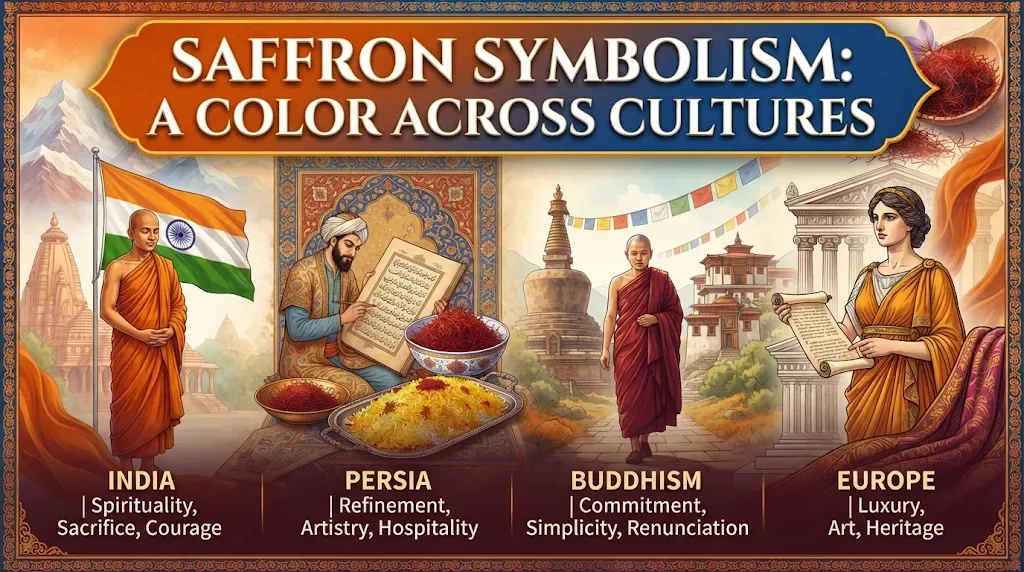
5. Saffron Symbolism in Different Cultures
Although saffron has strong associations with South Asian spiritual traditions, its symbolism extends across several regions. Its meanings developed through trade, religious practices, artistic exchange, and everyday life.
Understanding these differences helps American readers appreciate the color without treating every tradition as identical.
Indian Cultural Meaning
In India, saffron is connected with spirituality, sacrifice, courage, and religious identity.
It also appears in important national and cultural contexts. The Indian national flag includes a saffron-colored upper stripe, officially associated with strength and courage.
However, saffron’s religious and national meanings are not identical. The historical meanings of the color are also more varied than any single modern interpretation.
Persian Cultural Meaning
Persian traditions connect saffron with refinement, fragrance, artistic beauty, and hospitality.
Saffron appears in traditional cooking and decorative arts. Its golden color also suggests warmth and preciousness.
Persian poetry and manuscript traditions provide additional examples of its artistic importance.
Buddhist Cultural Meaning
In several Buddhist communities, saffron-colored clothing communicates religious commitment and simplicity.
Its meaning contrasts with luxury in an interesting way. A color associated with an expensive spice can also represent freedom from material possessions.
European Historical Meaning
European societies historically associated saffron with precious textiles, religious art, perfumes, and expensive celebrations.
Ancient Greek literature also used saffron imagery to describe beautiful dawns and ceremonial clothing.
Today, these historical meanings survive mainly through literature, historical art, and cultural revival.
6. Psychological and Emotional Meaning of Saffron
Colors can influence how people perceive a room, outfit, image, or product. Saffron combines qualities commonly associated with yellow and orange.
As a result, it can feel both energetic and comforting.
Warmth and Emotional Comfort
Saffron often creates impressions of sunlight, firelight, and autumn warmth.
Its golden appearance can make spaces feel welcoming. This explains why designers sometimes use it in living rooms, restaurants, and hospitality settings.
However, personal experiences and cultural background influence individual reactions.
Confidence and Courage
Saffron’s strong visual presence can suggest determination and self-belief.
People may associate it with someone who embraces individuality rather than following every popular trend.
Its connection with courage also makes it attractive for designs celebrating personal transformation.
Wisdom and Reflection
Unlike fluorescent orange, muted saffron can feel thoughtful and mature.
Its historical connection with religious clothing and manuscripts adds another layer of meaning.
Consequently, it can represent learning, patience, and the search for personal understanding.
What Saffron Can Communicate Emotionally
- Confidence without unnecessary aggression.
- Creativity combined with warmth and optimism.
- Spiritual curiosity and personal reflection.
- Appreciation for craftsmanship and beauty.
- A desire for individuality and meaningful expression.
- Comfort, celebration, and emotional richness.
Importantly, these are common associations, not universal psychological rules.
7. Saffron Symbolism in Tattoos and Personal Identity
Saffron-inspired tattoos offer an interesting way to express spiritual beliefs, personal courage, and cultural appreciation.
The color works particularly well in designs involving flames, flowers, sunlight, and geometric patterns.
Popular Saffron Tattoo Ideas
Saffron flame: A flame represents transformation, determination, and inner strength.
Golden crocus: The flower connects the design with beauty, renewal, and the natural world.
Sun and mandala: These elements can represent awareness, balance, and spiritual development.
Saffron watercolor: Soft golden-orange shading communicates creativity and warmth.
Choosing the Right Meaning
A person might choose saffron to represent overcoming a difficult period. Another might use it to honor family heritage or spiritual commitments.
However, culturally significant imagery deserves thoughtful treatment. If a tattoo incorporates religious garments, sacred symbols, or national imagery, understanding its original meaning matters.
A color can be appreciated without claiming an identity or tradition that isn’t one’s own.
8. Saffron in Fashion, Home Decor, and Modern Design
Saffron has become an attractive color choice for people who enjoy warm, expressive interiors and clothing.
Its distinctive appearance makes it suitable for both traditional and contemporary designs.
Fashion and Personal Style
In fashion, saffron can communicate confidence and creativity.
It works especially well in:
- Silk dresses and elegant evening clothing.
- Scarves, handbags, and statement accessories.
- Sweaters and coats for autumn styling.
- Jewelry featuring amber and gold tones.
- Contemporary outfits with neutral colors.
Saffron also pairs beautifully with navy, cream, brown, deep green, and burgundy.
Home Decoration
In American homes, saffron can introduce warmth without making an entire room feel overwhelmingly bright.
Popular decorative combinations include:
- Saffron and cream for a soft, welcoming atmosphere.
- Saffron and navy for contrast and sophistication.
- Saffron and dark wood for traditional warmth.
- Saffron and sage green for a natural appearance.
- Saffron and gold for an elegant decorative effect.
A few saffron-colored cushions or ceramic pieces can create a noticeable change.
Social Media and Digital Expression
On social media, saffron-colored images often appear in food photography, fashion inspiration, travel content, and spiritual aesthetics.
Creators may use the color to suggest warmth, authenticity, creativity, or an elevated lifestyle.
However, a golden-orange image doesn’t automatically communicate a religious or political message. Context remains essential.
9. Saffron as a Symbol of Luxury and Wealth
One of saffron’s most interesting meanings comes from its economic history. The spice is produced from the delicate red stigmas of the Crocus sativus flower.
Harvesting requires substantial manual effort. Each flower produces only a small amount of usable saffron.
Consequently, saffron has maintained a reputation for rarity and expense.
Why Saffron Became a Luxury Symbol
Historically, saffron served several purposes beyond cooking. People used it for dyeing fabrics, creating fragrances, decorating manuscripts, and preparing ceremonial products.
Its vivid color also resembled gold.
These qualities made it desirable among wealthy households and communities with access to expensive imported goods.
Modern Luxury Associations
In the United States, saffron’s luxurious identity appears in several areas:
- Fine dining and sophisticated culinary experiences.
- Premium fabrics and decorative accessories.
- Gold-inspired interior design.
- Fragrance and beauty products.
- Elegant wedding and celebration decorations.
However, luxury isn’t its only meaning. Its spiritual associations often emphasize simplicity and detachment from material wealth.
This contrast gives saffron an unusual symbolic depth: it can represent both precious possessions and the decision to live without them.
10. Controversies and Misunderstandings Surrounding Saffron
Saffron is generally associated with positive qualities. Nevertheless, its cultural and political meanings require some care.
A symbol can have different meanings depending on the community using it.
Saffron and Political Identity in India
Saffron is an important color in Indian religious and national life.
It also appears in modern political movements, particularly those associated with Hindu nationalism.
Some political groups use saffron to communicate religious or cultural identity. However, this doesn’t mean every saffron garment, object, or decoration carries a political message.
The distinction matters for American audiences. Saffron has religious, historical, cultural, and political meanings that shouldn’t automatically be treated as interchangeable.
Confusing Saffron With Other Yellow Dyes
Saffron is sometimes confused with turmeric, safflower, and other yellow-orange colorants.
These materials may produce similar shades, but they’re different plants with different histories.
Turmeric, for example, has its own religious, cultural, and culinary meanings.
Calling every golden-orange substance saffron can erase these distinctions.
Assuming One Universal Spiritual Meaning
Another common misunderstanding is that saffron always represents the same spiritual belief.
In reality, its meanings vary across Hindu, Buddhist, Jewish, Persian, and other cultural contexts.
Some traditions emphasize devotion. Others emphasize fragrance, beauty, prosperity, or artistic value.
Respectful interpretation begins with understanding the particular tradition involved.
11. How Saffron Symbolism Has Changed Over Time
Saffron’s meaning has never remained completely fixed. Its history reflects changing ideas about religion, wealth, beauty, identity, and cultural belonging.
From Ancient Luxury to Spiritual Devotion
In ancient Mediterranean societies, saffron was valued for its fragrance, color, and ceremonial uses.
Over time, its use in religious clothing and artistic traditions strengthened its spiritual associations.
In several Asian religious communities, saffron-colored clothing became connected with renunciation and devotion.
This created an interesting contrast with its reputation as an expensive luxury product.
From Traditional Dye to Modern Design
Historically, saffron was used to color textiles, manuscripts, and decorative objects.
However, synthetic dyes gradually replaced many traditional applications because they were cheaper and easier to produce.
Today, saffron-inspired shades remain popular in fashion, branding, and interior decoration.
Saffron in Contemporary America
Modern American interpretations combine historical and contemporary influences.
The color can represent cultural appreciation, personal confidence, luxury, or spiritual curiosity.
Meanwhile, growing interest in global food traditions and interior design has introduced saffron to audiences who might not know its deeper history.
Its meaning continues to evolve through personal expression and cultural exchange.
Frequently Asked Questions
1. What does saffron symbolize?
Saffron symbolizes wealth, prosperity, purity, courage, wisdom, and spiritual energy. It is also associated with sacred traditions and luxury.
2. Why is saffron considered a sacred color?
Saffron is considered sacred because of its connection with religion, spirituality, sacrifice, and enlightenment in different cultural traditions.
3. What does the saffron color represent?
The golden-orange color represents warmth, positivity, courage, happiness, prosperity, and divine energy.
4. Why was saffron valuable in ancient civilizations?
Saffron was highly valued because of its rarity, difficult harvesting process, rich color, and use in traditional art, religious practices, and luxury goods.
5. What is the symbolic meaning of the saffron crocus flower?
The Saffron Crocus (Crocus sativus) represents beauty, wealth, happiness, and luxury. Its purple flowers and valuable red stigmas make it culturally significant.
6. How is saffron connected with courage and spirituality?
Saffron is linked with courage, sacrifice, and spiritual awakening. Its sacred color is used in various traditions to express devotion, strength, and enlightenment.
Conclusion
Saffron symbolism represents much more than a beautiful golden-orange color. Throughout history, it has been connected with wealth, luxury, courage, purity, spirituality, and sacred fire. From ancient civilizations to modern cultural traditions, saffron continues to hold a special place as a symbol of prosperity, sacrifice, and divine energy. Its rare beauty and rich history make it one of the most meaningful natural symbols across cultures.

Evelyn Thomas is the voice behind SoulMeanings.com, sharing thoughtful articles on spirituality, dream interpretation, symbolism, and self-discovery to inspire meaningful living.


Pingback: Freedom Symbolism: Icons, Animals and Ancient Signs