
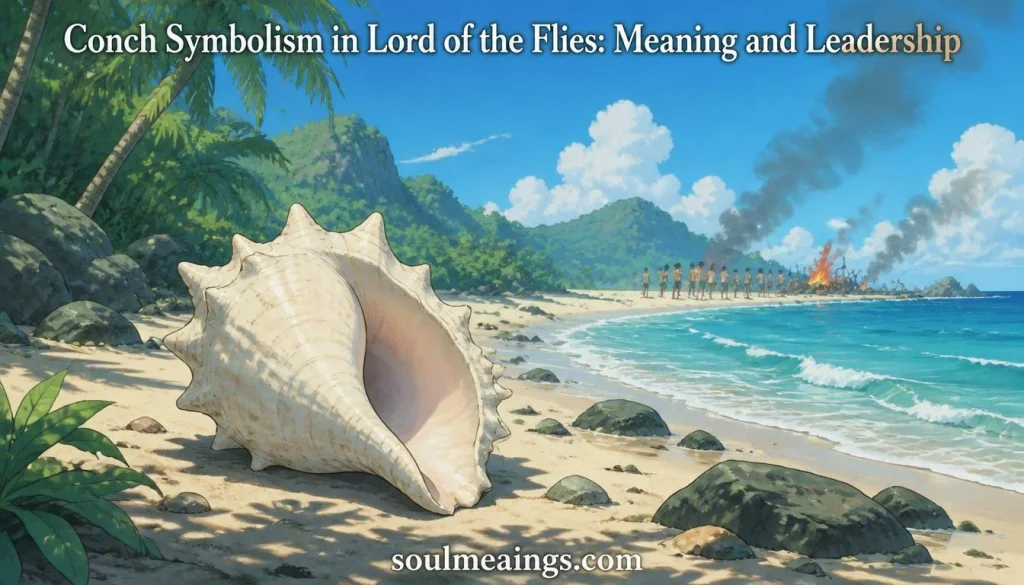
Conch Symbolism in Lord of the Flies shows how a simple shell represents leadership, shared rules, and social order.
William Golding uses the conch shell to explore how people build a community. Initially, it appears to be an ordinary seashell, but it becomes an important moral symbol of human nature, authority, and civilization.
Through literary symbolism, Golding reveals powerful truths about leadership and social order. The conch helps the boys organize meetings, build group unity, and create a collective voice through communication.
As the story develops, the conch represents democracy, freedom of speech, and the right to speak. It establishes shared rules for decision-making and encourages cooperation and respect. However, growing conflict exposes the fragile democracy of their society.
When the boys stop respecting the shell, its authority and power disappear. This social breakdown highlights the struggle between order and chaos and shows how fragile rules can destroy social stability and important moral values.
Quick Answer
Conch symbolism in Lord of the Flies represents democracy, shared authority, communication, and civilization. Its destruction symbolizes the collapse of order and the triumph of violence over cooperation.
TL;DR
- The conch represents democracy, order, and enlightened behavior.
- Ralph uses it to organize meetings and establish leadership.
- Holding the conch gives characters the right to speak.
- Jack’s growing power weakens the shell’s authority.
- Its destruction marks the collapse of their organized society.
- The conch connects leadership with responsibility and mutual respect.
What Does the Conch Shell Represent in Lord of the Flies?
The conch shell is one of the novel’s most important symbols. It begins as a practical object but gradually becomes a powerful sign of authority. Golding uses its changing importance to explore human behavior and social responsibility.
A Symbol of Civilization
At the beginning, Ralph and Piggy discover the shell near the beach. Ralph blows into it, creating a sound that attracts the other boys.
This moment begins their attempt to build an organized community. The shell gives them a shared purpose and a recognizable system.
It represents several important ideas:
- Civilization: The boys attempt to recreate the organized world they left.
- Order: Meetings follow agreed rules instead of constant arguments.
- Democracy: Members receive opportunities to express their opinions.
- Authority: The shell gives the meeting rules a visible form.
- Cooperation: The boys must respect one another to maintain peace.
The Conch as a Physical Symbol
Golding describes the shell through its pale cream color and delicate appearance. Its shape and natural beauty make it stand out among the island’s surroundings.
However, its importance comes from what the boys believe it represents. The shell has no natural political authority. Its power develops through shared agreement.
This distinction becomes essential later. When the boys stop respecting the rules, the shell loses its influence.
Historical Background of the Conch Shell
Conch shells have carried practical and symbolic meanings across many societies. Their use as instruments and ceremonial objects helps explain why Golding’s choice feels meaningful.
However, the novel doesn’t establish a direct connection between its fictional conch and one particular ancient tradition.
Ancient Uses of Conch Shells
Across different regions, large seashells served as communication instruments. People blew into them to produce loud sounds that traveled across considerable distances.
Their historical uses included:
- Calling people together for important gatherings.
- Sending signals across coastal and island communities.
- Supporting ceremonies and religious practices.
- Marking important public or community events.
- Representing authority, sacred power, or protection in certain traditions.
Conch Shells in Religious and Cultural Traditions
In Hindu traditions, the conch, often called shankha, holds religious importance. It can represent purity, auspicious beginnings, and divine power.
In some Buddhist traditions, the conch appears among the Eight Auspicious Symbols. It can represent the spreading of teachings.
Meanwhile, maritime communities have used shell trumpets for practical communication. These different associations show how one natural object can gain several meanings.
Golding draws on the familiar image of a shell used to call people together. He develops that image into a literary symbol of social organization.
Conch Symbolism and Democracy
Democracy is one of the strongest meanings associated with the conch. The boys use it to establish a system where members can participate in group discussions.
For American readers, this connects naturally with ideas about voting, public debate, and equal participation.
The Right to Speak
Ralph introduces a rule that only the person holding the conch can speak during meetings. This prevents everyone from talking simultaneously.
The arrangement gives quieter boys an opportunity to express themselves. It also creates a basic system of fairness.
Piggy especially values this arrangement because other boys often dismiss his opinions. The conch gives his voice greater recognition.
The Limits of Democracy
However, Golding also shows that democratic systems depend on people’s willingness to follow shared rules.
The conch cannot physically force anyone to listen. Its authority exists only while the group accepts its importance.
This creates an important message:
Democracy requires participation, respect, and responsibility.
Without these qualities, even well-established rules can become meaningless.
How the Conch Represents Leadership and Authority
The conch connects leadership with responsibility rather than physical strength. It helps establish Ralph’s position as chief and supports his attempts to organize the boys.
However, Golding contrasts Ralph’s leadership with Jack’s growing desire for control.
Ralph’s Responsible Leadership
Ralph sees the conch as an important tool for maintaining order. He uses meetings to discuss shelter, food, rescue, and the group’s safety.
His leadership depends on cooperation and shared decisions. Although he makes mistakes, he generally tries to protect the group’s interests.
The shell reinforces his authority because the boys initially accept its rules.
Jack’s Rejection of Authority
Jack increasingly dislikes the conch because it limits his influence. He prefers direct commands, hunting, and personal control.
As his confidence grows, he begins questioning the value of meetings. Eventually, he openly rejects the shell’s authority.
This contrast reveals two competing leadership styles:
- Ralph represents cooperation and organized decision-making.
- Jack represents domination and control through fear.
- Piggy represents reason, rules, and thoughtful discussion.
- Roger represents increasingly uncontrolled violence.
Golding shows that leadership becomes dangerous when power loses accountability.
Why Does Piggy Value the Conch So Much?
Piggy’s relationship with the conch reveals his strong belief in reason and organized society. Unlike many boys, he understands that rules protect people from disorder.
Piggy’s Connection to Civilization
Piggy often encourages Ralph to think carefully before making decisions. He believes meetings and discussions can solve their problems.
The conch gives him something he rarely receives independently: a recognized voice.
He also understands that the shell’s authority depends on collective respect. Therefore, he becomes deeply upset when the boys ignore it.
The Conch and Piggy’s Identity
Piggy represents intelligence, practical thinking, and social responsibility. His attachment to the shell reflects his desire for a community based on fairness.
When he carries it toward Jack’s camp, he still believes reason can overcome violence.
Unfortunately, the other boys no longer share his values. His fate and the shell’s destruction occur together, connecting the loss of a thoughtful voice with the collapse of enlightened behavior.
What Does the Conch’s Destruction Symbolize?
The destruction of the conch is one of the novel’s most important turning points. It happens when Roger releases a massive rock toward Piggy.
The rock kills Piggy and shatters the shell into fragments. This moment represents the final destruction of the boys’ organized society.
The End of Democratic Order
Before this event, the conch still represents the possibility of discussion and peaceful disagreement. Afterward, its authority disappears completely.
The boys no longer recognize a shared system of rules. Physical power replaces discussion and cooperation.
The Connection Between Piggy and the Conch
Piggy’s death and the shell’s destruction happen simultaneously. This creates a powerful connection between intellectual responsibility and enlightened values.
Their destruction suggests that violence has defeated reason on the island.
The scene communicates several important ideas:
- Democratic authority has lost its influence.
- Respect for shared rules has completely collapsed.
- Violence has replaced peaceful communication.
- Piggy’s rational voice has been silenced.
- The boys have moved further away from civilization.
The shattered shell becomes a visible reminder of everything the boys have lost.
The Changing Meaning of the Conch Throughout the Novel
The conch doesn’t maintain the same influence throughout the story. Its changing importance reflects the boys’ growing separation from proper behavior.
| Stage | Meaning in the Novel | Connection to Leadership | Symbolic Message |
| Discovery | Communication and unity | Ralph calls the boys together | Cooperation begins |
| First meetings | Democracy and order | Ralph establishes rules | Shared authority matters |
| Growing conflict | Fragile authority | Jack challenges Ralph | Rules need respect |
| Group division | Declining influence | Jack rejects the shell | Power becomes divided |
| Destruction | Collapse of civilization | Violence replaces leadership | Order has disappeared |
This progression makes the conch a dynamic symbol. Its changing condition reflects the changing values of the characters.
Conch Symbolism in the American Context
Although Lord of the Flies takes place on a fictional tropical island, its themes connect with familiar American civic values.
The conch offers a useful way to examine democracy, public participation, and the responsibilities that come with freedom.
Freedom of Speech and Equal Participation
American democratic ideals emphasize the importance of expressing opinions. The conch creates a similar opportunity within the boys’ community.
However, Golding also explores what happens when people refuse to respect others’ voices.
The shell reminds readers that having freedom of speech isn’t enough. People must also allow others to participate.
Rules and Social Responsibility
American communities rely on shared laws and public institutions. These systems work best when people recognize their responsibilities.
The boys’ island offers a fictional example of what happens when common rules lose public support.
The message isn’t that every rule is perfect. Instead, Golding explores why communities need fair ways to resolve disagreements.
The Importance of Collective Responsibility
The conch also represents the responsibilities that come with freedom. A democratic society cannot survive through individual rights alone.
People must listen, compromise, and respect fair procedures. Golding’s fictional island demonstrates how quickly these responsibilities can disappear.
For American students, the shell offers a useful way to discuss civic participation. It shows that leadership and freedom depend on mutual respect.
Cross-Cultural and Spiritual Meanings of the Conch
The conch has meanings beyond Golding’s novel. Different cultures have used shells in spiritual ceremonies, communication, and traditional practices.
These meanings aren’t identical to the shell’s literary role. However, they provide useful cultural context.
Conch in Hindu Traditions
In Hinduism, the conch is known as shankha. It appears in religious ceremonies and traditional imagery.
It is commonly associated with:
- Purity: A connection with spiritual cleanliness and sacred practices.
- Good fortune: An association with auspicious beginnings.
- Divine protection: A connection with certain deities and sacred traditions.
- Spiritual awakening: Its sound can represent the announcement of sacred teachings.
Conch in Buddhist Traditions
In Buddhism, the white conch shell is one of the Eight Auspicious Symbols. It commonly represents the spreading of Buddhist teachings.
Its sound can symbolize the reach of wisdom and spiritual guidance.
Broader Cultural Associations
In various coastal communities, shell trumpets have served as practical communication tools. Their sound can bring people together or announce important events.
This broader history adds another layer to Golding’s symbolism. The conch connects communication with community, shared meaning, and collective action.
Emotional and Psychological Meaning of the Conch
The conch also represents emotional security and the human desire for belonging. At first, it gives the boys confidence that they can build a functioning community.
However, its declining authority reflects their growing fear and insecurity.
Safety and Belonging
The shell creates a shared activity that helps the boys feel connected. Meetings give them opportunities to discuss concerns and establish expectations.
This structure offers a sense of stability in an unfamiliar environment.
Fear and Loss of Control
As the boys become more frightened, they increasingly turn toward Jack’s promises of protection.
The conch begins to feel less powerful because it cannot satisfy their immediate emotional needs.
This change highlights several psychological associations:
- Security: Shared rules create predictable social environments.
- Trust: Cooperation depends on believing others will respect agreements.
- Fear: Uncertainty can weaken people’s confidence in institutions.
- Belonging: Group participation creates connections between individuals.
- Powerlessness: Ignored rules can leave responsible people feeling helpless.
The Human Need for Order
Golding explores the tension between enlightened behavior and destructive impulses. The conch represents the structures people create to manage conflict.
However, those structures remain vulnerable when fear and personal ambition take control.
read more: Symbolism in The Hunger Games: Mockingjay, Bread, Fire, Roses
Modern Uses of Conch Symbolism in Literature and Media
Today, the conch remains an important literary symbol in discussions about power, communication, and social organization.
Its meaning also connects with modern conversations about leadership and group behavior.
Literature and Education
In American classrooms, Lord of the Flies often encourages discussions about democracy and human nature.
Students examine the conch to understand how an ordinary object can represent complicated social ideas.
Teachers also use it to explore character development, symbolism, and the novel’s central conflicts.
Social Media and Online Discussions
The conch can serve as a metaphor in discussions about public debate and online communities.
For example, people might compare a group’s shared speaking rules with the boys’ meeting system.
This comparison highlights the importance of respectful communication, even when opinions differ.
Art, Decor, and Personal Expression
Conch shells also appear in coastal-inspired artwork and home decoration. Their natural shape often creates associations with beaches, oceans, and peaceful environments.
In literary-inspired artwork, however, a conch can represent deeper ideas:
- A shell surrounded by figures can suggest community and cooperation.
- A broken shell can represent lost trust or social division.
- A white conch can suggest fairness and peaceful communication.
- A shell held by one person can represent leadership and responsibility.
These interpretations depend on the artwork’s context rather than one universal meaning.
Misunderstandings and Controversies About Conch Symbolism
Readers sometimes interpret the conch as a simple symbol of goodness. However, Golding’s treatment is more complicated.
The shell represents an ideal system, but it doesn’t guarantee that the boys will behave fairly.
The Conch Doesn’t Create Democracy by Itself
The boys establish rules around the shell, but those rules depend on voluntary participation.
The object itself cannot make people responsible or compassionate.
Instead, it represents their shared agreement to maintain order.
Ralph’s Leadership Isn’t Perfect
Ralph supports the conch’s authority, but he doesn’t always give everyone equal attention.
His leadership has limitations, and the novel doesn’t present him as a perfect democratic leader.
This makes the symbolism more realistic. Even well-intentioned leaders can struggle to protect fairness.
The Conch Doesn’t Represent Every Cultural Meaning
Outside the novel, conch shells have different meanings across religious and cultural traditions.
It would be inaccurate to assume that every community understands the shell through democracy or political authority.
Golding gives the conch a particular literary role. That role shouldn’t erase its wider cultural history.
How Conch Symbolism Changes Over Time
The conch’s changing importance reflects the novel’s movement from organized cooperation toward violence.
At first, it brings the boys together. Later, it becomes a reminder of rules that fewer characters respect.
From Unity to Division
During the early chapters, the shell helps create a sense of shared identity.
However, Jack’s growing influence challenges the group’s original agreements.
As the boys divide into separate groups, the conch loses its ability to unite them.
From Authority to Powerlessness
The shell initially carries considerable influence because everyone recognizes its authority.
Eventually, physical strength and intimidation become more important than peaceful discussion.
Its destruction completes this transformation.
Why Its Meaning Still Matters
Modern readers can recognize similar struggles in discussions about institutions, leadership, and public trust.
Golding’s message remains relevant because communities still depend on shared responsibilities.
The conch reminds readers that enlightened behavior requires more than rules. It requires people who are willing to respect them.
FAQs About Conch Symbolism in Lord of the Flies
1. What does the conch symbolize in Lord of the Flies?
The conch symbolizes civilization, authority, democracy, and social order. It represents the shared rules that help the boys maintain a peaceful community.
2. Why is the conch important in the novel?
The conch shell helps the boys organize meetings and make decisions. It also gives each boy the right to speak.
3. How does the conch represent leadership?
The conch supports Ralph’s leadership by helping him establish rules and maintain order. It becomes a symbol of his authority and responsibility.
4. What does the destruction of the conch mean?
The destruction of the conch represents the collapse of civilization, democracy, and organized society. It also marks the loss of order, respect, and unity.
5. How does the conch represent democracy?
The conch allows boys to speak during meetings without interruption. This reflects equality, shared responsibility, and freedom of speech.
6. What does William Golding teach through the conch?
William Golding shows that society depends on shared rules, mutual respect, and cooperation. Without these values, order can quickly turn into chaos.
Conclusion
Conch Symbolism in Lord of the Flies reveals the importance of civilization, leadership, and social responsibility. What begins as an ordinary seashell becomes a powerful symbol of democracy, authority, and unity. Through its changing importance, William Golding shows how easily society can collapse when people stop respecting rules. The conch ultimately reminds readers that peace and order depend on cooperation, respect, and shared values.

Sophia Wilson is a spiritual content writer and researcher at SoulMeanings.com, specializing in dream meanings, symbolism, spiritual insights, and personal growth topics that help readers navigate life’s journey with greater understanding.


Pingback: Saffron Symbolism: Sacred Fire, Courage, and Luxury