
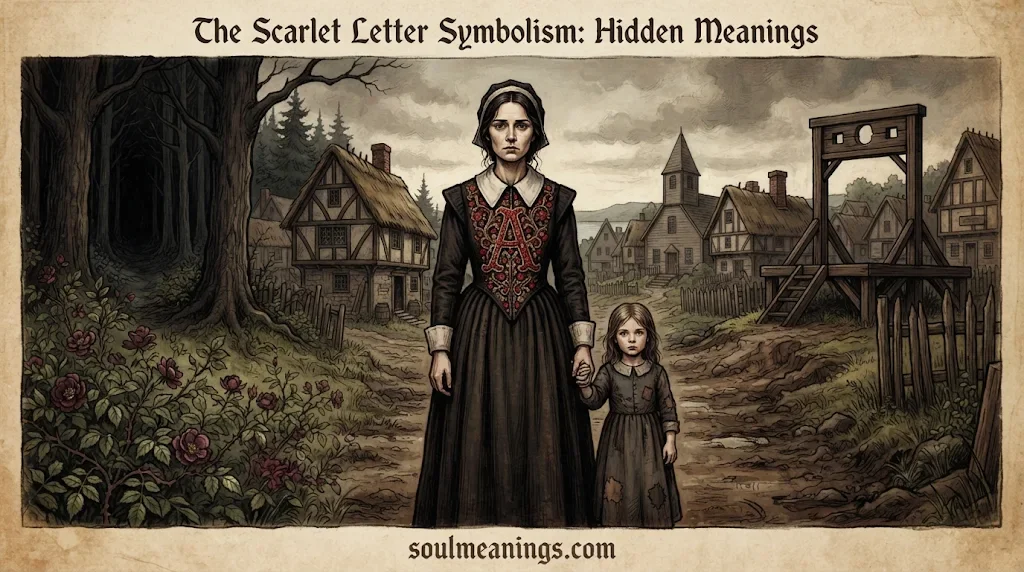
The Scarlet Letter Symbolism: Hidden Meanings explores guilt, shame, identity, freedom, and redemption in Nathaniel Hawthorne’s portrayal of Puritan society.
In Nathaniel Hawthorne’s The Scarlet Letter, an important American classic published in 1850, the story explores more than adultery and punishment. Set in seventeenth-century Puritan Boston, it follows Hester Prynne, who is publicly punished for adultery and forced to wear a bright red letter A on her clothing.
This scarlet letter symbolism represents guilt, shame, identity, and independence. Through color symbolism, Hawthorne shows how Puritan law, religious authority, and society influence individual lives and create public judgment.
Hawthorne also uses Pearl symbolism, forest symbolism, and rosebush symbolism to reveal deeper meanings. The scaffold scenes represent public shame and social judgment, while the forest suggests personal freedom and inner transformation. Pearl represents the consequences of hidden relationships, while the rosebush suggests forgiveness and redemption.
These symbols highlight social hypocrisy, moral conflict, and the difference between public expectations and private morality. Through Hester’s struggles, Hawthorne explores individual identity, human nature, and the power of society to judge others. These themes make the novel relevant to readers even today.
Quick Answer
Symbolism in The Scarlet Letter Explained centers on the red letter A, which represents adultery, public shame, guilt, and eventually personal strength. In American literature, it also symbolizes the conflict between individual freedom and society’s power to judge, while suggesting that people can redefine their identities.
TL;DR
- The scarlet A initially represents adultery and public punishment.
- Hester gradually transforms the letter into a symbol of strength.
- Red represents passion, sin, suffering, and individuality.
- The scaffold represents public judgment and moral accountability.
- Pearl symbolizes nature, innocence, and the consequences of human choices.
- Hawthorne questions hypocrisy, rigid morality, and social exclusion.
1. What Does The Scarlet Letter Symbolize?
The central symbol in Hawthorne’s novel is a red letter A. Hester Prynne must wear it on her chest as a permanent reminder of her adultery.
However, its meaning changes throughout the story. What begins as an instrument of humiliation becomes a complicated symbol of identity and independence.
The Red Letter A
The letter A has several connected meanings:
- Adultery: Its original meaning identifies Hester’s alleged moral offense.
- Shame: It exposes her private actions to public judgment.
- Identity: It becomes inseparable from Hester’s public reputation.
- Strength: Hester gradually develops confidence despite her punishment.
- Transformation: Its meaning changes as the community’s perception evolves.
The letter is particularly important because Hester embroiders it herself. Instead of wearing a plain badge, she creates something elaborate and beautiful.
This detail introduces an important contradiction. The community intends to make her appearance shameful, yet her creativity gives the punishment an unexpected dignity.
Why the Symbol Changes
Hawthorne doesn’t give the letter one permanent meaning. Different characters interpret it differently, depending on their experiences and beliefs.
For Hester, it becomes part of her personal history. For the community, it remains a reminder of forbidden behavior. For readers, it raises questions about whether society has the right to define another person’s identity.
2. Historical Origins of The Scarlet Letter
Understanding the novel’s historical background makes its symbolism much clearer. Hawthorne wrote about Puritan New England while reflecting on American society during the nineteenth century.
Puritan Society in Seventeenth-Century America
Puritans were English Protestants who wanted to reform the Church of England. Many settled in New England during the seventeenth century.
Their communities placed considerable importance on religious discipline, moral behavior, and shared responsibilities.
Consequently, behavior considered sinful could become a public concern rather than a private matter.
Punishments could include public humiliation, fines, imprisonment, and other forms of discipline. Public exposure was especially powerful in small communities where neighbors knew one another.
Did Historical Women Wear Scarlet Letters?
Hawthorne’s story draws on historical practices, although its exact setting and punishment shouldn’t be treated as a perfect historical record.
Seventeenth-century Massachusetts had laws addressing adultery and other sexual offenses. Historical research also identifies colonial cases involving distinctive clothing marks.
A Salem law from 1694 required certain convicted adulterers to wear a visible letter A. Earlier colonial records also describe other forms of identifying clothing.
However, Hawthorne’s fictional events occur decades earlier. His novel combines historical details with artistic imagination.
Why Hawthorne Chose This Period
Published in 1850, the novel looks backward to colonial America. Yet it also reflects nineteenth-century concerns about morality, gender, religion, and personal freedom.
Hawthorne’s ancestors had connections to the Puritan leadership involved in the Salem witchcraft trials. This family history adds another layer to his interest in religious authority and public judgment.
Thus, the novel isn’t simply a historical story. It’s also a reflection on how American communities create and enforce moral rules.
3. The Symbolism of the Color Red
Red is one of the most important colors in The Scarlet Letter. It appears through Hester’s embroidered badge and connects several themes throughout the novel.
For American readers, red can suggest love, danger, courage, sacrifice, and strong emotion. Hawthorne brings several of these associations together.
Red as Sin and Shame
In the Puritan community, the scarlet color makes Hester’s punishment impossible to ignore. It marks her as someone who has broken an important social rule.
The bright color also contrasts with the dark, restrained clothing of the community. This visual difference emphasizes Hester’s separation.
Red as Passion and Individuality
Red also represents human desire and emotional intensity. Hester’s relationship with Dimmesdale involves feelings that conflict with her community’s strict expectations.
However, red isn’t simply a negative color. Its association with passion also suggests vitality and personal freedom.
Red as Strength and Transformation
As the story develops, Hester’s relationship with the letter changes. She doesn’t allow society’s judgment to erase her personality.
Her compassion, independence, and determination give the symbol a more complicated meaning. Red becomes connected with the strength required to survive public humiliation.
4. What Does the Letter A Mean in America?
The letter A has become a recognizable literary symbol in American culture. It represents the lasting power of social labels and the consequences of public judgment.
Although Hawthorne’s original setting is colonial Boston, modern American readers often connect the letter with broader questions of identity and reputation.
From Adultery to Identity
Initially, the A identifies Hester as an adulterer. However, the community gradually sees qualities that don’t fit this single description.
She becomes known for helping others, supporting vulnerable people, and raising Pearl independently.
In this way, the letter exposes the weakness of defining someone through one action.
The Letter as a Symbol of Social Judgment
American culture frequently explores the tension between individual rights and community expectations. Hawthorne presents this tension through Hester’s experience.
The letter demonstrates how a public label can follow someone even after circumstances change.
Today, similar ideas appear in discussions about social exclusion, reputation, online criticism, and second chances.
The Changing Meaning of the Letter
One particularly interesting development occurs when community members begin interpreting the A differently.
Some associate it with Hester’s charitable work and abilities. The meaning shifts from an accusation toward a recognition of her character.
Hawthorne uses this development to question whether public judgment can ever fully understand an individual.
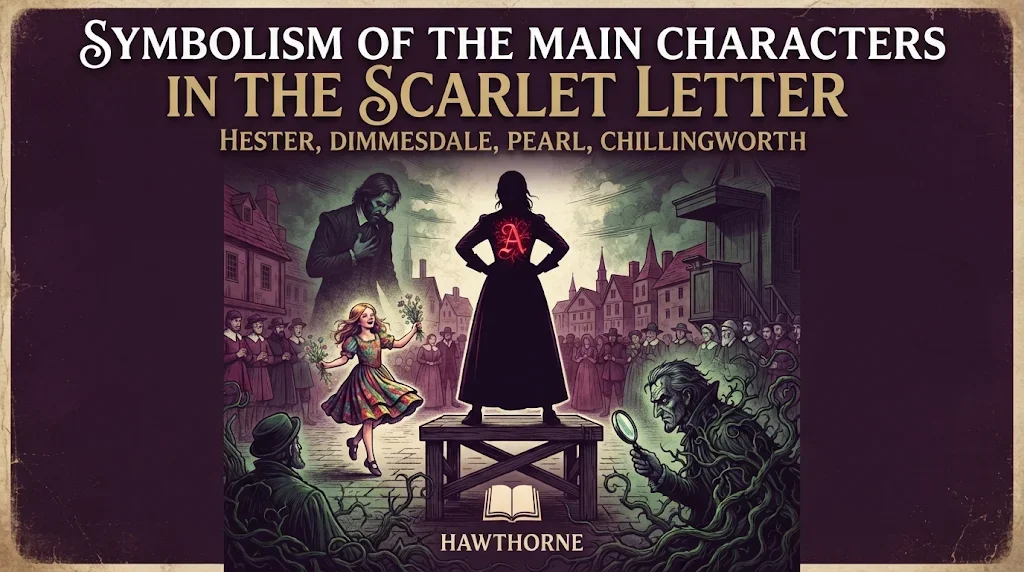
5. Symbolism of the Main Characters
The characters in The Scarlet Letter represent different responses to guilt, morality, secrecy, and social pressure.
Hawthorne develops these meanings through their actions and relationships rather than simply assigning each character one fixed definition.
Hester Prynne: Independence and Resilience
Hester represents personal strength in the face of social rejection. Although the community tries to define her through her past, she develops an identity beyond her punishment.
Her embroidery also symbolizes creativity and self-expression.
She doesn’t completely reject her community, but she refuses to let its judgment destroy her sense of worth.
Arthur Dimmesdale: Guilt and Hypocrisy
Dimmesdale is the minister who shares responsibility for the relationship with Hester. Unlike Hester, he hides his involvement from the community.
His character represents the psychological burden of concealed guilt.
His public position contrasts sharply with his private suffering. Through him, Hawthorne explores the difference between appearing morally respectable and acting honestly.
Pearl: Innocence and Freedom
Pearl is Hester and Dimmesdale’s daughter. She represents the consequences of their relationship, but she also symbolizes innocence, energy, and natural freedom.
Her unusual behavior challenges the strict expectations of Puritan society.
Pearl frequently notices things that adults try to hide. In this sense, she becomes a reminder that concealed truths rarely disappear.
Roger Chillingworth: Revenge and Obsession
Chillingworth represents revenge, bitterness, and destructive obsession.
After discovering Dimmesdale’s secret, he becomes consumed by the desire to uncover and punish him.
His behavior demonstrates how the pursuit of revenge can damage the person seeking it. Hawthorne presents his obsession as another form of moral failure.
6. Symbolism of the Scaffold and Public Shame
The scaffold is one of the novel’s most important settings. It represents public judgment, religious authority, confession, and accountability.
Hawthorne uses three major scaffold scenes to connect the characters’ private struggles with the community’s expectations.
The First Scaffold Scene
At the beginning, Hester stands on the scaffold while members of the community watch and criticize her.
She carries Pearl and wears the scarlet letter. This scene establishes the public nature of her punishment.
The scaffold becomes a stage where the community displays its authority over individual behavior.
The Second Scaffold Scene
Later, Dimmesdale joins Hester and Pearl on the scaffold at night.
Unlike Hester’s public punishment, this moment happens in darkness. It represents his hidden guilt and desire for confession.
However, he still lacks the courage to acknowledge the truth publicly.
The Final Scaffold Scene
Near the novel’s conclusion, Dimmesdale finally reveals his involvement.
This scene brings together confession, suffering, and accountability. The scaffold becomes more than a place of punishment.
It also represents the possibility of confronting a truth that has remained hidden.
7. The Rosebush and Forest: Nature’s Symbolism
Nature provides an important contrast to the strict social world of Puritan Boston. Hawthorne uses flowers, trees, and wilderness to explore freedom, emotion, and human complexity.
These natural images are especially important because they challenge the idea that society always represents moral truth.
The Wild Rosebush
The novel opens with an image of a wild rosebush growing near the prison entrance.
Its delicate flowers contrast with the harsh prison environment. The rose suggests kindness, beauty, hope, and compassion.
It also introduces the possibility that goodness can exist alongside suffering.
The narrator’s attention to this flower encourages readers to consider Hester with sympathy rather than immediate condemnation.
The Forest
The forest represents a world beyond the community’s strict rules.
Within the Puritan worldview, wilderness could suggest danger, uncertainty, and spiritual disorder. However, Hawthorne gives it more complicated meanings.
For Hester and Dimmesdale, the forest becomes a place where they can speak more freely.
It represents emotional freedom, personal desire, and the possibility of imagining a different future.
The Contrast Between Nature and Society
The prison and forest represent opposing environments, although neither is entirely simple.
| Symbol | Meaning in the Novel | Broader American Association |
| Rosebush | Hope, compassion, natural beauty | Renewal and kindness |
| Forest | Freedom, secrecy, desire | Independence and wilderness |
| Prison | Punishment and social control | Confinement and authority |
| Scaffold | Public judgment and confession | Accountability and reputation |
| Marketplace | Community expectations | Public opinion and social pressure |
Together, these settings show how human behavior changes under different social conditions.
8. The Spiritual and Religious Meaning of The Scarlet Letter
Religion is central to the novel because its characters live within a community shaped by Puritan Christianity. Hawthorne explores sin, confession, forgiveness, and the relationship between human judgment and divine judgment.
For American readers, these themes also reflect the country’s early religious history.
Sin and Moral Responsibility
The scarlet letter initially represents a visible form of sin. Hester’s community believes that public punishment reinforces moral standards.
However, Hawthorne questions whether punishment automatically produces genuine moral improvement.
He also shows that wrongdoing can take different forms. Dimmesdale’s secrecy and Chillingworth’s revenge create their own forms of suffering.
Confession and Redemption
Confession becomes an important spiritual theme through Dimmesdale’s struggle.
His inability to acknowledge his actions publicly contributes to his emotional suffering.
In contrast, Hester must live openly with the consequences of her behavior. Her experience raises questions about honesty, forgiveness, and personal responsibility.
read more: Piggy’s Glasses Symbolism: Meaning in Lord of the Flies
Cross-Cultural Perspectives
Although the novel is rooted in Protestant New England, its themes connect with broader religious ideas.
- Christian traditions often explore sin, repentance, confession, and forgiveness.
- Buddhist teachings examine attachment, suffering, and the consequences of actions.
- Many other spiritual traditions consider the relationship between personal conduct and community responsibility.
These traditions have distinct beliefs and practices. Their connections here are thematic, not evidence that they share identical teachings.
Hawthorne’s central question remains universal: How should people respond when someone makes a serious mistake?
9. Emotional and Psychological Meaning
One reason The Scarlet Letter remains powerful is its exploration of human emotions. Hawthorne shows how guilt, shame, fear, and social rejection affect people differently.
These experiences help modern readers understand the emotional meaning behind the novel’s symbols.
Shame Versus Guilt
Although shame and guilt are closely connected, they aren’t exactly the same.
Guilt focuses on something a person believes they have done wrong. Shame can affect how someone sees their entire identity.
Hester experiences both emotions, but she gradually develops a stronger sense of self. Dimmesdale, meanwhile, struggles because he cannot openly acknowledge his guilt.
The Psychology of Public Judgment
The scarlet letter represents the emotional consequences of being constantly judged.
Hester cannot easily escape the opinions of her neighbors. Their attention becomes a reminder of her punishment.
Modern readers may recognize similar experiences in public criticism, social exclusion, and online humiliation.
What the Symbols Emotionally Represent
- Red suggests intense feelings, passion, and emotional conflict.
- Darkness represents secrecy, fear, and hidden suffering.
- The forest suggests relief from social pressure.
- The scaffold represents exposure and vulnerability.
- Pearl represents emotional honesty and unexpected freedom.
These meanings aren’t fixed psychological rules. They’re literary associations that help readers understand the characters.
10. Modern Uses of The Scarlet Letter Symbolism
Today, the scarlet letter has become a wider cultural expression. People often use it when discussing shame, reputation, identity, and public criticism.
Its meaning now extends beyond the original story.
The Scarlet Letter in Everyday Language
In American English, having a scarlet letter can mean carrying a lasting mark of disgrace.
For example, someone might describe an unfair public label as a scarlet letter. The expression suggests that society continues judging someone through a past mistake.
However, the phrase can also criticize the people doing the judging.
Tattoos and Personal Identity
Some readers may choose an embroidered A or red letter tattoo to represent personal experiences.
Possible interpretations include:
- Surviving judgment or rejection.
- Taking control of a difficult personal history.
- Remembering a lesson about accountability.
- Challenging unfair social expectations.
- Celebrating independence and resilience.
A tattoo inspired by the novel doesn’t necessarily celebrate adultery. Its meaning depends on the person choosing it.
Social Media and Digital Reputation
The scarlet letter has particular relevance in the digital age.
Online criticism can spread quickly, and old mistakes may remain visible long after circumstances change.
The novel offers a useful way to discuss digital shaming and the difficulty of rebuilding a public reputation.
Literature, Education, and Popular Culture
The novel remains an important part of American literary education.
Teachers use its symbols to introduce discussions about history, religion, gender, social power, and personal responsibility.
Its central image also appears in literary artwork, theatrical adaptations, classroom projects, and discussions about social stigma.
11. Misunderstandings, Controversies, and Changing Interpretations
The novel contains complicated moral questions. Readers don’t always agree about Hester’s choices, Hawthorne’s criticism of Puritan society, or the meaning of the ending.
Understanding these disagreements prevents overly simple interpretations.
Was the Novel Written to Defend Adultery?
Not necessarily. Hawthorne explores forbidden desire, but he also examines its consequences.
Hester and Dimmesdale experience emotional and social suffering. Their relationship raises questions about personal freedom and responsibility.
The novel is more complicated than a simple defense or condemnation of their actions.
Does the Scarlet Letter Always Represent Shame?
No. Its meaning changes throughout the story.
The community initially uses it to identify Hester’s offense. Later, some people associate it with her helpfulness and abilities.
Therefore, interpreting the letter only as a symbol of sin overlooks its development.
Is Hawthorne Criticizing All Religion?
No. His criticism focuses largely on rigid judgment, hypocrisy, and the misuse of religious authority.
Dimmesdale’s religious position is especially important because his public image conflicts with his private behavior.
Hawthorne examines the difference between genuine morality and outward respectability.
Gender and Unequal Punishment
One important controversy involves the different treatment of Hester and Dimmesdale.
Hester receives visible public punishment. Dimmesdale retains his respected position while hiding his involvement.
This contrast invites questions about gender expectations and unequal social consequences.
Modern readers often interpret this difference through discussions of women’s independence, social power, and double standards.
Avoiding Oversimplification
Readers should also remember that the fictional Puritan community doesn’t represent every Puritan individual or every religious community.
Hawthorne creates a particular literary setting. His characters and conflicts shouldn’t be treated as a complete historical account of colonial American life.
12. How The Scarlet Letter’s Meaning Has Changed Over Time
The meaning of the scarlet letter has developed considerably since Hawthorne published his novel in 1850.
Its changing interpretation reflects broader developments in American culture, including attitudes toward morality, privacy, gender, and individual identity.
The Nineteenth-Century Interpretation
Early readers encountered a story shaped by Victorian concerns about sexuality, morality, and social responsibility.
Hester’s punishment and Dimmesdale’s suffering encouraged discussion about sin and the consequences of forbidden relationships.
However, Hawthorne’s sympathetic portrayal of Hester also complicated conventional moral expectations.
The Twentieth-Century Interpretation
During the twentieth century, literary discussions increasingly explored the novel’s treatment of gender, social control, psychology, and individual freedom.
Hester became an important figure in conversations about women’s independence and resistance to restrictive social expectations.
The scarlet letter also became a broader metaphor for social stigma.
The Twenty-First-Century Interpretation
Today, readers often connect the novel with digital reputation, public criticism, identity, and social exclusion.
The idea of carrying a permanent label feels especially relevant in a culture where information can remain publicly accessible.
However, the novel’s original themes remain important. Its central questions concern how people judge others and whether individuals can move beyond their past.
Frequently Asked Questions
1. What does the scarlet letter A symbolize?
The scarlet letter A represents adultery, guilt, shame, and public punishment. Over time, it also becomes a symbol of Hester’s strength and independence.
2. What does the forest symbolize in The Scarlet Letter?
The forest symbolizes freedom, privacy, and independence. It provides a place where characters can move beyond strict Puritan rules.
3. What does Pearl symbolize in the novel?
Pearl symbolizes the consequences of Hester’s relationship, but she also represents hope, individuality, and truth.
4. What does the rosebush symbolize?
The rosebush near the prison represents hope, beauty, compassion, and redemption despite suffering and punishment.
5. What does the scaffold symbolize in The Scarlet Letter?
The scaffold represents public shame, religious judgment, and social punishment. It is also an important setting for revealing hidden truths.
6. How does Nathaniel Hawthorne use symbolism in the novel?
Hawthorne uses colors, characters, natural settings, and religious imagery to explore guilt, morality, social hypocrisy, personal freedom, and redemption.
Conclusion
The Scarlet Letter Symbolism: Hidden Meanings reveals deeper ideas about guilt, shame, identity, freedom, and redemption. Nathaniel Hawthorne uses the scarlet letter, Pearl, the forest, the scaffold, and the rosebush to explore the conflict between personal values and social judgment. These symbols make the novel a lasting example of American literature and keep its themes relevant to modern readers.

Sophia Wilson is a spiritual content writer and researcher at SoulMeanings.com, specializing in dream meanings, symbolism, spiritual insights, and personal growth topics that help readers navigate life’s journey with greater understanding.

