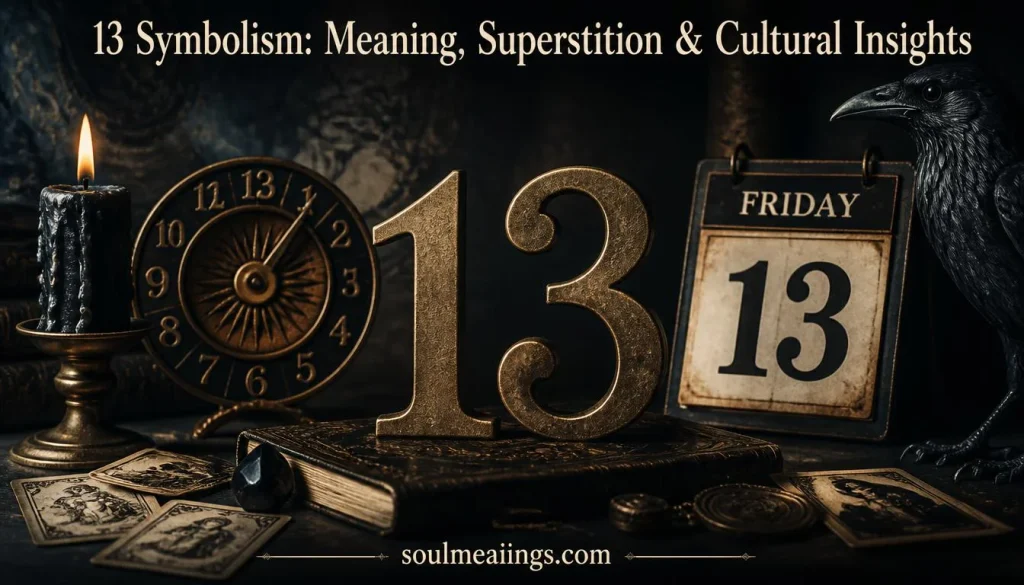
13 Symbolism: Meaning, Superstition & Cultural Insights explores the cultural beliefs, superstitions, and spiritual meanings behind this fascinating number.
The number 13 has a mixed reputation across cultures. Some people consider it an unlucky number linked to bad luck, fear, and triskaidekaphobia, while others see it as a sacred number representing good luck, personal growth, and spiritual significance.
Its symbolic meaning appears in religion, mythology, dreams, tarot, literature, and popular culture. These different interpretations show how context and personal beliefs shape the meaning of 13.
In American culture, 13 represents both superstition and national pride. The Great Seal of the United States includes references to the original 13 colonies, connecting the number with American independence, history, and founding principles.
Although horror movies and hotel superstitions often associate 13 with bad luck, its symbolism can also represent rebellion, transformation, and spiritual growth. Understanding 13 symbolism reveals how cultural traditions, historical associations, and personal perspectives influence the way people interpret this powerful number.
Quick Answer
In the United States, 13 symbolism is commonly associated with bad luck, mystery, and Friday the 13th. However, it can also represent transformation, independence, spiritual renewal, and the courage to move beyond fear. Its meaning varies across cultures, religions, and personal beliefs.
TL;DR
- The number 13 is widely associated with bad luck in American culture.
- Friday the 13th strengthens its connection with superstition and fear.
- Some spiritual interpretations connect 13 with transformation and personal growth.
- Ancient cultures sometimes associated the number with lunar cycles and feminine symbolism.
- Tattoos and fashion can use 13 to express rebellion or individuality.
- The number isn’t universally unlucky; its meaning depends on cultural context.
What Does the Number 13 Symbolize?
The number 13 doesn’t have one universal meaning. In American culture, it often signals misfortune, but its symbolism also includes change, courage, and independence.
The Main Symbolic Meanings
Three major interpretations help explain the number’s lasting appeal.
- Bad luck: Traditional superstitions connect 13 with unexpected problems and unfavorable outcomes.
- Transformation: Some modern spiritual interpretations view 13 as a sign of change and new beginnings.
- Rebellion: The number can represent independence, nonconformity, and resistance to social expectations.
These meanings often overlap. For example, someone who embraces 13 might see it as a way to challenge fear rather than invite misfortune.
Why Context Matters
A number becomes meaningful through the stories and beliefs people attach to it. Consequently, 13 might seem threatening on a horror movie poster but empowering on a tattoo.
Personal experience matters, too. Someone born on the 13th might consider it a lucky number because it marks a meaningful birthday.
Historical Origins of the Number 13
The history of 13 symbolism stretches across different societies and periods. However, it’s important to distinguish documented traditions from stories created later to explain the superstition.
Ancient Roots and Early Beliefs
Ancient societies used numbers to organize calendars, rituals, trade, and religious practices. Some cultures also assigned numbers special meanings based on their observations of nature and the sky.
The number 12 became important in many traditions. There are 12 months in the familiar calendar, 12 signs in the Western zodiac, and 12 apostles in Christian tradition. Because 13 comes immediately after 12, some interpretations treat it as a number that disrupts an established pattern of completeness.
However, this doesn’t mean ancient people everywhere feared 13. Different societies developed different number systems and beliefs, and many did not treat it as inherently unlucky.
Norse Mythology and Christian Tradition
Two frequently repeated stories help explain the number’s negative associations in Western folklore.
In one Norse legend, the trickster god Loki arrives at a gathering of gods, contributing to the death of Baldr. Later retellings connect this gathering with 13 guests, although the exact details vary across versions.
In Christian tradition, popular accounts associate 13 guests at the Last Supper with Judas Iscariot’s betrayal of Jesus. The crucifixion is traditionally observed on Good Friday, adding another layer to later superstitions about Friday the 13th.
These stories influenced cultural interpretations, but neither proves that all negative beliefs about 13 began in ancient times.
read more: Shoe Symbolism: Meaning, History & Spiritual Insights
Why Is 13 Considered Unlucky in America?
In the United States, 13 is one of the most recognizable symbols of superstition. Its reputation appears in everyday decisions, building design, travel habits, and popular entertainment.
The Influence of Friday the 13th
The combination of Friday and the number 13 became especially prominent in modern Western culture. The exact origin remains uncertain, although the belief was established in print by the nineteenth and early twentieth centuries.
In 1907, American author Thomas W. Lawson published Friday, the Thirteenth, a novel about a stockbroker who exploits fears surrounding the date. Later, the Friday the 13th horror franchise helped make the superstition familiar to new generations.
As a result, the date became associated with suspense, danger, and eerie coincidences. Yet many Americans treat it playfully rather than seriously.
Everyday Examples of the Superstition
The fear of 13 sometimes affects practical choices in American life.
- Some hotels and office buildings label the floor after 12 as 14.
- Certain airlines have omitted row 13 from their seating layouts.
- Some people avoid scheduling weddings or major events on Friday the 13th.
- Horror movies and seasonal decorations use 13 to create suspense.
- Friends may joke about the date when something unexpected happens.
These practices show how a cultural belief can influence behavior without proving the number causes bad outcomes.
Spiritual Meaning of the Number 13
In modern spiritual discussions, 13 often receives interpretations that differ from traditional American superstition. Some people associate it with personal growth, renewal, and the courage to leave familiar patterns behind.
Transformation and New Beginnings
The number 13 can symbolize a turning point. Because it follows 12, some modern interpretations present it as a step beyond an established cycle.
For people who use numerology as a reflective practice, 13 may represent the need to release old habits and make room for something new. However, these interpretations are matters of belief rather than scientifically established properties of the number.
Angel Number 13
In contemporary angel-number beliefs, seeing 13 repeatedly may be interpreted as encouragement to remain resilient during change. Some readers connect it with creativity, determination, and trust in personal growth.
These meanings aren’t shared by every spiritual tradition. Instead, they belong mainly to modern numerology and related spiritual practices.
If the number keeps catching your attention, you can use it as a prompt to reflect on your goals. There’s no need to assume that it predicts an event or delivers a guaranteed message.
Number 13 in Different Cultures and Religions
The number’s reputation changes across cultural settings. Understanding these differences helps explain why a number that seems unlucky in one place may have a neutral or positive meaning elsewhere.
Cultural Interpretations Around the World
| Context | Common Association | Cultural Notes |
| United States | Bad luck and mystery | Friday the 13th is a familiar superstition. |
| Christian folklore | Betrayal and misfortune | Popular interpretations connect 13 guests with the Last Supper. |
| Norse folklore | Disruption and tragedy | Later accounts associate Loki with an unlucky gathering. |
| Some Chinese-speaking communities | Potentially favorable meanings | Number symbolism varies by dialect, pronunciation, and local custom. |
| Modern numerology | Change and personal growth | Interpretations depend on the system and practitioner. |
Is 13 Lucky in Other Cultures?
Yes, the number isn’t universally considered unlucky. Its meaning can change with language, local traditions, and personal beliefs.
In some Chinese-speaking contexts, number symbolism depends on how a number sounds when spoken. However, there isn’t one universal Chinese interpretation of 13, and attitudes differ among communities.
Similarly, ancient Mesoamerican societies used the number 13 in important calendar and religious systems. In some Maya traditions, it had a meaningful place in sacred timekeeping. That historical role shouldn’t be reduced to a simple claim that every Maya community considered 13 lucky.
The key lesson is that numbers don’t carry identical meanings everywhere. Cultural context gives them much of their symbolic power.
Psychological Meaning of 13
The number 13 offers an interesting example of how beliefs influence emotions and everyday choices. Its reputation can make ordinary situations feel threatening, even when there’s no evidence of a special risk.
Why People Fear the Number 13
Fear of the number 13 is known as triskaidekaphobia. For some people, the fear is mild and appears only in specific situations. Others experience greater anxiety around the number.
Several psychological patterns can help explain this response:
- Learned associations: People may absorb superstitions from family, friends, movies, or cultural traditions.
- Confirmation bias: Someone who expects bad luck may notice negative events and overlook ordinary outcomes.
- Fear of uncertainty: Unpredictable situations can make familiar superstitions feel reassuring or meaningful.
- Social influence: Hearing others discuss an unlucky date can strengthen its reputation.
These patterns don’t mean every person who avoids 13 has an intense fear. Many people simply follow a tradition or enjoy the mystery surrounding the number.
Can 13 Have a Positive Psychological Meaning?
Absolutely. People can also reinterpret 13 as a symbol of confidence and self-acceptance.
For example, someone who chooses 13 as a personal number may enjoy challenging an old superstition. Instead of expecting trouble, they treat the number as a reminder to make independent choices.
This shift illustrates how personal meaning can differ from cultural expectations.
Number 13 in Tattoos, Fashion, and Pop Culture
In modern America, the number 13 appears in tattoos, clothing, artwork, and entertainment. Its appeal often comes from its mysterious reputation and its ability to communicate different ideas.
The Meaning of a 13 Tattoo
A 13 tattoo can express several things, depending on the person wearing it.
- Rebellion: The number can challenge traditional ideas about luck and misfortune.
- Personal identity: It might represent a birthday, anniversary, or meaningful memory.
- Resilience: Some people use it to symbolize surviving difficult experiences.
- Interest in mystery: The number fits designs inspired by horror, folklore, and the supernatural.
- Group identity: In certain settings, it can carry meanings connected to a particular community.
Context matters when interpreting tattoos. The number alone doesn’t reveal someone’s beliefs, background, or intentions.
Movies, Music, and Social Media
Horror films have helped keep the number’s ominous image alive. The Friday the 13th franchise, for example, connects it with suspense and fear.
On social media, people may post about Friday the 13th, share spooky artwork, or joke about unfortunate events. Others use the number in usernames, captions, and personal designs because they consider it distinctive.
Consequently, 13 can function as both a frightening symbol and a playful cultural reference.

The Number 13 in American Life and Traditions
Although 13 is often linked with bad luck, it also has a place in American history and national identity. These examples show why its meaning cannot be reduced to superstition alone.
The Thirteen Original Colonies
One of the most important American associations with 13 comes from the thirteen colonies that declared independence from Great Britain in 1776.
The number appears in early American flags, including the original national flag design with thirteen stars and thirteen stripes. Today, thirteen stripes remain on the United States flag, representing the original colonies.
In this context, 13 represents the country’s founding, independence, and shared history. Its meaning is patriotic rather than unlucky.
Other Familiar American Associations
The number appears in several everyday and historical settings.
- The thirteen stripes on the U.S. flag represent the original colonies.
- The original American flag included thirteen stars.
- A baker’s dozen contains thirteen items, traditionally offering one extra.
- Friday the 13th inspires horror-themed events, parties, and entertainment.
- Some people celebrate the number to challenge superstitions about bad luck.
These examples highlight an important contrast. The same number can represent national pride in one setting and cultural anxiety in another.
Numerology and the Meaning of 13
Numerology is a belief system that assigns symbolic meanings to numbers. In modern numerology, 13 is sometimes interpreted through its individual digits and its connection with the number 4.
What Does 13 Mean in Numerology?
A common numerological method adds the digits together:
1+3=4
Within some numerology systems, 4 is associated with structure, stability, discipline, and practical effort. Therefore, some practitioners interpret 13 as a combination of change and the work needed to build something lasting.
The number 1 may represent initiative, while 3 can be associated with creativity and expression. These meanings vary by numerological tradition and aren’t universal rules.
Is 13 a Powerful Number?
Some numerology practitioners consider 13 meaningful because it combines several symbolic ideas. They may interpret it as a reminder that progress requires patience, responsibility, and consistent effort.
However, numerology doesn’t establish that a number controls personality or determines future events. You can explore its symbolism as a personal reflection tool without treating it as a prediction.
Common Myths and Misunderstandings About 13
Many popular stories about 13 blend folklore, religion, and modern entertainment. Separating documented history from later explanations helps readers understand the superstition more clearly.
Does 13 Always Bring Bad Luck?
No. There is no reliable evidence that the number 13 causes misfortune.
People may remember stories about unfortunate events that happened on the thirteenth day. However, similar events happen on other dates, too. The date alone doesn’t establish a meaningful connection.
Did Friday the 13th Begin in Ancient Times?
The separate beliefs surrounding Fridays and the number 13 have older cultural roots. However, the familiar superstition combining them into Friday the 13th appears much later in the historical record.
The exact origin remains uncertain. Stories linking the date directly to the arrest of the Knights Templar on October 13, 1307, are popular, but historians haven’t established that event as the source of the superstition.
Does the Number Have a Universal Spiritual Meaning?
No. Spiritual interpretations depend on the traditions and beliefs involved.
Some modern numerology systems associate 13 with transformation or personal growth. Other traditions use it in calendars, religious practices, or symbolic systems without sharing those interpretations.
It’s best to approach these meanings with curiosity rather than assume everyone understands the number in the same way.
How the Meaning of 13 Has Changed Over Time
The number’s history reveals how cultural symbols develop and change. Although its reputation for bad luck remains familiar, other interpretations have gained attention.
From Superstition to Popular Entertainment
In Western folklore, 13 became associated with misfortune through a combination of traditions, religious stories, and cultural repetition. During the nineteenth and twentieth centuries, references to unlucky dates and groups of thirteen became more visible.
Books, newspaper stories, and horror movies later reinforced these associations. As a result, Friday the 13th became a widely recognized cultural event.
From Bad Luck to Individual Expression
Today, many Americans treat the number as a personal or creative symbol rather than a warning.
Some embrace 13 because they enjoy its rebellious reputation. Others connect it with their birthday, national history, or spiritual beliefs.
This change doesn’t mean the superstition has disappeared. Instead, the number now carries several meanings at once, depending on the person and setting.
FAQs About 13 Symbolism
What does the number 13 symbolize?
The number 13 symbolizes transformation, mystery, and change. Depending on cultural beliefs, it can represent either bad luck or positive growth.
Why is 13 considered an unlucky number?
Many people associate 13 with bad luck because of historical traditions and superstitions. This belief also influences hotel designs and popular culture.
What is triskaidekaphobia?
Triskaidekaphobia is the fear of the number 13. People with this fear may avoid certain dates, hotel floors, or situations involving the number.
Is 13 a lucky number in some cultures?
Yes, some people view 13 as a lucky number associated with good fortune, personal growth, or spiritual meaning. Its interpretation varies across cultures and individuals.
What does 13 symbolize in American history?
In American history, 13 represents the original 13 colonies and the nation’s founding. References to thirteen also appear in the Great Seal of the United States.
What does the number 13 mean spiritually?
The spiritual meaning of 13 often involves transformation, renewal, and personal development. Some interpret it as encouragement to embrace change and learn from life’s experiences.
Conclusion
13 symbolism reveals how one number can carry different meanings across cultures, history, and personal beliefs. While some people associate 13 with bad luck, fear, and superstition, others connect it with transformation, independence, and spiritual growth. In American history, the number also represents the original thirteen colonies and the nation’s founding principles. Ultimately, the meaning of 13 depends on cultural traditions and individual perspectives. Understanding these interpretations helps you explore the number’s symbolism without treating superstition as fact.

Evelyn Thomas is the voice behind SoulMeanings.com, sharing thoughtful articles on spirituality, dream interpretation, symbolism, and self-discovery to inspire meaningful living.