
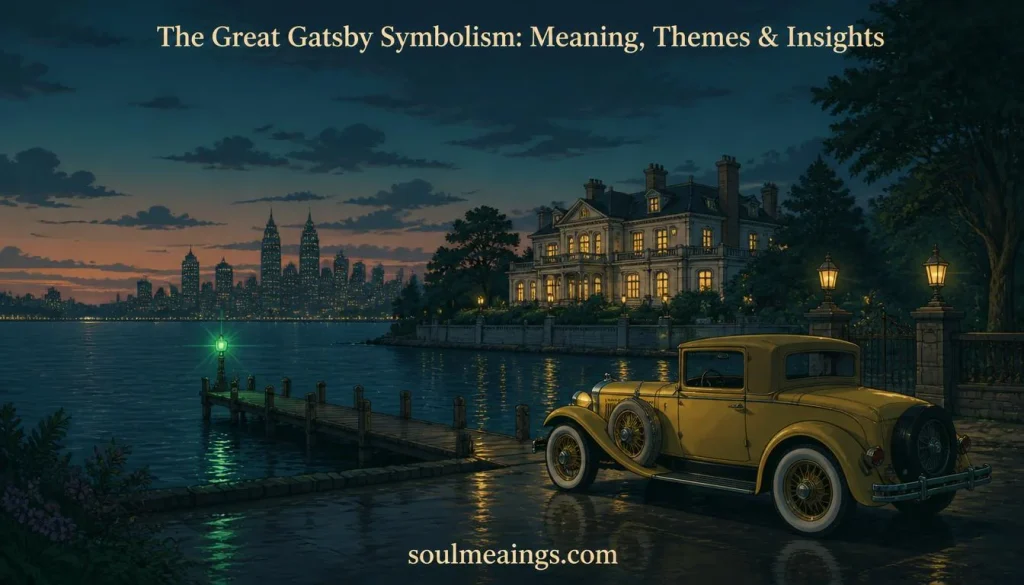
The Great Gatsby Symbolism shows how F. Scott Fitzgerald uses simple images to explore dreams, hope, and identity.
Published in 1925, this American literary masterpiece uses rich symbolism to connect wealth, success, personal desires, and the pursuit of dreams with the gap between dreams and reality. T
he green light represents Gatsby’s hope and ambition, while the valley of ashes reflects poverty and social inequality. Gatsby’s mansion symbolizes wealth, power, and materialism, while the eyes of Dr. T. J. Eckleburg raise questions about morality, truth, and moral values.
These symbolic elements reveal deeper truths about human nature and the American Dream. Through character symbolism, color symbolism, object symbolism, and setting symbolism, Fitzgerald explores love, idealism, disillusionment, and the conflict between appearances and reality.
The novel also highlights social class, class divisions, and societal expectations. Its lasting literary symbolism continues to inspire literary analysis in classrooms and pop culture, offering valuable life lessons about ambition, identity, and the pursuit of happiness.
Quick Answer
The Great Gatsby symbolism explores the American Dream, unattainable desires, wealth, social inequality, and the corruption hidden beneath glamour. In American culture, its most famous symbols reveal the tension between chasing success and finding genuine happiness.
TL;DR
- The green light represents Gatsby’s hopes and unreachable dreams.
- The eyes of Doctor T. J. Eckleburg suggest judgment and moral emptiness.
- The Valley of Ashes reveals poverty beneath wealthy society’s glamour.
- Gatsby’s mansion symbolizes status, ambition, and his desire for Daisy.
- East Egg and West Egg represent inherited wealth and newly acquired fortunes.
- The novel questions whether the American Dream offers happiness or endless desire.
Overview of the Novel’s Symbols
Fitzgerald fills the novel with recurring images that reveal what characters want and fear. For American readers, these symbols offer a closer look at the country’s ideas about success, class, and personal reinvention.
How symbolism works in the story
Symbolism occurs when an object, place, color, or image carries a meaning beyond its literal purpose. In The Great Gatsby, everyday details often expose truths that characters try to hide.
For example, Gatsby’s mansion isn’t simply a large house. It reflects his wealth, his carefully constructed identity, and his hope of winning Daisy’s love. Similarly, the green light across the water becomes a physical sign of a dream that always seems just out of reach.
The novel’s central symbolic ideas
- Hope and longing: The green light captures Gatsby’s desire for a different future.
- Money and status: The Eggs reveal how wealth shapes social belonging.
- Moral decline: The Valley of Ashes exposes the damage hidden beneath luxury.
- Time and memory: Gatsby’s desire to repeat the past drives his tragedy.
Together, these symbols reveal the distance between appearances and reality. They also explain why the novel remains relevant in a society that often measures success through money and status.
Historical Background
The novel reflects the social changes and cultural tensions of 1920s America. Understanding this period helps readers see why Fitzgerald connects wealth, pleasure, and ambition with moral uncertainty.
The Roaring Twenties
After World War I, the United States experienced economic growth, consumer expansion, and changing social habits. Jazz music, automobiles, fashionable clothing, and lavish parties became visible signs of modern life.
However, prosperity wasn’t shared equally. Social divisions remained strong, and the decade’s excitement existed alongside poverty, prejudice, and economic insecurity. Fitzgerald’s fictional world captures both sides of this era.
Older roots of its symbols
Fitzgerald didn’t create every symbolic idea from nothing. The novel draws on older literary traditions involving light and darkness, journeys, lost innocence, and the search for an ideal world.
- Light and darkness: Long used in literature to contrast hope with danger or truth with deception.
- The wasteland: A barren landscape traditionally suggests destruction, spiritual emptiness, or social decline.
- The dream journey: Stories across cultures often explore the pursuit of something precious that remains difficult to attain.
- Moral vision: Eyes and watching figures have long appeared in art and literature as signs of judgment or awareness.
These are broad literary traditions, not proof that every symbol has a single ancient religious origin. Fitzgerald reshapes familiar images to examine modern American life.
Prohibition and changing values
During much of the novel’s setting, national Prohibition restricted the manufacture and sale of alcoholic beverages. Illegal liquor businesses created opportunities for people who wanted quick wealth.
Gatsby’s fortune is connected to criminal activity, although the novel doesn’t present every detail of his business dealings. His rise reflects an era when wealth could bring social attention without guaranteeing respectability.
The Green Light
The green light is the novel’s best-known symbol of hope, desire, and an imagined future. It shines from the end of Daisy Buchanan’s dock across the water toward Gatsby’s property.
What the green light means
At first, Gatsby’s distant light represents his hope of reuniting with Daisy. He believes that winning her love will restore the life he has imagined for years.
Yet the light also represents something larger than romance. It captures the human habit of placing happiness in a future achievement instead of appreciating the present.
- Hope: Gatsby believes his dream remains possible.
- Desire: The distance makes Daisy seem even more precious.
- Ambition: Gatsby links personal fulfillment with achieving a particular goal.
- Illusion: His dream depends on an idealized version of the past.
Why the color green matters
Green can suggest growth, renewal, nature, and new beginnings. In American culture, it can also evoke money, making it especially fitting for a story about wealth and aspiration.
However, green doesn’t carry one universal meaning. Its interpretation depends on context, and Fitzgerald uses it to connect Gatsby’s emotional longing with his pursuit of success.
The green light today
Modern readers often connect the green light with ambitious goals, romantic longing, and the belief that happiness lies just beyond reach. It can represent anything people desperately want but struggle to obtain.
The symbol also invites an uncomfortable question: What happens when a dream becomes more important than reality?
The Eyes of Doctor T. J. Eckleburg
The eyes of Doctor T. J. Eckleburg appear on an old advertising billboard overlooking the Valley of Ashes. The faded blue eyes and enormous spectacles create an unsettling image above the bleak industrial landscape.
Judgment and moral emptiness
The eyes are often interpreted as a symbol of judgment, conscience, or a missing moral authority. Their position above the wasteland makes them seem to watch a society filled with selfish choices and hidden wrongdoing.
However, Fitzgerald leaves their meaning open to interpretation. The billboard originally advertises an eye doctor, so the eyes also represent ordinary commercial imagery that has lost its original purpose.
Why the eyes matter
- Moral awareness: They suggest that wrongdoing may not remain unseen.
- Spiritual uncertainty: Characters struggle to find meaning or guidance.
- Commercial decay: An abandoned advertisement becomes a haunting landmark.
- False comfort: People may project meaning onto an image that cannot respond.
George Wilson interprets the eyes in religious terms after the tragedy surrounding Myrtle. His interpretation shows how grief can shape the meaning people assign to their surroundings.
The billboard doesn’t necessarily represent God directly. Instead, it raises questions about morality and belief in a world where traditional sources of guidance seem absent.
The Valley of Ashes
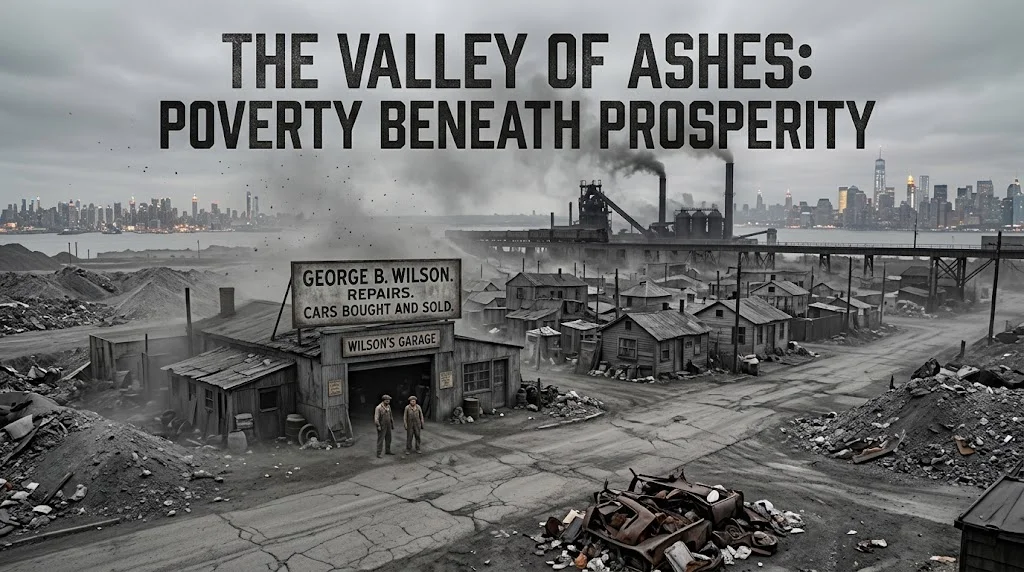
The Valley of Ashes is a bleak stretch between the wealthy communities of Long Island and New York City. Its gray dust, industrial waste, and struggling residents sharply contrast with the luxury surrounding Gatsby and the Buchanans.
Poverty beneath prosperity
The valley symbolizes the human cost of wealth and careless ambition. While rich characters enjoy parties, cars, and comfortable homes, working-class people struggle in an environment marked by neglect.
George and Myrtle Wilson live and work in this desolate setting. Their circumstances reveal how little power they have compared with people who possess money and social influence.
What the Valley of Ashes represents
- Social inequality: Wealthy characters enjoy privileges unavailable to poorer residents.
- Moral decay: The setting reflects the damage caused by selfish choices.
- Lost hope: Gray surroundings suggest lives limited by circumstance.
- Environmental destruction: Industrial waste reveals the physical cost of prosperity.
Its meaning in modern America
The valley remains relevant to discussions about economic inequality and communities left behind by growth. It reminds readers that visible prosperity doesn’t tell the whole story.
Fitzgerald also connects the setting to personal responsibility. The wealthy characters can move through the valley without facing its hardships directly, just as they often avoid the consequences of their actions.
East Egg and West Egg
East Egg and West Egg are fictional communities on Long Island where the novel’s wealthy characters live. Although both contain impressive homes, they represent different paths to wealth and different levels of social acceptance.
East Egg: inherited privilege
East Egg represents old money, or wealth passed down through generations. Tom and Daisy Buchanan belong to this established social class.
Their wealth gives them more than comfort. It provides family connections, social influence, and a sense of belonging that money alone can’t easily purchase.
West Egg: newly acquired wealth
West Egg represents new money, earned or accumulated more recently. Gatsby’s mansion stands here, surrounded by signs of ambition and extravagance.
Although Gatsby becomes extremely wealthy, he never gains full acceptance from people like Tom and Daisy. His background remains a barrier, showing that social class involves more than a bank balance.
| Symbol or setting | Meaning in the USA | Common associations | Notes |
| East Egg | Established wealth | Family status, privilege | Represents old money |
| West Egg | Newly acquired wealth | Ambition, reinvention | Gatsby lives here |
| Valley of Ashes | Unequal prosperity | Poverty, neglect | Separates wealthy spaces |
| Green light | An idealized future | Hope, longing | Appears across the water |
| Gatsby’s mansion | Wealth and aspiration | Luxury, display | Also reveals loneliness |
Why the two Eggs matter
The contrast challenges the idea that hard work and money automatically create equal opportunities. Gatsby can buy expensive clothes and host grand parties, but he can’t easily buy the history that gives old-money families their status.
For modern American readers, the Eggs offer a way to examine inherited advantage, social mobility, and the invisible rules that shape belonging.
Gatsby’s Mansion and Parties
Gatsby’s mansion is a symbol of wealth, ambition, and the identity he builds to attract Daisy. Its impressive rooms and extravagant gatherings make him appear successful, yet they hide his emotional isolation.
A house built around a dream
Gatsby’s mansion reflects his belief that wealth can transform his life. He fills it with luxury partly because he wants Daisy to see what he’s achieved.
However, the mansion’s size doesn’t bring him lasting happiness. Gatsby welcomes crowds of guests, but many attend for entertainment rather than friendship.
What the parties reveal
- Excess: Lavish celebrations show the decade’s appetite for pleasure.
- Performance: Gatsby presents a carefully shaped version of himself.
- Loneliness: Large crowds don’t guarantee genuine connection.
- Social ambition: His hospitality helps him reach toward Daisy’s world.
The parties also expose the difference between reputation and reality. Guests spread rumors about Gatsby while enjoying his generosity, often without knowing him personally.
The American Dream behind the mansion
Gatsby’s home reflects the promise of reinvention in American culture. He changes his name, builds his fortune, and creates a life that seems far removed from his modest beginnings.
Yet his story reveals the limits of material success. A mansion can display achievement, but it can’t force love, erase the past, or guarantee acceptance.
The American Dream
The American Dream is one of the novel’s central themes and a major reason its symbols remain influential. It traditionally suggests that people can improve their lives through effort, opportunity, and determination.
Gatsby’s version of the dream
Gatsby believes he can create a better future by becoming wealthy and winning Daisy’s love. His rise appears to support the promise of self-reinvention.
However, his dream becomes tied to an idealized past. He doesn’t simply want a future with Daisy; he wants to recover the earlier relationship he remembers.
When ambition becomes an illusion
Fitzgerald shows how the pursuit of success can become destructive when people confuse possessions with fulfillment. Gatsby’s wealth brings attention, but it can’t guarantee emotional security or social acceptance.
- Opportunity: Gatsby’s rise reflects the desire to improve one’s circumstances.
- Materialism: Wealth becomes a measure of personal worth.
- Exclusion: Established elites protect their social position.
- Disillusionment: Gatsby’s dream collapses under reality.
What the novel says about America
The novel doesn’t simply dismiss ambition or condemn everyone who becomes wealthy. Instead, it questions a society that celebrates riches while overlooking integrity, compassion, and responsibility.
For readers in the United States today, Gatsby’s story encourages a broader definition of success. It asks whether achievement means much when it comes at the expense of genuine relationships and personal values.
read more: Jewelry Symbolism: Meaning, Spiritual Significance & Culture
Colors and Their Meanings
Fitzgerald uses color to create moods and reinforce the novel’s major themes. These colors don’t function like a fixed code; their meanings develop through the characters and events around them.
Green, yellow, and white
Green is most closely associated with Gatsby’s hope and the distant light on Daisy’s dock. It connects desire with the possibility of renewal, while also suggesting the money that helps Gatsby construct his new identity.
Yellow and gold frequently appear in scenes involving luxury and display. Yellow can suggest artificial glamour or moral carelessness, while gold often evokes wealth and status.
White appears in descriptions of Daisy and Jordan, helping establish an impression of elegance and refinement. However, this appearance can conceal privilege, dishonesty, or emotional distance.
How color shapes the novel
- Green: Hope, desire, money, and imagined possibilities.
- Yellow: Flashy wealth, spectacle, and possible corruption.
- Gold: Luxury, status, and social power.
- White: Elegance, surface innocence, and appearances.
Why these colors still resonate
In American culture, green often connects with money, while gold suggests prestige. White can signal purity or sophistication, depending on context.
Fitzgerald complicates these familiar associations. His characters may look impressive without behaving honorably, reminding readers that appearance doesn’t always reveal character.
Cars and Carelessness
Cars represent freedom, modern technology, wealth, and social power in The Great Gatsby. During the 1920s, automobiles became increasingly important symbols of changing American lifestyles.
Gatsby’s yellow car
Gatsby’s bright yellow car is one of the novel’s most important objects. Its striking appearance connects it with luxury, attention, and the public image he wants to project.
However, the car also becomes linked to tragedy. Myrtle Wilson is killed in a hit-and-run involving Gatsby’s car, and the vehicle becomes central to the confusion and blame that follow.
The symbolism of automobiles
- Freedom: Cars offer the promise of movement and independence.
- Status: Expensive vehicles display wealth and influence.
- Danger: Speed and power can create serious consequences.
- Carelessness: Powerful characters can escape responsibility for their actions.
Who takes responsibility?
The novel’s treatment of cars reinforces its criticism of careless privilege. Tom and Daisy repeatedly benefit from their social position, while less powerful people suffer the consequences of decisions made by the wealthy.
The automobile therefore becomes more than a symbol of modern progress. It reveals how freedom without responsibility can become destructive.
Time and the Past
Time is central to Gatsby’s tragedy because he believes the past can be recreated. His desire to restore his earlier relationship with Daisy shapes his choices and prevents him from fully accepting the present.
Gatsby’s belief in repetition
Gatsby’s dream depends on the idea that Daisy can return to the person she was before marrying Tom. He expects her to reject her marriage and erase the years that have passed.
Nick challenges this belief when Gatsby insists that the past can be repeated. Their disagreement reveals a basic conflict between hope and reality.
What time symbolizes
- Memory: People often preserve idealized versions of earlier experiences.
- Regret: The past can become a source of longing.
- Change: Time alters relationships, identities, and opportunities.
- Illusion: Refusing to accept change can make a dream impossible.
The lesson for modern readers
Gatsby’s longing is understandable because many people wish they could revisit important moments. However, Fitzgerald shows the danger of treating memories as exact pictures of reality.
The past can shape our hopes, but it can’t always be restored. Gatsby’s tragedy grows from his refusal to accept that Daisy and his own life have changed.
Daisy, Gatsby, and Myrtle
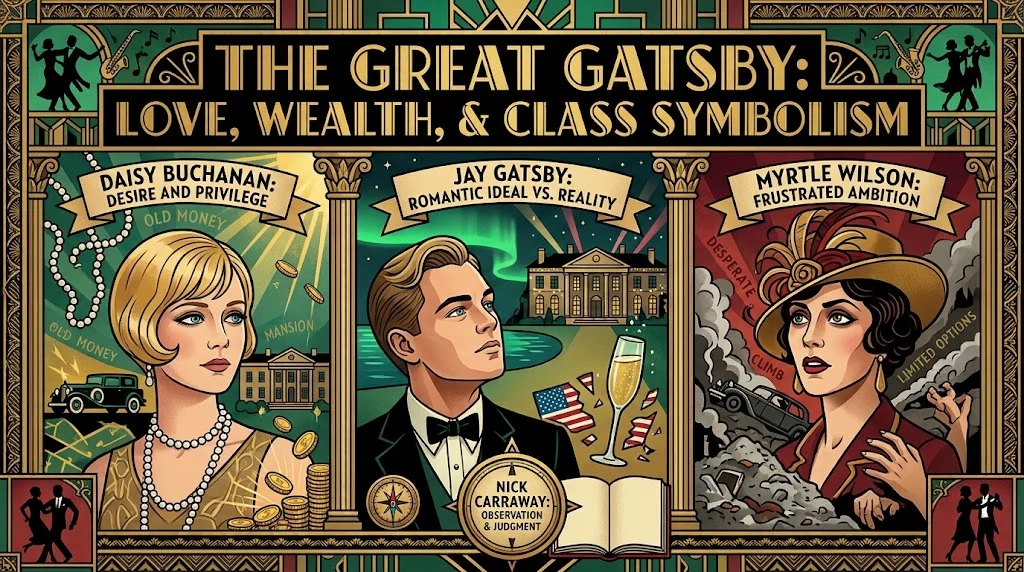
The novel’s characters also carry symbolic meaning. Their desires and decisions reveal how love, wealth, gender expectations, and social power shape life in the 1920s.
Daisy Buchanan: desire and privilege
Daisy represents Gatsby’s romantic ideal, but she also embodies the security and status associated with old money. Her voice is famously described as being full of money, connecting her appeal directly to wealth.
Gatsby loves the version of Daisy he has imagined. Yet Daisy is a person with her own fears, loyalties, and limitations, not simply a prize waiting for him.
Myrtle Wilson: frustrated ambition
Myrtle wants to escape her working-class circumstances. Her relationship with Tom offers a glimpse of wealth and status, but it doesn’t give her genuine security or equality.
Her tragic fate exposes the risks faced by people with little social power. She becomes caught in a world where wealthy characters can treat others as disposable.
Nick Carraway: observation and judgment
Nick serves as the novel’s narrator, guiding readers through Gatsby’s world. His perspective shapes how the events and characters appear, although his judgments aren’t always completely neutral.
Nick’s role highlights the difference between witnessing events and fully understanding them. His narration encourages readers to question both Gatsby’s dream and the society surrounding it.
Modern Meanings and Misunderstandings
The Great Gatsby continues to influence how Americans discuss ambition, wealth, romance, and social status. Its symbols appear in classroom discussions, adaptations, themed parties, fashion, and online conversations.
How readers use its symbols today
- The green light: A visual metaphor for ambitious goals or distant hopes.
- Gatsby-inspired fashion: A reference to 1920s glamour, jazz, and luxury.
- Lavish party themes: An aesthetic drawn from the novel’s extravagant gatherings.
- American Dream discussions: A way to examine wealth, opportunity, and inequality.
- Literary tattoos or artwork: Personal reminders of longing, ambition, or disillusionment.
Common misunderstandings
One common mistake is assuming that Gatsby’s wealth proves he has achieved the American Dream. The novel makes that conclusion much more complicated by showing his emotional isolation and eventual downfall.
Another mistake is treating the green light as purely positive. Although it represents hope, it also reveals how desire can become an illusion when people refuse to question their goals.
Similarly, the eyes of Doctor T. J. Eckleburg aren’t simply a universally agreed symbol of God. Their meaning remains uncertain, and the characters interpret them in different ways.
Does the novel criticize all wealth?
No. Fitzgerald’s criticism focuses on materialism, social exclusion, and irresponsible behavior rather than claiming that every wealthy person is immoral.
The distinction matters because the novel explores how people use wealth and privilege. Its central warning concerns a society that values appearances while allowing powerful individuals to avoid accountability.
Broader Cultural Meanings
Although The Great Gatsby is rooted in American history, its symbols connect with themes found in literature around the world. Hope, social ambition, lost love, and the conflict between appearance and reality are widely recognizable human experiences.
Shared themes across cultures
Stories from many traditions explore people who pursue wealth, power, love, or an ideal future. These stories don’t share one universal meaning, but they often ask whether desire brings fulfillment or suffering.
The green light can be understood through this broader literary pattern. It represents an imagined future that motivates a person’s actions, even when reality doesn’t match the dream.
Likewise, the Valley of Ashes resembles other literary wastelands that portray social breakdown or spiritual emptiness. Fitzgerald uses this familiar image to expose the inequalities of his own time.
A respectful way to interpret the symbols
- Hope: The desire to build a better life appears in many cultural stories.
- Lost love: Literature often explores the pain of longing for someone unavailable.
- Moral responsibility: Stories across traditions question the consequences of selfish behavior.
- Social inequality: Many narratives examine how wealth and status shape human relationships.
These connections are useful comparisons, not claims that the novel belongs to a particular religious tradition. Its symbolism remains closely tied to American society and the historical setting of the 1920s.
FAQs About The Great Gatsby Symbolism
1. What is the main symbolism in The Great Gatsby?
The main symbolism in The Great Gatsby focuses on the American Dream, wealth, hope, and social class. Fitzgerald uses symbols to show how ambition and materialism can lead to disappointment.
2. What does the green light symbolize in The Great Gatsby?
The green light represents hope, desire, and Gatsby’s dream of being with Daisy. It also reflects his belief that he can recreate the past and achieve an ideal future.
3. What does the valley of ashes symbolize?
The valley of ashes represents poverty, social inequality, and moral decay. It contrasts with the wealth of East Egg and West Egg, showing the hidden costs of prosperity.
4. What do the eyes of Dr. T. J. Eckleburg represent?
The eyes of Dr. T. J. Eckleburg can symbolize moral judgment, spiritual emptiness, and the loss of religious values. Their meaning remains open to interpretation.
5. What does Gatsby’s mansion symbolize?
Gatsby’s mansion symbolizes wealth, status, and material success. However, it also highlights Gatsby’s loneliness and his hope that money will help him win Daisy’s love.
6. Why is symbolism important in The Great Gatsby?
Symbolism helps readers understand the novel’s deeper themes, including ambition, love, illusion, and social class. It makes Fitzgerald’s criticism of wealth and the American Dream more powerful.
Conclusion
The Great Gatsby Symbolism reveals the deeper meaning behind Fitzgerald’s memorable characters, settings, and objects. The green light, valley of ashes, Gatsby’s mansion, and eyes of Dr. T. J. Eckleburg explore hope, wealth, inequality, and moral decay. Together, these symbols show the gap between dreams and reality and the dangers of chasing success at any cost. Even today, the novel offers valuable insights into the American Dream, human ambition, and the lasting influence of social class and materialism.

Charlotte Brown is a passionate writer at SoulMeanings.com, dedicated to exploring spirituality, symbolism, dreams, and life’s deeper meanings. Her work helps readers find clarity, inspiration, and personal insight.
Pingback: Moth Symbolism: Spiritual Meaning and Intuition