
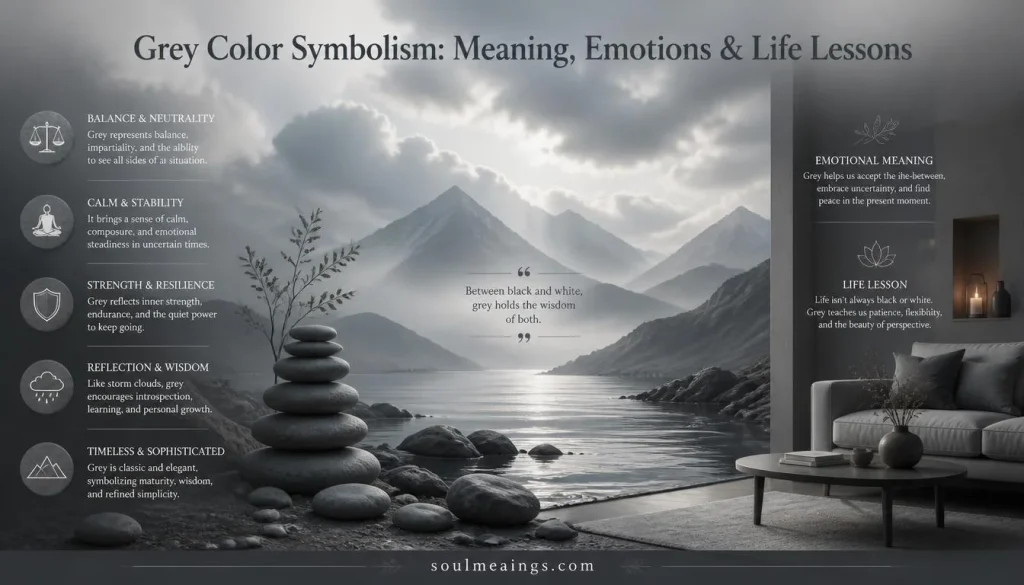
Grey Color Symbolism: Meaning, Emotions & Life Lessons explores how grey represents balance, emotions, cultural values, and personal growth.
Unlike bold or vibrant colors, grey rarely demands attention. Its neutral tone, calm appearance, and subtle effect convey simplicity, elegance, and sophistication. Positioned between black and white, grey symbolizes balance, compromise, neutrality, and subtlety.
In the United States, it appears in fashion, home décor, branding, and modern design, where it reflects maturity and understated elegance.From a color psychology perspective, grey can represent wisdom, maturity, and emotional balance, but it may also suggest melancholy, indecision, uncertainty, and emotional distance.
Its meaning varies across art, culture, and everyday life. In art and design, grey communicates restraint and subtle expression, while its cultural and spiritual symbolism encourages reflection, personal development, and life lessons. Although grey can sometimes appear dull or emotionless, its versatile symbolism makes it a meaningful color associated with sophistication, calmness, and emotional depth.
Quick Answer
Grey color symbolism in the United States commonly represents neutrality, maturity, balance, sophistication, and quiet strength. It can also symbolize sadness, uncertainty, emotional distance, or transition. Spiritually and culturally, grey may suggest humility, reflection, wisdom, and the space between opposing forces.
TL;DR
- Grey symbolizes balance, neutrality, maturity, and understated strength.
- In American culture, grey often represents professionalism and modern sophistication.
- Historically, grey connects with stone, ash, undyed wool, and aging.
- Emotionally, it may suggest calmness, sadness, restraint, or uncertainty.
- Spiritually, its meaning depends on the tradition and surrounding symbols.
- Today, grey appears in tattoos, fashion, home decor, and digital culture.
What Does Grey Color Symbolize?
Grey sits between black and white, creating a visual connection between light and darkness. Because of this position, people often associate it with moderation, uncertainty, and the ability to see different sides of a situation.
In everyday American life, grey can look professional and dependable. However, the same color may appear dull or gloomy when paired with dark surroundings.
The Core Meanings of Grey
Three central ideas help explain grey’s symbolism.
- Balance: Grey can represent a middle position between opposing viewpoints.
- Wisdom: Its connection with silver hair and age suggests experience and maturity.
- Ambiguity: Its muted appearance can represent situations without clear answers.
Grey also symbolizes restraint. Unlike bright colors that immediately attract attention, it often communicates quietly.
What Different Shades Suggest
Not every grey creates the same impression. Lighter shades can feel open and peaceful, while darker shades may seem serious or mysterious.
Light grey suggests calmness, simplicity, openness, and subtle elegance. It works well when a space needs a gentle, understated appearance.
Medium grey represents neutrality, practicality, balance, and reliability. It often appears in professional clothing and everyday design.
Dark grey can communicate authority, seriousness, protection, and mystery. However, too much dark grey may feel heavy or distant.
Silver grey suggests refinement, modern technology, innovation, and polished elegance. Its reflective surface distinguishes it from flat, matte grey.
Historical Origins of Grey Color Symbolism
Grey’s symbolic history developed through everyday materials, religious practices, art, and changing social values. Unlike colors tied to one famous ancient myth, grey gained many meanings through its practical uses.
Grey in Ancient Times
Ancient people encountered grey in stone, ash, metal, animal fur, and cloudy skies. These materials connected the color with endurance, aging, fire, and the natural world.
Stone buildings and monuments also gave grey a lasting association with permanence. Their ability to survive for centuries made grey stone a useful image of strength and continuity.
However, ancient cultures didn’t share one universal meaning for grey. Its importance depended on local beliefs, available materials, and the purpose of an object.
Grey in Medieval Europe
During the Middle Ages, undyed wool often appeared grey or brownish-grey. Such fabrics were practical and less expensive than richly dyed textiles, helping associate grey clothing with simplicity and modest living.
Certain religious communities also wore undyed or muted garments. In these settings, grey could express humility, restraint, or a rejection of luxury.
Ash carried a related meaning in Christian traditions. Biblical references to ashes and sackcloth connect them with mourning, repentance, and humility, although grey wasn’t the only color used for these ideas.
The Industrial Age and Modern Design
Industrialization brought grey into factories, railways, machinery, and expanding cities. Concrete, steel, iron, and smoke strengthened its association with work, engineering, and urban life.
Later, modern architecture and minimalist design embraced grey for its clean, adaptable appearance. Today, the color can suggest both industrial toughness and carefully designed simplicity.
This history explains why grey can seem humble in one setting and sophisticated in another.
What Does Grey Mean in American Culture?
In the United States, grey carries a mixture of professional, emotional, historical, and everyday meanings. Its associations often come from clothing, buildings, weather, popular language, and familiar national imagery.
Professionalism and Reliability
Grey suits, office furniture, and business interiors often communicate seriousness and restraint. Because grey doesn’t compete strongly with other colors, it can support a polished, practical appearance.
Technology, manufacturing, and architecture also use grey to highlight materials and structure. In these settings, the color can suggest efficiency rather than emotional expression.
Grey in American History
Grey has a particularly important historical association with the American Civil War. Confederate military uniforms were commonly associated with grey, although uniforms varied by unit, supply, and period.
Today, Confederate symbols remain controversial because of their connections with slavery, secession, racial oppression, and later white supremacist movements. Grey fabric alone, however, doesn’t carry those political meanings.
This distinction matters: a color’s historical associations depend on the object, its use, and the message surrounding it.
Everyday American Associations
Grey also appears in familiar expressions and settings throughout American life.
- Grey skies: Rainy weather, quiet reflection, or a gloomy mood.
- Grey hair: Aging, experience, dignity, or wisdom.
- Grey areas: Unclear rules, competing perspectives, or difficult decisions.
- Grey suits: Professionalism, formality, and understated confidence.
- Concrete and steel: Urban development, durability, and industrial strength.
These examples show how American culture builds symbolism from ordinary experiences. The meaning isn’t fixed, but the context often makes it understandable.
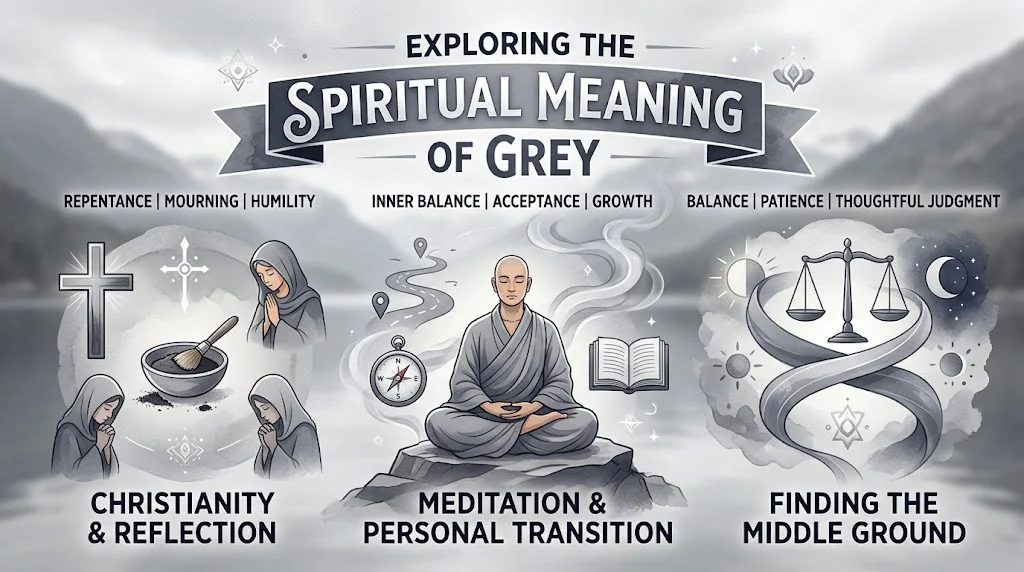
Spiritual Meaning of Grey
Grey can represent spiritual reflection, humility, transition, and the search for balance. However, its spiritual meaning varies between traditions, so it shouldn’t be treated as a universal sacred color.
Grey in Christianity
Christian symbolism often connects ashes with repentance, mourning, and humility. Ash Wednesday, observed in many Christian traditions, uses ashes as a reminder of human mortality and spiritual reflection.
Grey garments and muted colors may also communicate modesty or simplicity in particular religious settings. Still, Christian traditions use different colors for different purposes, and grey doesn’t have one fixed meaning across all denominations.
Grey in Meditation and Personal Reflection
Some people interpret grey as a reminder to slow down and examine their thoughts. Its understated appearance can provide a visual focus for reflection without the intensity of brighter colors.
In personal spiritual practice, grey might represent:
- Inner balance: Making space for competing feelings or ideas.
- Acceptance: Recognizing that life doesn’t always offer simple answers.
- Humility: Remembering personal limits and remaining open to learning.
- Transition: Moving through uncertainty toward a new understanding.
These are personal interpretations rather than established spiritual rules. The meaning depends on an individual’s beliefs and experiences.
Grey and the Space Between Opposites
Grey often works as a metaphor for the middle ground between extremes. In spiritual reflection, this can encourage patience, thoughtful judgment, and a willingness to reconsider assumptions.
However, balance doesn’t mean every position is equally reasonable. Sometimes, careful reflection helps people recognize clear differences rather than blur them.
Grey Color Meaning in Different Cultures
Grey’s symbolism changes across cultural settings because people learn to interpret colors through local history, traditions, and everyday experiences. A meaning common in the United States may not apply elsewhere.
Western Cultural Associations
In many Western settings, grey suggests neutrality, modesty, professionalism, and maturity. It can also represent sadness, old age, or emotional restraint.
These associations appear in clothing, architecture, literature, and everyday expressions. However, they describe common patterns rather than rules that everyone follows.
Asian Cultural Perspectives
Grey may suggest restraint, dignity, simplicity, or age in particular Asian contexts. Yet Asia includes many cultures and religious traditions, each with its own practices.
For example, the meaning of grey in Japanese design may differ from its meaning in a Chinese painting or a South Asian religious setting. It’s important not to assume that one interpretation applies across the entire region.
Cultural Meaning at a Glance
| Context | Possible symbolism | Important distinction |
| United States | Professionalism, neutrality, maturity | Historical and emotional context can change the meaning |
| Medieval Europe | Simplicity, modest clothing, humility | Associations depended on social class and religious practice |
| Modern Japanese design | Restraint and understated elegance | Meanings vary by setting and individual interpretation |
| Christian traditions | Ashes, mourning, repentance | Ash symbolism is more specific than grey alone |
| Contemporary design | Minimalism, practicality, sophistication | Materials, lighting, and surrounding colors matter |
The main lesson is simple: grey doesn’t mean the same thing everywhere. Cultural history provides clues, but specific objects and traditions offer better explanations than broad generalizations.
Grey Color Psychology and Emotional Associations
Grey often feels quiet because it has little visual intensity compared with bright, saturated colors. People may interpret that quietness as calm, seriousness, sadness, or emotional distance.
However, color psychology doesn’t support a single emotional response for everyone. Personal memories, cultural learning, lighting, and surrounding colors all influence perception.
Positive Emotional Associations
Grey can provide a feeling of stability when its surroundings feel busy or overwhelming. Its understated appearance allows other details to stand out.
Common positive associations include:
- Calmness: Muted shades may create a softer visual atmosphere.
- Composure: Grey can communicate restraint during serious situations.
- Maturity: Its connection with aging can suggest experience.
- Stability: Grey stone and concrete evoke strength and permanence.
- Practicality: Neutral shades often feel adaptable and uncomplicated.
These associations explain why grey appears frequently in offices, modern homes, and understated clothing.
Negative Emotional Associations
Grey can also remind people of storm clouds, fading light, and gloomy weather. In stories and everyday speech, these images often connect it with sadness or uncertainty.
Potential negative associations include emotional distance, boredom, dullness, loneliness, and indecision. Still, these aren’t automatic effects of seeing grey.
A bright, naturally lit room with warm grey walls may feel welcoming. By contrast, a dark room with little natural light may feel cold or heavy.
Can Grey Influence Your Mood?
Color can influence the atmosphere people perceive, but its effects aren’t identical or guaranteed. Grey may feel restful to one person and depressing to another.
Instead of treating color as a psychological diagnosis, consider how it interacts with your surroundings. Light, texture, contrast, and personal experience can change the overall impression.
Grey as a Symbol of Wisdom, Age, and Experience
Grey hair is one of the most familiar symbols of aging in American culture. It can represent accumulated experience, patience, maturity, and knowledge gained over time.
The Wisdom of Grey Hair
In books, films, and everyday life, grey-haired characters often appear as mentors, elders, or experienced leaders. This visual convention helps audiences recognize a character’s supposed life experience quickly.
However, hair color doesn’t measure intelligence or wisdom. Younger people can be thoughtful, and older people can continue learning throughout their lives.
Grey hair can also represent authenticity. Some people choose to stop coloring their hair because they prefer their natural appearance or reject pressure to hide visible aging.
What Grey Teaches About Growing Older
Grey offers a useful reminder that change doesn’t always mean decline. It can represent the experiences, relationships, mistakes, and lessons that shape a person’s perspective.
At the same time, grey hair can carry different meanings depending on personal attitudes toward aging. For some, it represents confidence; for others, it brings complicated feelings about time and identity.
Its symbolism becomes more meaningful when it reflects an individual’s actual story rather than assumptions about age.
Grey as a Symbol of Balance and Life Lessons
Because grey occupies the space between black and white, it often represents the complexity of real life. It can remind us that many decisions involve competing values, incomplete information, and changing circumstances.
Finding the Middle Ground
The expression grey area describes a situation that lacks a clear answer. In American conversation, it often appears when rules, responsibilities, or moral questions become complicated.
Grey can therefore encourage a thoughtful approach rather than an immediate judgment. It reminds us to examine details before deciding what something means.
However, not every problem has a middle-ground solution. Some situations require clear boundaries, firm decisions, or a direct response.
Life Lessons Associated With Grey
- Accept uncertainty: You don’t need every answer before taking a thoughtful next step.
- Look beyond appearances: A quiet exterior doesn’t reveal a person’s full story.
- Practice patience: Understanding complex situations often takes time.
- Stay open to learning: Experience can change how you see earlier decisions.
- Recognize change: Different stages of life can carry different forms of value.
Grey’s symbolism is useful because it makes room for complexity without demanding that every situation remain uncertain.
read more: Turtle Symbolism: Meaning and Cultural Insights
Grey Color Symbolism in Tattoos
Grey tattoos can communicate remembrance, resilience, maturity, mystery, or understated personal strength. Their meaning depends on the design, the wearer’s intentions, and any additional symbols.
Popular Grey Tattoo Designs
Grey ink and black-and-grey shading appear in many tattoo styles. Artists use different shades to create depth, contrast, and detailed imagery.
A grey rose may represent remembrance, a complicated relationship, quiet beauty, or personal transformation. Its meaning becomes clearer when combined with other imagery.
Mountain designs can symbolize endurance, perspective, and overcoming challenges. Grey shading emphasizes the texture of stone and the passage of time.
Clock tattoos often represent time, memory, mortality, or meaningful life changes. Grey shading can give them a reflective, timeless appearance.
What Does a Grey Tattoo Say About You?
Some wearers choose grey because they prefer subtle designs over bright colors. Others appreciate the depth and contrast that black-and-grey artwork creates.
However, a tattoo doesn’t automatically reveal someone’s personality or beliefs. Its symbolism should come from the wearer’s story rather than assumptions about color preferences.
Grey in Fashion, Home Decor, and Modern Design
Grey remains popular in American fashion and interiors because it works with many colors and materials. It can create a restrained background, establish a formal mood, or highlight another feature.
Grey in Clothing
Grey clothing can suggest professionalism, simplicity, and confidence without appearing overly dramatic. Charcoal suits often feel formal, while light grey sweaters can look relaxed and approachable.
Grey also pairs easily with navy, white, black, beige, and muted pastels. These combinations make it useful for everyday wardrobes and professional settings.
Grey in Home Decor
In American homes, grey walls, sofas, countertops, and flooring often support a modern or minimalist style. Its neutral appearance can help rooms feel coordinated.
However, grey can seem cold when a room lacks warmth or contrast. Wood, textured fabrics, warm lighting, plants, and colorful accessories can create a more inviting atmosphere.
Grey in Technology and Branding
Grey appears in many product interfaces, electronic devices, appliances, and industrial designs. It can make products look understated, functional, and contemporary.
In digital interfaces, grey often marks secondary information or inactive controls. Designers must still provide enough contrast so people can read text and identify important elements.
The broader lesson is that grey works best when its purpose is clear. Neutrality can support a design, but excessive neutrality may make the result feel lifeless.
Grey in Nature, Art, and Popular Culture
Natural landscapes and creative works give grey many of its strongest emotional associations. Fog, rain, stone, smoke, and distant mountains can create feelings of mystery, stillness, or uncertainty.
Grey in Nature
Grey appears in clouds, rocks, tree bark, animal fur, and winter landscapes. These natural examples connect it with endurance, transition, and the quieter side of the environment.
Storm clouds may suggest approaching change, while smooth river stones can evoke patience and the gradual effects of time. Neither meaning is universal, but both offer familiar visual metaphors.
Grey in Film and Literature
Artists often use grey settings to communicate tension, uncertainty, or emotional distance. A muted color palette may make a scene feel reflective or unsettling.
In contrast, grey can also help highlight a character’s resilience. A person standing against a bleak landscape may appear determined, especially when the story contrasts their inner strength with the surroundings.
Grey and the Phrase “Grey Area”
The expression grey area is especially important in modern American English. It describes something that doesn’t fit neatly into established categories.
For example, a workplace policy may leave room for interpretation. Calling it a grey area signals that the situation needs closer examination, not necessarily that anyone has done something wrong.
This metaphor captures grey’s central symbolic tension: it can represent both uncertainty and the wisdom needed to navigate it.
Misunderstandings, Controversies, and Changing Meanings
Grey is sometimes described as universally neutral, peaceful, or wise. In reality, its symbolism changes with historical events, social settings, and personal experiences.
Does Grey Always Represent Neutrality?
No. Grey can suggest neutrality in a design or conversation, but it can also represent sadness, conformity, or uncertainty.
Likewise, using grey clothing doesn’t automatically communicate impartiality. The person’s behavior, the setting, and other symbols may matter far more than the color itself.
Historical and Political Associations
As noted earlier, grey Confederate uniforms have a specific place in American Civil War history. Their associations can become politically charged when displayed alongside Confederate flags, memorials, or other symbols connected with that history.
However, grey clothing, paint, or decoration shouldn’t automatically be interpreted as a political statement. A responsible interpretation considers the entire display and its historical context.
Avoiding Overgeneralizations
Color symbolism becomes misleading when people assign fixed meanings to entire cultures or groups. Claims that grey always represents a particular religion, personality type, or spiritual condition overlook important differences.
A better approach is to ask three questions:
- What object or shade of grey appears?
- Where and when is it being used?
- What other symbols or circumstances shape its meaning?
These questions help separate documented historical associations from personal interpretations and unsupported generalizations.
How Grey Symbolism Has Changed Over Time
Grey’s meaning has shifted as societies changed their clothing, technology, art, and ideas about status. Its older associations with modesty and practical materials now exist alongside modern ideas about sophistication and innovation.
From Practicality to Sophistication
In earlier European settings, grey undyed fabrics could suggest affordability, simplicity, or religious restraint. Industrialization later strengthened its connection with machinery, factories, and urban environments.
Today, grey can appear in luxury interiors, designer clothing, and sleek technology. The same color once associated with plain materials can now communicate deliberate elegance.
Traditional and Modern Meanings Compared
| Earlier association | Modern interpretation | What changed |
| Undyed, practical clothing | Minimalist fashion | Simplicity became a deliberate style |
| Ash and mourning | Reflection and remembrance | Personal interpretations expanded |
| Industrial machinery | Technology and innovation | Grey became part of modern product design |
| Grey hair and aging | Confidence and authenticity | Some people embrace natural aging |
| Cloudy weather | Calm, mystery, or melancholy | Art and media use different emotional tones |
These shifts show why grey symbolism should be understood through both history and current context. Older meanings haven’t disappeared, but new uses have broadened the color’s emotional range.
FAQs About Grey Color Symbolism
1. What does grey symbolize?
Grey symbolizes balance, neutrality, wisdom, maturity, and sophistication. It can also represent uncertainty, emotional distance, and calmness.
2. What is the spiritual meaning of grey?
The spiritual meaning of grey often relates to balance, reflection, patience, and finding peace during uncertain times. Its interpretation varies across spiritual traditions.
3. What does grey represent in color psychology?
In color psychology, grey is associated with neutrality, calmness, restraint, and emotional control. However, it may sometimes feel dull, distant, or emotionally muted.
4. Does grey symbolize positive or negative emotions?
Grey can symbolize both. Its positive meanings include wisdom, sophistication, balance, and maturity, while its negative associations may include melancholy, indecision, and uncertainty.
5. What does grey symbolize in art and design?
In art and design, grey represents simplicity, subtlety, balance, and elegance. Designers often use it to create modern, understated, and professional appearances.
6. What life lessons can we learn from grey?
Grey reminds us that life isn’t always black and white. It encourages balance, thoughtful decisions, patience, and understanding different perspectives before reaching conclusions.
Conclusion
Grey color symbolism reveals that even a neutral color can carry deep emotional and cultural meaning. Grey represents balance, wisdom, sophistication, maturity, and calmness, while sometimes reflecting uncertainty or emotional distance. Its use in art, fashion, interior design, and everyday life shows how context shapes its meaning. Ultimately, grey reminds us to embrace life’s complexities, seek balance, and recognize that wisdom often comes from understanding the space between extremes.

Charlotte Brown is a passionate writer at SoulMeanings.com, dedicated to exploring spirituality, symbolism, dreams, and life’s deeper meanings. Her work helps readers find clarity, inspiration, and personal insight.