
Symbolism in The Giver: Meaning, Themes & Literary Analysis explores how Lois Lowry uses objects, colors, and memories to reveal deeper truths about freedom, control, and human emotions.
Lois Lowry’s novel, The Giver, is a masterpiece of dystopian literature that portrays a seemingly perfect community hiding serious problems. Through literary symbolism, the story explores individuality, memory, conformity, choice, and personal freedom. Ordinary objects and experiences become symbolic tools that reveal the difference between a perfect world and a meaningful life.
The novel’s color symbolism, memory symbolism, river symbolism, and sled symbolism contribute to its deeper meaning. These symbols connect Jonas, human experience, and identity while revealing social control, emotional suppression, and societal restrictions. They highlight the conflict between individuality and conformity, freedom and control, and memory and identity.
Through these recurring symbols, Lowry explores important literary themes, philosophical insights, and life lessons about human nature, meaningful choices, and individual identity. Ultimately, the novel’s hidden meaning challenges the idea of a perfect society and emphasizes the value of authentic human experiences.
Quick Answer
Symbolism in The Giver represents freedom, individuality, memory, emotional connection, and the dangers of excessive social control. The color red symbolizes difference and awakening, while the sled represents discovery and new possibilities. Together, these symbols show why human experiences, personal choices, and shared memories matter.
TL;DR
- Red represents individuality, beauty, and Jonas’s growing awareness.
- The sled symbolizes discovery, change, and the journey toward freedom.
- Memories preserve history, wisdom, love, and painful experiences.
- Sameness represents conformity and the loss of personal choice.
- Gabriel symbolizes hope, innocence, and the possibility of a new beginning.
- The river represents boundaries, uncertainty, escape, and the unknown.
Overview of Symbolism in The Giver
In The Giver, symbols give deeper meaning to objects, characters, and places. Lowry uses familiar images to reveal what Jonas’s community has lost through its pursuit of order.
The novel’s most important symbols connect to its central conflict: safety versus freedom. Although the community avoids many hardships, it also suppresses individuality and meaningful emotions.
Major Symbols and Their Meanings
The following symbols help readers understand the novel’s central ideas.
- Red apple: Awakening, difference, and new understanding.
- Snow-covered hill: Discovery, pleasure, and the beginning of change.
- Memories: Knowledge, history, and emotional depth.
- Sameness: Conformity, control, and restricted choices.
- Gabriel: Innocence, love, and hope for change.
- The river: Escape, uncertainty, and the boundary between familiar and unknown worlds.
These meanings develop as Jonas learns more about his society. An ordinary object can initially seem unimportant, then become meaningful after he experiences something new.
Historical Background of The Giver’s Symbolism
Published in 1993, The Giver belongs to the dystopian tradition. Dystopian fiction describes societies that appear orderly but contain serious problems involving power, freedom, or human rights.
Lowry builds on literary traditions that explore the conflict between individual freedom and collective control. However, she presents these ideas through a young protagonist and everyday experiences rather than complicated political arguments.
Earlier Literary Roots
The novel draws on several long-standing literary patterns.
- The forbidden truth: A character discovers facts that challenge an accepted worldview.
- The journey: Physical movement reflects personal growth and discovery.
- The awakening: New knowledge changes how a character understands life.
- The controlled society: Stability becomes dangerous when authorities suppress independent thought.
These patterns appear in older myths, philosophical stories, and modern dystopian fiction. However, The Giver uses them distinctively by making memories the source of both wisdom and suffering.
Why History Matters in the Novel
Jonas’s community has separated its citizens from the past. As a result, people cannot fully understand the choices that shaped their lives.
The Giver preserves experiences from earlier generations. Through him, Jonas learns that history includes beauty, violence, love, pain, and mistakes.
This idea matters in the United States, where public discussions often connect historical memory with civic responsibility. Lowry’s story suggests that forgetting the past doesn’t eliminate its lessons or prevent people from repeating mistakes.
What Does the Color Red Symbolize in The Giver?
Red is one of the novel’s clearest symbols. Jonas first notices something unusual about an apple, then gradually recognizes color in other objects and people.
Because his community has adopted Sameness, most citizens cannot perceive the full range of colors. Red therefore represents more than visual beauty; it reveals differences that the community has tried to eliminate.
Red as Individuality and Awakening
The apple introduces Jonas to a reality beyond what his society teaches. His unusual perception suggests that he can recognize things others cannot.
As his understanding develops, red becomes associated with several ideas.
- Individuality: Differences make people and experiences distinctive.
- Awareness: Seeing color helps Jonas question accepted rules.
- Beauty: The world offers richness beyond practical usefulness.
- Emotional depth: Recognizing differences opens the door to stronger feelings.
Jonas eventually realizes that color also makes choice possible. If everything looks the same, people lose opportunities to express preferences.
Why Red Matters to American Readers
In American culture, red can suggest love, danger, courage, celebration, or warning, depending on context. However, these associations aren’t the novel’s only meanings.
Lowry gives red a specific role within Jonas’s experience. It becomes a sign that a supposedly perfect society has sacrificed something valuable.
The novel encourages readers to appreciate differences without assuming that every difference creates conflict. Instead, it asks whether eliminating differences can also eliminate important parts of being human.
What Does the Sled Symbolize in The Giver?
The sled introduces Jonas to a memory of snow, a hill, and the excitement of moving downhill. It becomes a lasting symbol of discovery and personal transformation.
The experience matters because Jonas has never known snow or experienced this kind of freedom. Through the memory, he encounters something his controlled community has removed from everyday life.
The Sled as a Journey of Discovery
The sled’s meaning changes as Jonas gains knowledge. At first, it represents a pleasant experience. Later, it becomes connected to the broader world that existed before Sameness.
Its symbolism includes:
- Discovery: Jonas experiences something outside his familiar world.
- Freedom: The downhill ride suggests movement without strict control.
- Change: Each new memory alters his understanding.
- Hope: The sled connects him to possibilities beyond his community.
The sled also links pleasure with risk. Later memories show Jonas that life contains pain as well as happiness.
The Sled and the Novel’s Ending
The sled returns in the novel’s final scene, when Jonas and Gabriel approach a snowy destination. Jonas recognizes the experience from his earlier memory.
The ending remains open to interpretation. Some readers understand it as a real arrival at a welcoming place, while others consider the possibility that Jonas is experiencing a final vision as he struggles against the cold.
Either way, the sled connects the ending to the beginning. It represents Jonas’s continuing search for warmth, safety, freedom, and human connection.
What Do Memories Symbolize in The Giver?
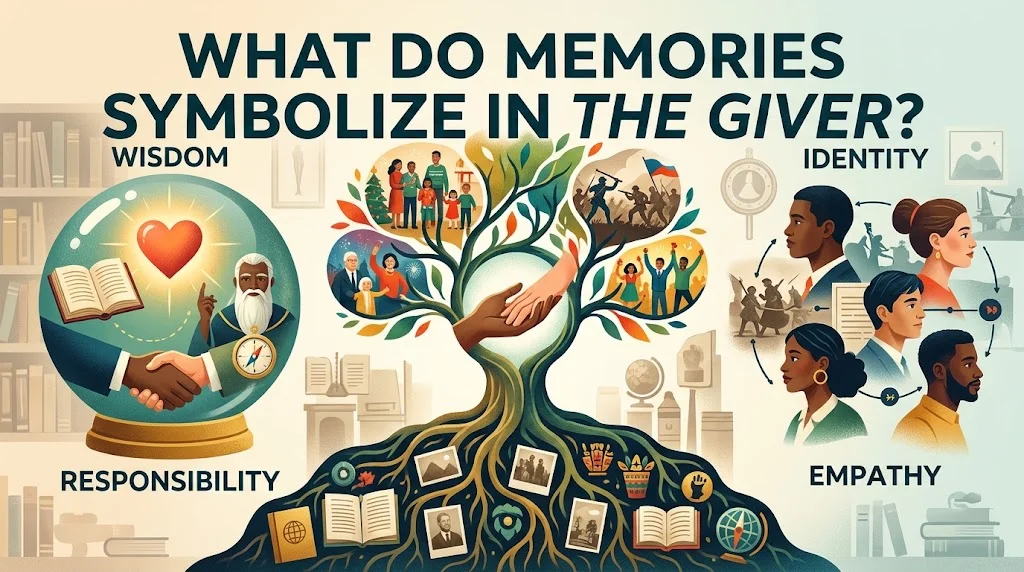
Memories are central to the novel because they preserve experiences that the community has deliberately abandoned. The Giver carries memories of the past and transfers them to Jonas during his training.
These memories include joyful experiences, such as celebrations and family affection, as well as suffering, violence, and loss. Together, they reveal the full range of human life.
Memories as Wisdom and Responsibility
Without memories, Jonas’s community cannot properly understand the consequences of its decisions. Its leaders maintain order but lack the historical knowledge needed to recognize many dangers.
Memories symbolize:
- Wisdom: Past experiences help people make better decisions.
- Identity: Shared experiences connect individuals to their history.
- Empathy: Painful memories help Jonas understand other people’s suffering.
- Responsibility: Knowledge creates an obligation to consider consequences.
Jonas learns that avoiding painful memories doesn’t make a society truly wise. Instead, it prevents people from understanding why certain choices matter.
The Importance of Collective Memory in America
American society also relies on collective memory. Family stories, historical records, museums, memorials, and public celebrations help communities understand their past.
However, remembering history can involve disagreement. People may interpret the same events differently or question which experiences receive attention.
Lowry’s novel doesn’t suggest that every memory is pleasant. Instead, it shows why difficult experiences must remain part of a society’s understanding of itself.
What Does Sameness Symbolize in The Giver?
Sameness represents the community’s attempt to eliminate differences and reduce uncertainty. Its leaders believe controlling important parts of life will prevent conflict and suffering.
Under this system, citizens have little freedom to choose their jobs, relationships, or everyday experiences. Even natural differences, including color and weather, have largely disappeared.
The Hidden Cost of Conformity
Sameness initially appears practical. The community provides structure, predictable routines, and protection from many dangers.
However, these benefits come with serious costs.
- Restricted freedom: Citizens cannot make many important decisions.
- Reduced individuality: Personal preferences have little room to develop.
- Emotional suppression: Strong feelings are controlled rather than understood.
- Limited understanding: Citizens lack experiences that could challenge their beliefs.
The symbol shows how a system can appear peaceful while hiding the consequences of its rules.
Sameness and American Individualism
In the United States, individual choice is closely connected to ideas of personal liberty and self-expression. Many Americans value the freedom to select their careers, relationships, beliefs, and lifestyles.
However, individual freedom also comes with responsibilities toward others. Lowry’s novel doesn’t argue that every choice is automatically good.
Instead, it asks readers to consider how much control a society should exercise over personal life. The story suggests that eliminating risk entirely may also eliminate freedom, creativity, and meaningful growth.
What Does Gabriel Symbolize in The Giver?
Gabriel, the infant Jonas helps protect, symbolizes innocence, hope, and the possibility of change. His vulnerability makes the community’s strict rules more personal and emotionally powerful.
At first, Gabriel is simply a baby who struggles to sleep and develop within the Nurturing Center’s expectations. However, his connection with Jonas gradually gives him a deeper role in the story.
Gabriel as Hope and New Beginnings
Gabriel represents the future because his life remains open to possibilities that the community’s rules attempt to control.
His importance becomes clearer through several ideas.
- Innocence: Gabriel hasn’t fully absorbed the community’s beliefs.
- Love: Jonas develops an attachment that challenges official expectations.
- Protection: Jonas becomes willing to risk his safety for another person.
- Renewal: Their journey suggests that life beyond the community may offer change.
Gabriel’s relationship with Jonas reveals the difference between treating people as responsibilities and caring for them as individuals.
Why Their Bond Matters
The community discourages attachments that could interfere with its carefully managed family structure. Jonas’s growing love for Gabriel challenges this emotional distance.
Through their relationship, Lowry shows that compassion can motivate people to question unjust rules. Jonas doesn’t simply reject his society in theory; he acts because another person’s life matters to him.
Gabriel therefore symbolizes hope grounded in action. His presence helps turn Jonas’s growing awareness into a personal decision.
What Does the River Symbolize in The Giver?
The river forms an important boundary around Jonas’s community. It separates the familiar world from places and possibilities beyond its control.
Because the river appears near moments of danger and escape, it represents uncertainty, transition, and the limits of the community’s authority.
The River as a Boundary
The river helps establish the difference between staying within the rules and moving beyond them. Crossing a boundary means facing risks that cannot be fully predicted.
Its meanings include:
- Escape: The river marks the edge of the controlled community.
- Uncertainty: The world beyond familiar boundaries remains unknown.
- Transition: Crossing suggests a movement toward a different life.
- Risk: Leaving familiar surroundings brings danger and responsibility.
The river also reminds readers that physical boundaries can reflect social boundaries. Jonas’s community tries to control not only where people go, but also what they know and experience.
Water as a Broader Symbol
Across many literary and cultural traditions, water can represent change, renewal, danger, or passage. These associations vary, so the river shouldn’t be assigned one universal spiritual meaning.
In Lowry’s novel, its role depends on the story’s events. It represents the uncertainty Jonas must face when he leaves a world designed to protect him from difficult choices.
read more: Moon Phases Symbolism: Change, Renewal & Life Lessons
What Does the Colorless World Symbolize in The Giver?
The community’s colorless appearance reflects its pursuit of predictability and control. By removing visible differences, the society creates a world where variation becomes difficult to recognize.
This setting supports the novel’s central warning: a society can reduce visible conflict while quietly removing valuable parts of human experience.
Grayness and Emotional Restriction
The absence of color reflects more than the community’s physical environment. It also mirrors the limited emotional range that citizens are encouraged to experience.
The colorless world symbolizes:
- Uniformity: People experience fewer visible differences.
- Emotional limitation: Strong feelings have little room to develop.
- Predictability: Daily life follows established patterns.
- Loss: Beauty and variety have been sacrificed for control.
As Jonas begins seeing color, the contrast between his experiences and those of his neighbors becomes increasingly clear.
Why Contrast Matters
Lowry uses contrast to make abstract ideas easier to understand. Readers can imagine a colorful world more easily than they can imagine a complete loss of individuality.
The shift from a muted environment to vivid memories makes Jonas’s awakening visible. It also encourages readers to question whether a perfectly controlled life would truly feel fulfilling.
What Do the House, Books, and Rules Symbolize in The Giver?
The community’s homes, books, and rules help show how authority shapes everyday life. These elements appear ordinary, yet they reveal how deeply the society controls information, relationships, and behavior.
Their symbolism becomes clearer as Jonas discovers the difference between public life and the knowledge held by the Giver.
Books as Knowledge and Hidden Truth
The Giver’s books stand apart from the community’s limited access to information. They represent accumulated knowledge, independent thought, and experiences that official systems cannot fully replace.
The books also show that information alone isn’t enough. Citizens need access to history and the freedom to reflect on what they learn.
Homes and Rules as Social Control
The community organizes family life through assigned roles and carefully managed relationships. This structure creates stability, but it also limits personal attachment and independent decision-making.
Rules symbolize the tension between social order and personal freedom. Some rules help people live together safely, while others protect authority at the expense of human dignity.
For American readers, this distinction raises an important question: when does structure support a community, and when does it become a tool for controlling people?
Emotional and Psychological Meaning of The Giver’s Symbols
Lowry’s symbols connect abstract themes to recognizable emotions. Readers can understand Jonas’s awakening through the excitement of seeing color, the comfort of affection, and the fear of leaving familiar surroundings.
These experiences help explain why the novel’s symbols remain memorable beyond the classroom.
How Symbols Reflect Human Emotions
Each major symbol connects to a different part of human experience.
- Red: Curiosity, excitement, beauty, and awareness.
- The sled: Joy, freedom, discovery, and movement.
- Memories: Nostalgia, grief, understanding, and empathy.
- Gabriel: Tenderness, responsibility, and hope.
- The river: Fear, uncertainty, and courage.
These emotional associations develop through the story rather than functioning as fixed definitions. For example, memories can bring happiness, but they can also create pain.
Why Emotional Depth Matters
Jonas initially believes that following the rules makes him a good citizen. However, his new experiences reveal that obedience alone cannot answer every moral question.
His emotions help him recognize the consequences of his community’s decisions. Love, grief, and fear become sources of understanding rather than problems that must always be suppressed.
Lowry suggests that a meaningful life requires more than comfort. It also requires the ability to care, remember, question, and respond to others.
Symbolism in The Giver Compared With American and Cross-Cultural Meanings
Although The Giver has a specific fictional setting, its symbols connect with broader cultural ideas. American readers may relate the story to individual freedom and public memory, while other traditions offer different associations with color, journeys, water, and renewal.
These comparisons can deepen understanding, provided readers distinguish the novel’s meanings from cultural interpretations outside it.
A Comparison of Major Symbols
| Symbol | Meaning in The Giver | Broader Associations | Important Context |
| Red | Difference and awakening | Love, energy, danger, celebration | Meaning depends on context |
| Sled | Discovery and transformation | Journeys, childhood, new beginnings | Connects the story’s opening and ending |
| Memories | History and wisdom | Heritage, identity, shared experience | Can preserve joy and suffering |
| River | Escape and uncertainty | Passage, change, renewal | Cultural meanings vary |
| Colorless world | Conformity and control | Uniformity and emotional restriction | Specific to the novel’s social system |
Broader Spiritual and Cultural Connections
In some spiritual traditions, water represents purification or renewal. In other contexts, it can symbolize danger, separation, or the movement between stages of life.
Red also carries different meanings across cultures. It may be associated with celebration, prosperity, courage, love, or warning, depending on the tradition and situation.
However, these comparisons aren’t evidence that Lowry intended every possible cultural meaning. The strongest interpretation begins with the novel itself and uses broader symbolism only when it adds useful context.
Misunderstandings and Controversies in The Giver’s Symbolism
Readers sometimes interpret The Giver as a simple argument that rules are bad or that freedom always produces better outcomes. However, the novel’s symbols support a more thoughtful reading.
Lowry shows that order and safety can have value. The problem arises when a society pursues them by removing personal choice, emotional depth, and access to truth.
Common Misunderstandings
Several distinctions help clarify the novel’s message.
- Sameness isn’t simply equality: Equal dignity doesn’t require eliminating every difference.
- Memories aren’t always comforting: Painful experiences can still provide essential wisdom.
- Freedom isn’t effortless: Making choices can create risk and responsibility.
- Color isn’t only decoration: It reveals individuality and a richer experience of life.
These distinctions prevent readers from reducing the story to a single lesson.
Why the Novel Can Be Controversial
The Giver addresses sensitive topics, including emotional control, death, family relationships, and the authority of institutions. Its treatment of release is particularly disturbing because the community presents it as an ordinary procedure.
For some readers, these themes raise questions about how much difficult material is appropriate for young audiences. Others value the novel because it creates opportunities to discuss morality, social control, and individual responsibility.
The important point is to examine the context rather than treat every disturbing event as an isolated symbol. Lowry uses the community’s practices to reveal the human costs of a system that prioritizes order over individual lives.
How the Meaning of The Giver’s Symbols Changes Over Time
The meaning of each symbol develops as Jonas gains experience. What seems ordinary at the beginning may later reveal a hidden problem or an entirely different way of understanding the world.
This gradual change is one reason the novel rewards rereading.
From Curiosity to Understanding
At first, the apple’s strange appearance confuses Jonas. Later, the discovery of color helps him recognize that his community has deliberately sacrificed important differences.
Likewise, the sled begins as an enjoyable memory. It eventually becomes connected to freedom, risk, and the possibility of a life beyond the community.
Memories also change in meaning. Initially, Jonas receives them as part of his training. Eventually, he understands that they carry knowledge and suffering that his society has chosen to avoid.
Why These Changes Matter Today
Modern readers may recognize similar tensions in debates about technology, education, public information, and personal freedom. Systems designed for convenience can be useful, but they can also restrict meaningful choices when people surrender too much control.
The novel doesn’t provide a simple solution to every social problem. Instead, its symbols encourage readers to ask what a community must preserve to remain genuinely human.
FAQs About Symbolism in The Giver
1. What Does Symbolism Mean in The Giver?
Symbolism in The Giver uses objects, colors, and experiences to represent deeper ideas about freedom, memory, individuality, and control.
2. What Does Color Symbolize in The Giver?
Color symbolizes individuality, emotion, and freedom. When Jonas begins seeing colors, he discovers what his community has lost through its strict control.
3. What Do Memories Symbolize in The Giver?
Memories symbolize wisdom, emotions, and human history. They help Jonas understand love, pain, happiness, and the importance of learning from the past.
4. What Does the Sled Symbolize in The Giver?
The sled symbolizes discovery, freedom, and new experiences. It also represents Jonas’s journey toward understanding life beyond his controlled community.
5. What Does the River Symbolize in The Giver?
The river symbolizes danger, uncertainty, and change. It represents the risks and possibilities that exist beyond the community’s controlled environment.
6. Why Is Symbolism Important in The Giver?
Symbolism helps readers understand the novel’s deeper themes, including conformity, personal freedom, emotional suppression, and individuality. It reveals the problems hidden beneath the community’s seemingly perfect society.
Conclusion
Symbolism in The Giver helps readers explore the deeper meaning of Lois Lowry’s dystopian novel. Through colors, memories, the river, and the sled, Lowry examines freedom, individuality, emotions, and social control. These symbols reveal that a seemingly perfect society can still lack essential human experiences. Ultimately, The Giver reminds readers that memories, personal choices, and genuine emotions are essential to a meaningful life.

Evelyn Thomas is the voice behind SoulMeanings.com, sharing thoughtful articles on spirituality, dream interpretation, symbolism, and self-discovery to inspire meaningful living.