
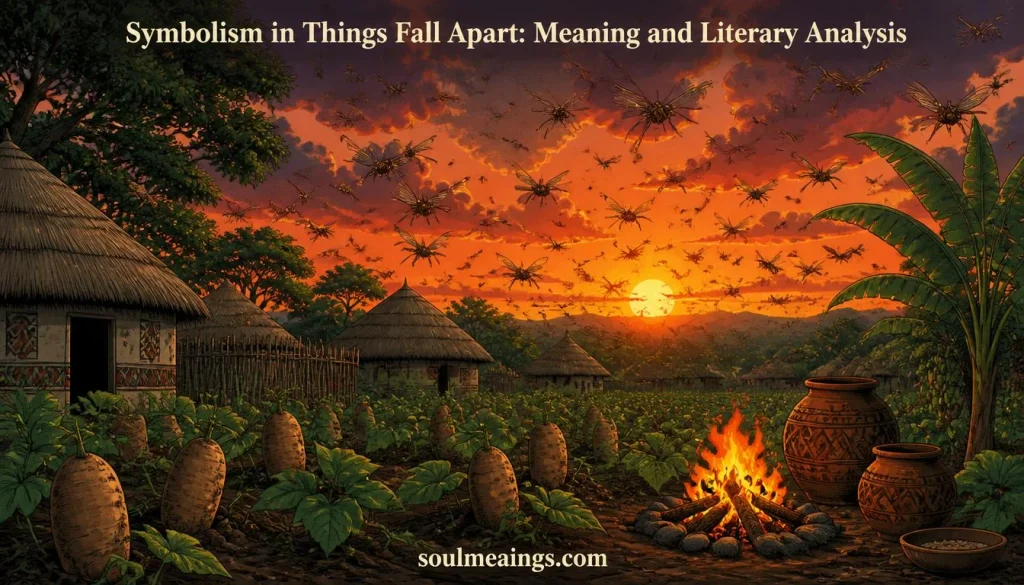
Symbolism in Things Fall Apart: Meaning, Culture & Literary Analysis explores how Chinua Achebe uses cultural symbols to explain Igbo traditions, identity, and change in colonial Nigeria.
Chinua Achebe’s Things Fall Apart is a landmark of African literature and Nigerian literature. Through Okonkwo’s life, Achebe explores the complexities of Igbo culture, Igbo society, and pre-colonial Nigeria.
The novel uses symbolism and imagery to reveal cultural values through important symbols such as yams, fire, kola nuts, egwugwu, and locusts. These symbols represent tradition, masculinity, identity, change, and human nature, making everyday objects, rituals, and natural elements meaningful parts of the story.
The novel also explores cultural heritage, traditional beliefs, spiritual beliefs, and community life. Achebe shows how colonial influence creates social upheaval, cultural conflict, and spiritual change, transforming traditional Igbo society. These struggles reveal the consequences of rigid societal structures and competing beliefs.
The novel’s literary symbolism, character development, and cultural significance help readers understand the deeper connections between identity, tradition, and societal transformation. Its powerful themes offer lasting lessons about cultural understanding, human struggles, and the effects of change.
Quick Answer
Symbolism in Things Fall Apart highlights cultural identity, masculinity, tradition, spiritual beliefs, and colonial disruption. Yams represent prosperity and status, fire reflects Okonkwo’s fierce temperament, and locusts foreshadow major changes. Together, these symbols reveal the tension between personal ambition, community values, and cultural survival.
TL;DR
- Yams represent wealth, hard work, and masculine status in Igbo society.
- Fire reflects Okonkwo’s strength, anger, and destructive temperament.
- Locusts foreshadow the arrival of disruptive changes.
- Drums express community identity, celebration, communication, and shared traditions.
- Chi represents personal destiny and spiritual relationships.
- Colonialism disrupts established beliefs, social structures, and community unity.
What Does Symbolism Mean in Things Fall Apart?
Symbolism occurs when an object, action, character, or event represents a deeper idea. In Achebe’s novel, familiar parts of daily life reveal how the Igbo community understands success, morality, spirituality, and belonging.
How Achebe Uses Symbols
Achebe connects symbolic details to the experiences of his characters. Rather than explaining every meaning directly, he allows readers to discover connections through repeated images and events.
For example, yams reveal the importance of agricultural success. Meanwhile, fire reflects Okonkwo’s personality and the dangers of his rigid beliefs.
Several major symbols work together to develop the novel’s central ideas:
- Natural symbols: Yams, fire, and locusts connect nature with human experiences.
- Cultural symbols: Drums, festivals, and ancestral ceremonies express shared identity.
- Spiritual symbols: Chi and sacred practices connect individuals with spiritual beliefs.
- Social symbols: Titles, wrestling, and family relationships reveal status and expectations.
These symbols make the story meaningful beyond its setting. They help American readers understand how cultural values shape individual choices and community life.
Historical Background of Things Fall Apart
Published in 1958, Things Fall Apart explores Igbo society during the period of British colonial expansion. However, its cultural background reaches much further into the traditions and histories of southeastern Nigeria.
Igbo Culture Before Colonial Rule
Before British rule, Igbo communities maintained their own political systems, religious practices, markets, and social customs. Many communities organized themselves around village assemblies, family networks, and local institutions.
Oral storytelling played an important role in preserving knowledge. Proverbs, folktales, songs, and ceremonies helped people communicate values across generations.
Achebe incorporates these traditions into his writing. Consequently, the novel presents Igbo culture as a living system rather than a collection of peculiar customs.
Why Achebe Wrote the Novel
Achebe wrote against colonial-era portrayals that often reduced Africans to stereotypes. He wanted readers to recognize African societies as complex communities with their own histories and moral debates.
The novel therefore carries two connected meanings. It tells Okonkwo’s personal tragedy while examining the effects of colonialism on an established society.
Its symbols help communicate this wider history. They show what people value, what they fear losing, and how rapidly familiar meanings can change.
The Symbolism of Yams in Things Fall Apart
Yams are among the novel’s most important symbols. In Umuofia, farming supports family life, while a successful yam harvest can bring wealth, respect, and social standing.
Yams as Wealth and Masculinity
Okonkwo’s success as a farmer helps distinguish him from his father, Unoka, whom he considers unsuccessful. Through hard work and careful planning, Okonkwo builds a reputation as a prosperous man.
Yams become a measure of his achievement. However, this connection also reveals how strongly he fears weakness and failure.
The crop carries several meanings:
- Prosperity: A good harvest provides food and strengthens a household’s position.
- Masculinity: Yam farming is associated with male labor and social achievement.
- Discipline: Growing yams requires patience, planning, and physical effort.
- Tradition: Farming connects families to seasonal rhythms and community celebrations.
The Limits of Success
Although yams symbolize achievement, they also expose the limits of Okonkwo’s values. He treats productivity and strength as proof of personal worth.
As a result, he struggles to respect qualities he considers feminine, including tenderness and patience. The symbol therefore reveals both the benefits of hard work and the dangers of defining human value too narrowly.
Fire Symbolism and Okonkwo’s Personality
Fire is closely associated with Okonkwo throughout the novel. It represents his energy, ambition, anger, and destructive behavior.
Fire as Strength and Destruction
Okonkwo wants to become powerful and respected. Like a strong flame, his determination helps him overcome hardship and achieve success.
However, fire can also spread beyond control. Okonkwo’s anger damages his relationships, especially when he suppresses affection to protect his reputation as a strong man.
His connection with fire reflects a central contradiction. The qualities that help him rise in society also contribute to his downfall.
What Fire Reveals About Masculinity
Okonkwo’s fear of resembling his father influences nearly every part of his life. He treats gentleness as weakness and often responds to disagreement with aggression.
Fire symbolizes the emotional cost of this rigid mindset. It shows how ambition can become harmful when fear controls personal choices.
In this sense, Achebe uses fire to explore a familiar human struggle: the difference between strength that protects and strength that destroys.
Locusts Symbolism and Colonialism
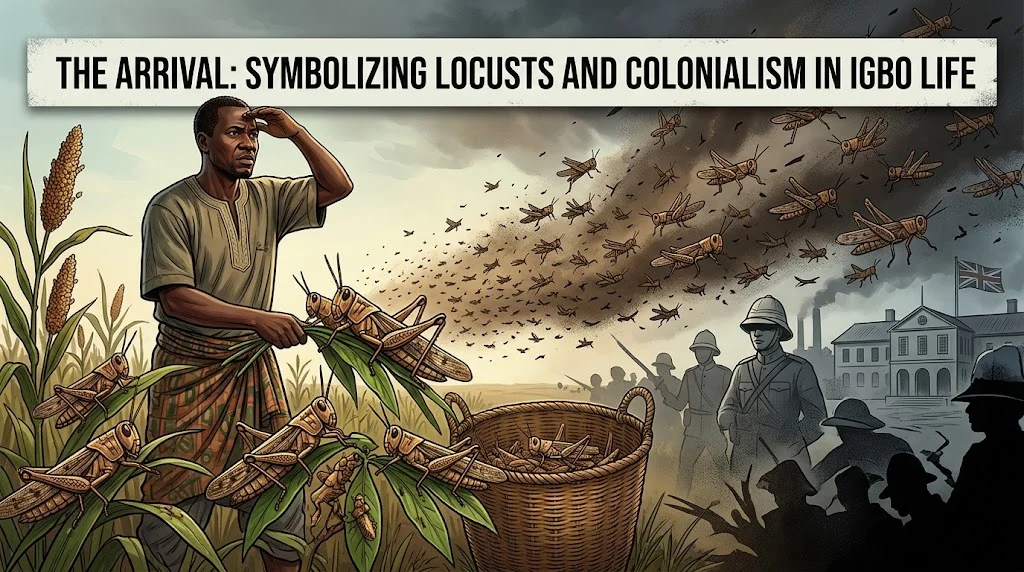
The arrival of locusts is one of the novel’s clearest examples of foreshadowing. These insects initially appear as a remarkable natural event, attracting excitement among the villagers.
Locusts as a Warning
The villagers welcome the locusts partly because they can collect and eat them. Their arrival seems familiar rather than immediately threatening.
However, the episode foreshadows the arrival of European colonial forces. Like a swarm spreading across the landscape, colonial influence eventually reaches more parts of Igbo life.
The comparison becomes especially significant when the characters discuss a warning that white men will come. Locusts consequently become a symbol of approaching disruption.
Why the Symbol Matters
The image suggests that major changes don’t always appear dangerous at first. Something may seem interesting, useful, or manageable before its wider consequences become clear.
The locusts also connect personal experience with historical events. What begins as a village’s encounter with insects becomes a warning about cultural upheaval.
However, the symbol shouldn’t reduce every individual encounter to a simple comparison. Its main purpose is to highlight the scale and consequences of colonial expansion.
Drums Symbolism and Igbo Community Life
Drums represent the shared life of Umuofia. Their sounds accompany wrestling matches, festivals, announcements, and important community gatherings.
Drums as the Heartbeat of the Village
Achebe describes drumming in ways that connect its rhythm with the life of the village. The sound suggests that individual experiences belong to a larger social world.
Drums communicate without relying on written messages. Their rhythms can bring people together and mark moments that matter to the entire community.
They symbolize:
- Unity: Shared rhythms bring villagers together during important events.
- Communication: Drums can announce occasions and convey messages.
- Continuity: Repeated ceremonies connect the present with inherited traditions.
- Collective identity: Community sounds express belonging beyond individual households.
What Happens When Community Bonds Weaken?
As colonial influence grows, the social world surrounding these traditions comes under pressure. Changes in religion, authority, and relationships weaken some established connections.
The drums therefore carry more than festive meaning. They evoke a communal life that faces increasing challenges as the novel progresses.
For readers today, the symbol highlights how music and public rituals help communities preserve identity during periods of change.
Chi Symbolism: Personal Destiny and Spiritual Belief
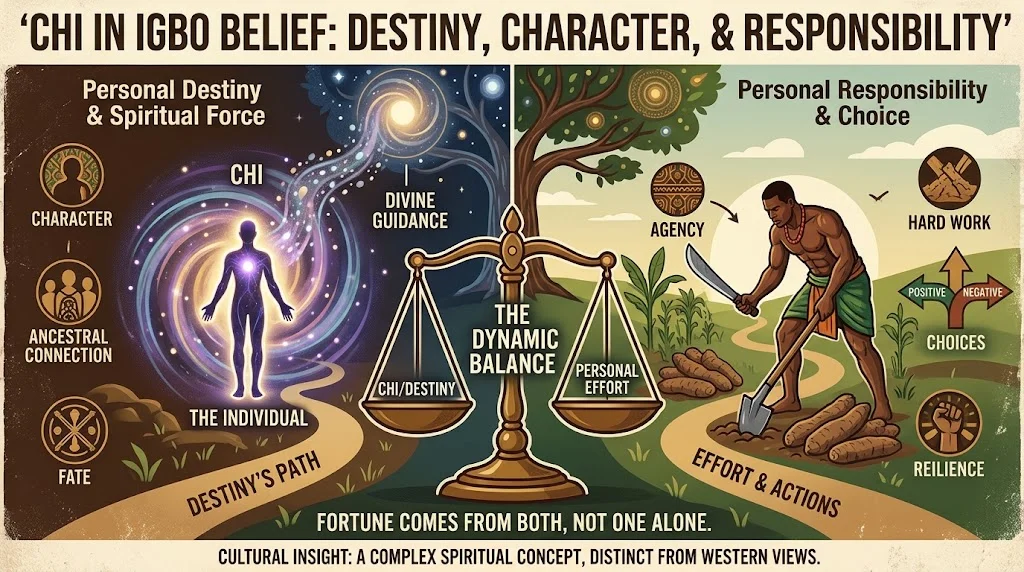
In the novel, chi refers to a personal spiritual force or guiding presence within Igbo belief. Its meaning involves destiny, individual character, and a person’s relationship with spiritual forces.
Chi and Personal Responsibility
The concept of chi complicates the idea that success depends entirely on personal effort. Okonkwo believes strongly in hard work, yet his life includes events beyond his control.
The novel explores the relationship between personal determination and destiny. A person may strive for success while still facing unexpected obstacles.
This idea challenges a simple explanation of fortune. Neither effort nor destiny alone explains every outcome in the story.
A Complex Spiritual Concept
Chi shouldn’t be treated as identical to a single concept from another religion. Its meaning belongs to a particular cultural and spiritual framework.
For American readers, it offers an opportunity to consider how different traditions understand individual agency. It also shows why cultural context matters when interpreting spiritual symbols in literature.
The Egwugwu as Symbols of Ancestral Authority
The egwugwu are masked figures who represent ancestral spirits during important communal proceedings. Their presence connects justice, tradition, and spiritual authority.
Justice and Community Order
In the novel, the egwugwu hear disputes and help maintain social order. Their judgments carry authority because they are connected to the community’s inherited customs.
Their masks and ceremonial roles create a visible link between the living and the ancestors. This connection gives the proceedings meaning beyond ordinary personal disagreements.
Colonial Challenges to Traditional Authority
The egwugwu also reveal what is at stake when colonial institutions challenge existing systems. Their authority represents a social structure with its own rules and sources of legitimacy.
Their symbolism is especially important because Achebe doesn’t portray Igbo society as lacking institutions. Instead, he shows how established forms of authority operate and how they become vulnerable to outside pressure.
The egwugwu thus symbolize cultural continuity, collective judgment, and the struggle to preserve local authority.
How Proverbs and Folktales Create Symbolic Meaning
Proverbs and folktales are central to the novel’s storytelling style. They express community wisdom and reveal the values people use to understand their experiences.
Proverbs as Cultural Memory
Characters use proverbs to explain relationships, defend decisions, and communicate lessons. Their meanings often depend on shared knowledge rather than literal words alone.
This style also makes the novel sound connected to oral storytelling. Achebe brings the rhythms and insights of Igbo speech into an English-language novel.
Folktales and Contrasting Values
Stories within the novel sometimes reveal different attitudes toward power, gender, nature, and family. They can offer gentler perspectives than Okonkwo’s strict worldview.
These stories remind readers that a culture isn’t defined by one person’s beliefs. Different voices and traditions can exist within the same community.
For American readers, the storytelling style also demonstrates how language preserves cultural knowledge. Translation can make a story accessible while still asking readers to respect its original context.
Symbolism in Things Fall Apart: Meanings at a Glance
The following table summarizes major symbols and their roles in the novel.
| Symbol | Meaning in the Novel | Common Associations | Literary Significance |
| Yams | Wealth, labor, masculine status | Success and responsibility | Reveals Okonkwo’s ambition |
| Fire | Strength, anger, destruction | Passion and danger | Foreshadows personal tragedy |
| Locusts | Approaching colonial disruption | Sudden change and invasion | Foreshadows colonial expansion |
| Drums | Community life and communication | Unity and cultural continuity | Expresses shared identity |
| Chi | Destiny and spiritual connection | Individual agency and fate | Complicates ideas of success |
| Egwugwu | Ancestral authority and justice | Tradition and social order | Shows the structure of Igbo institutions |
These symbols work together rather than standing alone. Each connects personal choices to the larger community and its changing circumstances.
Symbolism in Things Fall Apart and Its Meaning for American Readers
For readers in the United States, the novel offers a way to explore identity, cultural memory, and the effects of outside power. Its setting is specifically Igbo, but its questions reach beyond one place or period.
Cultural Identity and Belonging
The village’s customs show how language, ceremonies, farming, and family relationships create a shared identity. These practices help people understand their place in the community.
The novel also shows that cultural belonging can involve conflict. Some characters question existing customs, while others resist change.
This complexity matters because cultures aren’t completely uniform. People within a community can disagree about tradition while still sharing important connections.
Colonialism and Historical Memory
The colonial encounter transforms religion, government, and relationships in Umuofia. These changes reveal how outside institutions can challenge local knowledge and authority.
American readers may connect these questions with broader discussions of colonization and cultural representation. However, the historical experiences of different communities shouldn’t be treated as identical.
Achebe’s novel invites comparison without erasing the particular history of the Igbo people.
Emotional and Psychological Symbolism in the Novel
The symbols in Things Fall Apart also reveal emotional struggles. They help readers understand how fear, pride, grief, and the desire for acceptance influence behavior.
Fear and the Need for Control
Okonkwo’s deepest fear is becoming like his father. This fear shapes his ideas about masculinity and pushes him to seek control through status and aggression.
Fire reflects the anger that grows from this insecurity. Yams, meanwhile, represent the success he uses to protect himself from shame.
Together, these symbols show how a person’s public strength can hide private vulnerability.
Grief, Isolation, and Change
As the community changes, Okonkwo struggles to find a place within its emerging social order. His expectations no longer align with the choices of everyone around him.
His tragedy grows from both personal rigidity and broader historical forces. Achebe encourages readers to consider how fear of change can isolate people from those they love.
The emotional meaning is not limited to Okonkwo. It also concerns the pain communities experience when familiar relationships and institutions begin to break apart.
read more: Symbolism in The Giver: Meaning, Themes & Literary Analysis
Modern Interpretations and Common Misunderstandings
Today, readers often discuss the novel in classrooms, book clubs, and online literary communities. Its symbols offer useful ways to examine colonialism, identity, gender, and cultural representation.
How Readers Use These Symbols Today
Readers may use the novel’s imagery to discuss wider themes:
- Fire: The danger of uncontrolled anger and rigid expectations.
- Yams: The relationship between achievement and social pressure.
- Locusts: The consequences of powerful outside forces.
- Drums: The importance of shared culture and community memory.
- Chi: The tension between personal choice and circumstances.
These are literary interpretations, not universal definitions of the symbols in every culture.
Misunderstandings to Avoid
One common mistake is treating the novel as a complete description of every Igbo community. Achebe presents a specific fictional community, shaped by recognizable cultural traditions.
Another mistake is interpreting every symbol through Western religious or psychological ideas. Those perspectives may offer useful comparisons, but they shouldn’t replace the novel’s cultural context.
Finally, the story shouldn’t be read as suggesting that Igbo society was perfect before colonialism. Achebe portrays internal tensions and difficult customs alongside community strengths.
How Symbolism Changes Throughout Things Fall Apart
The novel’s symbols gain meaning as the story develops. At first, familiar objects and customs express a community’s rhythms and values. Later, they reveal how those values face growing pressure.
From Stability to Disruption
Early in the novel, yams, drums, ceremonies, and ancestral institutions help establish the structure of village life. Readers see how these practices support identity and social order.
Later, the locusts foreshadow outside forces that threaten this familiar world. Fire becomes increasingly connected with the personal costs of Okonkwo’s rigid approach to life.
As colonial institutions gain influence, symbols of continuity take on a more fragile quality. Their meanings shift because the social conditions around them have changed.
Why the Title Matters
The title Things Fall Apart suggests the breakdown of relationships and systems that once seemed stable. It reflects Okonkwo’s personal collapse and the wider disruption of his community.
The title also captures a painful gap between personal expectations and historical reality. Okonkwo wants to preserve his understanding of strength and tradition, yet he cannot control the changes surrounding him.
Importantly, the novel doesn’t suggest that every cultural tradition simply disappears. Instead, it explores the conflict, adaptation, and loss that accompany colonial change.
FAQs About Symbolism in Things Fall Apart
1. What does symbolism mean in Things Fall Apart?
Symbolism in Things Fall Apart refers to objects, animals, rituals, and natural elements that express deeper ideas. Chinua Achebe uses these symbols to explore Igbo culture, tradition, identity, and colonial change.
2. What do yams symbolize in Things Fall Apart?
Yams symbolize wealth, hard work, masculinity, and social status in Igbo society. Okonkwo’s success as a yam farmer reflects his ambition and desire for respect.
3. What does fire symbolize in the novel?
Fire symbolizes Okonkwo’s strength, anger, and destructive nature. His fiery personality helps him gain power but also contributes to his personal struggles and downfall.
4. What do kola nuts symbolize in Things Fall Apart?
Kola nuts symbolize hospitality, respect, friendship, and unity. Sharing kola nuts is an important Igbo cultural tradition that welcomes guests and strengthens community relationships.
5. What do locusts symbolize in the novel?
Locusts symbolize the arrival of colonial forces and the changes that follow. Their appearance initially fascinates the villagers, creating a connection with the unexpected arrival of European missionaries.
6. What do the egwugwu symbolize in Things Fall Apart?
The egwugwu symbolize ancestral authority, spiritual beliefs, and traditional justice. Their role in community disputes demonstrates how Igbo society maintains order through cultural customs and religious traditions.
Conclusion
Symbolism in Things Fall Apart helps readers understand the deeper meanings in Chinua Achebe’s portrayal of Igbo life. Symbols such as yams, fire, kola nuts, locusts, and the egwugwu represent important ideas about masculinity, hospitality, spirituality, authority, and colonial change. Through these literary devices, Achebe celebrates the richness of Igbo culture while showing how personal choices and outside influences transform communities. Understanding these symbols makes the novel’s themes of tradition, identity, cultural conflict, and societal change easier to appreciate.

Isabella Taylor is a spiritual content creator who shares thoughtful insights on dreams, symbols, and self-discovery. Through her writing at SoulMeanings.com, she inspires readers to find meaning and guidance in everyday life.


Pingback: Snapdragon Symbolism: Strength, Grace & Spiritual Meaning