
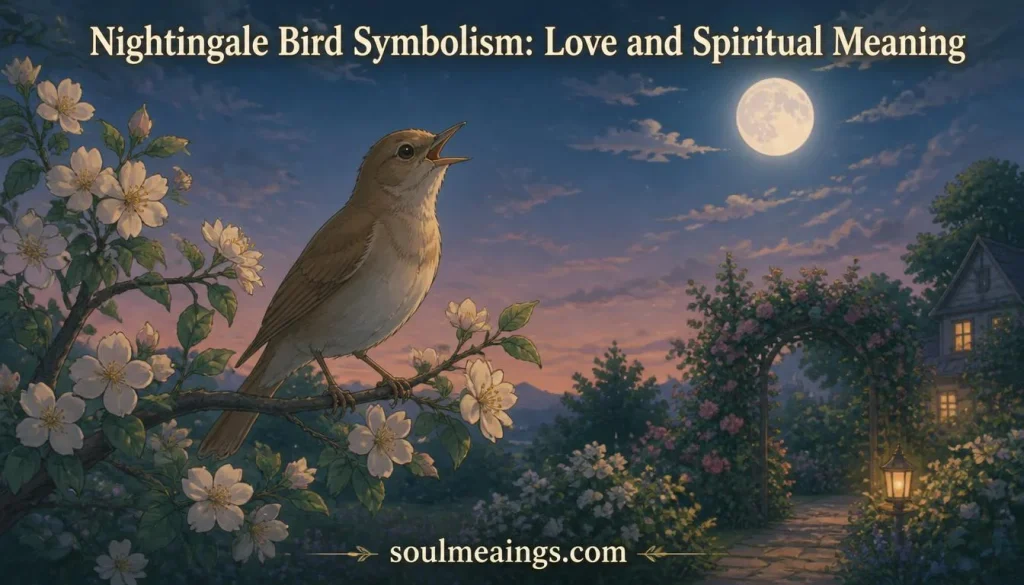
Nightingale Bird Symbolism: Love and Spiritual Meaning explores how this enchanting bird represents love, hope, creativity, and spiritual guidance through its beautiful song.
The nightingale is known for its melodious song, soulful voice, and nighttime singing. For centuries, poets, musicians, and storytellers have connected this bird with romantic love, emotional expression, and artistic inspiration.
In the United States, nightingale symbolism often reflects self-expression, creative freedom, and finding beauty in darkness. Its presence in literature, poetry, music, and visual art highlights the connection between nature and human emotions.
The spiritual meaning of the nightingale relates to transformation, spiritual awakening, and personal growth. Its symbolism encourages embracing change, exploring creativity, and trusting inner guidance. In dream interpretations, the nightingale may represent hope, imagination, or a need to understand your feelings.
Across cultures and traditions, it remains a meaningful symbol in storytelling, tattoos, decor, and digital expression. Its timeless connection with love, spirituality, and emotional depth reminds us that even in difficult moments, beauty and inspiration can help us grow.
Quick Answer
Nightingale bird symbolism in the United States commonly represents romantic love, creative inspiration, emotional honesty, and hope. More broadly, its nighttime song connects with spiritual reflection, longing, beauty, and the power of expressing one’s deepest feelings.
TL;DR
- Love: Represents romance, devotion, longing, and emotional connection.
- Inspiration: Reflects poetry, music, imagination, and creative freedom.
- Spirituality: Suggests inner reflection, hope, and a connection with nature.
- Transformation: Connects nighttime singing with finding light during difficult periods.
- Cultural history: Appears in ancient stories, poetry, folklore, and music.
- Modern meaning: Inspires tattoos, artwork, personal writing, and nature-themed decor.
What Does a Nightingale Look Like?
The nightingale’s appearance helps explain why its symbolism centers on voice rather than outward beauty. Unlike brightly colored songbirds, it has a modest appearance that contrasts with its remarkable singing.
Physical Features and Symbolic Meaning
The common nightingale (Luscinia megarhynchos) is a small songbird with brown upperparts, lighter underparts, and a reddish-brown tail. Its coloring helps it blend into dense shrubs and woodland, making it easier to hear than see.
This contrast creates a meaningful symbolic image. The nightingale suggests that a person’s inner qualities may matter more than their outward appearance.
- Brown feathers: Groundedness, humility, and a connection with nature.
- Reddish-brown tail: Warmth and vitality in artistic interpretations.
- Hidden presence: Quiet strength and qualities that others may overlook.
- Powerful song: Emotional expression, creativity, and the courage to be heard.
These meanings are symbolic interpretations, not fixed meanings established by nature. Still, the contrast between the bird’s plain appearance and rich song makes it an enduring image of inner beauty.
Why Does the Nightingale Sing at Night?
Male nightingales sing at night, especially during the breeding season. Their songs help attract mates and communicate with other birds.
For human listeners, however, nighttime singing often suggests privacy, mystery, and feelings that emerge when the world grows quiet. This association has helped make the bird a powerful symbol in poetry and romantic storytelling.
Historical Origins of Nightingale Symbolism
Nightingale symbolism developed through ancient stories, classical literature, and centuries of poetic tradition. Its history shows how people transformed an ordinary bird’s song into a way of expressing complicated emotions.
Ancient Greek Mythology
One famous Greek myth connects the nightingale with Philomela, a woman whose story involves violence, loss, and transformation. In the version told by the Roman poet Ovid, Philomela is transformed into a bird after suffering terrible abuse.
The story connects the nightingale with grief, survival, and the struggle to communicate after being silenced. However, versions of the myth differ, and the bird’s identity varies across classical retellings.
This background gives the nightingale a more complex meaning than romance alone. Its song can symbolize the return of a voice after suffering or the expression of pain that ordinary speech cannot convey.
From Classical Stories to Romantic Poetry
Ancient writers used birdsong to explore love, nature, and human emotion. Later, European poets developed these themes through images of nighttime singing, longing, and beauty.
John Keats’s Ode to a Nightingale, published in 1820, became a particularly influential example. The poem explores beauty, suffering, mortality, and the desire to escape ordinary human limitations.
Over time, the nightingale became a symbol of artistic inspiration as well as romantic feeling. Its song offered writers a way to explore the tension between life’s fleeting moments and the lasting power of art.
Nightingale Symbolism in the United States
In the United States, the nightingale is best understood as a literary and artistic symbol rather than a major national emblem. American readers often encounter it through poetry, music, romantic imagery, and stories about the relationship between nature and human feeling.
Love and Emotional Expression in American Culture
American culture frequently uses birdsong to suggest freedom, hope, and personal expression. The nightingale fits naturally into this tradition because its song seems to communicate feelings beyond ordinary language.
Its symbolic appeal also reflects familiar American values, including individuality and creative freedom. A nightingale can represent the decision to share your perspective, even when you feel overlooked.
Literature, Music, and Popular Imagination
American classrooms, libraries, and literary communities continue to encounter the nightingale through classic poetry and its many cultural adaptations. Keats’s poem, in particular, connects the bird with beauty, sadness, and the limits of human life.
The bird also appears in songs, paintings, and romantic imagery. Although it isn’t an official symbol of the United States, it remains recognizable as an image of artistic expression and emotional depth.
Spiritual Meaning of the Nightingale
The spiritual meaning of the nightingale often centers on listening, inner truth, hope, and the relationship between silence and expression. These interpretations vary by tradition and personal belief, so no single spiritual meaning applies to everyone.
Inner Wisdom and Finding Your Voice
A nightingale’s song may remind people to listen to their inner thoughts rather than rely entirely on outside opinions. Its hidden presence can also suggest that meaningful growth sometimes happens quietly.
People who connect with this symbolism may interpret the bird as an invitation to:
- Speak honestly about feelings that have remained unspoken.
- Make time for reflection and personal growth.
- Trust creative instincts without seeking constant approval.
- Find hope during uncertain or emotionally difficult periods.
These are personal interpretations, not promises of supernatural guidance. The bird can still offer a meaningful reminder to slow down and consider what matters most.
Hope in Darkness
Because the nightingale sings after dark, people may associate it with finding beauty during difficult times. Darkness becomes a setting for its music rather than a reason for silence.
Spiritually, this image can represent faith, resilience, or the possibility of renewal. For someone facing change, the nightingale may serve as a reminder that difficult moments don’t erase the ability to create, love, or hope.
Nightingale Symbolism in Different Cultures
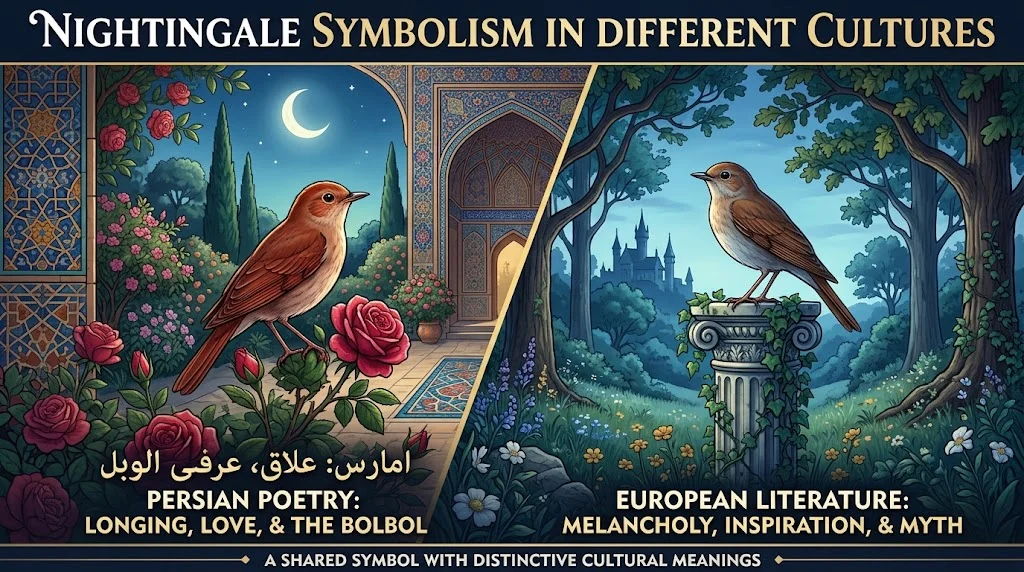
The nightingale carries different meanings across cultures, especially where poetry and music have played major roles. Understanding these differences helps readers appreciate the bird without treating any single interpretation as universal.
Persian Poetry and the Rose
In Persian literary tradition, the nightingale, often called the bolbol, is closely linked with the rose. The rose represents beauty or the beloved, while the nightingale often represents a passionate lover who sings of longing.
This relationship appears throughout Persian poetry, including the works associated with Hafez and other celebrated poets. In mystical interpretations, the lover’s yearning can also suggest the soul’s longing for a deeper spiritual connection.
The image carries both beauty and sadness. The nightingale may sing with devotion even when the rose seems distant or unattainable.
European Literary Traditions
European literature has frequently connected the nightingale with love, melancholy, and poetic inspiration. Greek and Roman stories added themes of suffering and transformation, while later writers emphasized beauty and the power of song.
These traditions influenced how English-language readers understand the bird today. However, literary symbolism doesn’t mean every European culture or writer interprets the nightingale in exactly the same way.
A Shared Symbol With Different Meanings
Across traditions, the nightingale often represents strong feelings expressed through music or poetry. Yet the meaning may shift between romantic devotion, spiritual longing, grief, and creative freedom.
This variety is part of the symbol’s lasting appeal. It gives readers room to connect the bird with their own experiences while respecting its specific cultural history.
Nightingale Symbolism for Love and Relationships
Love is among the most familiar meanings associated with the nightingale. Its song provides a natural image for expressing devotion, desire, tenderness, and the emotions people struggle to explain.
Romantic Love and Devotion
The nightingale’s connection with romantic love is especially strong in poetry. Its song can represent someone who continues expressing affection even when the beloved is far away.
In modern American life, this association makes the bird suitable for romantic artwork, love letters, and meaningful gifts. It can communicate a quieter kind of affection than more obvious romantic symbols.
Longing and Unrequited Love
Not every love story ends with two people together. In many poems, the nightingale represents the lover who sings for someone who may never return that affection.
This interpretation adds emotional depth to the symbol. It can represent missing someone, remembering a lost relationship, or accepting that love doesn’t always lead to the outcome we want.
The nightingale can therefore stand for both the happiness of connection and the vulnerability that comes with caring deeply.
Emotional and Psychological Meaning of the Nightingale
The nightingale often symbolizes the connection between emotion and expression. Its song gives people a way to imagine feelings becoming something audible, beautiful, and shared.
Creativity and Emotional Release
Artists may associate the bird with the moment when an idea becomes a poem, song, painting, or personal story. Its voice represents the freedom to create without needing every feeling to be explained logically.
For everyday readers, this meaning can encourage journaling, music, or honest conversations. Creative expression doesn’t need to be perfect to help someone communicate what matters.
Melancholy and Reflection
The nightingale’s nighttime song can also feel wistful or lonely. This is why it appears so naturally in stories about memory, separation, and the passage of time.
However, sadness isn’t necessarily a negative meaning. The bird may represent the ability to acknowledge difficult feelings while still recognizing beauty in the world.
What the Nightingale May Represent Personally
Someone who feels drawn to the nightingale may value emotional honesty, imagination, sensitivity, or independence. These associations are useful for personal reflection, but they aren’t psychological diagnoses or reliable ways to judge another person’s character.
The most meaningful interpretation depends on the experience that made the bird stand out. A song heard during a peaceful evening may carry a different feeling from one encountered during a period of grief.
Nightingale Symbolism in Dreams, Tattoos, and Art
Today, the nightingale appears in personal artwork, tattoos, poetry-inspired designs, and nature-themed decor. Its meaning usually depends on the surrounding images and the reason someone chooses it.
Seeing a Nightingale in a Dream
Some people interpret a nightingale in a dream as a symbol of love, creativity, or a desire to express themselves. A singing bird might feel hopeful, while a distant or silent bird might reflect longing.
However, dreams don’t have universally established symbolic meanings. Your emotions, memories, and personal experiences are more useful than assuming every dream carries a fixed message.
Nightingale Tattoos
A nightingale tattoo can represent a personal connection to music, literature, love, or overcoming hardship. Its relatively subtle appearance also suits people who prefer symbolism that isn’t immediately obvious.
Common design ideas include:
- A nightingale beside a rose to represent love and devotion.
- A singing bird beneath the moon to suggest hope in darkness.
- A bird with musical notes to celebrate artistic expression.
- A nightingale among branches to reflect personal growth and freedom.
The meaning belongs to the person wearing the tattoo. Someone may choose the bird for a literary reference, while another may associate it with a loved one or an important life experience.
Artwork and Home Decor
Nightingale illustrations can bring a sense of quiet beauty to bedrooms, reading spaces, studios, and gardens. Paired with roses, they often emphasize romance, while moonlit scenes highlight mystery and reflection.
For many people, the appeal comes from the bird’s connection with nature and creative life. Its image can also serve as a personal reminder to make room for music, writing, and meaningful conversation.
Nightingale Symbolism by Color and Context
Unlike birds known for vivid plumage, the nightingale has fairly modest natural coloring. Its symbolic meaning usually comes from its song, setting, and artistic presentation rather than feather color alone.
The following table explains common interpretations in modern American artwork and personal symbolism. These are creative associations, not universal cultural rules.
| Context | Meaning in the USA | Common Associations | Notes |
| Brown feathers | Humility and inner beauty | Simplicity, groundedness | Inspired by the bird’s natural appearance |
| Singing at night | Hope and emotional expression | Reflection, resilience | Often used in poetry and artwork |
| Nightingale with a rose | Romantic devotion | Beauty, longing, affection | Strongly linked with Persian poetry |
| Nightingale with musical notes | Creativity and artistic identity | Music, poetry, freedom | Popular as a personal design concept |
| Silent or distant bird | Separation or unspoken feelings | Memory, loneliness | Meaning depends on the story or setting |
How the Setting Changes the Meaning
A nightingale singing among flowers may suggest happiness and romantic affection. In contrast, the same bird beneath a dark sky may communicate solitude, longing, or quiet strength.
These differences show why context matters. Rather than treating a symbol as a code with one correct answer, consider the emotions and ideas surrounding it.
Nightingale Symbolism Compared With Other Birds
Bird symbolism often draws on movement, song, appearance, and behavior. Comparing the nightingale with familiar birds helps explain what makes its meaning distinctive for American readers.
Nightingale vs. Cardinal
The cardinal is a familiar sight in many American neighborhoods and is often associated with vitality, confidence, and personal remembrance. Its bright red plumage also makes it a strong visual symbol.
The nightingale, by contrast, is more closely associated with song, romantic longing, and artistic inspiration. It is often recognized through literature rather than everyday encounters in the United States.
Nightingale vs. Mockingbird
The northern mockingbird is well known in the United States for its ability to imitate other birds and sounds. It can symbolize adaptability, expression, and the richness of the natural world.
The nightingale’s symbolic strength lies more in its traditional connection with poetry and love. Both birds celebrate sound, but their cultural associations developed along different paths.
Nightingale vs. Dove
The dove is widely used as a symbol of peace, gentleness, and reconciliation. The nightingale generally emphasizes personal emotion, beauty, and the act of expressing oneself.
Someone choosing between these bird images might consider the message they want to communicate. A dove often suggests harmony, while a nightingale offers a more intimate image of feeling and creative voice.
read more: Mantis Symbolism: Spiritual Meaning & Life Lessons
Misunderstandings About Nightingale Symbolism
The nightingale has accumulated many meanings through centuries of storytelling. However, not every interpretation found online reflects a documented cultural tradition or a biological fact.
Is the Nightingale Always a Positive Symbol?
No. The nightingale can represent happiness, love, and inspiration, but it can also symbolize grief, separation, and unfulfilled desire.
Its association with Philomela’s story illustrates this complexity. In that tradition, the bird’s song can recall suffering and the struggle to communicate after trauma.
Does a Nightingale Have a Fixed Spiritual Message?
There is no universally accepted spiritual message attached to seeing or hearing a nightingale. Some people interpret the experience as meaningful, while others simply appreciate the bird’s song.
Personal reflection can make the encounter valuable without requiring a supernatural explanation. It’s helpful to distinguish an individual belief from a meaning shared by a particular cultural or religious tradition.
Is the Nightingale a Common American Wild Bird?
The common nightingale is native to parts of Europe, Asia, and North Africa, and it winters in sub-Saharan Africa. It isn’t a familiar, widespread wild songbird across the United States.
American references to nightingales therefore often come through books, music, and artistic imagery. Also, hearing a bird sing at night doesn’t necessarily mean you’ve heard a nightingale; several other species sing after dark.
How Nightingale Symbolism Has Changed Over Time
The nightingale’s symbolism has shifted as literature, art, and cultural traditions have changed. Its enduring themes remain recognizable, but different eras have emphasized different aspects of its song.
From Myth to Romantic Inspiration
In ancient stories, the nightingale could represent grief, transformation, and the struggle to speak. Persian poets later made the bird a central image of passionate love and longing.
During the Romantic era, writers increasingly explored its connection with nature, imagination, and the mystery of human existence. Keats’s poetry helped preserve the bird as a symbol of beauty that seems to reach beyond ordinary life.
Modern Interpretations
Today, the nightingale can represent emotional openness, creative identity, and personal resilience. Its symbolism also appears in nature-inspired art and contemporary discussions of finding one’s voice.
These newer interpretations don’t erase the older ones. Instead, they build on a long tradition of using birdsong to explore the emotions people share across generations.
FAQs About Nightingale Bird Symbolism
1. What does nightingale bird symbolism mean?
Nightingale bird symbolism represents love, hope, creativity, emotional expression, and spiritual guidance. Its beautiful song often symbolizes the power of expressing feelings through words, music, and art.
2. What is the spiritual meaning of a nightingale?
The spiritual meaning of a nightingale often relates to inner growth, transformation, hope, and spiritual awakening. It can remind you to trust your inner voice and welcome positive changes.
3. Does a nightingale symbolize love?
Yes, the nightingale is often associated with romantic love, devotion, longing, and emotional connection. Its soulful song has inspired love poetry and stories across generations.
4. What does hearing a nightingale sing symbolize?
Hearing a nightingale sing may symbolize joy, inspiration, emotional freedom, and new beginnings. Spiritually, some people interpret its song as a reminder to appreciate beauty and express themselves honestly.
5. What does a nightingale symbolize in dreams?
A nightingale in a dream may represent hope, creativity, love, or unexpressed emotions. Its meaning depends on the dream’s setting and the feelings you experience.
6. Why is the nightingale important in literature and art?
The nightingale has a long history in literature, poetry, music, and visual art. Writers and artists often use its song to explore love, beauty, freedom, longing, and the connection between nature and human emotions.
Conclusion
Nightingale Bird Symbolism: Love and Spiritual Meaning reveals how a small bird can carry powerful messages about the human experience. Its melodious song represents love, hope, creativity, emotional expression, and spiritual growth. Across cultures, the nightingale continues to inspire poets, musicians, artists, and storytellers.
Whether you encounter its symbolism in a dream, a poem, a tattoo, or a song, the nightingale can remind you to embrace creativity, express your feelings, and find beauty in darkness. Its lasting appeal lies in the way it connects nature with our deepest emotions, encouraging us to appreciate love, welcome change, and discover meaning in everyday life.

Charlotte Brown is a passionate writer at SoulMeanings.com, dedicated to exploring spirituality, symbolism, dreams, and life’s deeper meanings. Her work helps readers find clarity, inspiration, and personal insight.
Pingback: Manatee Symbolism: Peace, Gentleness & Spiritual Meaning