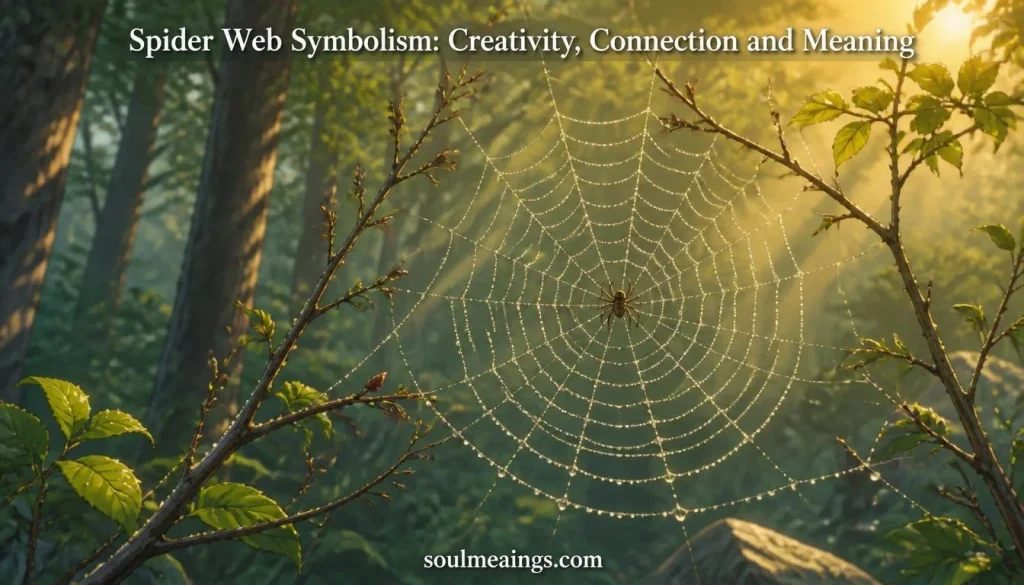
Spider Web Symbolism: Creativity, Connection and Meaning explores how delicate webs represent creativity, patience, strength, and interconnectedness.
More than an insect trap, a spider web is one of nature’s fascinating creations. Its intricate structures, delicate patterns, and complex design show how something fragile can remain strong. Across cultures, history, and ancient traditions, spider webs symbolize destiny, purpose, fragility, and the delicate balance of life.
In spirituality, art, and human storytelling, spider webs represent hidden connections, personal growth, and the web of fate. Their spiritual meaning also appears in dreams, tattoos, and symbolic interpretations.
Through their cultural significance, color meanings, and life lessons, spider webs remind us that small actions create larger connections. Ultimately, spider web symbolism reflects the interconnected nature of life and the importance of patience and creativity.
Quick Answer
Spider web symbolism commonly represents creativity, connection, patience, and the interconnectedness of life in American culture. It can also symbolize protection, destiny, transformation, and the beauty of creating something meaningful through consistent effort.
TL;DR
- Spider webs symbolize creativity, patience, and personal achievement.
- Connected threads represent relationships and life’s interconnected nature.
- Ancient stories associate spiders with creation and storytelling.
- American culture connects webs with Halloween, mystery, and transformation.
- Spider web tattoos can express resilience, identity, and independence.
- A broken web may represent change, loss, or rebuilding.
What Does a Spider Web Symbolize?
A spider web is a natural structure created by a spider using silk. Its delicate threads form organized patterns that help spiders catch prey, move, and sometimes protect themselves. However, people also interpret these patterns through cultural and personal experiences.
In symbolism, the web’s design is particularly important. Its circular center, connecting lines, and carefully arranged threads suggest order within complexity.
Creativity and Creation
A spider builds its web through instinct, effort, and repeated movements. This process makes the web a symbol of creativity and bringing ideas into reality.
It reminds us that meaningful achievements often begin with small actions. Like a spider creating a structure thread by thread, people develop skills through practice.
Connection and Relationships
Every thread connects with another part of the web. Similarly, human relationships depend on communication, trust, and shared experiences.
The web can represent:
• Family relationships and emotional bonds.
• Friendships built through shared experiences.
• Communities connected through cooperation.
• The influence of individual choices on others.
Patience and Persistence
Building a web takes time and careful effort. Furthermore, spiders sometimes rebuild their webs after damage.
This behavior makes the web a meaningful symbol of patience, determination, and resilience. It encourages people to continue working toward their goals despite setbacks.
Historical Origins of Spider Web Symbolism
Spider symbolism reaches back into ancient storytelling, mythology, and traditional beliefs. Long before modern decorations and tattoos, people observed spiders creating intricate structures and connected their behavior with human creativity.
However, spider web meanings weren’t identical across ancient societies. Different communities developed their own stories and interpretations.
Ancient Greek Mythology and Arachne
One famous story comes from ancient Greek mythology. It concerns Arachne, a talented mortal weaver known for her extraordinary skill.
According to the myth, Arachne challenged Athena, the goddess associated with wisdom and crafts, to a weaving contest. Their competition ended tragically, and Arachne was transformed into a spider in many versions of the story.
This myth connects spiders and webs with:
• Artistic talent and creative expression.
• Pride and the consequences of arrogance.
• Skill, craftsmanship, and competition.
• The complicated relationship between humans and divine power.
The story helped establish spiders as figures connected with weaving, artistic ability, and the consequences of human ambition.
Ancient and Traditional Storytelling
Spiders also appear in creation stories and traditional folklore beyond Greece. Their ability to produce silk and construct complex structures made them natural figures for stories about making and organizing the world.
In some West African storytelling traditions, Anansi appears as a spider or spider-associated trickster figure. These stories connect the spider with intelligence, storytelling, resourcefulness, and cultural knowledge.
Anansi traditions are especially important within Akan storytelling and have influenced wider African diaspora folklore.
Medieval and Later European Interpretations
During medieval and later European periods, spiders sometimes became associated with darkness, decay, fear, and neglected spaces.
Their presence in abandoned buildings encouraged associations with isolation and the passage of time. However, positive meanings connected with craftsmanship and natural design continued.
Consequently, the spider web developed both creative and unsettling interpretations.
read more: Snake Symbolism: Spiritual Meaning, Transformation and Wisdom
Spider Web Symbolism in American Culture
In the United States, spider webs have several meanings shaped by folklore, entertainment, seasonal traditions, and everyday experiences. Their appearance in homes, gardens, books, and popular media has made them familiar cultural images.
Halloween and American Traditions
Spider webs are especially recognizable during Halloween. Americans use artificial webs to decorate houses, porches, stores, and haunted attractions.
Their association with abandoned buildings and dark corners creates an atmosphere of mystery. However, this connection doesn’t make spider webs exclusively negative symbols.
The U.S. Fish and Wildlife Service also explains their seasonal connection. Spiders can become more noticeable during fall mating periods, particularly in September and October.
U.S. Fish & Wildlife Service
Creativity and American Individualism
American culture often celebrates creativity, independence, and personal achievement. The spider web offers a useful image for these values.
A person building something meaningful can identify with the spider’s patient work. Each thread represents an idea, decision, or effort contributing to a larger achievement.
This interpretation appears naturally in:
• Artwork celebrating independent thinking and imagination.
• Stories about building a business or pursuing ambitions.
• Designs representing personal growth and determination.
• Creative projects inspired by nature’s patterns.
The Web as a Symbol of Community
The expression web of relationships describes how people connect through families, workplaces, and communities.
In American society, this idea appears in discussions about social networks and community support. It also reflects how one person’s actions can affect many others.
The web therefore represents both personal identity and shared responsibility.
Spider Web Symbolism Across Cultures and Spiritual Traditions
Spider webs have inspired different cultural and spiritual interpretations. Their intricate construction makes them natural symbols of creation, wisdom, protection, and interconnected existence.
However, these meanings aren’t universal. Each tradition has its own stories, practices, and cultural background.
Spider Woman in Indigenous Traditions
Spider Woman holds an important place in several Indigenous traditions of the American Southwest, particularly Hopi storytelling.
In some traditional accounts, Spider Woman participates in creation and helps establish the world. She is also associated with weaving, knowledge, guidance, and the transmission of traditional skills.
These stories connect web-making with the power of creation and the importance of cultural knowledge.
However, Indigenous traditions aren’t interchangeable. Spider Woman’s meaning differs across communities and individual stories.
Anansi and African Storytelling
Anansi is a well-known spider-associated figure in Akan storytelling from West Africa. He is often portrayed as clever, resourceful, and capable of overcoming difficult situations.
His stories traveled through the African diaspora, especially into Caribbean and American storytelling traditions.
The spider connection can therefore represent:
• Intelligence and creative problem-solving.
• Storytelling and the preservation of cultural memory.
• Resourcefulness during difficult circumstances.
• The power of wit over physical strength.
Spiritual Meaning of the Spider Web
In contemporary spiritual interpretations, a spider web can represent the invisible connections shaping everyday life.
Some people see its structure as a reminder that personal choices influence wider experiences. Others connect it with patience, mindfulness, and the process of creating one’s future.
Common spiritual interpretations include:
- Connection: Everything has relationships with other things.
- Creation: Your actions help shape your personal journey.
- Protection: A web can represent a carefully maintained safe space.
- Wisdom: Complex situations require observation and patience.
- Transformation: Damaged structures can be rebuilt into something meaningful.
These are symbolic interpretations rather than universal religious teachings.
Emotional and Psychological Meaning of Spider Webs
Spider webs can produce surprisingly different emotional reactions. One person might admire their beauty, while another feels uncomfortable seeing them in a dark corner.
These responses often depend on personal experiences, cultural associations, and the surrounding environment.
Creativity and Inspiration
A carefully constructed web can inspire admiration because of its detailed design. Its balance and repeating patterns suggest organization and creative intelligence.
For artists and creative thinkers, it can represent the process of turning imagination into something visible.
Fear and Discomfort
Spider webs also appear in places associated with neglect, darkness, and insects. As a result, some people connect them with fear or unpleasant environments.
This reaction can be stronger for individuals who already dislike spiders.
However, a negative emotional response doesn’t make the web inherently negative. Its meaning depends on context.
Feeling Connected or Trapped
The web has two contrasting psychological interpretations.
On one hand, its threads represent supportive relationships and belonging. On the other hand, tangled threads can suggest complicated situations or restricted freedom.
This contrast makes spider web symbolism useful when exploring emotional experiences.
Different Types of Spider Webs and Their Meanings
Not every spider web has the same appearance. Natural web designs differ according to spider species and their needs.
These differences also create opportunities for artistic and symbolic interpretation. Understanding the basic shapes helps explain why some designs communicate different feelings.
Orb Webs
Orb webs have a recognizable circular design with radiating support threads and spiral sections.
They often symbolize:
- Harmony and balance.
- Unity and interconnectedness.
- Creative planning.
- The cycles and patterns of life.
Sheet Webs
Sheet webs appear as horizontal or curved layers of silk. They can look like delicate fabric stretched across grass or branches.
Symbolically, they may suggest shelter, stability, and the foundations of personal growth.
Funnel Webs
Funnel-shaped webs contain a tunnel-like retreat where a spider can hide.
In artwork, this structure may suggest mystery, hidden opportunities, caution, or protection.
Irregular Cobwebs
Cobwebs have tangled, less organized appearances. They frequently appear in abandoned buildings and neglected spaces.
Their common symbolic associations include:
- Forgotten memories.
- Isolation and loneliness.
- The passage of time.
- Unresolved situations.
Biologically, however, these structures are functional spider webs, not simply signs of neglect. Different species create different web designs for different purposes.
National Geographic+1
Spider Web Colors and Their Symbolic Meanings
Natural spider silk is often nearly transparent or pale. However, artists and designers frequently use different colors to communicate specific ideas.
Color interpretations aren’t fixed rules. They depend on personal associations and the setting.
| Color | Common Symbolic Meaning | Emotional Association | Typical Use |
| White | Purity and clarity | Peace and simplicity | Minimalist artwork |
| Black | Mystery and protection | Strength and uncertainty | Gothic tattoos |
| Silver | Intuition and reflection | Calm and elegance | Jewelry and decor |
| Gold | Achievement and creativity | Confidence and success | Decorative artwork |
| Red | Passion and warning | Intensity and energy | Expressive designs |
| Blue | Connection and peace | Trust and calmness | Modern illustrations |
Black Spider Webs
Black spider webs commonly appear in Gothic artwork, Halloween decorations, and alternative fashion.
They can represent mystery, independence, protection, or darker emotions. Their meaning depends heavily on surrounding imagery.
White and Silver Spider Webs
White and silver designs often emphasize delicacy and natural beauty.
They can suggest clarity, peaceful relationships, and the quiet complexity of life.
Gold and Colorful Spider Webs
Gold webs can communicate accomplishment and creative success. Meanwhile, colorful designs offer a more playful interpretation.
Artists sometimes use bright colors to transform an image associated with fear into something imaginative and welcoming.
Spider Web Tattoos: Meaning and Symbolism
Spider web tattoos have a long and complicated history in American body art. Today, people choose them for personal expression, artistic beauty, cultural associations, or meaningful life experiences.
However, placement and historical context can influence how others interpret these designs.
Common Spider Web Tattoo Meanings
A spider web tattoo can communicate several personal messages.
• Creativity: Celebrating imagination and artistic expression.
• Resilience: Representing the ability to rebuild after difficult experiences.
• Connection: Honoring relationships and meaningful personal bonds.
• Patience: Recognizing the value of consistent effort.
• Mystery: Expressing an interest in darker or alternative aesthetics.
The Historical Meaning of Elbow Spider Web Tattoos
The elbow spider web has a particularly important history in American prison culture. It has been associated with time spent incarcerated and feeling caught within the justice system.
However, some white supremacist groups have also used spider web imagery. These associations depend on particular settings and subcultures.
The National Gang Center notes that spider web tattoos appear among both gang-involved and nongang individuals. Therefore, a tattoo alone cannot establish someone’s identity or affiliations.
nationalgangcenter.ojp.gov+1
Anyone considering this design should understand its possible historical associations. A decorative tattoo doesn’t automatically communicate criminal involvement or extremist beliefs.
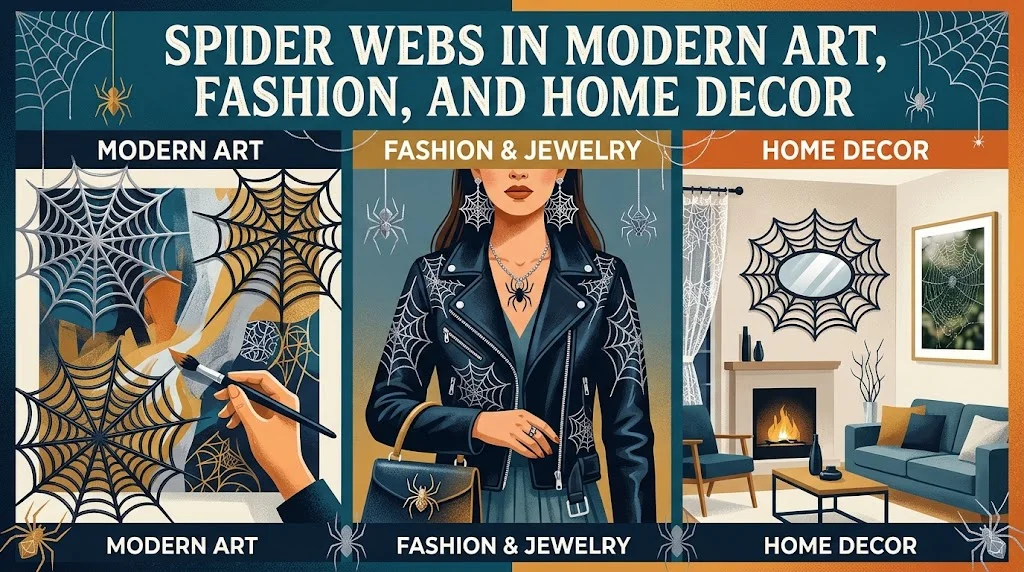
Spider Webs in Modern Art, Fashion, and Home Decor
Today, spider webs appear in many forms of visual expression. Their recognizable geometry makes them suitable for both delicate and dramatic designs.
In American popular culture, their meanings range from natural beauty to mystery and alternative identity.
Spider Webs in Art and Fashion
Artists often use spider webs to create patterns, textures, and visual contrasts.
In fashion, web-inspired designs can communicate individuality and creativity. They also appear in Gothic, punk, alternative, and Halloween-inspired styles.
Common examples include:
• Web patterns printed on shirts and jackets.
• Silver web-shaped jewelry and decorative accessories.
• Illustrations combining spiders, flowers, and geometric patterns.
• Artwork exploring relationships, complexity, and transformation.
Spider Webs in Home Decor
Spider web designs can create different moods inside a home.
For example, delicate silver webs may suit nature-inspired artwork. In contrast, black web decorations often create a dramatic Halloween atmosphere.
Some people also display natural web photography because of its delicate structure and intricate details.
Spider Webs on Social Media
Social media has expanded the visual use of spider web imagery.
People share web photographs, nature videos, illustrations, and tattoo designs. Some use spider web graphics to express personal creativity or alternative fashion interests.
However, the meaning of a post depends on its caption and surrounding images. A spider web emoji or graphic doesn’t have one universally accepted message.
Negative Meanings and Controversies of Spider Webs
Spider webs don’t always represent positive qualities. Their associations with traps, danger, and imprisonment create more complicated interpretations.
Understanding these meanings helps readers avoid oversimplifying the symbol.
Feeling Trapped or Controlled
A web catches insects through its connected, sometimes sticky threads. This natural function creates an obvious metaphor for restriction.
In literature and everyday language, someone caught in a web may represent a person struggling with complicated circumstances.
The image can suggest:
• Unhealthy relationships or emotional dependence.
• Complicated situations that feel difficult to escape.
• Manipulation and hidden dangers.
• Fear of losing personal independence.
Prison and Gang Associations
Some spider web tattoos have documented connections with prison and gang subcultures.
However, these associations aren’t universal. Meaning can depend on location, placement, historical period, and the group using the design.
The National Gang Center specifically cautions against treating tattoos as standalone proof of gang membership.
nationalgangcenter.ojp.gov
Misunderstanding Cultural Symbols
Another common mistake involves treating every spider-related design as interchangeable.
For example, a spider web tattoo and an Indigenous dreamcatcher aren’t the same cultural symbol. Dreamcatchers have particular histories and meanings within Indigenous communities.
Respecting these distinctions prevents cultural traditions from becoming simplified decorative labels.
Spider Webs in Dreams: Symbolic Interpretations
Dreams involving spider webs can inspire curiosity because webs carry several contrasting associations.
Some people interpret them through personal emotions, current challenges, or spiritual beliefs. However, dream symbolism doesn’t provide a scientifically established way to predict future events.
Seeing a Spider Web in a Dream
A spider web might represent relationships, creative plans, or complicated circumstances.
Its meaning depends on how the dream feels to the person experiencing it.
Walking Into a Spider Web
This experience may symbolize frustration or feeling caught in an unexpected situation.
It can also reflect concerns about boundaries or personal independence.
Seeing a Broken Spider Web
A damaged web may represent interrupted plans or changing relationships.
Alternatively, it can suggest the opportunity to rebuild something more meaningful.
Building or Watching a Spider Web
Watching a spider construct its web may represent patience and creative development.
Some people connect this image with working toward long-term goals through small, consistent actions.
These interpretations are reflective possibilities, not fixed explanations of dreams.
How Spider Web Meanings Have Changed Over Time
Spider web symbolism has developed through mythology, traditional storytelling, religious imagery, popular culture, and personal expression.
Its meaning has never remained completely fixed.
From Creation to Mystery
Ancient stories often connected spiders with weaving, intelligence, and creation. The Arachne myth, for example, linked spider imagery with artistic skill and human ambition.
Later European associations sometimes emphasized darkness, neglected places, and fear.
Both interpretations continue to influence modern imagery.
From Traditional Stories to American Pop Culture
In the United States, Halloween helped strengthen the spider web’s connection with mystery and haunted spaces.
Meanwhile, American tattoo culture developed additional associations with prison experiences and alternative identity.
Contemporary Interpretations
Today, people increasingly use spider web designs for personal reasons.
Some appreciate their geometry, while others connect them with relationships, creativity, and resilience.
This variety shows how symbols evolve through changing social experiences.
What Spider Web Symbolism Teaches Us About Life
Beyond its historical and cultural meanings, the spider web offers several thoughtful lessons.
Its construction provides a useful metaphor for how people approach relationships, ambitions, and personal challenges.
Small Actions Create Larger Results
A web begins with individual threads. Similarly, meaningful achievements often develop through small decisions and repeated efforts.
Relationships Require Connection
A web depends on its connected strands. Human relationships also depend on communication, trust, and shared responsibility.
Setbacks Don’t End Creativity
Spider webs can become damaged and rebuilt. This offers a reminder that failure doesn’t always mean the end of progress.
Balance Matters
A web needs both strength and flexibility. Likewise, people benefit from maintaining clear goals while adapting to changing circumstances.
These lessons make the spider web a meaningful image for personal reflection.
FAQs About Spider Web Symbolism
1. What does a spider web symbolize?
A spider web symbolizes creativity, patience, interconnectedness, and destiny. It also represents the connections that shape our lives.
2. What is the spiritual meaning of a spider web?
Spiritually, a spider web represents creation, life’s connections, and personal growth. It may also remind you to build your future with patience.
3. Do spider webs symbolize creativity?
Yes. Their detailed patterns represent creativity, imagination, and careful planning. They show how small efforts can create something meaningful.
4. What does a spider web mean in dreams?
A spider web in a dream may symbolize hidden connections, complicated situations, or feeling trapped. Its meaning depends on the dream’s details and emotions.
5. What do spider webs symbolize in different cultures?
Across different cultures, spider webs can represent creation, wisdom, destiny, and interconnectedness. Their meanings vary between traditions and stories.
6. What does a spider web tattoo represent?
A spider web tattoo may represent patience, survival, creativity, and life’s connections. Its personal meaning often depends on the wearer’s experiences.
Conclusion
Spider Web Symbolism: Creativity, Connection and Meaning reveals how a simple natural structure can carry powerful messages. Spider webs represent creativity, patience, destiny, strength, and interconnectedness across different cultural and spiritual traditions. Their delicate patterns remind us that every action can influence something greater. Whether seen in nature, dreams, art, or tattoos, spider webs encourage us to value our connections, trust the creative process, and approach life’s challenges with patience.

Sophia Wilson is a spiritual content writer and researcher at SoulMeanings.com, specializing in dream meanings, symbolism, spiritual insights, and personal growth topics that help readers navigate life’s journey with greater understanding.