
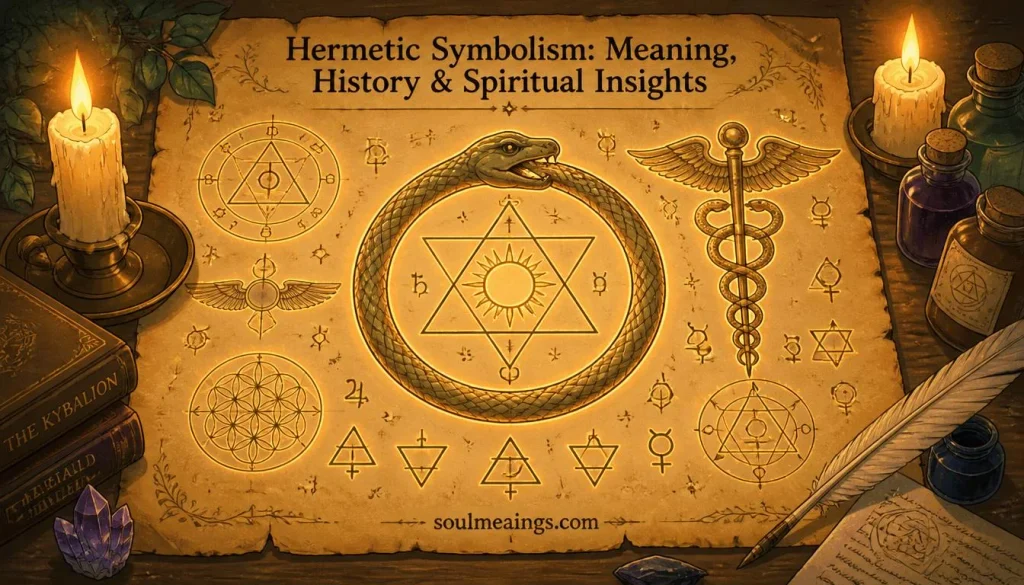
Hermetic Symbolism explores how ancient symbols connect the universe, human nature, and spiritual knowledge.
Rooted in Hermeticism, this tradition draws on Egyptian, Greek, and mystical thought to explain hidden truths, cosmic unity, transformation, and spiritual enlightenment. Its symbols represent balance, wisdom, divine knowledge, and the connection between the microcosm and macrocosm, encouraging self-discovery, inner wisdom, and personal growth.
The origins of Hermetic symbolism connect ancient Egypt, ancient Greece, and Hermes Trismegistus, a legendary teacher associated with Greek Hermes and the Egyptian god Thoth. Hermetic teachings influenced alchemy, astrology, Kabbalah, and Western esoteric traditions.
Key symbols include the Ouroboros (eternal cycles and renewal), the Caduceus (balance and healing associations), the Sun, Moon, and Mercury (celestial symbolism), and the Philosopher’s Stone (spiritual transformation).
Today, these symbols appear in art, tattoos, literature, and spiritual practices, inspiring mysticism, spiritual growth, hidden knowledge, and deeper understanding of life.
Quick Answer
Hermetic symbolism represents hidden spiritual truths about the universe, transformation, and consciousness. In the USA, it is often linked to personal growth, mystical philosophy, and psychological self-understanding, while globally it reflects ancient teachings about unity and universal order.
TL;DR
• Rooted in ancient mystical philosophy and symbolic language
• Focuses on transformation, unity, and hidden knowledge
• Strong influence on Western spirituality and psychology
• Popular in USA art, tattoos, and self-development culture
• Combines Egyptian, Greek, and Renaissance ideas
• Still widely used in modern spiritual exploration
Overview of Hermetic Symbolism
Hermetic symbolism is a visual and philosophical system used to express spiritual truths. It often appears in symbols, metaphors, and coded teachings. For readers in the USA, it is commonly associated with self-discovery and alternative spirituality.
Core Idea Behind the Symbols
Hermetic symbols are not meant to be literal. Instead, they represent deeper truths about existence.
• Unity of mind and universe
• Transformation through knowledge
• Balance between opposites
• Hidden structure of reality
What Is Hermeticism and Its Origins
Hermeticism is a philosophical and spiritual tradition based on writings attributed to Hermes Trismegistus. These teachings shaped much of Western esoteric thought.
Ancient Foundations
Hermetic ideas emerged from a blend of Egyptian and Greek traditions. They were later preserved in philosophical texts that influenced later mystical systems.
Key Historical Influence
Hermeticism impacted early science, alchemy, and philosophy, especially during the Renaissance.
read more: Yew Symbolism: Spiritual Meaning, Immortality & Protection
Core Symbols in Hermetic Tradition
Hermetic symbolism uses recurring images that express universal principles. These symbols appear in manuscripts, artwork, and modern interpretations.
Common Hermetic Symbols
• Ouroboros (snake eating its tail)
• Caduceus (two serpents around a staff)
• The All-Seeing Eye
• Sacred geometry patterns
• The Emerald Tablet imagery
• Sun and moon duality symbols
Historical Roots in Ancient Civilizations
Hermetic symbolism draws from multiple ancient cultures. It reflects shared human attempts to understand the universe.
Egyptian and Greek Influence
Egypt contributed mystical imagery, while Greece added philosophical structure.
Transition Into Written Tradition
These ideas were eventually compiled into texts that shaped later Western mystical thought.
Hermetic Symbolism in Medieval and Renaissance Europe
During the Renaissance, Hermetic ideas became deeply influential among scholars and artists. They were often connected to science and early chemistry.
Revival of Ancient Wisdom
European thinkers rediscovered Hermetic texts and linked them with philosophy and natural science.
Influence on Art and Science
Artists and scientists used symbolic language to explore nature and transformation.
Symbolism in the United States Today
In modern American culture, Hermetic symbolism appears in spirituality, psychology, and creative expression.
Modern Interpretation in the USA
People often interpret these symbols in personal and psychological ways.
| Context | Meaning in the USA | Common Associations | Notes |
| Meditation | Inner transformation | Mindfulness, awareness | Used in spiritual practice |
| Psychology | Subconscious mind | Jungian archetypes | Symbol of inner growth |
| Tattoos | Personal meaning | Protection, identity | Popular among spiritual seekers |
| Art & Design | Mystery and depth | Sacred geometry | Used in modern visuals |
| Social Media | Spiritual identity | Self-growth content | Symbolic storytelling |
Cultural Appeal
These symbols appeal to Americans seeking meaning beyond material life. They often represent self-improvement and inner balance.
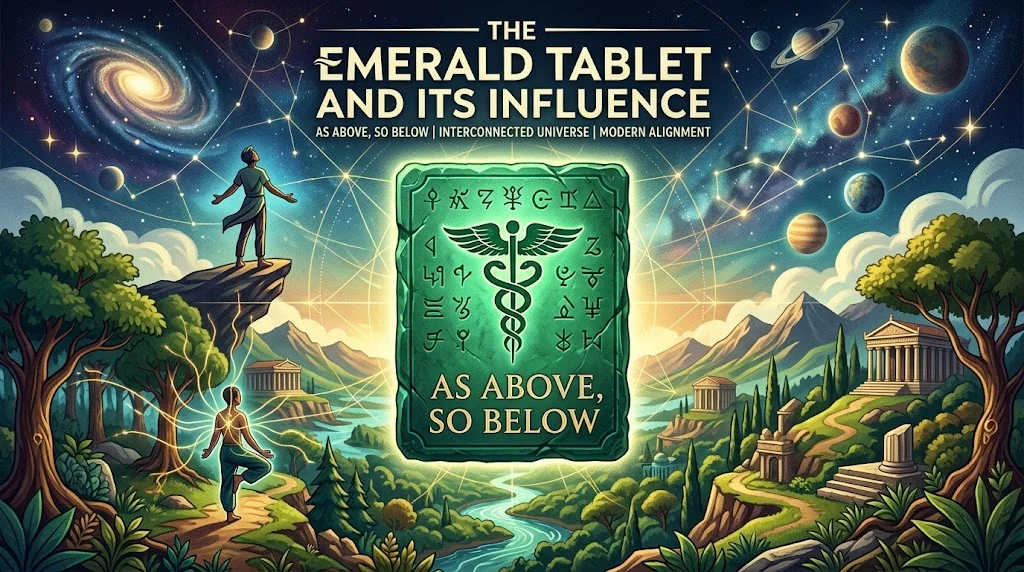
The Emerald Tablet and Its Influence
The Emerald Tablet is one of the most famous Hermetic texts. It is often summarized by the phrase about “as above, so below.”
Meaning of the Tablet
It teaches that the universe is interconnected at all levels.
Modern Interpretation
In the USA, it is often used as a metaphor for personal alignment and universal connection.
Alchemical Symbols and Transformation
Alchemy is closely tied to Hermetic symbolism. It uses physical transformation as a metaphor for spiritual change.
Key Alchemical Ideas
• Turning base elements into gold
• Purifying the self through experience
• Balancing opposites
• Seeking inner perfection
Symbolic Meaning Today
In modern spirituality, alchemy represents emotional healing and personal growth.
Psychological Meaning and Jungian Interpretation
Psychology has given Hermetic symbolism new depth. Carl Jung linked these symbols to the human unconscious.
Inner Archetypes
Hermetic symbols are seen as reflections of inner psychological patterns.
USA Psychological Use
Many therapists and thinkers use symbolic language to explore identity and behavior.
Spiritual and Esoteric Interpretations
Hermetic symbolism is often used in spiritual practices focused on awareness and energy.
Spiritual Themes
• Connection between mind and universe
• Expansion of consciousness
• Inner awakening
• Universal harmony
Modern Usage in Tattoos, Art, and Media
Hermetic symbols are widely used in modern culture, especially in visual expression.
Popular Uses Today
• Tattoo designs representing transformation
• Album and music artwork
• Spiritual social media content
• Home decor with sacred geometry
• Fashion inspired by mystical themes
Misunderstandings, Misuse & Controversies
Hermetic symbolism is sometimes misunderstood or misrepresented. In some cases, symbols are removed from their original meaning.
Common Misinterpretations
• Confusing symbols with literal magic
• Oversimplifying ancient teachings
• Using symbols without context
• Mixing unrelated belief systems
Respectful Understanding
It is important to recognize these symbols as philosophical rather than literal tools.
Shifts Over Time in Hermetic Symbolism
Hermetic symbolism has changed significantly from ancient times to the modern world.
Evolution of Meaning
• Ancient era: sacred philosophical teachings
• Renaissance: scientific and mystical exploration
• Modern era: psychological and spiritual interpretation
Modern Revival
Today, interest in Hermetic ideas is growing again through wellness culture and personal development.
FAQs About Hermetic Symbolism
1. What does Hermetic symbolism mean?
Hermetic symbolism uses symbols and images to express deeper truths about the universe, human nature, and spiritual knowledge. It explores themes such as balance, wisdom, transformation, and hidden meanings.
2. What are the origins of Hermetic symbolism?
Hermetic symbolism developed from ancient Egyptian and Greek traditions. It is closely associated with Hermes Trismegistus, a legendary figure linked to Greek Hermes and the Egyptian god Thoth.
3. What are the main Hermetic symbols?
Important Hermetic symbols include the Ouroboros, Caduceus, Sun, Moon, Mercury, and Philosopher’s Stone. Each carries different associations with renewal, balance, knowledge, or transformation.
4. What does the Ouroboros symbolize in Hermeticism?
The Ouroboros, often shown as a serpent eating its own tail, represents eternal cycles, renewal, unity, and the continuous process of transformation.
5. How is Hermetic symbolism connected to alchemy?
Hermetic symbolism and alchemy share themes of transformation, balance, and hidden knowledge. Alchemical symbols can describe physical processes while also representing personal and spiritual development.
6. How is Hermetic symbolism used today?
Today, Hermetic symbolism appears in art, tattoos, literature, and spiritual exploration. People use these symbols to express personal beliefs, explore ancient wisdom, and reflect on self-discovery and spiritual growth.
Conclusion
Hermetic Symbolism: Meaning, History & Spiritual Insights reveals how ancient symbols continue to inspire curiosity about life, the universe, and human consciousness. From the Ouroboros to the Philosopher’s Stone, these images explore transformation, wisdom, balance, and spiritual growth. Understanding their historical roots and symbolic meanings can help you appreciate their influence on alchemy, philosophy, and modern spiritual practices. Ultimately, Hermetic symbolism offers a way to reflect on hidden meanings, personal development, and the connection between the inner self and the wider universe.

Evelyn Thomas is the voice behind SoulMeanings.com, sharing thoughtful articles on spirituality, dream interpretation, symbolism, and self-discovery to inspire meaningful living.

Pingback: Jewelry Symbolism: Meaning, Spiritual Significance & Culture