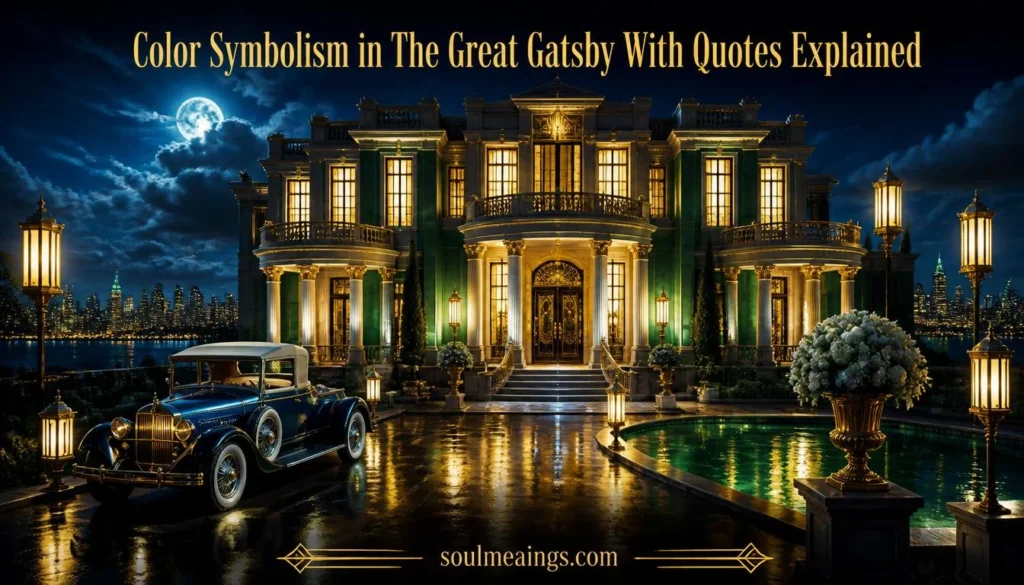
Color Symbolism in The Great Gatsby With Quotes Explained shows how Fitzgerald turns color into a visual language for dreams, wealth, love, and identity.
F. Scott Fitzgerald’s novel, The Great Gatsby, uses color as more than decoration within its American classics setting. Readers can notice emotion, status, illusion, and repeated shades through the green light, white, yellow, gold, blue, gray, silver, blackened, and faded tones. These colors shape Daisy, Gatsby, wealth, romance, and the rot beneath the Jazz Age.
In the United States, the school text remains part of the American language, especially when discussing ambition, old money style, luxury culture, doomed romance, fake glamour, and the American Dream. Fitzgerald deliberately gives each color symbolic significance to symbolize both dreams and failures. Green suggests hope, wonder, greed, and envy, while white suggests innocence, purity, privilege, and exclusivity.
This multiple, contradictory meaning approach creates a double-edged significance and a devastating message about the viability of the American Dream. The author turns this into a message that teachers can explore through teaching, while students can use color symbolism, a Complete Teaching Unit, and worksheets to analyze its significance.
The unit and quotes also connect identity, love, social divisions, and 1920s America with the novel, which was published in 1925. Its symbols connect with modern ideas about success, appearance, and the pursuit of happiness. Through the use of color, Fitzgerald creates a contrast between glamorous images, struggles, and hidden realities. Gatsby’s green light across
Quick Answer
Color Symbolism in The Great Gatsby with quotes explained often centers on the false promise of the American Dream. In the United States, colors like green symbolize hope and wealth, while white, gold, and yellow reveal illusion, status, and moral decay. Fitzgerald used color to show the gap between appearance and reality.
TL;DR
• Green represents hope, money, and unreachable dreams.
• White often hides dishonesty beneath innocence.
• Gold symbolizes old wealth and social power.
• Yellow suggests corruption, decay, and moral emptiness.
• Blue reflects loneliness, fantasy, and emotional distance.
• Fitzgerald used color to criticize the American Dream.
Overview of Color Symbolism in The Great Gatsby
Why Colors Matter in the Novel
Fitzgerald carefully repeated certain colors throughout the story. Because of this, readers begin linking each shade with emotions, ideas, and social class. The colors help create mood while also revealing hidden truths.
In American literature classes, this symbolism matters because it teaches readers how visual details shape meaning. Even today, students often connect Gatsby’s color imagery to modern ideas about wealth, fame, and identity.
Colors as Emotional Signals
Many colors in the novel work like emotional clues. Instead of directly telling readers how characters feel, Fitzgerald lets colors suggest it indirectly.
• Green signals longing and future dreams.
• White suggests purity but also deception.
• Gold reflects power and inherited wealth.
• Yellow hints at corruption and decay.
• Blue creates feelings of sadness and distance.
• Gray symbolizes hopelessness and spiritual emptiness.
The Historical Background Behind Fitzgerald’s Color Use
The Jazz Age and Visual Luxury
The Great Gatsby was written during the Roaring Twenties. During this era, Americans saw major growth in advertising, fashion, cinema, and consumer culture. Bright colors became linked to glamour and success.
Because of this cultural shift, Fitzgerald used rich visual imagery to mirror the excitement of the decade. However, he also warned readers about its dangers.
Symbolism Traditions Before the 1920s
Color symbolism existed long before Fitzgerald. Ancient cultures, religious traditions, and classic literature all attached meanings to colors.
For example:
• Green often symbolized rebirth and desire.
• White represented innocence in Western traditions.
• Gold connected to royalty and divine power.
• Gray symbolized death or spiritual emptiness.
• Blue often reflected dreams or emotional depth.
Fitzgerald adapted these older meanings for modern America. Instead of using color for mythology, he used it to criticize modern society.
The Green Light Symbolism Explained
Gatsby’s Most Famous Symbol
The green light at Daisy’s dock is the novel’s most famous image. Gatsby watches it from across the water because it represents his dream of finally reaching Daisy.
One famous quote says:
“Gatsby believed in the green light, the orgastic future that year by year recedes before us.”
This moment connects green with hope and ambition. However, it also shows that Gatsby’s dream may never become real.
Green and the American Dream
In the United States, green strongly connects to money and opportunity. Fitzgerald used this association deliberately.
The green light symbolizes:
| Context | Meaning in the USA | Common Associations | Notes |
| Gatsby’s dream | Hope and ambition | Success, romance | Always distant |
| Money and wealth | Financial success | Dollars, luxury | Never satisfying |
| Future goals | Endless striving | Reinvention | Constant pursuit |
| Daisy herself | Idealized perfection | Desire, beauty | Mostly illusion |
Emotional Meaning of Green
Psychologically, green can feel calming and hopeful. Yet in the novel, it also creates frustration because Gatsby cannot truly possess what he wants.
Today, many Americans still connect green symbolism with:
• Career ambition and success culture.
• Luxury lifestyles on social media.
• Endless self-improvement goals.
• The pressure to “make it.”
• Emotional longing for unreachable ideals.
White Symbolism in The Great Gatsby
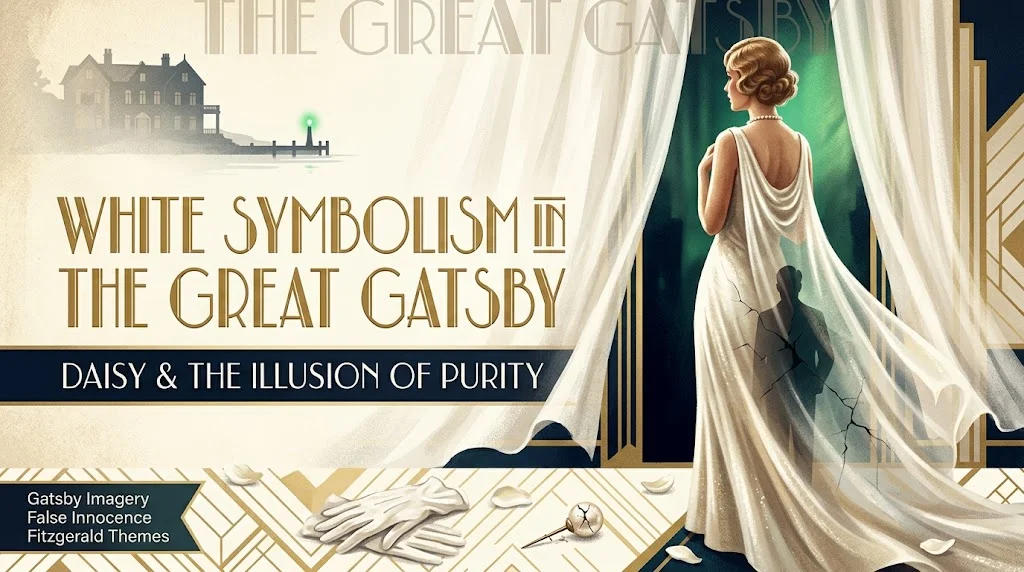
Daisy and the Illusion of Purity
Daisy Buchanan is strongly associated with white clothing and white rooms. At first, this makes her seem innocent, elegant, and delicate.
Nick describes Daisy and Jordan wearing white dresses early in the novel. The image creates softness and beauty.
However, Fitzgerald slowly reveals that white hides dishonesty and carelessness.
White as a Mask
In American culture, white often symbolizes innocence. Fitzgerald twists this meaning by showing how appearances can deceive people.
Daisy appears graceful and pure, but her actions often hurt others. Because of this, white becomes a symbol of false innocence.
• White curtains create dreamy illusions.
• White dresses suggest social perfection.
• Bright white rooms hide emotional emptiness.
• White imagery softens harsh realities.
• Daisy’s appearance masks selfish behavior.
Gold and Yellow Symbolism Explained
Old Wealth vs. Corruption
Gold and yellow appear frequently in Gatsby’s parties, cars, and clothing. Yet Fitzgerald separates the two colors carefully.
Gold often symbolizes real wealth and established status. Yellow, however, represents fake glamour and moral decay.
This distinction reflects class differences in America during the 1920s.
Gatsby’s Yellow Car
One important symbol is Gatsby’s yellow car. The vehicle appears glamorous at first. Later, though, it becomes connected to tragedy and death.
This shift changes yellow from exciting to dangerous.
A memorable quote describes Gatsby’s “rich cream color” car, blending luxury with artificial brightness.
Modern Meanings of Gold and Yellow
Today, Americans still connect gold with luxury and success. Yellow, however, can feel unstable or overly flashy.
• Gold suggests prestige and social power.
• Yellow hints at excess and recklessness.
• Gold feels timeless and refined.
• Yellow feels temporary and performative.
• Both colors reflect obsession with status.
Blue Symbolism and Emotional Distance
Gatsby’s Blue World
Blue appears around Gatsby’s gardens, chauffeur, and parties. Unlike gold or yellow, blue creates emotional coolness and mystery.
The color often reflects Gatsby’s loneliness beneath his glamorous image.
The Emotional Psychology of Blue
Blue commonly symbolizes sadness, fantasy, and emotional distance in American culture. Fitzgerald uses these meanings to deepen Gatsby’s character.
• Blue gardens feel dreamlike and unreal.
• Blue smoke creates mystery and confusion.
• Blue clothing suggests emotional isolation.
• Blue imagery softens harsh truths.
Today, blue still appears heavily in films and media to express loneliness or emotional reflection.
Gray Symbolism and the Valley of Ashes
A World Without Hope
Gray dominates the Valley of Ashes, one of the bleakest settings in the novel. The area represents poverty, exhaustion, and spiritual emptiness.
Unlike Gatsby’s bright parties, this place feels lifeless.
Industrial America and Moral Decay
The gray ashes symbolize the darker side of American progress. While wealthy characters enjoy luxury, working-class people struggle in polluted conditions.
This contrast mattered deeply in the 1920s and still resonates today.
• Gray represents hopelessness and exhaustion.
• Ashes symbolize spiritual emptiness.
• Industrial imagery critiques unchecked wealth.
• The setting exposes class inequality.
• Gray removes glamour from the American Dream.
read more: Indigo Symbolism: Spiritual, Cultural, and Emotional Meanings
Color Symbolism and the American Dream
Fitzgerald’s Criticism of Success Culture
The novel questions whether wealth truly creates happiness. Each major color reflects a different part of the American Dream.
For example, green represents ambition while gray shows disappointment. Gold suggests status, yet yellow exposes corruption.
Why American Readers Still Relate
Modern readers in the United States often connect Gatsby’s symbolism to today’s culture.
People still chase fame, beauty, luxury, and social approval. Because of this, the novel feels surprisingly current.
Modern American Connections
• Luxury branding uses gold and green heavily.
• White aesthetics dominate influencer culture.
• Blue lighting shapes emotional movie scenes.
• Yellow often signals caution or instability.
• Gray urban imagery suggests burnout and isolation.
Cross-Cultural Meanings of Gatsby’s Colors
Shared Symbolic Traditions
Although Fitzgerald focused on American society, many of his colors carry wider meanings.
Across cultures:
• Green often relates to renewal and growth.
• White may symbolize purity or mourning.
• Gold frequently connects to sacred power.
• Blue often reflects spirituality or calmness.
• Gray commonly represents aging or emptiness.
Differences Across Cultures
Some meanings differ outside the United States. For example, white symbolizes mourning in several Asian traditions rather than innocence.
Because symbolism changes culturally, readers may interpret Gatsby’s imagery differently depending on their background.
Color Symbolism in Movies and Pop Culture
The 2013 Film Adaptation
Baz Luhrmann’s 2013 adaptation amplified the novel’s colors dramatically. Bright golds, deep blues, and glowing greens became central visual themes.
This helped modern audiences notice Fitzgerald’s symbolism more clearly.
Social Media and Gatsby Aesthetics
Today, “Gatsby aesthetics” appear widely online. Many people use the novel’s imagery to symbolize luxury, nostalgia, or tragic romance.
Common modern uses include:
• Art deco wedding themes.
• Gold-and-black luxury decor.
• Green-light tattoo symbolism.
• Vintage glamour photography.
• TikTok edits about ambition and heartbreak.
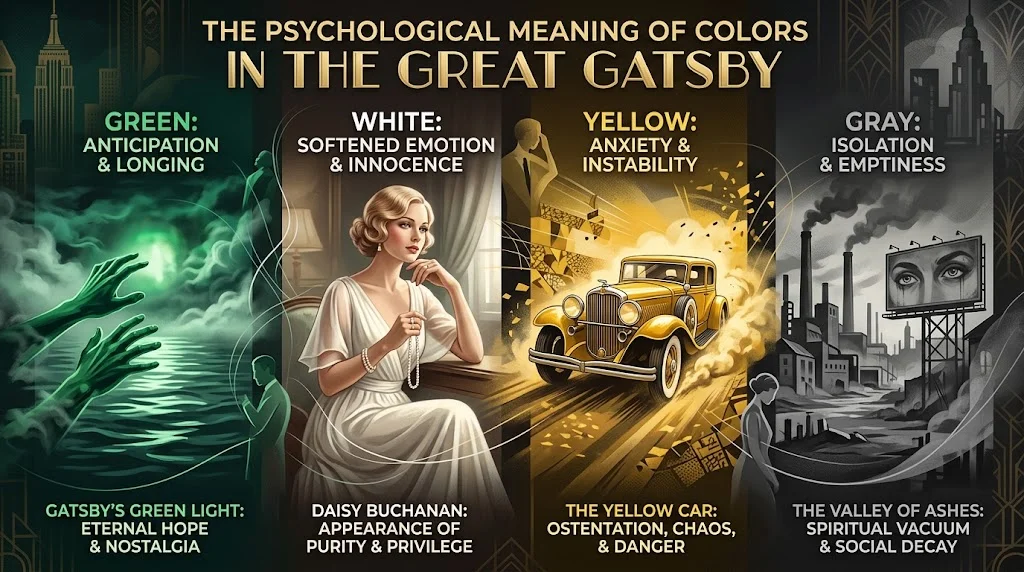
Psychological Meaning of the Novel’s Colors
Why Readers Remember the Colors
Psychologically, colors create emotional memory. Fitzgerald’s repeated imagery makes readers feel the novel’s themes instead of simply understanding them intellectually.
This emotional connection explains why Gatsby’s symbolism remains famous.
Emotional Signals in Key Scenes
• Green creates anticipation and longing.
• White softens emotional tension.
• Yellow increases anxiety and instability.
• Blue encourages reflection and sadness.
• Gray creates emotional heaviness.
Because these reactions feel instinctive, readers often remember the colors years later.
Misunderstandings and Controversies About Gatsby Symbolism
Not Every Color Has One Fixed Meaning
Some readers oversimplify the novel by assigning one exact meaning to every color. Fitzgerald’s symbolism is more flexible than that.
For example, green can symbolize hope and greed simultaneously.
Debates Among Modern Readers
Scholars and readers still debate parts of the symbolism today.
Common discussions include:
• Whether Gatsby is romantic or delusional.
• If Daisy represents love or social status.
• Whether colors change meaning over time.
• How class affects symbolic interpretation.
• Whether the American Dream is completely condemned.
These debates help keep the novel culturally alive.
How the Meaning of Gatsby’s Colors Changed Over Time
Earlier Interpretations
For decades, schools mainly taught the novel as a warning about wealth and moral decay.
During the mid-1900s, readers focused heavily on class and corruption.
Modern Interpretations
Today, many Americans also connect the story to identity performance, celebrity culture, and emotional loneliness.
Social media has made Gatsby’s themes feel newly relevant because appearance often matters as much as reality.
Revived Popularity in the 2020s
The novel gained renewed attention through fashion trends, film clips, and online discussions.
Modern readers often see Gatsby as:
• A symbol of self-invention.
• A warning about obsession.
• A reflection of luxury culture.
• A critique of performative success.
• A tragic dreamer chasing illusion.
FAQs
What does color symbolize in The Great Gatsby?
Color symbolizes dreams, wealth, love, identity, social class, and illusion. Fitzgerald uses different colors to reveal both what characters want and the hidden realities behind their lives.
What does the green light symbolize?
The green light mainly represents hope, dreams, and Gatsby’s desire for a future with Daisy. It also suggests the unreachable nature of the American Dream.
What does white symbolize in The Great Gatsby?
White can represent innocence, purity, and beauty. However, Fitzgerald also connects it with privilege, exclusivity, and appearances that hide deeper problems.
What do gold and yellow symbolize?
Gold often suggests wealth, luxury, and social status. Yellow can carry darker ideas, including false glamour, corruption, and the emptiness beneath material success.
Why does Fitzgerald use several colors with different meanings?
Fitzgerald gives colors multiple and sometimes contradictory meanings because people and society are complicated. This double-edged significance helps show the gap between glamorous appearances and difficult realities.
Why is color symbolism important in the novel?
Color symbolism helps readers understand characters, relationships, social divisions, and major themes without relying only on direct explanations. It makes Fitzgerald’s ideas about the American Dream, ambition, and illusion more vivid.
Conclusion
Color Symbolism in The Great Gatsby With Quotes Explained shows how Fitzgerald uses simple visual details to express complex ideas. The green light, white dresses, gold, yellow, blue, gray, and other shades connect characters with their dreams, wealth, identity, and social position. These colors also expose the contrast between glamorous images and the hidden realities underneath. Through this careful use of color, Fitzgerald makes the novel’s themes of the American Dream, love, ambition, illusion, and social class easier to see and understand.

Sophia Wilson is a spiritual content writer and researcher at SoulMeanings.com, specializing in dream meanings, symbolism, spiritual insights, and personal growth topics that help readers navigate life’s journey with greater understanding.