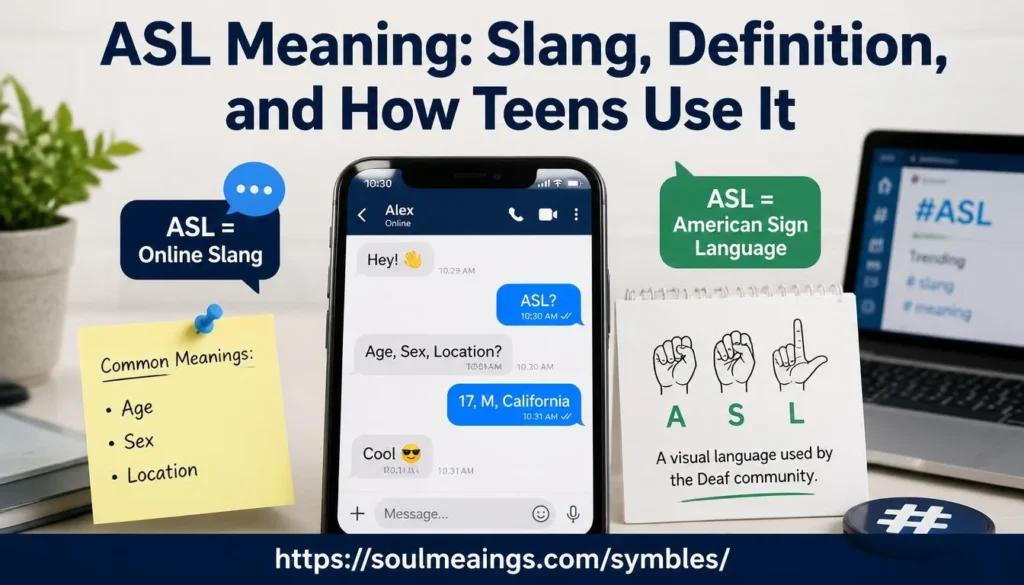
ASL Meaning: Slang, Definition, and How Teens Use It helps explain why this slang appears so often in modern texting, chats, and social media.
The ASL meaning can seem confusing when teens use this acronym in a message, online chats, or text messages. It is a commonly used phrase that people often see on social media, messaging apps, and gaming platforms.
The term is widely searched because users want to understand its definition, meaning, and use without struggling with unfamiliar short forms and terms. In my experience, learning the context makes online language much easier to follow. Just as LOL and WTF became familiar to adults, ASL represents the latest style of casual language that many users are learning to catch up with.
The meaning of ASL can have more than one meaning, depending on where and how it is used. In a simple question, it may carry one meaning, while a completely different situation can give it another idea or purpose.
These abbreviations help users communicate quickly, but they can also cause confusion when someone feels confused by an unfamiliar expression. This article helps break down the origin, modern use, and real examples of ASL, making it easier to recognize and understand in everyday online conversations.
What Does ASL Mean in Text and Chat?
Quick Answer
In older internet slang, ASL usually means “age, sex, location.” People used it in chatrooms to quickly ask someone’s age, sex, and general location.
Today, ASL can also mean “as hell” in informal texting. In other contexts, it means American Sign Language. The surrounding conversation usually tells you which meaning applies.
ASL Meaning at a Glance
| ASL Meaning | Common Context | What It Means |
| Age, Sex, Location | Older chatrooms and anonymous chats | Asking for basic personal details |
| As Hell | Texting, comments, social media | Adds emphasis to a statement |
| American Sign Language | Education, accessibility, Deaf communities | A visual language |
| A/S/L | Older online chats | Another form of age, sex, location |
The most important point is simple: ASL doesn’t have one universal meaning.
If someone writes only “ASL?” you need the conversation around it to interpret the abbreviation accurately.
What Does “Age, Sex, Location” Mean?
The original ASL slang meaning became popular during the early days of online chat. Users wanted a quick way to introduce themselves or learn basic information about another person.
Instead of typing three separate questions, they could simply write ASL?
Age
The A traditionally stands for age.
A person might ask this to find out how old someone is before continuing a conversation. In anonymous chatrooms, age could also help people understand whether they were talking to someone in a similar age group.
For example:
ASL?
A traditional response might look like:
24/F/Chicago
Here, the person has provided their age, sex, and general location.
Sex
The S traditionally stands for sex.
In older internet conversations, users often answered with M or F. However, language around gender and identity has become more nuanced since those chatroom days.
Because of that change, the traditional phrase can feel dated today. Someone asking for this information may use more specific and respectful wording instead.
Location
The L stands for location.
This usually meant a city, state, country, or broad region rather than an exact address.
For example:
27/M/Texas
The location gives a general idea of where the person lives. It doesn’t necessarily identify their exact whereabouts.
That distinction matters even more today because sharing precise location information online can create privacy and safety risks.
How ASL Became an Internet Slang Term
Early Chatroom Culture
Long before social media feeds and smartphone messaging, people gathered in online chatrooms to talk with strangers. Messages moved quickly, so users developed shortcuts that saved time.
ASL fit that environment perfectly.
Three letters could replace an entire question. It worked almost like a verbal handshake for anonymous online conversations.
People commonly used abbreviations such as:
- ASL — age, sex, location
- BRB — be right back
- LOL — laugh out loud
- AFK — away from keyboard
- TTYL — talk to you later
These expressions helped shape the informal language of early internet communities.
From Chatrooms to Modern Messaging
Modern communication works differently.
People now use texting apps, social networks, gaming chats, comments, and private messages. Users also tend to communicate with people they already know.
As a result, the classic ASL meaning in chat has become less dominant.
Still, the abbreviation hasn’t disappeared completely. You may encounter it in older online communities, anonymous conversations, or discussions where people deliberately use older internet slang.
What Does ASL Mean on Social Media?
The ASL meaning in text depends heavily on where and how someone uses it.
A social media comment can use the abbreviation differently from an anonymous chatroom. That’s why checking the sentence around it matters.
ASL on TikTok
On TikTok, ASL may appear in comments, captions, or direct messages.
One increasingly common slang interpretation is “as hell.”
For example:
“That song is catchy asl.”
Here, asl intensifies “catchy.” It doesn’t ask for someone’s age or location.
However, context remains essential because users can still use ASL in other ways.
ASL on Instagram
Instagram conversations can be even more varied because people use the platform for friendships, dating, entertainment, education, and business.
If someone sends:
“You funny asl.”
They most likely mean:
“You are funny as hell.”
But if someone sends only:
“ASL?”
especially in a conversation with a stranger, the older age, sex, location meaning may be intended.
ASL on Snapchat
Snapchat encourages quick, informal communication. Abbreviations naturally fit that style.
If someone writes:
“This filter is chaotic asl.”
The abbreviation almost certainly functions as an intensifier.
On the other hand, an unexplained “ASL?” from a stranger could refer to the traditional chatroom question.
ASL on WhatsApp and Text Messages
WhatsApp and ordinary text messages depend heavily on personal communication habits.
Friends may use asl to mean “as hell”:
“I’m tired asl.”
Someone talking to a new online contact might instead use:
“ASL?”
In that case, the meaning could be age, sex, location.
The sentence structure gives you a strong clue.
ASL Can Mean “As Hell”
One of the most important modern ASL slang meanings is “as hell.”
In this usage, ASL works as an intensifier. It strengthens the word or idea that comes before it.
For example:
- “That game was hard asl.”
- “I’m hungry asl.”
- “She runs fast asl.”
- “That movie was scary asl.”
- “This weather is hot asl.”
The phrase is extremely informal. You wouldn’t normally use it in a professional email or formal school assignment.
How “As Hell” Works in Slang
Think of asl as adding extra force to an adjective or description.
Compare:
“That test was hard.”
with:
“That test was hard asl.”
The second sentence gives the statement more intensity.
You may also see the abbreviation written in uppercase as ASL or lowercase as asl. On social platforms, lowercase usage is especially common.
Why “ASL” Can Be Confusing
Here’s where internet slang gets interesting.
The exact same three letters can mean completely different things:
“ASL?”
This may mean age, sex, location.
But:
“That outfit is expensive asl.”
means expensive as hell.
And:
“I’m learning ASL.”
means American Sign Language.
The surrounding words act like a signpost. Without them, the abbreviation can be ambiguous.
ASL vs. American Sign Language
When ASL Means American Sign Language
American Sign Language is a complete visual language used primarily by Deaf and hard of hearing communities in the United States and parts of Canada.
It isn’t simply English performed with hand movements.
ASL has its own:
- Grammar
- Vocabulary
- Sentence structure
- Facial expressions
- Cultural conventions
- Regional variations
That’s why the abbreviation ASL can appear in educational, accessibility, cultural, and communication discussions.
For example:
“Do you know ASL?”
Here, the speaker is almost certainly asking whether you know American Sign Language.
How to Tell Which Meaning Someone Uses
Context usually solves the mystery.
| Example | Likely Meaning |
| “ASL?” | Age, sex, location |
| “That was funny asl.” | As hell |
| “Do you know ASL?” | American Sign Language |
| “I’m taking an ASL class.” | American Sign Language |
| “I’m tired asl.” | As hell |
Notice how the sentence structure changes everything.
How to Tell What ASL Means From Context
Look at the Words Around ASL
The easiest trick is to read the entire sentence rather than focusing on the abbreviation.
If asl appears after an adjective, it often means “as hell.”
“Cold asl.”
If someone sends ASL? as a standalone message, the older age, sex, location interpretation becomes more likely.
Consider the Platform
Platform context can provide another useful clue.
An educational post about Deaf culture probably uses ASL to mean American Sign Language.
A casual TikTok comment may use asl as slang.
An anonymous chat may use the traditional meaning.
These aren’t strict rules. They’re simply useful signals.
Consider the Person You’re Talking To
People from different generations and online communities may use the same abbreviation differently.
Someone familiar with early internet culture might recognize ASL as “age, sex, location” immediately.
A younger social media user may encounter asl primarily as an informal version of “as hell.”
Meanwhile, someone studying sign language may naturally interpret ASL as American Sign Language.
Examples of ASL in Text and Chat
Real examples make the differences much easier to spot.
“ASL?”
This is the classic internet abbreviation.
It generally means:
Age, sex, location?
Someone is asking for basic personal details.
“How old are you? ASL?”
This message reinforces the traditional interpretation.
The speaker wants information about the person’s age and probably their sex and location as well.
“That Test Was Hard asl.”
Here, asl means “as hell.”
The speaker isn’t asking a question. They’re emphasizing how difficult the test felt.
“Do You Know ASL?”
Here, ASL almost certainly means American Sign Language.
The phrase “do you know” provides strong contextual evidence.
“What’s Your ASL?”
This one can be ambiguous.
In an older-style chat, it might mean age, sex, location. In another setting, someone might be referring to American Sign Language.
When the meaning isn’t obvious, asking for clarification is better than guessing.
related post: NGL Meaning in Text: Full Form and Uses
Is ASL Still Common Slang?
Older vs. Modern Usage
The traditional age, sex, location meaning is less central to mainstream internet communication than it once was.
People now have more ways to introduce themselves. Social profiles often display basic information without requiring a three-letter question.
Modern slang has also produced newer meanings for ASL.
The “as hell” interpretation can appear in casual online writing, particularly when users want to intensify an adjective.
Where You May Still See It
You might still encounter the classic meaning in:
- Anonymous chat environments
- Older online communities
- Internet nostalgia discussions
- Conversations with strangers
- Some dating-oriented chats
- Communities influenced by older internet slang
The newer as hell meaning can appear in:
- Text messages
- TikTok comments
- Instagram comments
- Snapchat
- Discord
- Casual social media posts
Why Its Meaning Has Shifted
Internet language changes quickly.
Words that once dominated chatrooms can become less common as new platforms appear. At the same time, existing abbreviations can develop new meanings.
That’s exactly what happened with ASL.
Instead of disappearing, the abbreviation gained another life in casual slang.
Is It Safe to Answer an ASL Question Online?
A request for age, sex, and location may look harmless. However, you don’t have to provide personal information simply because someone asks.
Your privacy matters more than satisfying a stranger’s curiosity.
What Information Is Reasonable to Share?
If you choose to answer, keep details general.
For example, you might share:
- An approximate age range
- A country
- A broad region
- A general city, if you’re comfortable
There’s rarely a good reason to give a stranger your exact location.
Information You Should Avoid Sharing
Be cautious about giving strangers:
- Your exact home address
- Your phone number
- Your school address
- Your workplace address
- Your real-time location
- Passwords or account details
- Private identification information
An online conversation doesn’t automatically make another person trustworthy.
If someone pressures you for increasingly specific information, that’s a reason to step back.
Common Mistakes When Interpreting ASL
Assuming ASL Always Means “Age, Sex, Location”
This is probably the biggest mistake.
The traditional meaning remains recognizable, but modern internet users also use ASL for other purposes.
Always check the surrounding text.
Assuming ASL Always Means “As Hell”
The opposite mistake can happen too.
If someone says:
“I’m studying ASL.”
They aren’t saying they’re studying “as hell.”
The topic clearly points toward American Sign Language.
Ignoring Capitalization and Sentence Structure
Capitalization isn’t a perfect rule, but it can provide a clue.
A sentence such as:
“That was wild asl.”
looks like casual slang.
Meanwhile:
“ASL classes are available at the college.”
clearly points toward American Sign Language.
Confusing Slang With American Sign Language
The abbreviation ASL has an important non-slang meaning.
American Sign Language represents a real language and a major part of Deaf culture. It shouldn’t be treated as simply another internet acronym.
How to Respond When Someone Says “ASL?”
Casual Response
If you’re comfortable sharing basic details, you can answer briefly.
For example:
“25, male, Texas.”
You don’t need to provide more information than you’re comfortable sharing.
Privacy-Conscious Response
You can also keep your information vague.
For example:
“I’m in my twenties and somewhere in the U.S.”
That’s enough to answer generally without revealing precise personal details.
Clarifying the Meaning
If you aren’t sure what someone means, ask directly:
“Do you mean age, sex, location?”
There’s nothing awkward about asking.
A short clarification can prevent an entire conversation from going in the wrong direction.
ASL Meaning Compared With Similar Chat Abbreviations
ASL vs. A/S/L
A/S/L is essentially another written form of age, sex, location.
The slash marks simply separate the three parts.
Both forms belong to older internet chat culture.
ASL vs. WYD
WYD means “what you doing?”
It asks about someone’s current activity.
ASL, when used traditionally, asks for personal information.
So the two abbreviations serve very different purposes.
ASL vs. HMU
HMU means “hit me up.”
Someone using HMU is usually inviting another person to contact them.
ASL doesn’t carry that same invitation. Its meaning depends on which ASL definition applies.
ASL vs. TTYL
TTYL means “talk to you later.”
It’s usually used when someone is ending a conversation temporarily.
ASL functions differently because it either asks for information, emphasizes a statement, or refers to American Sign Language.
Why Internet Slang Keeps Changing
From Acronyms to Context-Based Meanings
Internet language doesn’t stay frozen.
A word or abbreviation can begin with one meaning and later develop another. Sometimes an old abbreviation survives because users find a new way to use it.
ASL is a good example of this process.
Its original chatroom meaning still exists, while newer users may recognize the abbreviation through completely different contexts.
The Role of Social Media
Modern social platforms accelerate slang changes.
A phrase can spread rapidly through comments, short videos, memes, gaming communities, and private messages. Users then shorten, remix, and adapt it.
As a result, slang can change meaning faster than traditional dictionaries can document everyday usage.
Why Context Matters More Than the Acronym
The three letters ASL don’t tell the whole story.
Consider these examples:
- “ASL?”
- “Funny asl.”
- “Do you know ASL?”
- “ASL class starts Monday.”
Each sentence points toward a different interpretation.
That’s why reading the complete message is more useful than memorizing a single definition.
FAQs
What does ASL mean in slang?
In slang and texting, ASL can have different meanings based on the context. Its meaning depends on the conversation, platform, and how the person uses the acronym.
How do teens use ASL in text messages?
Teens may use ASL as a quick short form in text messages, online chats, and social media. The exact meaning becomes clearer when you look at the words around it.
Is ASL commonly used on social media?
Yes, ASL can appear on social media, messaging apps, and gaming platforms. However, its meaning can change depending on the context and the people involved.
Why can ASL be confusing?
ASL can cause confusion because it has more than one meaning. If you’re confused, check the full message and surrounding conversation before deciding what the acronym means.
Is ASL the same as LOL or WTF?
Not exactly. LOL and WTF have their own established meanings, while ASL can refer to different things depending on where and how it is used.
How can I understand ASL easily?
The easiest way is to consider the context, the platform, and the rest of the phrase. Looking at real examples can also help you understand and recognize the intended meaning.
Conclusion
Understanding the ASL meaning becomes much easier once you pay attention to context and everyday use. Like other online slang, this acronym helps people communicate quickly, but its meaning can shift from one conversation to another.
Whether you see ASL in a message, social media post, or gaming chat, don’t rely on the letters alone. Check where and how they are used, and the intended meaning will usually become clear.

Evelyn Thomas is the voice behind SoulMeanings.com, sharing thoughtful articles on spirituality, dream interpretation, symbolism, and self-discovery to inspire meaningful living.